
Living Room Window Treatments: How to Choose by Light, Privacy and Style

The best living room window treatments depend on how you use the room. Layered curtains over sheers or a roller blind suit most homes, Roman blinds give a tailored finish on smaller windows, and vertical blinds or ceiling-track curtains cover wide sliding doors. A two-layer setup works because the inner layer handles daytime glare and privacy while the outer layer adds softness, darkness on demand, and a finished look. In this blog by Floor Land, you will learn how each type performs, which fabrics and colors suit different rooms, how to size and mount them, and the mistakes that most often spoil an otherwise good living room.
Which Window Treatment Suits Which Living Room Need?
Start with the problem the windows need to solve, because the right treatment follows from that. This table matches common living room needs to the options that handle them best, along with the main compromise each one brings.
| Need | Best choices | Main trade-off |
| Soft, finished look | Full-length curtains in pinch pleat, wave or eyelet headings | Need stacking space beside the window and regular dusting |
| Daytime privacy with a view | Sheer curtains or a light-filtering roller blind | Little privacy after dark once interior lights are on |
| Glare on the TV or sofa | Roller blinds in screen-style fabric, or sheers | Tighter fabrics reduce the view outside |
| Dark room for films | Blackout curtains, or a blackout roller behind sheers | The room stays dim all day if left closed |
| Tailored, compact look | Roman blinds | Folded fabric covers a few inches of glass when raised |
| Very wide windows or sliding doors | Vertical blinds, or curtains on a ceiling track | Plain, narrow louvers can look office-like |
| Tall or hard-to-reach windows | Motorized curtains or blinds | Higher upfront cost and a power or battery source |
Top 10 Living Room Window Treatment Ideas for 2027
Explore the top 10 living room window treatment trends, featuring stylish solutions that balance natural light, privacy, energy efficiency, and modern aesthetic appeal.

1. Sheers Under Lined Curtains
A two-layer window lets the room change through the day.Sheer curtains hang closest to the glass, soften glare and give daytime privacy while still showing the sky, and a lined curtain in front closes for the evening. The setup needs a double rod or double track, with enough projection for the front panels to clear the sheers without dragging.
- Best for: most living rooms, especially those used from morning to night.
- Watch out for: once interior lights are on, sheers become see-through from outside, so the outer layer has to be closed in the evening.
2. Pinch Pleat Curtains for a Formal Look
Pinch pleat curtains form structured, evenly spaced folds that suit traditional and transitional rooms. They look best in heavier fabrics such as velvet, which hangs with real weight and blocks light and drafts, although it often needs professional cleaning, so check the care label first. Weight and drape are hard to judge from a photo, so review curtain fabric options in person. If you are weighing these against heavier, more formal panels, this comparison ofdrapes versus curtains explains the difference.
- Best for: formal or traditional rooms with generous wall space beside the window.
- Watch out for: the folds stack fairly deep when open, so plan for clear wall space on each side.
3. Wave Curtains on a Track
Wave curtains fall in continuous soft curves along a track, which gives a cleaner, more contemporary line than pleats and a smooth glide across wide openings. Linen blends and cotton suit the relaxed look, though they crease easily and let in more light. Lining adds hang and blocks more sun, which also protects the front fabric from fading.
- Best for: modern rooms and wide windows.
- Watch out for: fullness. Panels that are too narrow lose the wave and read as flat fabric.
4. Blackout and Soundproof Curtains for Cinema or Quiet Rooms
Blackout curtains use a lining that darkens a room almost completely, which suits a living room that doubles as a home cinema. Heavy lined curtains also absorb some sound and soften echo in rooms with hard floors.Soundproof curtains are generally made from denser, multi-layer fabric for that purpose, but no curtain stops traffic noise on its own, and a rug adds further echo control.
- Best for: media rooms and windows facing a street.
- Watch out for: the room stays dim all day when the curtains are closed, so pair them with sheers for daytime use.
5. Roller Blinds Behind Curtains
Roller blinds are one flat piece of fabric that rolls into a slim tube. They come in light-filtering and blackout versions and fit inside or just above the frame, so curtains can hang in front without competing for the same bracket. A light-filtering roller behind sheers is an easy fix for sun hitting a television or sofa, because you can lower it only when needed.
- Best for: glare control and modern rooms where clean lines matter.
- Watch out for: a plain roller reads as functional rather than decorative, so most living rooms look better pairing it with curtains.
6. Roman Blinds for Compact, Tailored Windows
Roman blinds fold into horizontal pleats as they rise, which brings more softness and pattern than a roller while staying compact. They suit small to medium windows and spots where long curtains would interfere with a sofa, radiator, or door. Lined versions improve light control and add body.
- Best for: side windows, recessed windows, and tight spaces.
- Watch out for: the stacked fabric always covers a few inches of glass at the top, even when fully raised.
7. Wooden Blinds for Warmth
Wooden blinds use real timber slats that tilt to direct light rather than simply block it, which helps when sun enters at a low angle and lets you keep privacy while still admitting daylight. They add warmth to neutral and natural interiors, and a tone close to your wooden floor ties the room together. Direct sun can also fade floorboards near the window, and angled slats reduce that.
- Best for: warm, natural interiors and rooms with low-angle sun.
- Watch out for: they are heavier than fabric blinds, collect dust along the slats, and need sturdy fixing on wide windows.
8. Vertical Blinds or Track Curtains for Sliding Doors and Wide Windows
Vertical blinds rotate their louvers to control light and open sideways, which suits wide openings and sliding doors. Curtains on a ceiling track achieve the same coverage with a softer look and stack neatly to the side. Either way, leave enough clearance so panels don’t catch on door handles.
- Best for: sliding doors, picture windows, and wide runs of glass.
- Watch out for: plain, narrow louvers can look office-like at home. Textured fabrics or wider louvers soften the effect.
9. Motorized Curtains and Blinds for Tall Windows
Motorized curtains and blinds open and close from a remote or app, solving the problem of tall, wide, or hard-to-reach windows and removing operating cords entirely. That matters in homes with young children. The ANSI/WCMA A100.1 safety standard from the Window Covering Manufacturers Association, revised in 2022, sets requirements that keep free-hanging operating cords off made-to-order window coverings, and the Window Covering Safety Council recommends cordless products wherever young children live or visit. Where a cord remains, anchor it out of reach and keep sofas, shelves, and cribs away from the window.
- Best for: tall windows and homes with young children or pets.
- Watch out for: higher upfront cost and a power or battery source at the window.
10. Solar and Cellular Shades for Sunny Rooms
Solar shades are roller shades made from a technical mesh, and their openness factor, usually between 1% and 10%, describes how tightly the fabric is woven. Lower numbers block more glare and provide stronger daytime privacy but reduce the view out, while higher numbers keep more view and daylight but offer less glare control. For living rooms, 3% or 5% is a common middle ground, and darker fabrics tend to preserve the outside view better than light ones. In the UAE, where strong sun reaches many living rooms for much of the year, that kind of control is worth considering.
Cellular, or honeycomb, shades trap air in pockets that slow the movement of heat through the glass. Testing by Pacific Northwest National Laboratory for the Department of Energy found that cellular shades reduced heating and cooling demand compared with standard vinyl blinds. The benefit is larger when the shade fits snugly and is operated with the sun’s path in mind.
- Best for: sun-exposed windows and rooms that overheat.
- Watch out for: a plain look, and solar fabrics become see-through from outside at night, so add curtains where evening privacy matters.
How to Choose Between These Ideas
Start with the problem the windows need to solve. If screen glare is the main issue, ideas 1, 5, and 10 handle it best. If privacy after dark matters most, a lined or blackout outer layer from ideas 1, 2, 3, or 4 is the answer. For wide glass or tall windows, consider ideas 8 and 9; for small or recessed windows, ideas 6 and 7.
Next, tie the choice to the rest of the room. Warm oak and walnut floors sit comfortably with cream, sand, and olive, while gray-toned or whitewashed floors pair better with cooler neutrals such as stone and slate blue. Curtains close to the wall color make windows recede and let the ceiling feel taller, while contrasting curtains create a focal point. If the sofa carries a bold pattern, keep the window treatment plain; if the sofa is a solid neutral, the window is the right place for color or print. The living room furniture ideas article is a useful starting point for planning the whole room together.
Matching the Treatment to What the Room Has to Do
Tailor your living room window treatments to specific functional needs, such as balancing light control for media viewing, ensuring daytime privacy, and improving thermal efficiency.
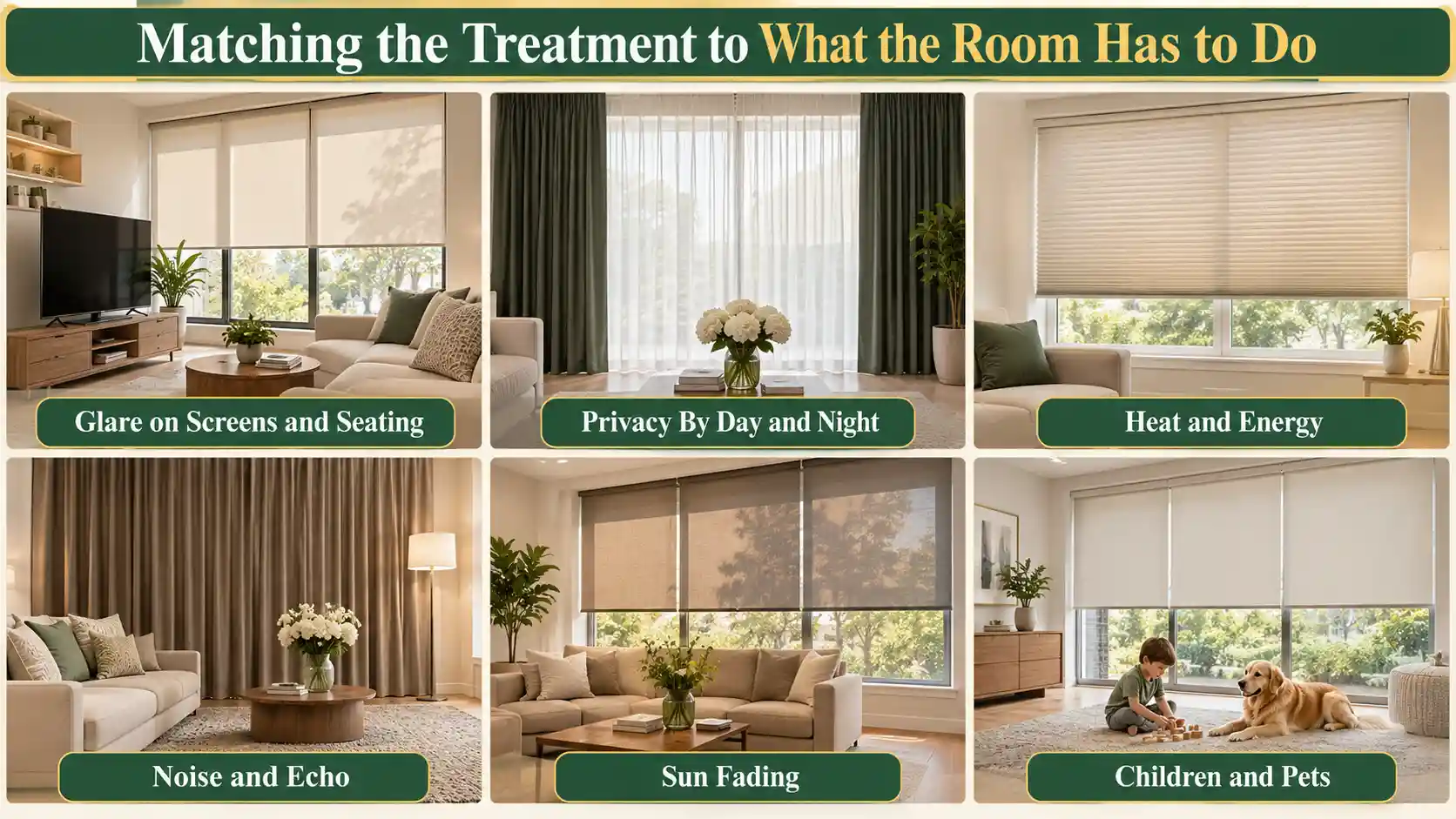
Glare on Screens and Seating
Glare is worst when low sun hits a television or lights a sofa directly. In the UAE, where strong sun reaches many living rooms for much of the year, adjustable control matters more than a single fixed solution. A light-filtering or low-openness roller behind sheers cuts glare while keeping some daylight, and wooden blinds can angle their slats away from the screen. For a room that doubles as a home cinema, blackout curtains over the lighter layer remove the remaining light.
Privacy By Day and Night
Privacy changes with the hour. Sheers and light-filtering fabrics handle daytime privacy, but any window facing a street or a neighboring balcony needs a lined or blackout layer for the evening. Tilting wooden blinds can maintain privacy while still admitting light, which fabric panels cannot.
Heat and Energy
Window treatments work alongside good glazing, not instead of it, but they still reduce heat gain when closed during the hottest hours. Cellular shades have the strongest test results among common options. Lined curtains, particularly with a pale backing, reduce heat entering through glass at a lower cost. Closing treatments on the sunny side and opening them on the shaded side keeps light and comfort balanced through the day.
Noise and Echo
Hard floors, large glass, and minimal soft furnishings make many living rooms echo. Heavy, lined curtains absorb some sound and soften reverberation, but they will not stop traffic noise on their own. Soundproof curtains are generally made from denser, multi-layer fabric for that purpose, and soft flooring such as a rug reduces echo further.
Sun Fading
Direct sunlight can fade upholstery, rugs, and the boards of a wooden floor near a sunny window. Fabric layers, screen shades, or lined curtains drawn during peak sun reduce the damage over the years.
Children and Pets
Corded blinds and shades are a strangulation hazard for young children. Where a cord remains, anchor it out of reach and keep sofas, shelves and cribs away from the window. Motorized curtains and cordless blinds remove the problem entirely.
Pairing Window Treatments with Flooring, Walls and Furniture
Window treatments cover a large visual area, so they should work with what is already in the room rather than compete with it. Three relationships do most of the work: floor, walls and seating.
Floors set the room’s temperature. Warm oak and walnut tones sit comfortably with cream, sand and olive, while gray-toned or whitewashed floors pair better with cooler neutrals such as stone, slate blue and soft gray. Dark floors gain from lighter curtains that lift the room, and a patterned or textured rug is easiest to balance with plain, solid curtains.
Walls offer two approaches. Curtains close to the wall color make windows recede and let the ceiling feel taller, a good strategy for small rooms. Contrasting curtains create a focal point, which works best on a single feature wall. Textured wall finishes call for simpler curtain fabrics so the surface does not feel crowded.
Seating completes the picture. If the sofa carries a bold pattern, keep the curtains plain and let texture provide the interest; if the sofa is a solid neutral, curtains are the right place to introduce color or print. Planning the whole room together also helps, and theliving room furniture ideas article is a useful starting point for layout and style direction.
Sizing and Mounting Living Room Window Treatments Correctly
Achieving the right balance of light, privacy, and aesthetic harmony begins with proper sizing and mounting of the living room window treatments.
Curtains
Mount the rod 4 to 6 inches (10 to 15 cm) above the window frame, or up to about 8 inches (20 cm) where wall space allows, and extend it 3 to 6 inches (8 to 15 cm) beyond the frame on each side. This lets open curtains rest on the wall rather than the glass, so the window keeps its full light and looks larger. Fullness matters too: a pair of panels should measure roughly two to two and a half times the rod width to produce even folds when closed. Length should reach the floor or hover just above it. Pooling is decorative, but it collects dust and interferes with doors and rugs.
Ready-made panels often come in set lengths such as 84, 96, and 108 inches, so measure from the planned rod position to the floor before buying. If panels end up too long or too short, you can correct the hem with curtain alterations. Where drilling is not an option, there are rod-free ways to hang curtains.
Blinds and shades
An inside mount sits within the window recess for a tidy look, but it needs enough frame depth and leaves small light gaps at the edges. An outside mount covers the frame, blocks more light and makes a window look wider. For an inside mount, measure the width at the top, middle, and bottom and use the narrowest figure.
Large and awkward windows
Bay windows suit a flexible track or a bent rod that follows the angles, or separate blinds for each pane. Large picture windows work with one wide roller or a pair of panels on a long rod. Sliding doors need stacking space beside the opening and enough clearance so panels do not catch on handles, which is why vertical blinds or curtains on a ceiling track are common solutions. Heavy lined curtains on wide runs need strong brackets and a center support, and the fixing wall matters as much as the rod, so professional curtain installation is worth considering for heavy fabrics or tall ceilings.
Common Mistakes to Avoid While Choosing Living Room Window Treatmenet
Take a look at the mistakes you must avoid when choosing a living room window treatment.
- Judging fabric under shop lighting. Check samples in the room itself in the morning, at midday, and in the evening, since color and sheerness shift with the light.
- Choosing hardware last. Rods, tracks and brackets are both visible and structural, and picking them after the fabric often leaves heavy curtains on weak supports.
- Matching every finish exactly. Perfectly matched rods, curtains, cushions and rugs can look flat. Related tones with varied textures feel more considered.
- Forgetting how the window opens. Casement handles, sliding doors and radiators below the sill all limit length and mounting options.
- Overlooking maintenance. Heavy velvet and lined fabrics may be dry-clean only, and slatted blinds need regular dusting, so choose based on how much upkeep a daily-use room can handle.
- Treating each window as a separate decision. Windows on the same wall should usually share one treatment so the room reads as a whole.
Final Words
Choosing the right living room window treatment involves more than matching curtains or blinds to your interior style. Consider how much natural light you want, the level of privacy needed, window size, and the room’s daily use before making a decision. Layered curtains, roller blinds, Roman shades, and motorized options each offer different benefits, while the right fabric, color, and installation improve the overall result. Pay attention to how your window treatments complement your flooring, walls, and furniture to create a balanced look. With careful measurements and suitable materials, you can achieve a living room that feels comfortable, functional, and visually complete.
Frequently asked questions
What is the best window treatment for a living room with large windows?
Curtains on a ceiling track or a wide rod, paired with a light-filtering roller blind or sheers underneath, suit most large windows. For very wide openings such as sliding doors, vertical blinds or panel-style treatments cover the width efficiently, and motorization helps when the windows are tall.
Should living room curtains touch the floor?
They should reach the floor or hover just above it. A clean, floor-length line makes the ceiling feel higher, while curtains that stop at the sill suit only windows with a radiator or furniture directly below.
Are blinds or curtains better in a living room?
Neither wins in every room. Curtains add softness and block more light when lined, while blinds give precise light control in less space. Combining the two is often the most flexible answer.
Can I mix different window treatments in one living room?
Yes, provided they share a color family or fabric character. Windows on the same wall should match, but a sliding door and a small side window can reasonably use different treatments suited to their size.
What reduces glare on a TV without making the room dark?
A light-filtering or screen-style roller blind, or sheer curtains, softens direct sun while keeping the room bright. Place the treatment on the window that faces the screen rather than on every window.