
How to Hang Curtains Without a Rod: 9 Renter-Friendly Ideas

You can hang curtains without a rod by using adhesive hooks, hook-and-loop strips, magnetic hooks, a wire stretched between two cup hooks, a ceiling track, or decorative knobs and nails. Lightweight sheers work with almost any of these methods. Heavier blackout or lined curtains need fixed anchors, such as a screw-mounted wire or a ceiling track, to stay up safely.
The best choice depends on three things: how much your curtain weighs, what your wall is made of, and whether the curtain needs to open and close every day. Get those three right, and a rod-free setup can look just as polished as a traditional one and often cleaner.
This guide by Floor Land covers nine tested methods, explains which curtains suit each one, and shows you how to avoid the mistakes that bring curtains crashing down.
Tools and Materials You May Need
Most rod-free methods need only a handful of basic items, and many of them are probably already in your drawer. Gather everything before you start to keep the job quick and avoid half-finished windows. Depending on the method you choose, keep these within reach:
- A tape measure and pencil to mark hook positions.
- A spirit level, because even a slight tilt shows clearly once fabric hangs.
- Rubbing alcohol and a clean cloth for preparing surfaces before applying adhesives.
- Clip rings, which let almost any curtain hang from hooks, wire, or rope.
- A small drill or screwdriver, but only for the low-hardware methods.
- A bathroom scale to weigh your curtain, explained further below.
No-Drill Methods for Renters
If you rent, damage-free options come first. Landlords often discourage drilling, and many tenancy agreements in Dubai treat wall holes as damage deducted from your deposit. The three methods in this section leave your walls completely untouched. They’re also the fastest to set up, and most of them take under an hour, including adhesive curing time.
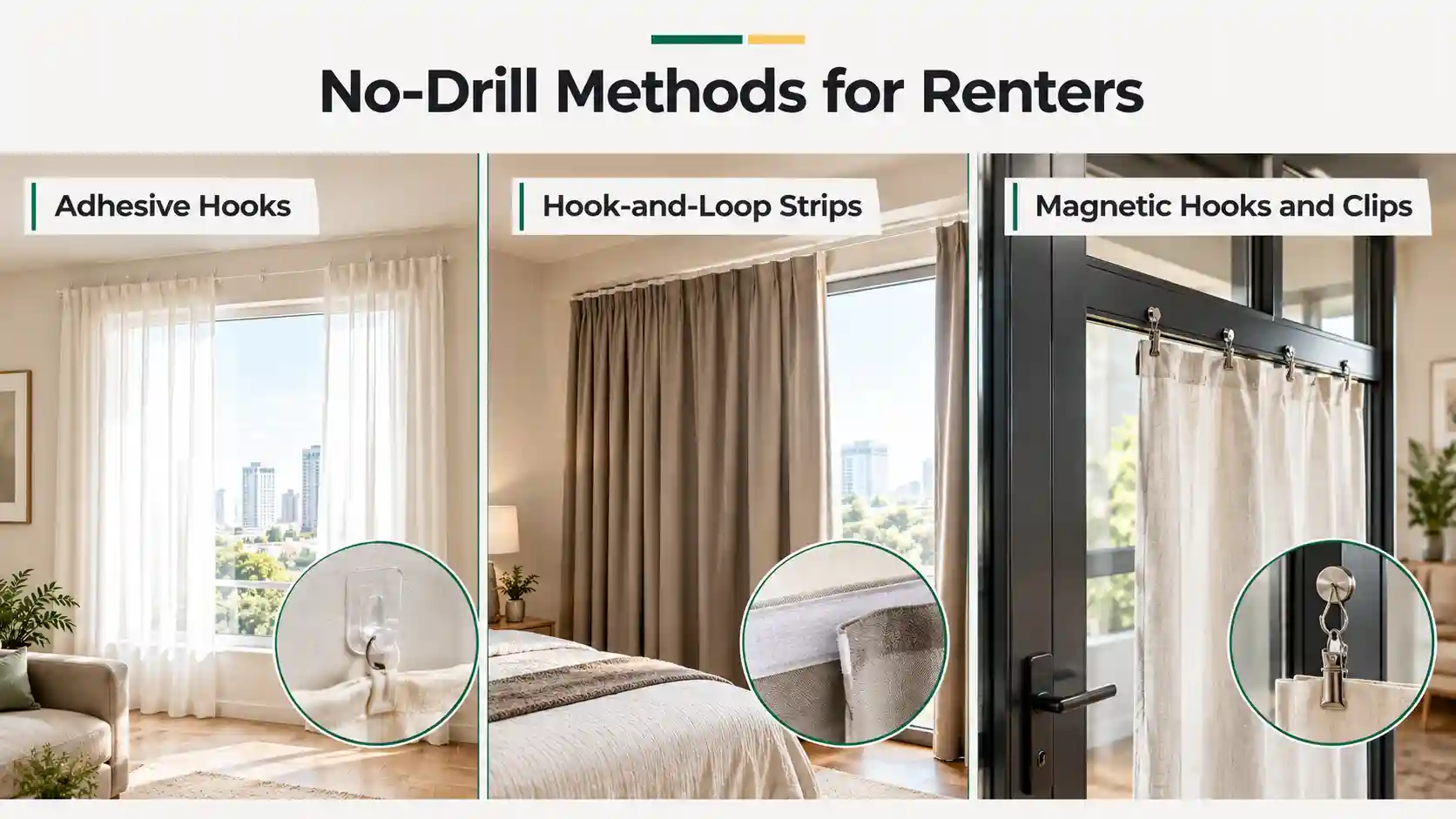
1. Adhesive Hooks
This is the most popular fix for renters, and it earns that spot. Adhesive hooks press onto the wall above the window and release cleanly when you stretch the removal tab. Place one hook per eyelet or tab. If you’re using clip rings, space the hooks about 15-20 cm apart.
They perform best with light fabrics. Airy sheer curtains are a natural match because they put very little strain on each hook. For anything heavier, choose hooks rated well above the curtain’s weight and add more.
One honest warning: adhesive hooks don’t handle daily tugging well. Every time you pull the fabric sideways, you put stress on the hook that it wasn’t really designed for. If you plan to open and close the curtain constantly, the wire method below will serve you better.
Steps to Perform:
- Measure and mark. Decide on the hanging height, usually 10-15 cm above the window frame. Lightly mark each hook position with a pencil, then check the line with a spirit level.
- Clean the surface. Wipe each spot with rubbing alcohol instead of household cleaners, which can leave residue that weakens the bond. Let it dry fully.
- Apply and press. Peel the liner, place the hook on your mark, and press firmly for at least 30 seconds. Firm pressure directly improves the bond.
- Wait before hanging. Leave the hooks for at least one hour so the adhesive reaches full strength. Most people skip this step, and it’s the main reason hooks fall.
- Hang the curtain. Attach the panel by its eyelets, tabs, or clip rings. Then adjust the folds so the fabric falls evenly.
- Remove correctly later. When it’s time to take the hooks down, stretch the tab slowly downward along the wall. Never pull it toward you.
2. Hook-and-Loop Strips
Think of this one as the blackout specialist. The rough hook side sticks to the window frame or wall. Sew or glue the soft loop side along the top edge of the curtain. Press them together so the fabric sits flush against the frame, leaving almost no light gap at the top.
That tight seal makes it a smart choice for bedrooms, nurseries, and anyone who sleeps during the day with blackout curtains. The trade-off is that the curtain stays fixed. To let light in, you peel back a corner or gather the panel with a tieback.
A few details make a big difference here:
- Choose a heavy-duty grade for anything thicker than plain cotton.
- Sew the soft side onto the fabric, because sewing holds up far better than glue through washing.
- Keep the rough side on the wall, so it can’t snag other laundry in the machine.
3. Magnetic Hooks and Clips
Steel front doors, metal window frames, and some sliding-door rails hold strong magnets surprisingly well. Heavy-duty magnetic hooks let you hang a light curtain in seconds, with no adhesive and no holes. You can also reposition them as often as you like, which is handy for glass-paneled doors that need occasional privacy.
Before you buy, test the surface with an ordinary fridge magnet. Most modern window frames are aluminum, and aluminum isn’t magnetic. In practice, this method usually works better on doors than on windows.
Steps to Perform:
- Test the window frame or door with a magnet.
- Position magnetic hooks at equal heights.
- Attach clip rings evenly along the top edge of the curtain
- Hang the rings on the hooks and adjust the fabric.
Low-Hardware Methods for a Cleaner Finish
If a few small screw holes are acceptable, your options grow considerably. Low-hardware methods offer more strength, smoother movement, and a more permanent result than adhesives. The holes they leave are small enough to fill and paint over in minutes when you move out.
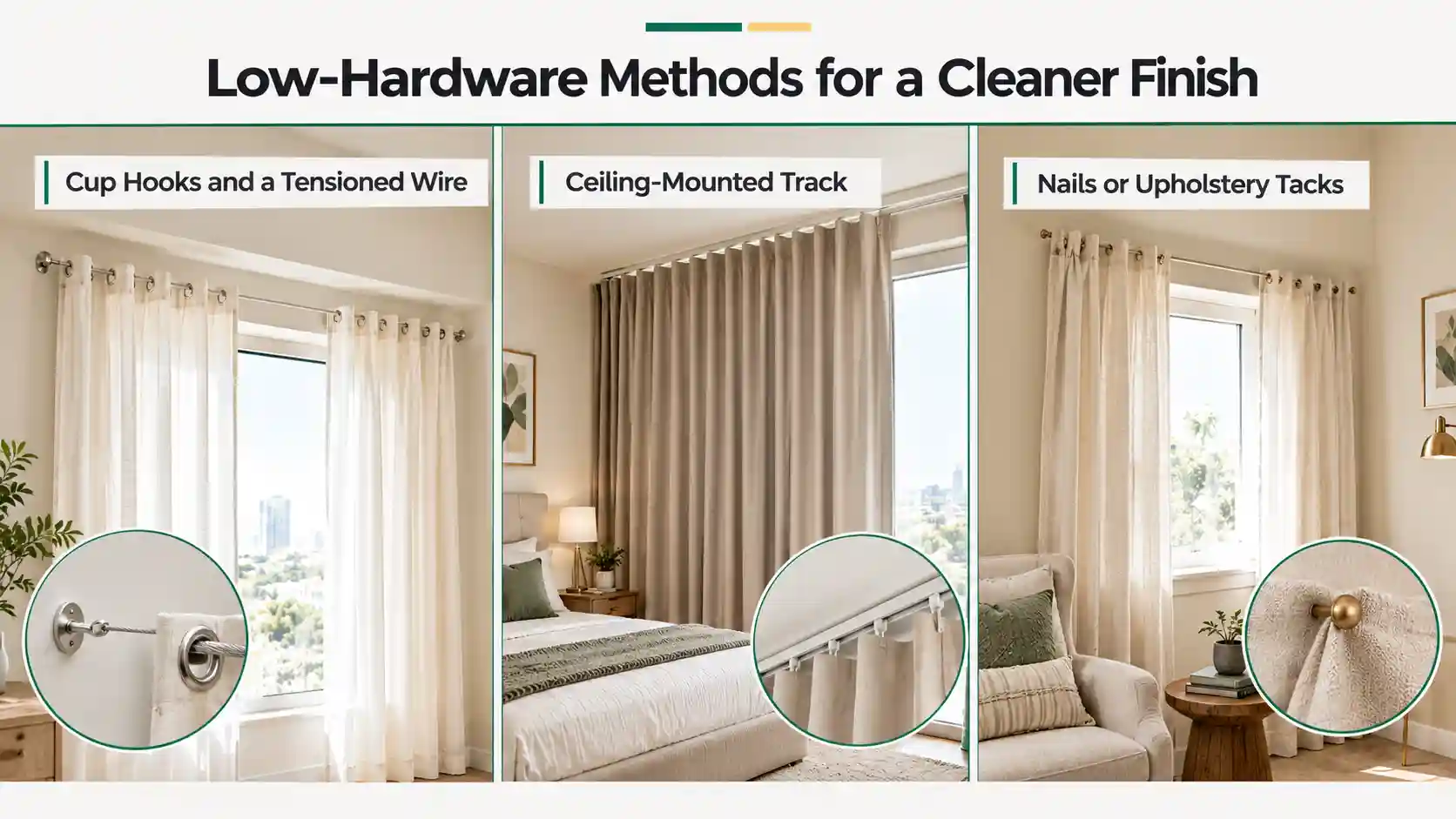
4. Cup Hooks and a Tensioned Wire
If you want curtains that slide open and shut, this is the most practical rod-free system. Here’s how it works:
- Screw a cup hook or eye screw into each side of the window recess.
- Thread the curtain onto a steel cable or curtain wire.
- Stretch the wire tight between the two hooks.
Eyelet curtains thread directly onto the wire. That gives you a neat, rippled header with no extra rings. Other styles can hang from clip rings that glide along the wire.
The holes are tiny and easy to fill. The main limit is span. On windows wider than about 1.5 to 2 meters, add a support hook in the middle, or the wire will sag into a visible dip. Wire kits with a built-in tensioner make it much easier to get a tight, straight line.
5. Ceiling-Mounted Track
A slim track fixed to the ceiling lets fabric fall from the very top of the room. This hotel-style look makes ceilings feel taller. It also solves the common problem of having no wall space above the window, which happens with bulkheads and full-height glass.
Tracks are the one rod-free option that handles heavy, lined fabric with ease. They also pair beautifully with wave curtains, which fold into soft, even S-shapes along the runners. Many tracks can bend to follow bay windows or corners, something a straight rod can’t do.
To keep a track straight and secure, you’ll need to drill into the ceiling and find solid fixings. Concrete, gypsum board, and false ceilings each need different anchors. For that reason, many homeowners hire a professional for curtain installation rather than risk a sagging run.
Steps to Perform:
- Measure the window and mark where the track will sit on the ceiling.
- Drill mounting holes and install fixings suited to the ceiling material.
- Secure the track and insert the curtain runners.
- Attach compatible curtain hooks and hang the panels.
6. Nails or Upholstery Tacks
Sometimes the simplest answer is a row of decorative tacks. Tap them into the wall along the window’s top edge. Then loop the fabric over them, or pin it into soft gathers.
The result feels relaxed and a little handmade, which suits reading corners, guest rooms, and studio spaces. Brass or antique-finish upholstery tacks look intentional rather than improvised. Save this method for fabrics you rarely need to move, because repeatedly lifting the fabric off the tacks wears the cloth.
Steps to Perform:
- Mark evenly spaced positions above the window.
- Choose tacks that suit the wall and curtain weight.
- Secure the fabric over the tacks with loops or gentle gathers.
- Adjust the folds to create an even drape.
Decorative Alternatives That Double as Décor
When the hanging hardware itself becomes part of the design, curtains feel like a styling choice rather than a workaround. These methods suit lighter fabrics and windows that don’t need frequent adjustment. They’re ideal when you want personality and privacy.
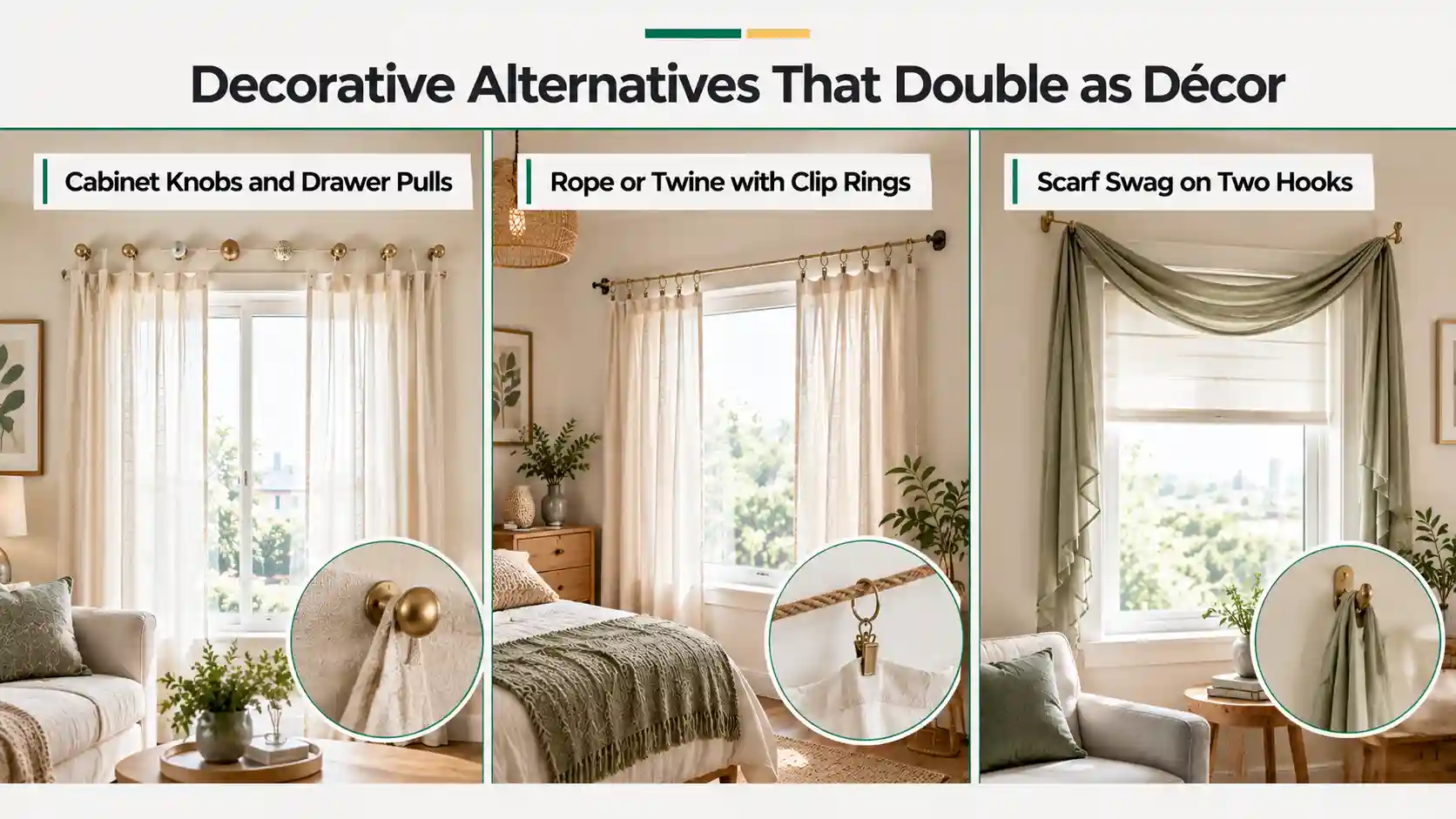
7. Cabinet Knobs and Drawer Pulls
A row of wooden, ceramic, or brass knobs turns the hardware into part of the decor. Screw them into the wall above the window and hang tab-top or tie-top panels over them. Matching the knobs to door handles or cabinet hardware ties the whole room together.
Spacing matters more than people expect, because a single crooked knob stands out immediately. Mark every position with a pencil and a spirit level before you drill. For a wide window, odd numbers of knobs usually look more balanced than even numbers.
Steps to Perform:
- Mark evenly spaced positions above the window.
- Drill holes and secure the knobs with suitable fixings.
- Place the curtain’s tabs or ties over the knobs.
- Adjust the spacing and fabric folds for a balanced finish.
8. Rope or Twine with Clip Rings
Stretch cotton rope, jute twine, or leather cord between two hooks, then clip the curtain on with ring clips. It’s inexpensive, casual, and easy to change with the seasons.
This works well in children’s rooms, studios, and boho-style spaces. Natural fibers stretch over time, so pull the rope taut at the start and expect to re-tighten it now and then. In rooms with young children, keep the rope tight and well above their reach, since loose loops can be a hazard.
How to Do It:
- Install secure hooks on both sides of the window.
- Thread clip rings onto the rope before attaching both ends.
- Secure the rope tightly between the hooks.
- Clip the curtain onto the rings and adjust the folds.
9. Scarf Swag on Two Hooks
A long, light fabric scarf draped between two hooks creates a soft valence across the top of the window. Let the ends fall down each side, or gather them into loose tails at different lengths.
This is a decorative finish, not a privacy solution. On its own, it softens bare windows that don’t need full coverage. Layered over a roller blind or fixed sheer panel, it adds the gentle frame that a rod-mounted curtain would otherwise provide.
Quick Steps:
- Install two hooks at the desired height above the window.
- Drape a long, lightweight scarf over the hooks.
- Adjust the center section to create soft folds.
- Arrange the hanging ends evenly or at different lengths for a decorative finish.
Quick Look – Which Rod-Free Method Fits Your Window?
Not every method suits every window, so a side-by-side view saves time before you buy anything. The table below compares all nine options by strength, drilling needs, and everyday usability. Use it to narrow your list to two or three methods, then read the detailed sections for those.
| Method | Best For | Drilling Needed? | Opens and Closes? | Weight Capacity |
| Adhesive hooks | Sheers, light cotton | No | Lift-off only | Light |
| Hook-and-loop strips | Fixed blackout panels | No | No | Light to medium |
| Magnetic hooks | Steel doors and frames | No | Slides on clips | Light |
| Cup hooks and wire | Sheers, room dividers | Tiny holes | Yes | Light to medium |
| Ceiling track | All fabrics, including blackout | Yes | Yes, smoothly | Heavy |
| Nails or tacks | Draped, decorative looks | Tiny holes | No | Light |
| Knobs or drawer pulls | Tab-top and tie-top panels | Yes | No | Medium |
| Rope with clip rings | Casual and kids’ rooms | Small hooks | Yes | Light |
| Scarf swag on two hooks | Decorative toppers | Optional | No | Light |
If you haven’t picked your custom curtains yet, it helps to choose the hanging method first. Knowing whether you need a light, sliding panel or a heavy, fixed one makes fabric shopping much simpler.
What to Check Before Hanging Curtains Without a Rod
Most rod-free failures happen because the method didn’t match the conditions. A hook that works perfectly in one room can let go in another. These three quick checks prevent nearly every common problem.
Weigh Your Curtain First
Curtain weight is the single biggest factor in choosing a method, yet few people ever check it. Stand on a bathroom scale holding the folded panel, then subtract your own weight. As a rough guide:
- Sheers usually weigh well under 1 kg per panel.
- Cotton and linen typically fall between 1 and 2 kg.
- Lined blackout and velvet panels often weigh more than that.
Divide the total by the number of hooks you plan to use. Then keep each hook comfortably below its rated capacity, because every pull on the curtain adds force beyond its resting weight.
Know Your Wall Surface
The surface behind your hooks matters as much as the hooks themselves. Smooth painted walls and glazed tiles suit adhesives well. Textured paint and wallpaper don’t. 3M advises against using its Command products on delicate or paper wallpaper, because the adhesive can only hold as well as the wallpaper’s own bond to the wall.
Freshly painted walls also need patience, and the manufacturer recommends waiting seven days after painting. For gypsum board, use proper hollow-wall anchors with any screwed method, because a plain screw can pull straight out.
Respect the Heat
Temperature quietly defeats more adhesive hooks than weight does. Command hooks are designed for indoor temperatures between 10°C and 40°C, and the adhesive may lose grip above 40°C. Window frames and glass in direct sun can easily pass that point.
This is a real issue in the UAE during summer. Mount adhesive hooks on the wall slightly above the frame, away from glass and metal that heat up during the afternoon.
Match the Method to Your Curtain’s Header
The header is the top edge of the curtain, where it attaches to its support. It often determines the method before anything else, so check yours before buying hardware. Here’s how the common styles pair up:
- Eyelet (grommet) panels slide naturally onto a tensioned wire, or sit over individual hooks.
- Tab-top and tie-top styles were practically made for knobs, nails, and single hooks.
- Rod-pocket curtains need clip rings because, without a rod, there’s nothing to slip through the pocket.
- Pinch-pleat headers take pin hooks, which pair best with a ceiling track.
- Plain flat-top panels work with clip rings on almost any method, or with hook-and-loop strips sewn along the edge.
Best Rod-Free Method for Each Room
Each room puts different demands on a curtain, from blocking light to handling humidity. What works in a living room may struggle in a bathroom. These pairings take the guesswork out of the decision.
Bedroom
Bedrooms need darkness above all, especially for light sleepers. Hook-and-loop strips with blackout fabric give the tightest seal and the darkest room. If you prefer curtains that open every morning, a ceiling track carries heavy blackout panels without strain.
Living Room
Living rooms usually have the largest windows and the most daily use. A ceiling track or tensioned wire handles wide spans and frequent openings. Layering a sheer on wire behind a heavier panel gives daytime privacy and evening coziness.
Kitchen and Bathroom
Moisture and heat are the main challenges in these two rooms. Short café-style panels on water-resistant adhesive hooks or a small wire work well. Keep any fabric well clear of the stove, and choose quick-drying fabrics that resist mildew.
Children’s Rooms
Safety comes before style in a child’s room. Hook-and-loop strips and fixed knobs eliminate dangling cords. If you choose rope or wire, keep it taut and mount it high, well beyond a child’s reach.
Home Office and Room Dividers
Curtains make a flexible, low-cost way to divide open-plan spaces. A ceiling track or a long tensioned wire lets you section off a work corner or a guest area. Sliding the curtain aside opens the space again in seconds.
Styling Tips for a Professional Finish
Hanging curtains without a rod shouldn’t make them look like a temporary fix. A few professional window-dressing proportions make any method look deliberate and finished. These details matter whether you use hooks, wire, or a track.
- Hang higher than the frame. Placing the support 10 to 15 cm above the window frame makes the window look taller. If you have the space, going closer to the ceiling has an even stronger effect.
- Extend beyond the sides. Let the fabric reach 10 to 20 cm past each side of the frame. When the curtain is open, more glass stays uncovered and the room gets more daylight.
- Get the fullness right. Curtains look richest when the total fabric width is about two to two and a half times the window width. Sheers can go fuller still. Flat, stretched fabric always looks cheaper than soft, generous folds.
- Choose a length with purpose. Floor-length curtains that just skim the floor feel tailored and elegant. Sill-length panels suit kitchens and windows above radiators or furniture.
Common Mistakes to Avoid
Even well-chosen methods can fail through small oversights during setup. Most of these mistakes take only seconds to avoid once you know about them. Check this list before you hang anything.
- Using too few hooks. The fabric sags between anchor points and puts extra strain on each hook. More hooks spread the load and give a straighter line.
- Sticking hooks onto hot glass or frames. Heat softens the adhesive, so the curtain may come down in the middle of the afternoon.
- Expecting adhesive hooks to carry blackout fabric. Heavy lined curtains need a wire, track, or screw-fixed hardware.
- Leaving a long wire unsupported. Spans wider than about 2 meters always sag without a middle support.
- Hanging too low or too narrow. Mounting close to the frame makes windows look smaller. Going higher and slightly wider makes a room feel more open.
- Skipping the curing time. Hanging fabric on a fresh adhesive hook is the fastest way to lose both the hook and the curtain.
Final Thoughts
A curtain rod is only one way to dress a window, and often not the most practical one. Start by weighing your curtain, check your wall surface, and think honestly about how often you’ll open it. Those three answers point you toward the right method almost every time.
For lightweight sheers in a rental, adhesive hooks or a simple wire will do the job beautifully. For heavy fabric or a seamless floor-to-ceiling finish, a ceiling track gives you strength and style together.
Frequently Asked Questions
Can you hang curtains without a rod and without drilling?
Yes. Adhesive hooks, hook-and-loop strips, and magnetic hooks all work without drilling. They’re best suited to light or medium-weight fabrics.
Can heavy blackout curtains be hung without a rod?
Yes, but not with adhesives alone. A ceiling track or a screw-mounted wire system is the safest way to support heavy lined fabric. Hook-and-loop strips can handle lighter blackout panels that stay fixed in place.
How many hooks do I need for one curtain panel?
Use one hook per eyelet or tab, or space hooks roughly every 15 to 20 cm. Heavier fabric needs closer spacing.
Will adhesive hooks damage painted walls?
They usually remove cleanly when you stretch the tab slowly downward. Damage tends to happen on fresh paint, textured walls, wallpaper, or when the hook is pulled straight off.
What is the best way to hang curtains without a rod in a rental?
For light curtains, adhesive hooks are the easiest choice. If you need the curtain to slide open and closed every day, a wire between two small cup hooks is more reliable. The tiny holes are easy to fill before you move out.
How do you make rod-free curtains open and close?
Choose a system the curtain can slide along, such as a tensioned wire, a ceiling track, or a rope with clip rings. Hooks, knobs, and hook-and-loop strips keep the curtain mostly fixed.
How high should curtains be hung without a rod?
The same rule applies with or without a rod: about 10 to 15 cm above the window frame. Hanging closer to the ceiling makes the room feel taller.
Can you hang curtains from the ceiling without a rod?
Yes. A ceiling-mounted track is the strongest and neatest option. For light sheers, a wire running between two ceiling hooks also works well.