
How Much Does Artificial Grass Cost? A Realistic Budget by Lawn Size
In the UAE, artificial grass typically costs AED 30–80 per square meter. A complete installation usually costs AED 60–130 per square meter. This equals approximately AED 2.8–7.4 and AED 5.6–12.1 per square foot, respectively. Several factors affect the price. These include pile height, fiber type, density, backing quality, and drainage. Installation costs also cover ground preparation, base materials, labor, and finishing.
These figures are published estimates, not fixed quotations. This Floor Land article breaks down material and installation costs separately. It also explains how to estimate your budget for small, medium, and large lawns.
Artificial Grass Prices in the UAE: Per Square Meter and Per Square Foot
Published UAE price guides generally break artificial grass down into three main quality tiers. Based on a 2025 price list from one Dubai installer, and converting square meters to square feet using 1 m² = 10.764 sqft, here is how the numbers shake out. For context, property-portal guides usually estimate turf at AED 60–120 and AED 70–120 per square meter, which fits comfortably inside these ranges.
| Grade | Turf only, per m² | Installed, per m² | Installed, per sq ft |
| Budget | AED 30–45 | AED 60–90 | AED 5.6–8.4 |
| Mid-range | AED 50–65 | AED 90–110 | AED 8.4–10.2 |
| Premium | AED 70–80 | AED 110–130 | AED 10.2–12.1 |
These are typical estimates from published guides, not actual quotes. Labor in the same guide runs AED 15–35 per m². Other guides itemize extras differently, listing installation at AED 10–30 per m², ground preparation at AED 15–50 per m², and seam tape, adhesive, and underlay at AED 5–15 per m². Retail rolls are advertised for about AED 17–30 per m² on promotion, but that is an advertised starting price for the turf alone.
Prices vary by specification, supplier, and site, and most installers quote per square meter after a survey. The sections below use dollar-quoted ranges for the component breakdown and worked lawn examples, because those guides itemize base, removal and labor. Convert at 3.6725 dirhams to the dollar and treat them as indicative for any market.
Material Cost vs Installed Cost
A turf price tag and an installed price describe two different things. The material price covers the rolls only. The installed price adds ground preparation, a compacted sub-base, weed membrane, seaming, infill, edging, waste removal and labor. A “from” price on a product page is an advertised starting price for the cheapest roll in a range, and it rarely survives contact with a full specification.
The fiber used in the turf is the first thing that moves the material price:
| Fibre | Per sq ft (material only) | Per m² | Typical use |
| Polypropylene | 2–6.35 | 22–68 | Lower-cost lawns, lighter traffic |
| Polyethylene | 2.20–4.10 | 24–44 | Soft-feel residential lawns |
| Nylon | 5–6.40 | 54–69 | Heavy use, strong sun and heat |
These are typical published ranges. Polypropylene spans the widest range because quality differs so much between budget rolls and engineered products. Nylon costs the most per square foot and is generally chosen where durability matters more than price.
Why Artificial Grass Prices Vary
Two rolls that look similar on a shelf can differ in price by a factor of two because the cost sits in what you cannot see at a glance.
- Pile height. Taller blades use more yarn. One home-and-garden retailer’s current sale prices for 4 m² rolls show the pattern clearly, with the same format and the same seller:
| Pile height | Sale price per m² (AED) | Approx. USD per m² |
| 20 mm | 27.25 | 7.4 |
| 30 mm | 37.25 | 10.1 |
| 37 mm | 44.75 | 12.2 |
| 45 mm | 54.75 | 14.9 |
These are advertised sale prices, not installed rates, converted at the fixed rate of 3.6725 dirhams to the dollar.
- Density and face weight. More yarn per square meter gives a fuller lawn that recovers better after foot traffic, and it adds directly to material cost.
- Backing and drainage. A coated, perforated backing lets water pass through. Cheaper backings can trap water or degrade sooner, which matters on balconies and over concrete where water has nowhere else to go.
- UV protection. Longer fade warranties, commonly eight to ten years on premium products, usually sit on higher-priced turf.
- Application. A family lawn, a pet area, and a putting green need different specifications. Putting greens sit at the top of published ranges, often 15–30 per square foot installed, because of the precision base and cutting they require.
- The site itself. Curves, trees, slopes, and limited access add labor hours. Small areas also tend to cost more per square foot because setup time and minimum charges do not shrink with the lawn.
Is Cheap Artificial Grass Worth It?
Cheap turf can be a sensible choice for a temporary area, a rented home or a low-traffic corner. As a main lawn, it often disappoints. Budget rolls tend to have a shorter, thinner pile that flattens sooner, a flatter color, and backing that drains less reliably.
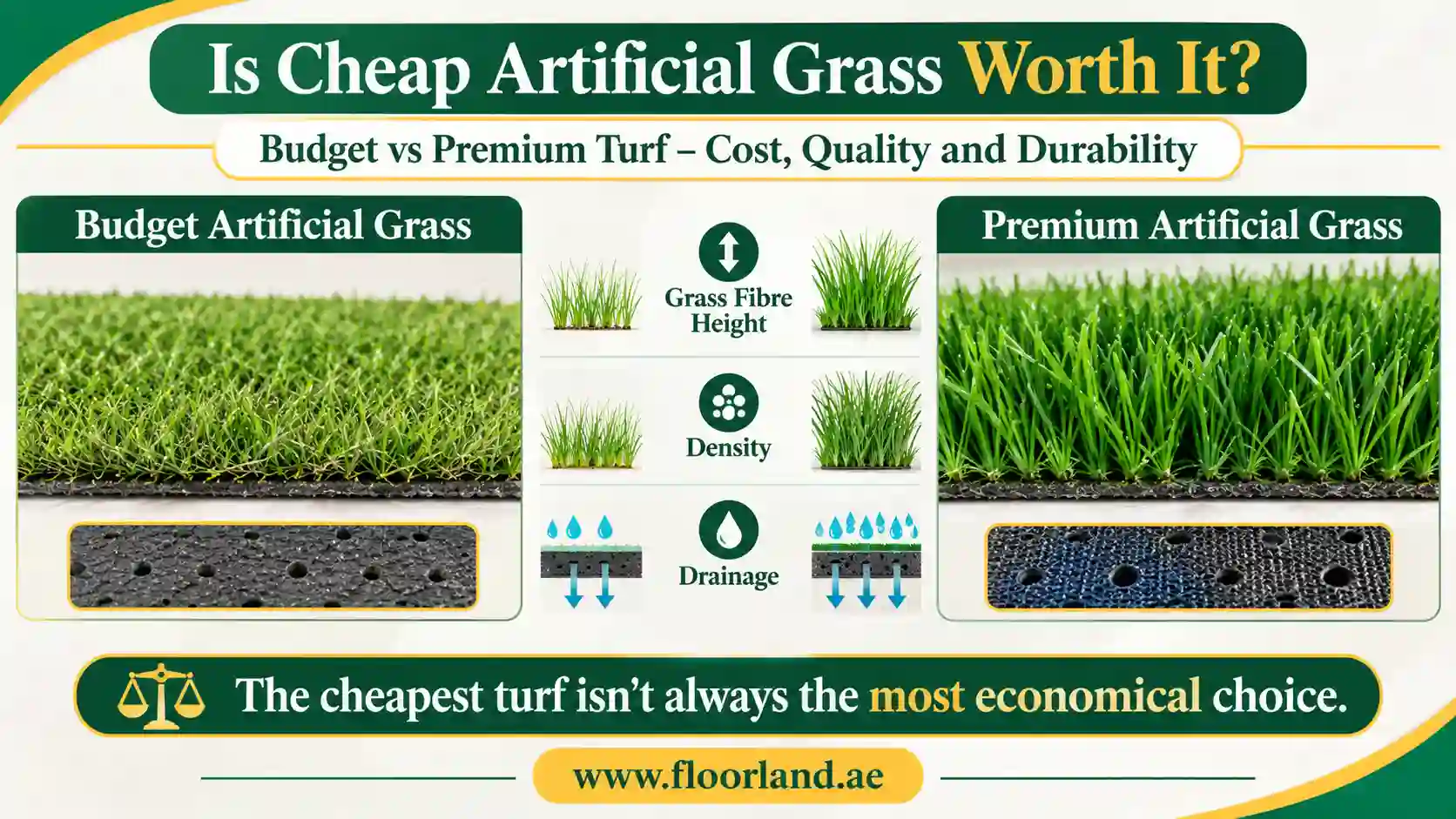
The savings are also smaller than it looks once labor is counted. Take a 500 sq ft lawn bought with 10% extra for cutting waste, so 550 sq ft of turf. At $2.50 per square foot, the rolls cost $1,375; at $5.00, they cost $2,750. The $1,375 difference is real, but the groundwork and labor stay the same either way. If the cheaper turf wears out early, you pay for a second installation, and the savings disappear.
Spread over a 15-year life, that $1,375 premium works out to about $92 a year. Many guides cite lifespans of 15 to 25 years for well-installed turf, though the actual figure depends on the product and how heavily the lawn is used.
| Comparison Factor | Budget Turf | Premium Turf |
|---|---|---|
| Material cost (500 sq ft lawn) | About $1,375 at $2.50/sq ft | About $2,750 at $5.00/sq ft |
| Pile and density | Shorter, lighter | Taller, denser |
| Backing | Often basic | Typically coated and perforated |
| Best suited to | Temporary or low-traffic areas | Main lawns, pets and children |
A mid-range product usually gives the best balance. Ask for a sample, check the pile height and backing, and compare them in daylight before you decide.
DIY vs Professional Installation Cost
Labor is the single largest line in an installed quote, at roughly 4–9 per square foot in published ranges, on a 500 sq ft lawn that is 2,000–4,500, which is why DIY tempts so many buyers.
What DIY removes is the labor charge. What it keeps is everything else: turf, sub-base, membrane, tape or adhesive, fixings, infill and waste disposal, plus tool hire for compacting the base and cutting the turf. It also adds your time, usually a few days for an average garden.
| Comparison Factor | DIY | Professional |
|---|---|---|
| Labour | Your own time | About $4–9/sq ft |
| Tools and equipment | Hire or buy | Included in the quote |
| Best suited to | Small, flat areas on firm ground | Large, sloped, shaped or hard-surface areas |
| Main risk | Poor base preparation shows up as dips and visible seams | Quote omits items that you assumed were included |
The base is where DIY projects go wrong. An uneven or poorly compacted sub-base shows through the turf within months, and fixing it means lifting the lawn. If you are unsure, a hybrid approach works well: have a professional prepare the base and lay the turf, then handle edging and finishing yourself.
Extra Costs to Add to Your Artificial Grass Budget
The items below are the ones most often missing from a first estimate. Prices come from a mix of published guides, and the sterling figures come from UK sources, so read them as indicators of scale and not as rates for your area.
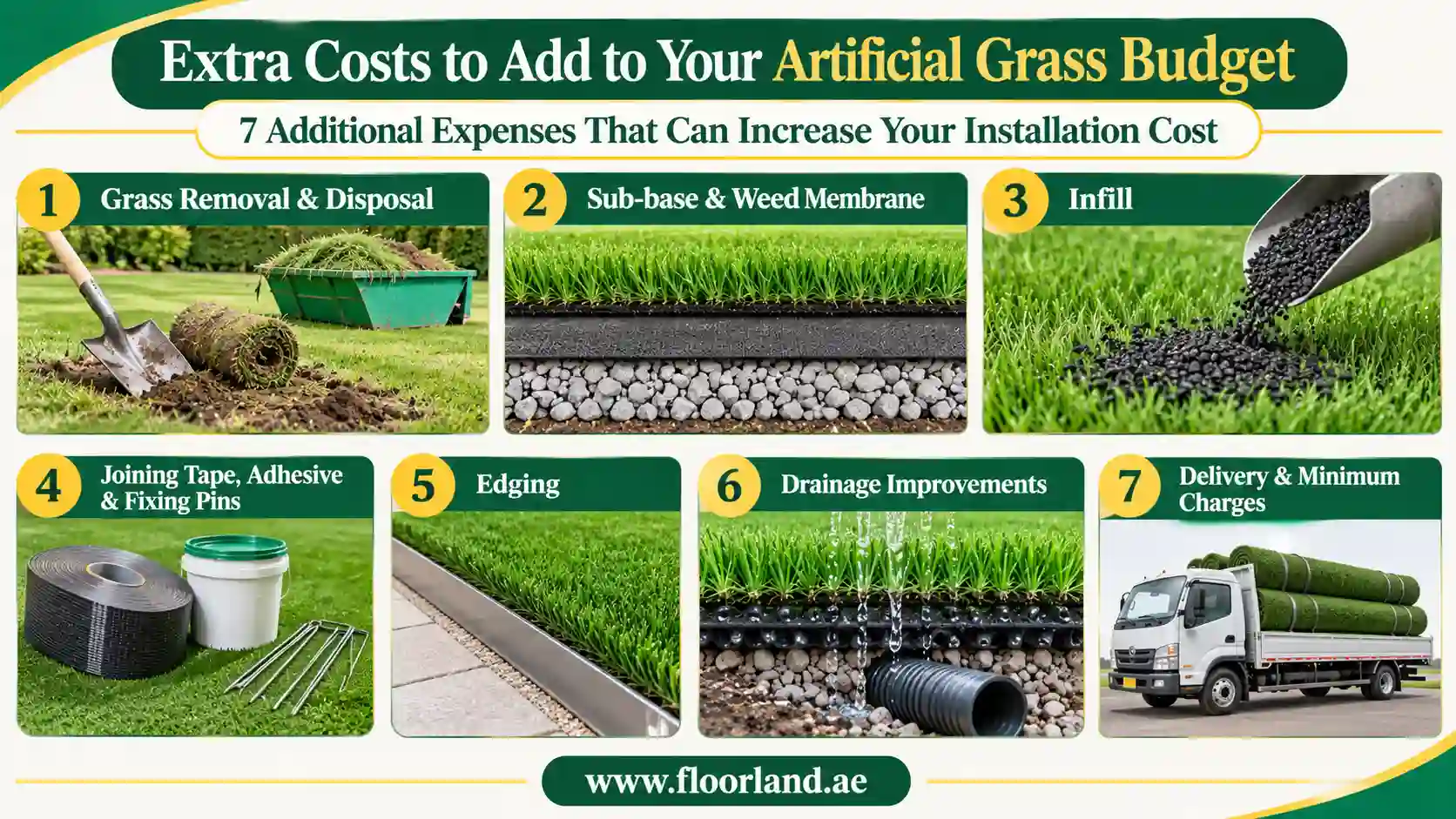
- Grass removal and disposal. Stripping existing turf typically adds 1–2 per square foot. One installer’s worked example for a 1,000 sq ft lawn allowed for two dump trips at about $248 per load.
- Sub-base and weed membrane. Together roughly 0.70–1.50 per square foot. Hard surfaces such as concrete need a different approach, because water must drain somewhere and the base may need drainage points.
- Infill. The same installer’s example priced infill at about $308 for 1,000 sq ft, or around $0.31 per square foot.
- Joining tape, adhesive, and fixing pins. Small per item, but they add up. One UK guide lists tape at about £1, adhesive at £6.50, and 100 pins at £24.
- Edging. UK guides put timber or metal edging at about £5 per meter and composite edging at £10–£15 per meter. Long perimeters make this a meaningful line.
- Drainage improvements. If the base cannot drain on its own, a soakaway can start from around £750 in UK pricing.
- Delivery and minimum charges. Small projects often carry fixed charges that make the per-square-foot rate higher.
How to Calculate Your Artificial Grass Cost
A reliable estimate takes four steps.
- Measure the area. Multiply length by width for each rectangle and add them together. Split irregular shapes into simple blocks. To convert, 1 m² equals 10.764 sq ft.
- Add waste. Allow about 10% extra turf for cutting, seams, and trimming around curves. Rolls come in fixed widths, commonly 2 m or 4 m, so odd shapes can waste more.
- Price each line. Turf is bought on the waste-adjusted area. Price sub-base, membrane, infill, and labor on the actual lawn area.
- Add the optional items. Removal, edging and drainage depend on your site.
Artificial Grass Cost for a Small, Medium and Large Lawn
The examples use the published ranges above, in USD per square foot, with low and high cases for each line. Assumptions: flat ground, 10% turf waste, one professional installation, and the existing lawn stripped. Edging, drainage work, delivery, and taxes are excluded.
| Line | Low rate | High rate |
| Turf (on waste-adjusted area) | $2.50 | $5.00 |
| Sub-base and weed membrane | $0.70 | $1.50 |
| Labour | $4.00 | $9.00 |
| Grass removal | $1.00 | $2.00 |
| Infill | $0.30 | $0.30 |
| Total per sq ft of lawn | $8.50 | $17.80 |
The totals below are slightly higher than these per-foot figures suggest, because turf is bought on 110% of the lawn area.
| Lawn | Area | Turf to buy | Estimated total |
| Small | 200 sq ft (18.6 m²) | 220 sq ft | 1,750–3,660 |
| Medium | 500 sq ft (46.5 m²) | 550 sq ft | 4,375–9,150 |
| Large | 1,000 sq ft (92.9 m²) | 1,100 sq ft | 8,750–18,300 |
As a line-by-line check, the medium lawn’s low case is $1,375 for turf (550 × $2.50), $350 for base and membrane, $2,000 for labor, $500 for removal, and $150 for infill, for a total of $4,375. The high case is $2,750, $750, $4,500, $1,000, and $150, for a total of $9,150.
These figures use flat rates for simplicity. Real quotes usually charge more per square foot on the small lawn because setup time and minimum charges don’t shrink with the area, and slightly less on the large one.
Residential, Commercial and Regional Price Differences
The application changes the specification, and the specification changes the price. One published guide gives these installed ranges:
| Application | Installed, per sq ft | Per m² |
| Residential lawn | 8–14 | 86–151 |
| Playground (includes safety padding) | 10–18 | 108–194 |
| Golf putting green | 15–30 | 161–323 |
Commercial projects add heavier-traffic fibers, shock pads where safety rules require them, and larger areas that usually lower the per-unit rate.
Location shifts the numbers even more than application. Published guides in sterling put a fully installed lawn at £50–£90 per m² across most of the UK and £65–£110 in London and the South East, with turf alone at £15–£45 per m². The UAE ranges at the start of this article convert to about 16–35 per m² installed, or 1.50–3.30 per square foot, at the fixed rate of 3.6725 dirhams to the dollar.
Those figures sit well below the dollar-quoted ranges used in the worked examples, and neither set is wrong. Labor rates, product specifications, and what each quote includes vary by market. Treat any single region’s pricing as a local reference point, and ask suppliers near you for current quotes before you set a budget.
Maintenance, Repairs and Lifetime Cost
Artificial grass needs no mowing or watering, but it is not maintenance-free. Regular brushing keeps the fibers upright, rinsing removes dust and debris, and pet areas need more frequent cleaning. Infill may need topping up, and seams occasionally need re-fixing. One published guide estimates about 250–350 a year for a typical residential lawn.
I could not find a reliable published rate for repairs such as patching or seam repair, so ask your installer for those prices up front, and check what any workmanship warranty covers.
Lifetime cost is easier to judge by the year. Using the medium lawn from earlier (4,375–9,150) over a 15-year life gives about 290–610 a year for the installation. Adding the maintenance estimate above, the illustrative running cost comes to roughly 540–960 a year. Natural sod costs far less to install, at 0.90–2 per square foot, which is 450–1,000 for the same 500 sq ft, but it brings ongoing watering, mowing, and feeding costs that vary widely by climate and are not included in that figure.
Guides commonly cite lifespans of 15 to 25 years, and some say 20 or more when the installation is done correctly. Those are manufacturer- and installer-influenced figures, so read them as a range and not a guarantee.
How to Keep the Cost Down Without Cutting Quality
The biggest savings come from decisions made before anyone lays a roll.
- Cover less area. Turf only where people actually walk and play; paving, gravel, or planting elsewhere cuts the largest line in the budget.
- Plan around roll widths. Sketch the layout against 2 m or 4 m rolls before ordering. Fewer seams and offcuts mean less waste, and you pay for waste at the turf rate.
- Spend on the base, not the extras. A well-compacted, well-drained base protects the lawn for its whole life. Fancier pile height matters less.
- Choose mid-range turf. The jump from budget to mid-range usually buys the most durability per dollar. Beyond that, extra gains narrow.
- Split the work. Removing old turf yourself, or finishing edging, can trim the labor bill without touching the critical groundwork.
- Compare itemized quotes. Ask each supplier for a breakdown of turf, base, labor, removal, and disposal, so you compare like with like.
- Check local incentives. Some regions offer rebates for removing natural lawns, which one guide puts at 1–3 per square foot where they exist. Availability depends entirely on your location.
Final Words
Artificial grass can be a worthwhile investment when you choose the right product and installation method. However, the lowest material price does not always mean the lowest overall cost. Turf quality, ground preparation, drainage, and fitting all affect how well the lawn performs over time.
Before making a decision, compare itemized quotations and check what each price includes. Consider your lawn size, intended use, and maintenance requirements. A mid-range product with good backing and drainage can offer a practical balance between cost and durability. Taking time to assess these details will help you set a realistic budget and avoid unexpected installation expenses.
Frequently Asked Questions
How much does artificial grass cost per square foot?
In UAE price guides, turf alone typically costs about AED 2.8–7.4 per square foot and a complete installation about AED 5.6–12.1. In dollar-quoted guides, the turf alone typically costs 2–8 per square foot. A complete professional installation, including base, labor, and finishing, usually lands between $8 and $20 per square foot. The widest published range runs from $5 to $20.
How much does artificial grass cost per square meter?
In the UAE, expect roughly AED 30–80 per m² for turf and AED 60–130 per m² installed. For dollar-quoted guides, multiply the per-square-foot figure by 10.764. That gives roughly 22–86 per m² for turf only and 86–215 per m² installed. Prices quoted in other currencies and markets can differ widely, so compare local quotes.
How much does it cost to install artificial grass on a 500 sq ft lawn?
Using the assumptions in the worked examples above, a 500 sq ft lawn comes to roughly 4,375–9,150, including turf, base, labor, removal of existing grass, and infill. Edging, drainage work and taxes are extra.
Is artificial grass cheaper than natural grass?
Not upfront. Natural sod typically costs 0.90–2 per square foot installed, against 8–20 for artificial turf. Over the years, artificial grass can offset part of that gap by removing mowing and watering, but the savings depend on local water and labor costs.
Is DIY artificial grass installation worth it?
For a small, flat area on firm ground, yes, because labor is the highest single cost at about 4–9 per square foot. For large, sloped or hard-surface areas, base preparation and seaming are difficult to get right, and a professional or hybrid approach often costs less than redoing the work.
How long does artificial grass last?
Published guides commonly cite 15 to 25 years, with some saying 20 or more for a correctly installed, good-quality product. Real lifespan depends on the product, UV exposure, foot traffic, and how well the base was built.
What is the cheapest type of artificial grass?
Polypropylene and basic polyethylene turf start around $2 per square foot for the material. The cheapest is rarely the best value on a main lawn because thinner pile and basic backing can wear or drain poorly, which raises the long-term cost.