
15 French Door Curtains – Best Options for Privacy, Light & Style
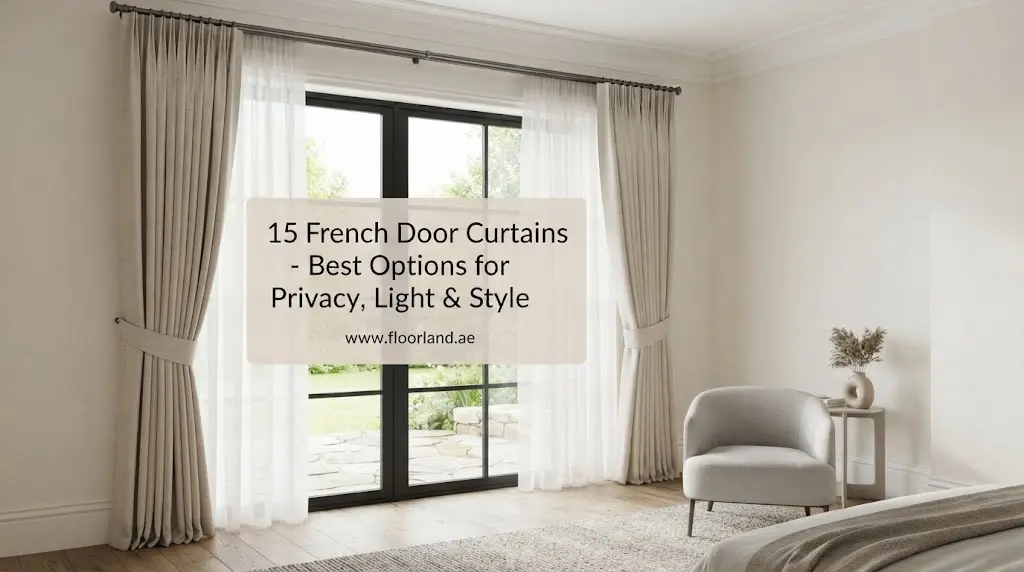
The best French door curtains mount close to the glass so the doors can open freely. Popular options include sash panels held by top and bottom rods, magnetic rods that stick to steel doors, and wide-rod drapes that stack fully past the door frame. For privacy with daylight, choose sheer or frosted-look fabric. For full privacy at night, pair sheers with lined or blackout panels.
French doors bring in light and views, but the glass also exposes your room to neighbors and passersby. The right bespoke curtain fixes that without blocking the doors or making the space feel dark. Below are 15 practical ideas, each with what it does best, plus tips on measuring, hardware, and fabric so you can pick with confidence.
Why French Doors Need a Different Curtain Approach
A regular window stays put, but a French door swings, gets used many times a day, and has a handle in the way. Curtains that work on a window often fail on a door. Keep these four points in mind before you go to the curtain store to buy these curtains for a French door.

- Door swing: If the doors open inward, any curtain that hangs freely will snag, bunch, or get caught in the hinge. Door-mounted options solve this.
- Handle clearance: Lever handles and knobs stick out about 2 to 3 inches. Rods and fabric must sit clear of them, or the curtain must stop above or below them.
- Traffic and wear: Doors open often, so the fabric should be durable and easy to wash. Tiebacks or holdbacks keep panels out of hands and paws.
- Two jobs at once: Most people want daylight during the day and privacy at night. Layering usually handles both better than one heavy panel.
15 French Door Curtain Ideas
Finding the right treatment for a swinging door takes a balance of privacy, light control, and hardware that stays out of the way. Explore these 15 creative ways to dress up your French doors without sacrificing everyday function.
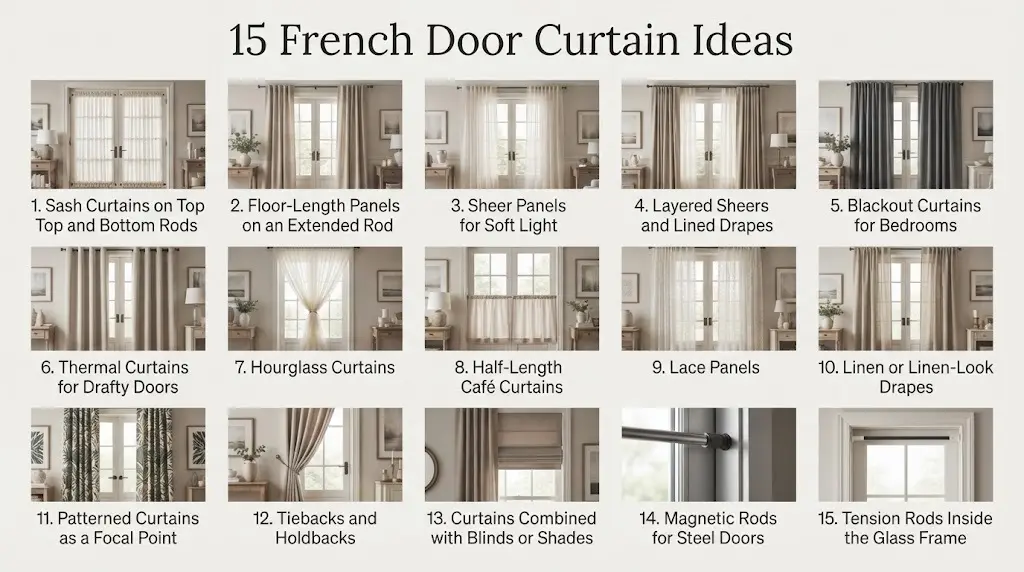
1. Sash Curtains on Top and Bottom Rods
If your French doors swing into the room, sash curtains solve the biggest problem right away. Each panel has a rod pocket sewn at the top and the bottom. You slide a slim rod through each pocket and mount the rods on the door itself, just above and just below the glass. The fabric stays stretched flat against the pane, so it travels with the door instead of flapping or catching in the hinge.
Sash panels also give you a tidy, tailored look that suits almost any room. Since they sit inside the door frame, they never cover the trim or crowd the handle. Many people gather the curtain fabric loosely for a soft shirred effect, while others prefer it pulled tight for a crisp finish.
A few things make sash curtains easier to live with:
- Choose a lightweight cotton or voile so the fabric gathers evenly on the thin rods.
- Measure each glass panel separately, because doors in older homes often differ by a quarter inch or more.
- Use swivel sash brackets if you want to flip the bottom rod up and let in more light on bright days.
2. Floor-Length Panels on an Extended Rod
Nothing looks more elegant on a pair of French doors than tall drapes that sweep from near the ceiling to the floor. The trick is to mount the rod well beyond the door frame. Extend it 12 to 24 inches past each side so the panels can stack fully against the wall when open. That way, the doors stay completely clear, and you lose no glass to bunched fabric.
Hanging the rod high has another benefit. When you place it 4 to 6 inches below the ceiling, the eye travels upward, and the room feels taller. This works especially well in living rooms and dining rooms with standard 8-foot ceilings.
For outward-opening doors, this setup is ideal because nothing blocks the swing. For inward-opening doors, make sure the top of the open door clears the rod, and the panels sit far enough to the side. Deep-projection brackets give you a little extra room if the fit is tight.
3. Sheer Panels for Soft Light
Sheer Curtainsare a favorite for a reason. They take the harsh edge off direct sun, reduce glare on screens, and still let your room feel open and bright. From outside, people see soft shapes and colors rather than clear details, which is enough privacy for most daytime living.
The catch comes after sunset. Once your lights are on and it is dark outside, sheers become close to transparent. If your French doors face a street or a neighbor’s window, plan for a second layer or a shade you can close at night.
White and ivory sheers keep things fresh and airy. Warm tones like oatmeal or blush give the light a cozy glow. If you want a bit more privacy without losing brightness, look for heavier “semi-sheer” fabrics, which hide more while still glowing in the sun.
4. Layered Sheers and Lined Drapes
One curtain rarely handles every hour of the day. Layering gives you a daytime look and a nighttime look from the same window treatment. Hang a sheer on the back rod of a double rod set, then hang a lined drape on the front rod.
During the day, draw the sheers across the glass and tie the drapes back. In the evening, close the heavy drapes over the sheers for full privacy and an extra barrier against cold glass. Guests will notice the depth and texture, too, since two fabrics catch light differently.
To keep the layers looking intentional, pick colors from the same family. A white sheer behind a soft gray linen drape is a safe, classic pairing. If you like contrast, try a natural sheer with a deep navy or forest green panel in front.
5. Blackout Curtains for Bedrooms
A bedroom with French doors can feel like a dream until the sun rises at 5 a.m. or a streetlight shines straight onto your pillow. Blackout curtains fix that. Their tightly woven or coated backing blocks almost all incoming light, helping you sleep longer and keeping the room cooler on summer afternoons.
Light usually sneaks in around the edges, not through the fabric. Close those gaps with a few simple steps:
- Choose a wraparound rod that curves back to the wall at each end.
- Mount the rod at least 4 inches above the door frame so light cannot spill over the top.
- Let the panels touch the floor or rest on it by about an inch.
- Overlap the two panels in the center, or add a small magnetic tape strip to hold them together.
Blackout fabric no longer means dull, heavy plastic. Today you can find it in velvet, linen-look weaves, and printed designs that look just like regular curtains from the room side.
6. Thermal Curtains for Drafty Doors
Glass is a poor insulator, and French doors have a lot of it. In winter, you may feel a chill several feet away from the doors. In summer, the same glass can turn a sunny room into a hot box. Thermal curtains add a layer of foam, felt, or dense weave that slows heat moving both ways.
They work best when they seal the space around the door. Let the panels reach the floor so they block the cold air that slips under the threshold. A cornice or valance across the top also stops warm room air from flowing down behind the curtain and cooling against the glass.
Thermal curtains will not replace proper weatherstripping, but they make a noticeable difference in comfort. Many people also see a small drop in heating and cooling bills, especially in older homes with single-pane doors.
7. Hourglass Curtains
Hourglass curtains bring a touch of old-world charm that feels right at home in farmhouse, cottage, and vintage-style spaces. They start as ordinary sash panels on top and bottom rods. Then you cinch the fabric in the middle with a ribbon, a strip of matching fabric, or a decorative tie. The panel narrows at the center and flares out at both ends, leaving a small diamond of glass visible on each side.
This style gives you most of the privacy of a full sash curtain while still letting in a little extra light. It also draws attention to the door’s shape, making plain doors look more detailed.
For the best shape, use fabric about twice as wide as the glass. Thin cotton, lace, and lightweight linen all pinch neatly. Heavier fabrics tend to bunch and lose the graceful curve.
8. Half-Length Café Curtains
Sometimes you only need to hide part of the view. Café curtains cover the lower half of the glass and leave the top open. When you sit at the table or relax on the sofa, the people walking past cannot see in. Yet you still see the sky, the treetops, and plenty of natural light.
This idea suits kitchens, breakfast nooks, and ground-floor rooms that face a sidewalk. It also works well in small rooms where full-length curtains would feel heavy and crowded.
Mount a slim rod across the middle of each door panel, or place it at whatever height blocks the view from your usual seat. Gingham, stripes, and small florals give a relaxed, country feel. Plain white linen keeps the look clean and modern
- 9. Lace Panels
Lace has shaken off its old-fashioned image. While you can still find traditional floral lace, many modern designs feature clean geometric lines, leafy botanicals, and subtle abstract patterns. When sunlight passes through, the pattern casts soft shadows across the floor and walls, adding movement to the room.
The open weave blurs the view from outside without blocking much light. That makes lace a smart choice for front-facing doors where you want some privacy but still want the room to feel bright.
Let the lace be the star of the space. It looks best against plain walls and simple furniture. If your room already has busy wallpaper or patterned upholstery, choose lace with a small, quiet motif so the two patterns don’t compete.
10. Linen or Linen-Look Drapes
Linen has a natural, lived-in texture that makes a room feel calm and relaxed. It softens light rather than blocking it, and its slight slubs and wrinkles add character up close. That is why linen shows up so often in modern, coastal, and Scandinavian homes.
Pure linen does have a few quirks. It can shrink in a hot wash, crease easily, and fade over time in strong sun. If you want the look without the upkeep, a linen-polyester blend is a practical middle ground. It hangs in the same easy folds but holds its shape and color much longer.
Neutral shades like flax, sand, and stone suit almost any color scheme. For French doors that see direct afternoon sun, ask for a lined version to protect the fabric and add a little more privacy at night.
11. Patterned Curtains as a Focal Point
French doors already pull attention because of their size. Bold curtains can turn them into the main feature of the room. This works especially well when your walls, floors, and furniture are mostly neutral, and the space needs a dose of color or personality.
The pattern you pick shapes the mood:
- Vertical stripes stretch the doors visually and make low ceilings feel higher.
- Large florals add warmth and suit traditional or eclectic rooms.
- Geometric prints feel modern and work well in living rooms and home offices.
- Botanical leaf prints bring an outdoor feel indoors, which suits doors that open onto a garden or patio.
To tie everything together, repeat one color from the curtain fabric in a cushion, rug, or piece of art elsewhere in the room.
12. Tiebacks and Holdbacks
Tiebacks are small details that solve a real daily problem. Without them, drapes drift back across the doorway, brush against the handle, and get pushed aside by hands that may not be clean. A tieback gathers each panel neatly to the side so you can walk through without touching the fabric.
You have two main styles to choose from. Fabric tiebacks, cords, and tassels create a soft, relaxed swag. Metal or wooden holdbacks are fixed hooks on the wall that give a sharper, more structured look. Magnetic tiebacks are a handy newer option, since they clip around the curtain without any wall mounting.
Placement changes the overall shape. Mount tiebacks about one-third of the way up from the floor for a classic, balanced curve. Place them higher, near the middle of the door, for a more dramatic, formal sweep.
13. Curtains Combined with Blinds or Shades
For the most control over light and privacy, let blinds do the hard work and let curtains handle the style. Mount slim cellular shades, roller shades, or mini blinds directly on each door, sized to cover just the glass. Then hang a pair of decorative side panels on a wall rod that frames the whole doorway.
This combination gives you options throughout the day. You can tilt blinds to let in light while blocking the view, raise shades fully on cloudy days, or close everything at night. The side panels can stay open most of the time, adding softness and color without ever getting in the way of the door.
When choosing door-mounted shades, look for low-profile models with hold-down brackets at the bottom. These stop the shade from swinging and tapping against the glass each time you open or close the door.
14. Magnetic Rods for Steel Doors
Renters often avoid door curtains because they cannot drill into the frame. Magnetic rods remove that worry. They grip any steel door or metal frame firmly, and you can pull them off in seconds when it is time to wash the fabric or move out.
Before you buy, test your door with a fridge magnet. If it sticks, you are good to go. Fiberglass and wooden doors will not hold a magnet, so you will need a different option.
Magnetic rods can support light cafe curtains, sash panels, and sheer curtains. They are not strong enough for heavy blackout drapes, which tend to slide down over time. Pair them with lightweight fabric, and they will stay exactly where you put them.
15. Tension Rods Inside the Glass Frame
Many French doors have a raised wooden molding around each glass pane. That small recess is the perfect spot for a short tension rod. Twist the rod until it presses firmly against both sides of the molding, then repeat at the bottom. You get the same clean, door-mounted look as a sash setup, but without a single screw.
This method works best when the recess is at least half an inch deep. Shallow moldings give the rod little to grip, and the curtain may slip each time the door slams. Rubber-tipped tension rods hold better than plain metal ends.
Tension rods also make seasonal swaps easy. You can hang a light sheer in summer and switch to a thicker lined panel when the weather turns cold, all in a few minutes.
How to Measure and Choose Hardware
Good measurements matter more than the fabric you pick. A curtain that is too narrow looks skimpy, and one that is too long drags and gets caught. Follow the steps that match your mounting style.
Measuring for Door-Mounted Curtains
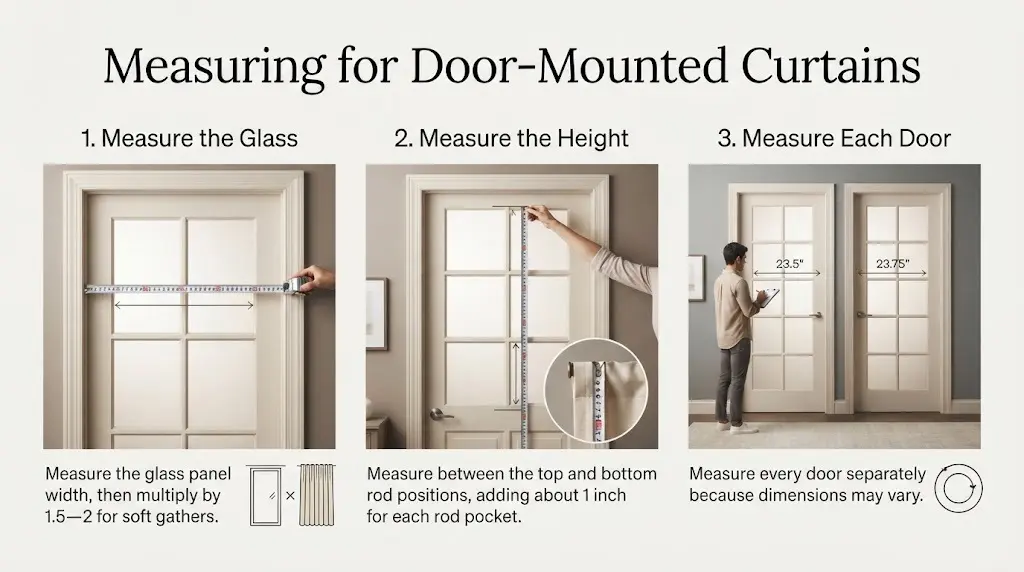
- Measure the width of the glass panel, not the whole door. Multiply by 1.5 to 2 for soft gathers.
- Measure the height from where the top rod will sit to where the bottom rod will sit. Add about 1 inch for each rod pocket.
- Repeat for each door, since older doors are not always identical.
Measuring for Wall-Mounted Curtains
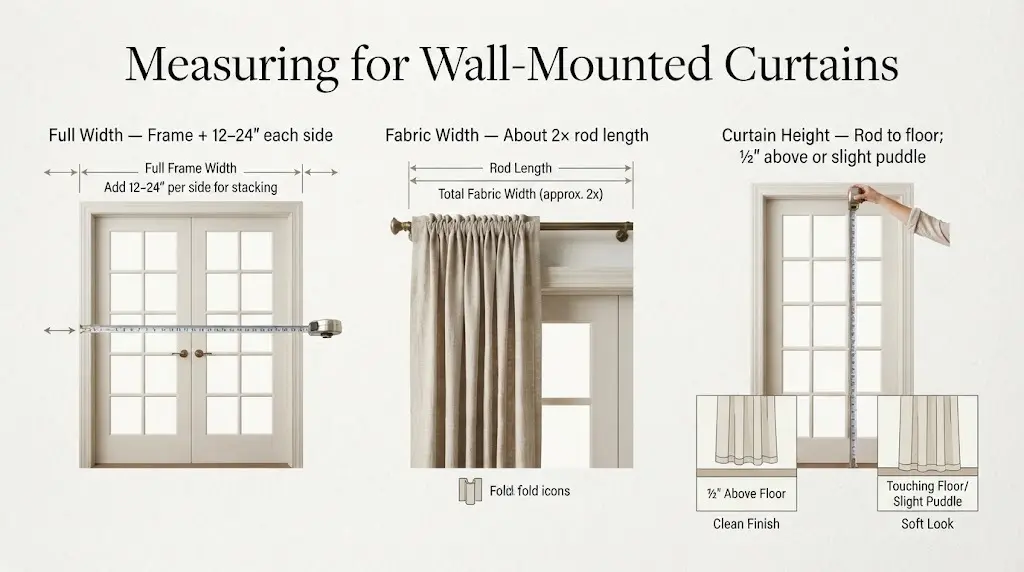
- Measure the full width of the door frame, including trim. Add 12 to 24 inches on each side so panels can stack off the glass.
- Choose a total fabric width of about 2 times the rod length for a full look.
- Measure from the rod height to the floor. For a clean finish, leave about half an inch above the floor. For a softer look, let the fabric touch or puddle slightly.
Choosing the Right Hardware
| Hardware | How it mounts | Best use |
| Sash rods | Screws into the door above and below the glass | Inward-opening doors |
| Magnetic rods | Sticks to steel or metal-framed doors | Rentals, no drilling |
| Tension rods | Wedges inside a recessed glass frame | Quick, temporary setups |
| Single wall rod | Brackets above the door frame | Panels that stack to the sides |
| Double wall rod | Two rods on shared brackets | Layering sheers and drapes |
| Wraparound rod | Curves back to the wall at each end | Blackout, less light leak |
If the doors open inward, check the clearance between the wall rod and the top of the door. Brackets with a deeper projection keep the door from hitting the fabric.
Common Mistakes to Avoid While Choosing Door Curtains
There are some mistakes that you must avoid while buying curtains for a glass door.
- Using a short rod: A rod that ends at the frame forces the panels to sit on the glass when open. Extend it past the frame so the doors stay clear.
- Ignoring the door swing: Loose panels on an inward-opening door will catch and tear. Use sash rods, or keep the curtain well above the door.
- Skimping on fabric: Flat panels look cheap. Aim for 1.5 to 2 times the width you need to cover.
- Relying on sheers alone at night: Sheers can look see-through after dark when the lights are on. Add a lined layer or blinds for evening privacy.
- Letting fabric block the handle: Curtains that fall over the handle get grabbed and soiled. Use tiebacks or stop sash panels short of the handle.
- Forgetting about cleaning: Door curtains get touched often. Choose machine-washable fabric or easy-release hardware.
Final Thoughts
The right French door curtain depends on three things: which way your doors swing, how much privacy you need, and how much light you want to keep. Start with the mounting method, then choose the fabric, and finish with color and tiebacks. With the right setup, your French doors can stay bright by day, private by night, and easy to use every time you step through them.
Frequently Asked Questions
What type of curtain is best for French doors?
Sash curtains on top and bottom rods are the most practical choice because they move with the door. If your doors open outward, floor-length panels on a wide wall rod also work well.
How do you hang curtains on French doors that open inward?
Mount slim rods directly on each door, above and below the glass. If you prefer wall-mounted drapes, hang the rod high enough and wide enough that the open doors clear the fabric.
Should French door curtains touch the floor?
Wall-mounted panels look best when they just skim the floor or stop half an inch above it. Door-mounted panels should end at the bottom of the glass so they do not drag.
How can I get privacy on French doors without losing light?
Use sheer, lace, or light linen curtains during the day. Frosted window film or top-down shades are other good options that keep the upper glass open.
Can I put curtains on French doors without drilling?
Yes. Magnetic rods work on steel doors, and tension rods fit inside recessed glass frames. Adhesive hooks can also hold very light café curtains.