

What Is Laminate Flooring? Pros, Cons, Types, and Uses
Laminate flooring is a multi-layer synthetic floor covering that fuses a high-density fiberboard (HDF) core, a high-resolution printed design layer, and a clear, hard-wearing melamine surface into one rigid plank. It recreates the look of Hardwood Floor, stone, or tile at a fraction of the cost. It can be installed as a floating floor with click-lock joints, and typically lasts 15 to 25 years in a home.
Its biggest limitation is water. Because the core is made from wood fiber, standard laminate swells if liquid seeps into the joints. So it performs best in living rooms, bedrooms, hallways, and offices, not bathrooms or laundry rooms.
This guide by Floor Land explains how manufacturers build laminate, how to read the AC durability rating printed on every box, which types exist, where laminate works and where it fails, what it costs, and how to spot a quality product before you buy.
How Is Laminate Flooring Made?
Swedish company Perstorp invented Laminate Flooring in 1977 and later sold it under the Pergo brand. The core idea hasn’t changed: manufacturers take decorative laminate used on kitchen countertops, bond it to a stable wood-fiber board, and machine the edges so the planks lock together.
Most residential laminate uses Direct Pressure Laminate (DPL) construction. A hydraulic press fuses all four layers in a single step at high heat and pressure, so the finished board behaves as one solid unit.
| Layer (top to bottom) | Material | What It Does for You |
| 1. Wear layer (overlay) | Clear paper saturated with melamine resin and aluminum oxide particles | Resists scratches, stains, and UV fading; sets the AC rating |
| 2. Décor layer | High-resolution printed paper, sealed with resin | Creates the wood, stone, or tile look |
| 3. Core board | High-density fibreboard (HDF), mostly recycled or reclaimed wood fiber | Provides rigidity, dent resistance, and the milled click-lock profile |
| 4. Balancing (backing) layer | Resin-impregnated paper | Keeps the plank flat and blocks moisture rising from below |
Expert tip: Core density matters as much as the wear layer. A dense HDF core (around 850 kg/m³ or higher) holds its locking profile better, dents less, and resists swelling at the edges. Reputable manufacturers publish this figure on their technical data sheets, so ask for it.
What Do AC Ratings Mean for The Laminate Flooring?
The AC (Abrasion Class) rating tells you how much foot traffic the wear layer withstands. Labs grade it under the European standard EN 13329 by grinding the surface with abrasive wheels and testing it for impact, stain, and burn resistance. Every reputable brand prints the AC rating and the matching EN use class on the packaging.
| AC Rating | Use Class | Traffic Level | Where It Fits |
| AC1 | 21 | Light residential | Guest bedrooms, closets |
| AC2 | 22 | General residential | Bedrooms, dining rooms |
| AC3 | 23 / 31 | Heavy residential, light commercial | Every room in most homes, including kitchens and hallways; small offices |
| AC4 | 32 | General commercial | Homes with large dogs or kids; shops, cafés, busy offices |
| AC5 | 33 | Heavy commercial | Department stores, public buildings, high-footfall reception areas |
What most guides get wrong: Thickness does not equal durability. A 12 mm AC3 plank will show wear sooner than an 8 mm AC4 plank because the wear layer, not the board, takes the abuse. Thickness mainly improves the feel underfoot, sound, and the ability to bridge small subfloor dips.
Types of Laminate Flooring
Retailers often sort laminate simply as “planks” or “tiles”, but you will make a better choice if you understand the six ways products actually differ.
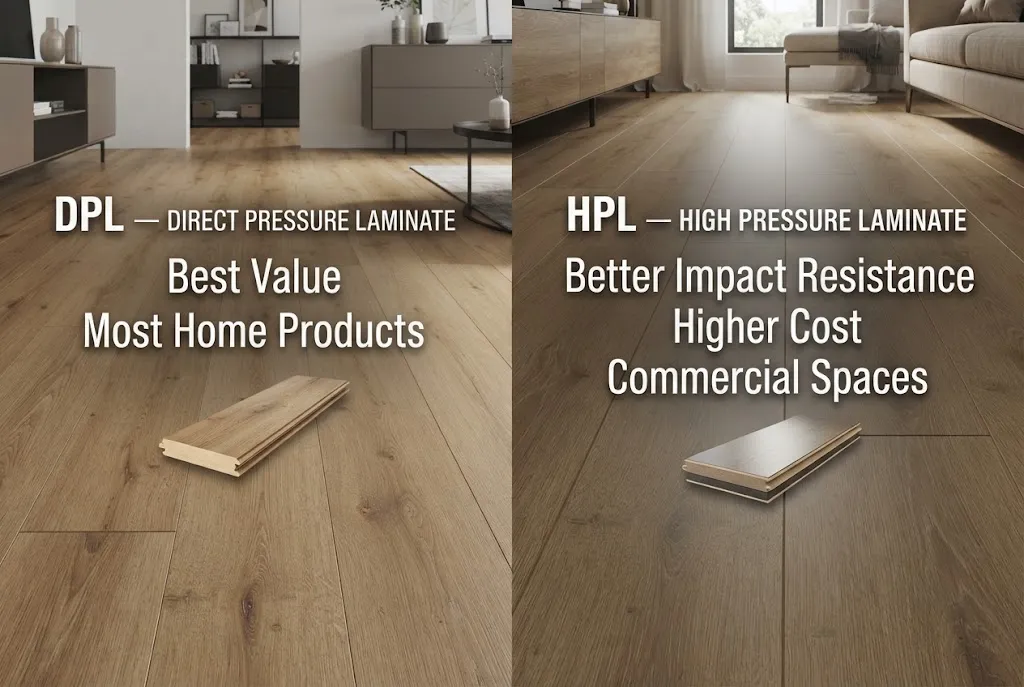
1. By Construction: DPL vs. HPL
DPL (Direct Pressure Laminate) covers most home products and offers the best value. HPL (High Pressure Laminate) presses the surface layers separately under far greater pressure before gluing them to the core. HPL resists impact better and costs more, so you mainly find it in commercial spaces.
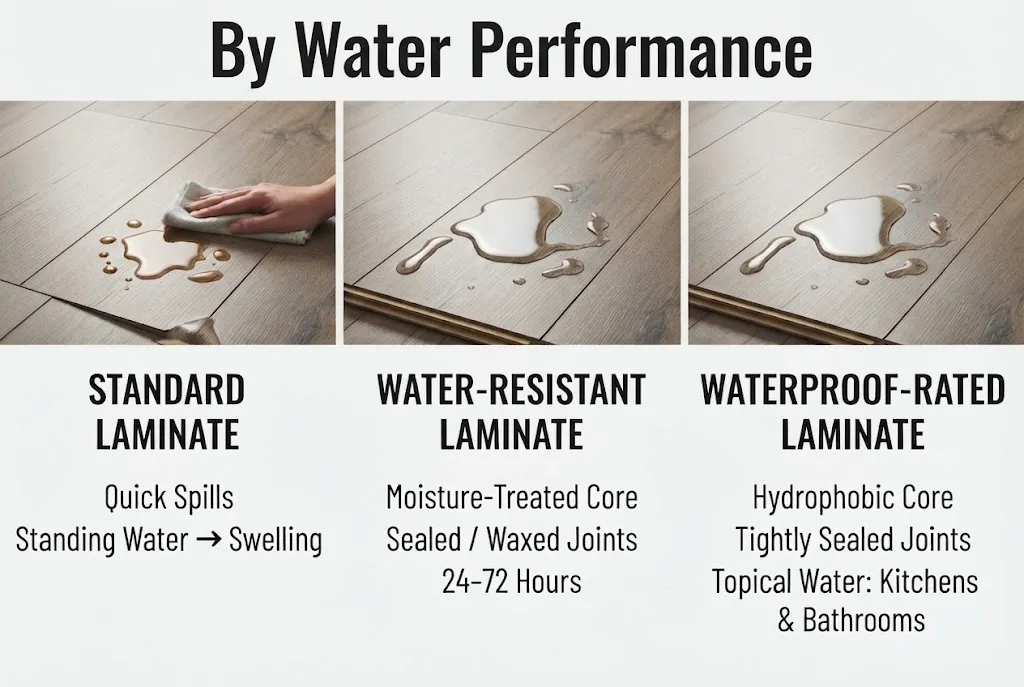
2. By Water Performance
Standard laminate handles quick spills you wipe up. Water left in the joints causes swelling. Water-resistant laminate uses a moisture-treated core and sealed or waxed joints. Manufacturers typically rate it against standing water for a set period, often 24 to 72 hours.Waterproof-rated laminate combines a hydrophobic core with tightly sealed joints and a warranty that covers topical water in kitchens and bathrooms. It still doesn’t handle floods or wet rooms where showers drain onto the floor. Always check how the manufacturer defines “waterproof” in the warranty; the terms vary widely between brands.
3. By Format and Pattern
Different formats of laminate flooring are available today.
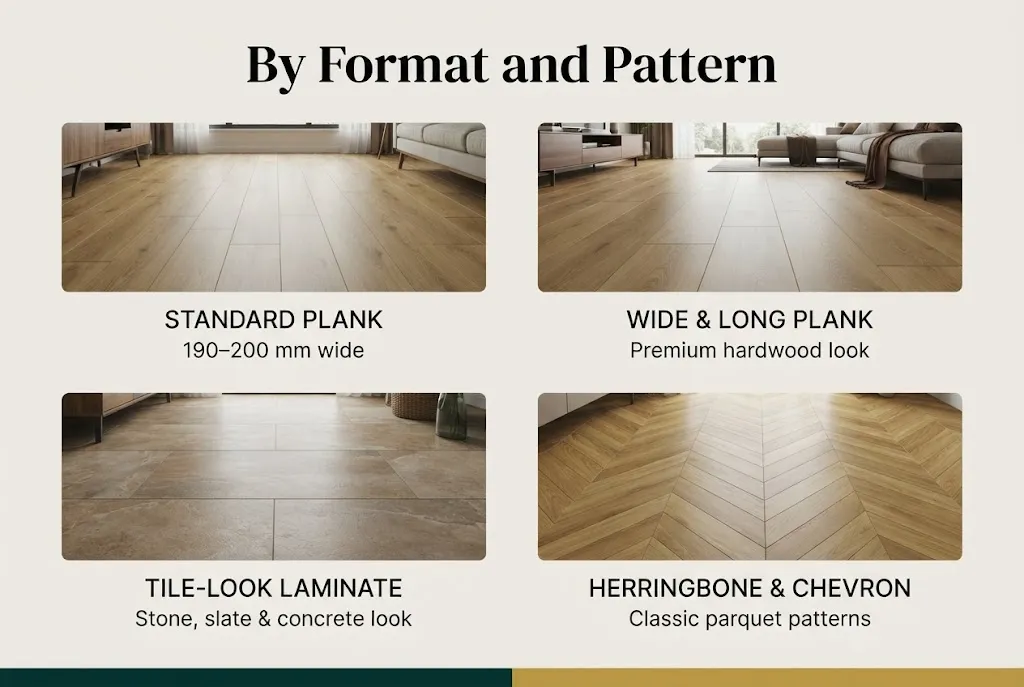
- Standard plank: Roughly 190–200 mm wide, the most common and budget-friendly option.
- Wide and long plank: Mimics premium hardwood boards and makes large rooms look calmer and more spacious.
- Tile-look laminate: Reproduces stone, slate, or concrete with a warmer, quieter surface than ceramic.
- Herringbone and chevron: Uses left- and right-hand planks to create classic parquet patterns. It takes longer to install and produces more cutting waste.
4. By Surface Texture
Depending on the surface texture, these types of laminate flooring exist:
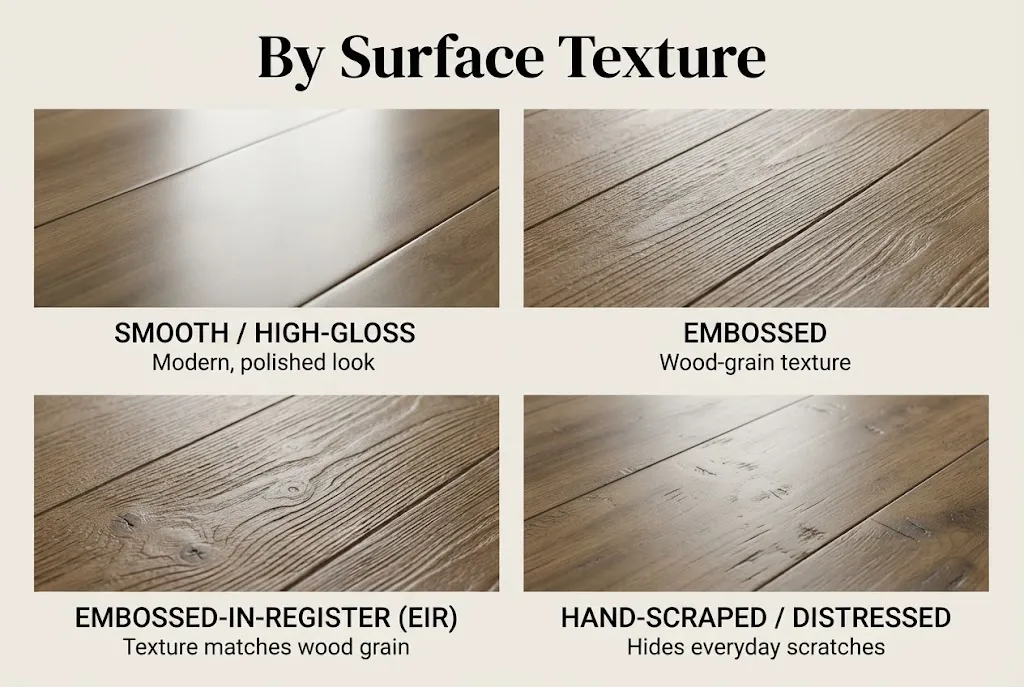
- Smooth or high-gloss: Modern look, but it shows scratches, dust, and footprints more readily.
- Embossed: Adds a general wood-grain texture across the surface.
- Embossed-in-register (EIR): Aligns the texture precisely with the printed grain and knots. EIR delivers the most convincing hardwood imitation.
- Hand-scraped or distressed: Hides everyday scratches well, making it a smart pick for pet owners.
5. By Edge Profile
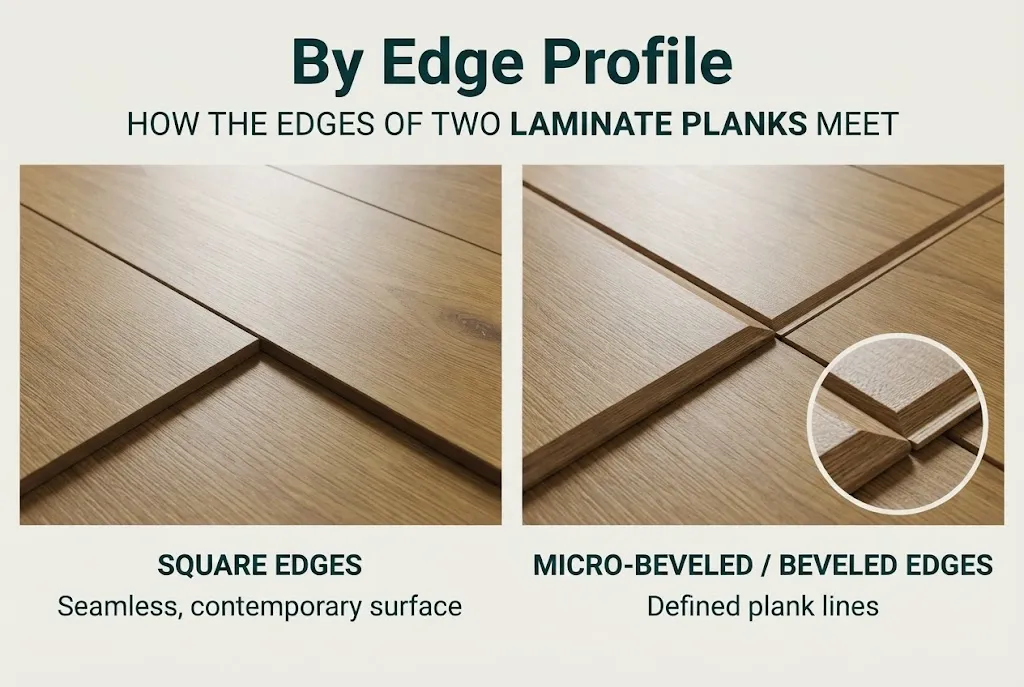
Square edges create a seamless, contemporary surface. Micro-beveled or beveled edges define each plank and look more like real boards, but the grooves collect a little more dirt.
6. By Underlay
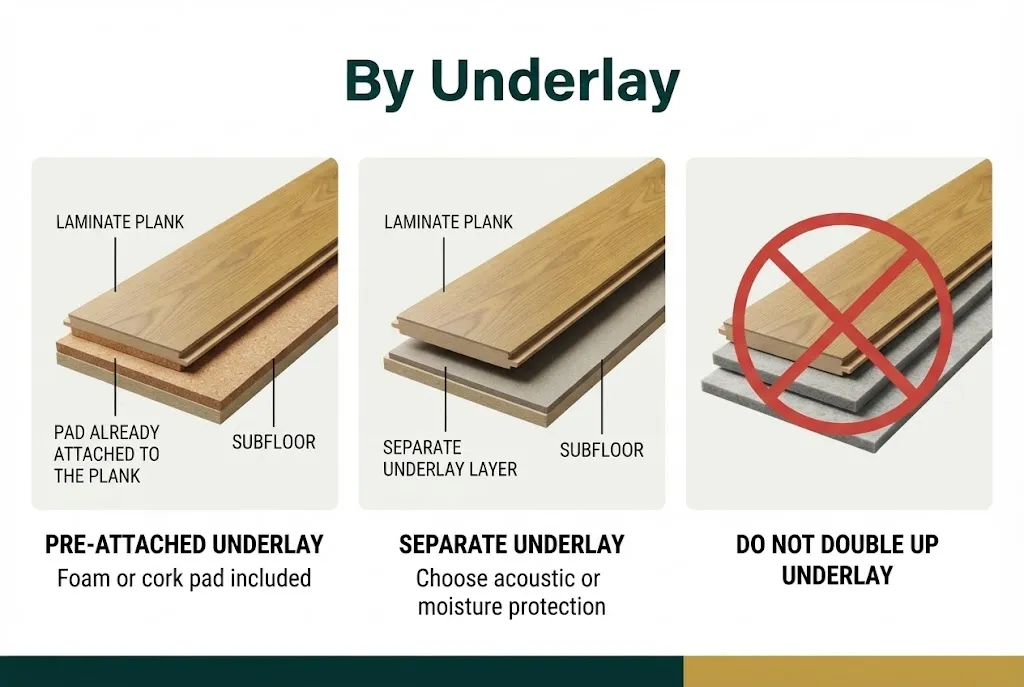
Some planks come with a pre-attached foam or cork pad, which saves time and money. Others need a separate underlay, which lets you choose a higher-grade acoustic or moisture-barrier product. Never double up underlay on attached-pad planks; the extra softness stresses the joints.
Pros of Laminate Flooring
There are many benefits that you can get from laminate flooring. Take a look at a few of them:
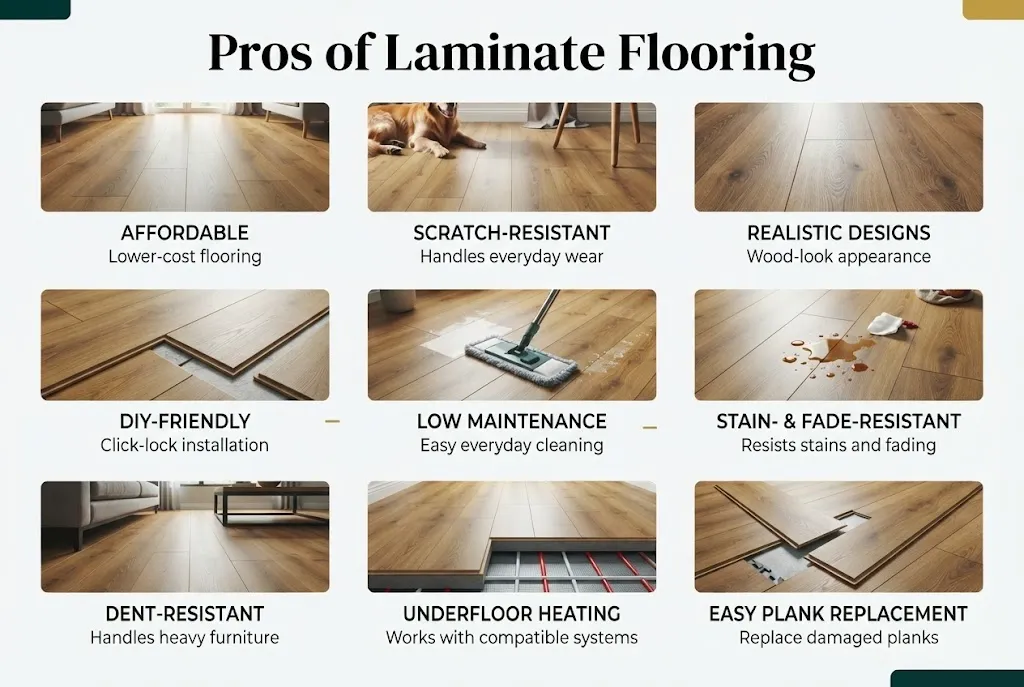
- Affordable: Laminate typically costs a third to half as much as solid hardwood, and DIY installation removes most labor costs.
- Highly scratch-resistant: The aluminum oxide wear layer outperforms most hardwood finishes against pet claws, grit, and chair legs.
- Realistic designs: Modern digital printing and EIR texturing make high-end laminate hard to tell from real wood at standing height.
- DIY-friendly installation: Click-lock planks float over the subfloor with no glue or nails, and you can walk on the floor immediately.
- Low maintenance: A vacuum and a lightly damp microfibre mop keep it clean; it never needs sanding, oiling, or sealing.
- Stain- and fade-resistant: The sealed melamine surface shrugs off food, wine, and most household stains, and it resists sun fading.
- Dent-resistant: The dense HDF core handles heavy furniture better than many softwoods and some vinyl floors.
- Compatible with underfloor heating: Most products work with water-based systems when you keep the surface temperature within the manufacturer’s limit, commonly about 27 °C (81 °F).
- Easy plank replacement: On a click-lock floor, you or a fitter can unclick rows from the nearest wall, or cut out a single damaged plank, and fit a spare.
Cons of Laminate Flooring
Like every flooring type, laminate also has a few limitations
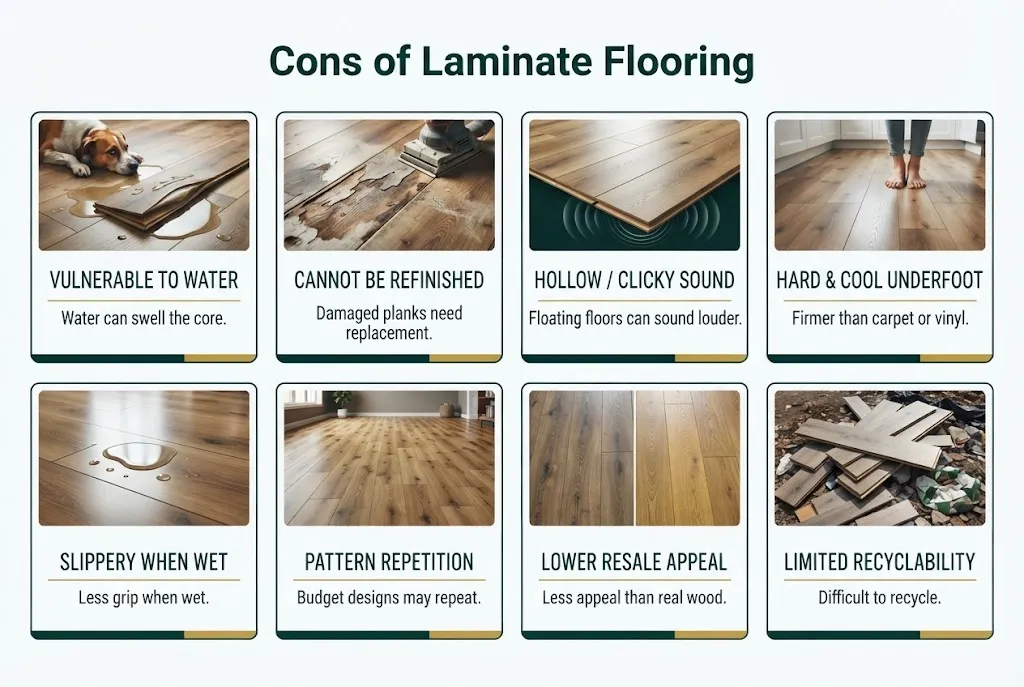
- Vulnerable to water: Standing water, pet accidents, and wet mopping can swell the core, and swollen planks do not shrink back.
- Cannot be refinished: Once the wear layer wears through, sanding will not help; you must replace the affected planks.
- Hollow or clicky sound: Floating floors can sound louder than glued or nailed floors. A quality acoustic underlay solves most of the problem.
- Hard and cool underfoot: It feels firmer than carpet or vinyl, which matters if you stand in the kitchen for long periods.
- Slippery when wet: Smooth and glossy finishes offer less grip, a real concern for older adults and young children.
- Pattern repetition on budget lines: Cheap laminate may use only a handful of printed designs, so the same knot appears again and again across the room.
- Lower resale appeal than real wood: Buyers generally value hardwood more, although quality laminate still beats worn carpet.
- Limited recyclability: The fused resin layers make laminate difficult to recycle, so most old flooring ends up in landfill.
Laminate vs. Hardwood vs. Engineered Wood vs. Vinyl
Laminate competes with three main alternatives. This table shows where each one wins so you can match the floor to your priorities.
| Factor | Laminate | Solid Hardwood | Engineered Wood | Luxury Vinyl (LVP) |
| Core material | HDF wood fiber | Solid timber | Plywood or HDF with real wood top | PVC, SPC, or WPC |
| Surface | Printed image | Real wood | Real wood veneer | Printed image |
| Scratch resistance | Excellent | Fair | Fair to good | Good |
| Water resistance | Low to moderate (high on rated lines) | Low | Low to moderate | Excellent |
| Can be refinished? | No | Yes, many times | 1–3 times, depending on veneer | No |
| DIY installation | Easy | Difficult | Moderate | Easy |
| Feel underfoot | Firm, can sound hollow | Solid, warm | Solid, warm | Softer, quieter |
| Relative cost | $ | $$$$ | $$$ | –$ |
| Typical lifespan | 15–25 years | 50–100 years | 20–40 years | 15–25 years |
Quick verdict: Choose laminate for scratch resistance and value in dry rooms. Choose LVP for kitchens, basements, and bathrooms. Choose engineered or solid wood when authenticity and long-term resale value matter most.
Where to Use Laminate Flooring
Laminate suits most areas of a home and many commercial settings, provided you match the product to the moisture level and traffic.
| Space | Suitability | What to Choose |
| Living room & dining room | Excellent | AC3, embossed texture, acoustic underlay |
| Bedrooms | Excellent | AC2–AC3; add rugs for warmth |
| Hallways & entryways | Very good | AC4; place a mat at the door to trap grit |
| Home office | Very good | AC3–AC4; use a chair mat under castor chairs |
| Kitchen | Good | Water-resistant or waterproof-rated AC3+; wipe spills quickly |
| Basement | Conditional | Only on a dry slab, with a moisture barrier and a water-resistant product |
| Stairs | Conditional | Use matching stair nosing; glue treads down rather than floating them |
| Full bathroom/laundry room | Not recommended | Choose LVP or porcelain tile instead |
| Retail, offices, hospitality | Good | AC4–AC5 or HPL; check the commercial warranty |
| Outdoors, saunas, unheated sunrooms | Avoid | Extreme humidity and temperature swings break the joints |
How Much Does Laminate Flooring Cost?
Prices vary by country, brand, and specification, but in the US market, laminate materials generally run from about $1 to $5 per square foot. Professional installation usually adds roughly $2 to $5 per square foot, depending on room complexity, subfloor preparation, and removal of the old floor. Always compare local quotes, as regional prices differ significantly.
These factors push the price up:
- Higher AC rating and denser HDF core
- Water-resistant or waterproof-rated construction
- Embossed-in-register texture and a larger number of unique plank designs
- Wide, long, or herringbone formats
- Pre-attached premium underlay
Budget for accessories too: underlay (if not attached), skirting or quarter-round trim, transition strips, and 7–10% extra flooring for cuts and waste (15% for herringbone).
How to Choose High-Quality Laminate?
Price alone does not reveal quality. Use these hands-on checks before you commit:
- Read the AC rating and use class on the box. Match it to your busiest room, not your quietest.
- Count the unique designs. Lay out 10–12 planks from one pack. Good products offer 8 or more unique prints, so repeats stay invisible.
- Test the joints. Click two planks together, then try to lift the seam. A quality locking system feels tight and leaves no visible gap.
- Tilt a plank under the light. On EIR products, the texture follows the knots and grain exactly. On cheaper products, the texture ignores the print.
- Check emissions certification. Look for TSCA Title VI or CARB Phase 2 compliance in the US, or E1 or E0 classification in Europe.
- Read the warranty fine print. “Lifetime” warranties often cover only manufacturing defects and exclude water damage, improper installation, or commercial use.
- Order enough stock from one batch. Color can vary slightly between production runs, so buy spares for future repairs.
Installation and Care Essentials
You can install laminate yourself if you prepare properly. These steps prevent the most common failures:
- Acclimatize the planks flat in the room, still in their packs, for about 48 hours.
- Check the subfloor. Clean, dry, and flat within the manufacturer’s tolerance, often around 3 mm over 2 meters (roughly 3/16 inch over 10 feet).
- Lay a moisture barrier over concrete and an acoustic underlay unless the planks include one.
- Leave an expansion gap of about 8–10 mm at walls and fixed objects, and hide it with skirting or trim. Skipping this causes peaking and buckling.
For daily care, vacuum with a hard-floor head, clean with a well-wrung microfibre mop and a pH-neutral cleaner, and put felt pads under furniture. Never use a steam mop, wax, or polish; steam forces moisture into the joints and voids most warranties.
Is Laminate Flooring Safe and Eco-Friendly?
Laminate cores use resin binders that can release small amounts of formaldehyde. Regulators now cap these emissions: the US EPA enforces TSCA Title VI limits for composite wood products, California applies CARB Phase 2, and Europe classifies panels as E1 or lower. Certified products emit very low levels, and emissions fall further within the first weeks after installation. Ventilate the room well after fitting.
On the environmental side, the HDF core makes use of wood fiber from sawmill residue and fast-growing timber. Look for FSC or PEFC certification to confirm responsible sourcing. The downside remains end-of-life disposal, as few facilities recycle laminate.
Final Verdict
Laminate flooring gives you the look of wood or stone with stronger scratch resistance, easier installation, and a much lower price than natural materials. It fits busy family homes, rentals, pet owners, and anyone renovating on a budget.
Pass on laminate if you need a floor for a bathroom or laundry room, want a surface you can refinish for decades, or plan to sell to buyers who expect hardwood. For everyone else, an AC3 or AC4 laminate with a dense core, EIR texture, and a solid warranty delivers excellent long-term value.
Frequently Asked Questions
Is laminate flooring real wood?
No. Laminate contains wood fiber in its core, but its visible surface is a printed image under a clear protective layer. Engineered and solid wood have a real timber surface.
How long does laminate flooring last?
Budget laminate lasts around 10–15 years, while premium AC4 products often last 20–25 years or more. Traffic, pets, moisture exposure, and cleaning habits affect lifespan.
Can you put laminate flooring in a kitchen?
Yes, if you choose a water-resistant or waterproof-rated product and wipe up spills promptly. Standard laminate carries more risk near sinks and dishwashers.
Is laminate flooring good for pets?
Laminate resists claw scratches better than most hardwood, making it a strong choice for dog owners. Choose AC4 with a textured finish for grip, and clean up accidents fast so urine does not seep into the joints.
Can you repair damaged laminate?
Yes. Fill small chips with a color-matched repair kit. For badly damaged planks, unclick the rows from the nearest wall or have a fitter cut out and replace the single plank. You do not need to replace the entire floor.
Is laminate or vinyl better?
Vinyl wins in wet areas because it is fully waterproof. Laminate wins on scratch resistance, dent resistance, and realistic wood texture. Many homeowners use laminate in living spaces and vinyl in bathrooms and utility rooms.
Does laminate flooring increase home value?
Quality laminate improves appeal compared with worn carpet or damaged floors, but buyers usually value real hardwood more. Treat laminate as a practical upgrade rather than a major value booster.
Can you install laminate over existing flooring?
Often, yes. You can float laminate over flat vinyl, ceramic tile, or hardwood. Remove carpet first, and make sure the old floor is level and firmly attached.