
How Long Does Spray Paint Take to Dry? 6 Factors That Control Drying Time
Most spray paint dries to the touch in 10 to 30 minutes, is safe to handle in about 1 hour, and is fully dry in roughly 24 hours at 70°F (21°C) and 50% relative humidity. Full cure, the point where the finish reaches maximum hardness and chip resistance, usually takes 5 to 7 days. Fast acrylic lacquers can be fully dry in about 30 minutes, while high-heat paints need a separate heat cure before they reach full strength.
Those figures come straight from brands, but they assume near-perfect conditions. Cold air, high humidity, heavy coats, and slick plastic all push every stage longer. The biggest mistake, though, has nothing to do with the weather. It happens when you spray a second coat at the wrong moment and watch the first one wrinkle. This guide by Floor Land covers each drying stage, real product data, the recoat window that trips up most DIYers, and simple tests to confirm that paint is fully dry.
How Long Does It Take for Spray Paint to Dry?
Spray paint during the apartment renovation does not simply go from wet to dry. It passes through several stages, and each one unlocks a different next step. Here is what each stage means and how long it typically takes under label conditions.
| Stage | What It Means | Typical Time (70°F / 50% RH) |
| Dry to touch | A light fingertip touch leaves no paint behind. Dust will no longer stick. | 10 to 30 minutes |
| Dry to handle | You can pick up and move the piece without leaving marks. | 1 to 2 hours |
| Recoat window | The safe period for applying the next coat or a clear coat. | Product-specific (often within 1 hour, or after 24 to 48 hours) |
| Fully dry | Most of the solvent has left the film. | About 24 hours |
| Full cure | Maximum hardness, adhesion, and chip resistance. | 5 to 7 days (longer on plastic or in cold weather) |
Drying Times by Paint Chemistry
Different types of spray paints are available today, and each has a different drying time based on its chemistry.
| Paint Type | Dry | Recoat | Safe to Stack |
| Water-based acrylic | 30 to 60 min | 2 hr | 12 to 24 hr |
| Solvent-based acrylic | 1 hr | 2 hr | 24 to 48 hr |
| Water-based polyurethane | About 30 min | 1 to 2 hr | 2 to 4 days |
| Solvent-based polyurethane | About 1 hr | 2 hr | 2 to 4 days |
| Spray epoxy | 2 to 4 hr | 4 to 6 hr | 24 to 48 hr |
How to Make Spray Paint Dry Faster (Safely)
You cannot add accelerators to an aerosol can, but you can control the environment around it. These steps shorten dry time without harming the paint finish during wall painting.
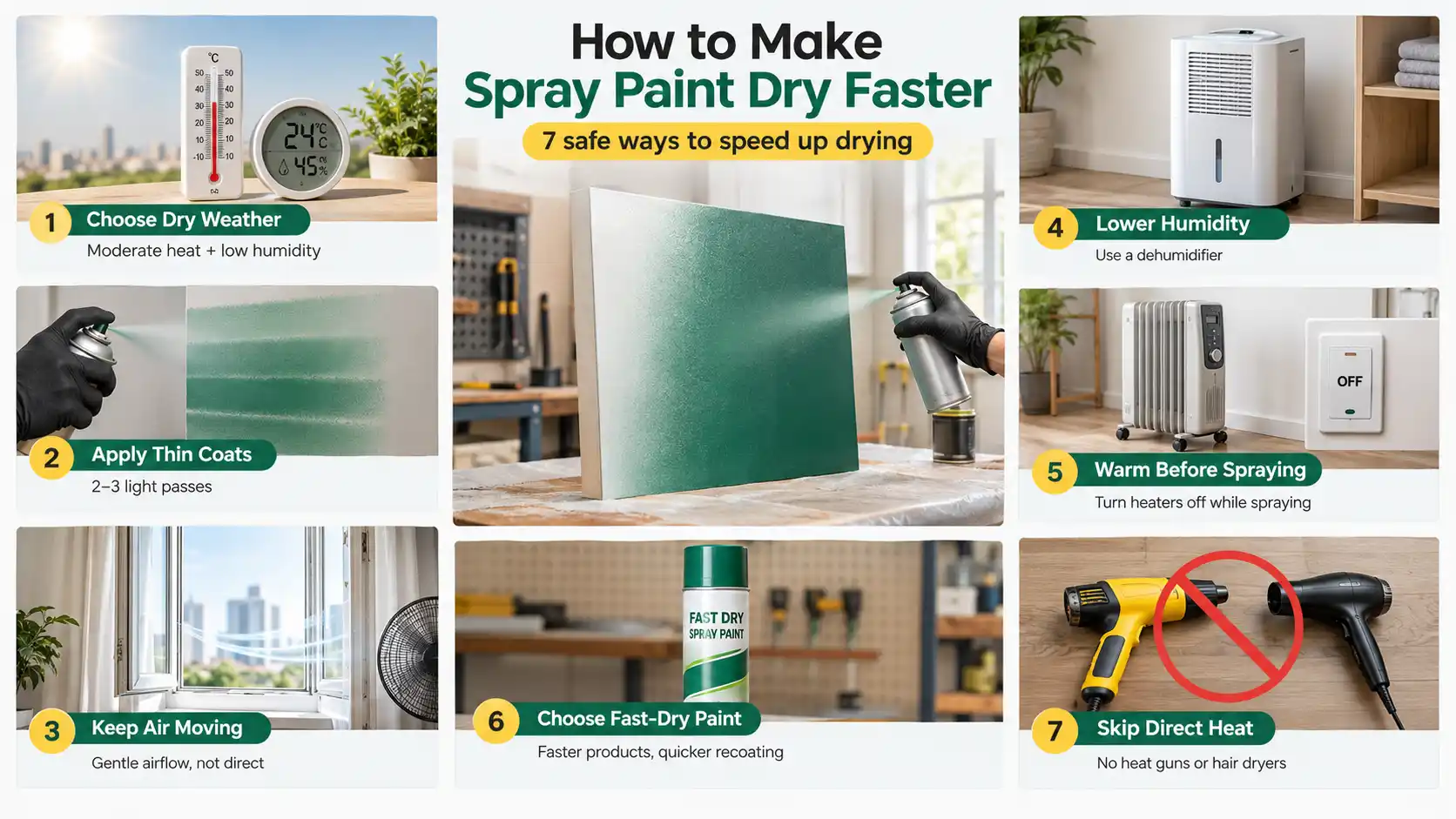
- Spray in the right weather. Aim for the temperature and humidity range on the label. Mid-morning on a dry day is ideal because surfaces warm up and move away from the dew point.
- Apply thin coats. Two or three light passes dry far faster than one heavy one.
- Keep air moving. Open doors and windows, or run a fan to circulate air across the room. Avoid blasting air straight at wet paint, since that can blow dust into the finish.
- Run a dehumidifier in an enclosed garage or workshop on damp days.
- Warm the space before you spray. Then shut off any heater with an open flame or glowing element while you paint and while fumes linger. Aerosol solvents are extremely flammable.
- Choose a faster product when time matters. Acrylic lacquer reaches fully dry in about 30 minutes and allows recoating at any time.
- Skip heat guns and hair dryers on wet paint. Concentrated heat can skin the surface over, trap solvent, and cause bubbles or wrinkles.
How to Tell If Spray Paint Is Really Dry
Clocks and labels give you a starting point, but your project gives you the final answer. Use these quick checks, always on a hidden area or a test piece sprayed at the same time. This prevents your exclusive home or villa painting work from being ruined.
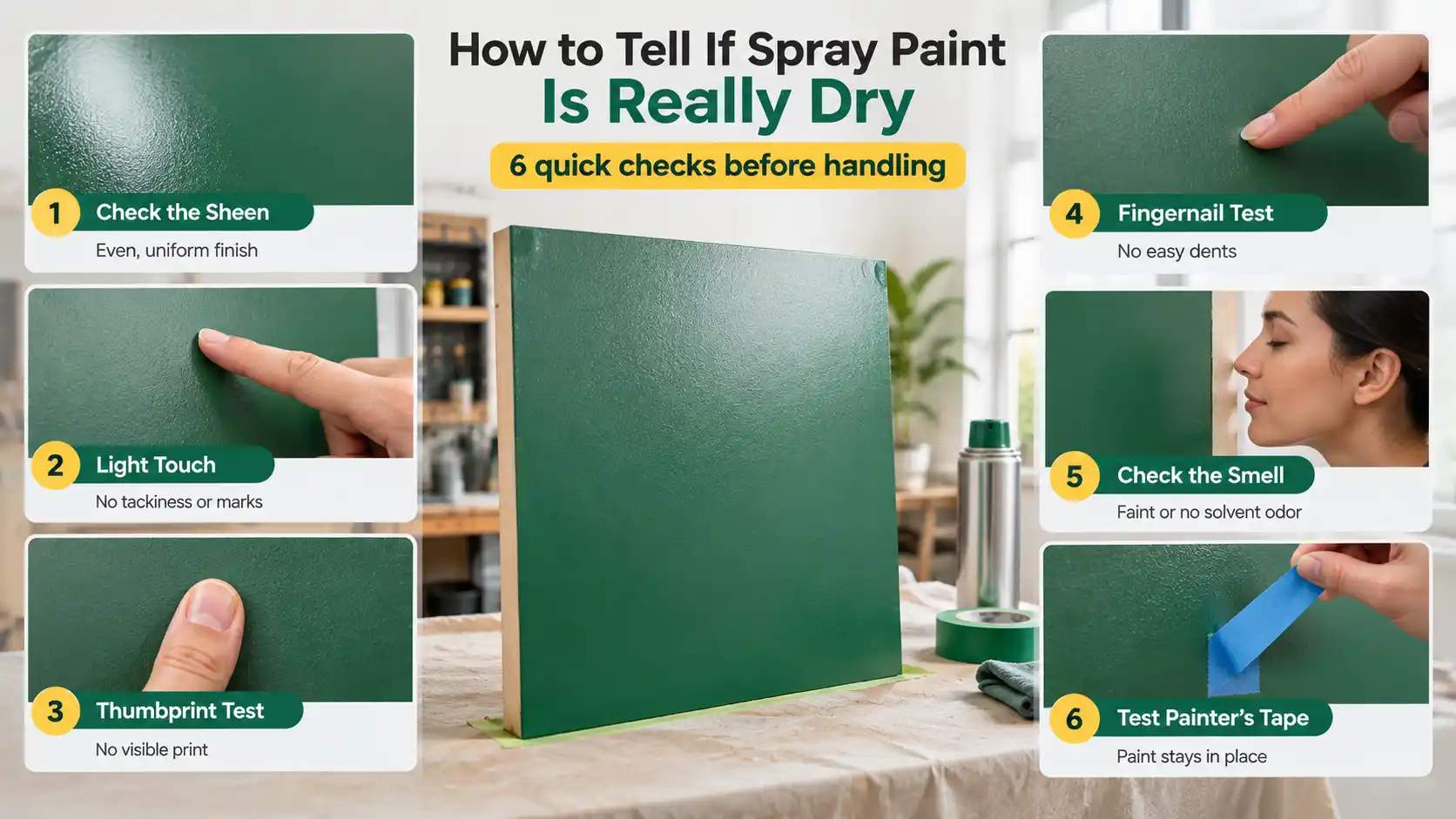
- Look at the sheen. Wet paint looks slick and uneven. Dry paint shows a uniform sheen with no darker wet patches, especially in corners and recesses.
- Try a light touch. Brush a clean fingertip across an inconspicuous edge. If it feels tacky or leaves a mark, the paint is not dry to the touch.
- Do a thumbprint test. Press your thumb firmly on a hidden spot for a few seconds. If a print remains, the film has not cured enough for handling or stacking.
- Try the fingernail test. If a fingernail dents the paint easily, it is still curing. A cured finish resists light pressure.
- Use your nose. A strong solvent smell means the film is still releasing solvent. The odor fades as the paint dries and cures.
- Tape a scrap before masking. Before you mask for a second color, stick painter’s tape on a test piece and pull it off. If paint lifts, wait longer.
6 Factors That Control Spray Paint Drying Time
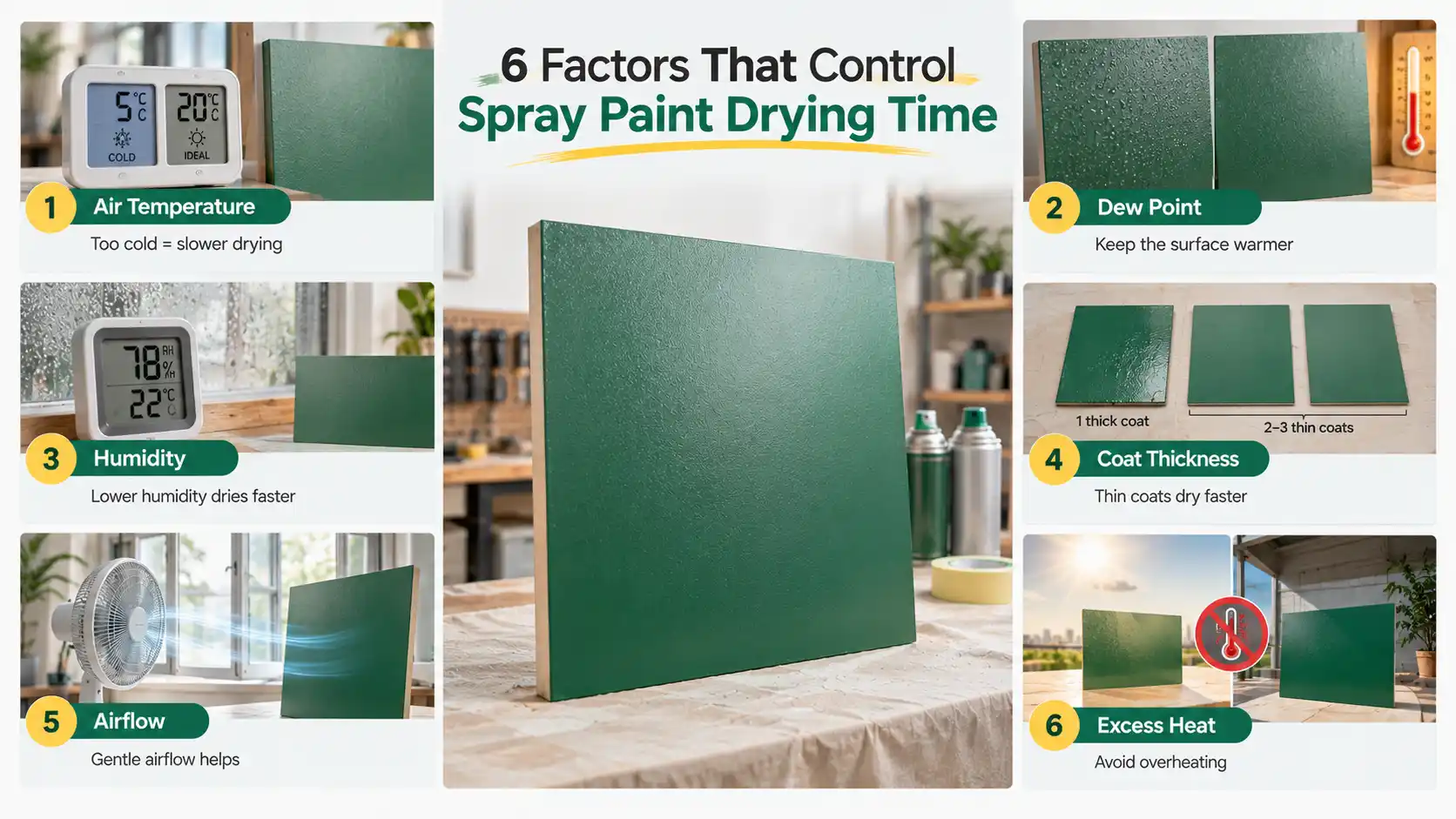
Below are some factors that determine spray paint drying time during painting services.
1. Air Temperature
Every dry time on a label assumes a specific temperature, usually around 70°F (21°C). Rust-Oleum states it directly: allow more time at cooler temperatures. Krylon recommends spraying COLORmaxx between 55°F and 75°F (13°C to 24°C), while Rust-Oleum’s lacquer can go on between 50°F and 90°F (10°C to 32°C). Never spray below the minimum temperature printed on your can.
2. Surface Temperature and Dew Point
This is the factor most DIY guides skip. Dew point is the temperature at which moisture in the air condenses onto a surface. Sherwin-Williams advises against applying any coating unless the surface is at least 5°F (3°C) above the dew point. The same rule appears in ASTM D3276 and ISO standards used by professional coating inspectors.
Here is a real example from Sherwin-Williams. At 70°F air and 65% humidity, the dew point is 57°F, so the surface must be at least 62°F before you paint. Surfaces cool quickly in the evening, so an item painted late in the day can collect invisible moisture before the paint sets. Paint in the morning or early afternoon, when surfaces warm rather than cool.
3. Humidity
Moist air cannot absorb as much solvent as dry air, so high humidity slows evaporation. It can also cause blushing, a milky haze that is especially common with lacquers. Family Handyman notes that lacquer can turn cloudy in high humidity, particularly when it is also cold. Krylon recommends humidity below 60%, and Rust-Oleum’s lacquer calls for less than 65%.
4. Coat Thickness
A heavy coat skins over on top while the solvent underneath stays trapped. That leads to soft spots, sags, and wrinkles. Rust-Oleum’s instructions call for two or more light coats applied a few minutes apart, holding the can 10 to 16 inches from the surface. Thin coats dry faster and more evenly than one thick coat.
5. Airflow
Moving air carries solvent vapor away from the surface so more can evaporate. A well-ventilated garage or a covered outdoor spot dries paint noticeably faster than a closed room. Airflow also protects you by clearing fumes.
6. Direct Sun and Excess Heat
Warmth speeds drying, but too much heat backfires. Paint that dries too fast can crack, turn powdery, or trap solvent under a surface skin. Coating inspectors commonly treat 125°F (50°C) as the upper limit for surface temperature. If a surface feels hot to the back of your hand, move it into the shade first.
Drying vs. Curing: Why “Dry” Is Not “Done”
Every can of spray paint holds four basic ingredients: pigment for color, a binder that forms the film, solvents that keep everything liquid, and a propellant that pushes it out of the nozzle. Once the paint lands, two separate processes begin.
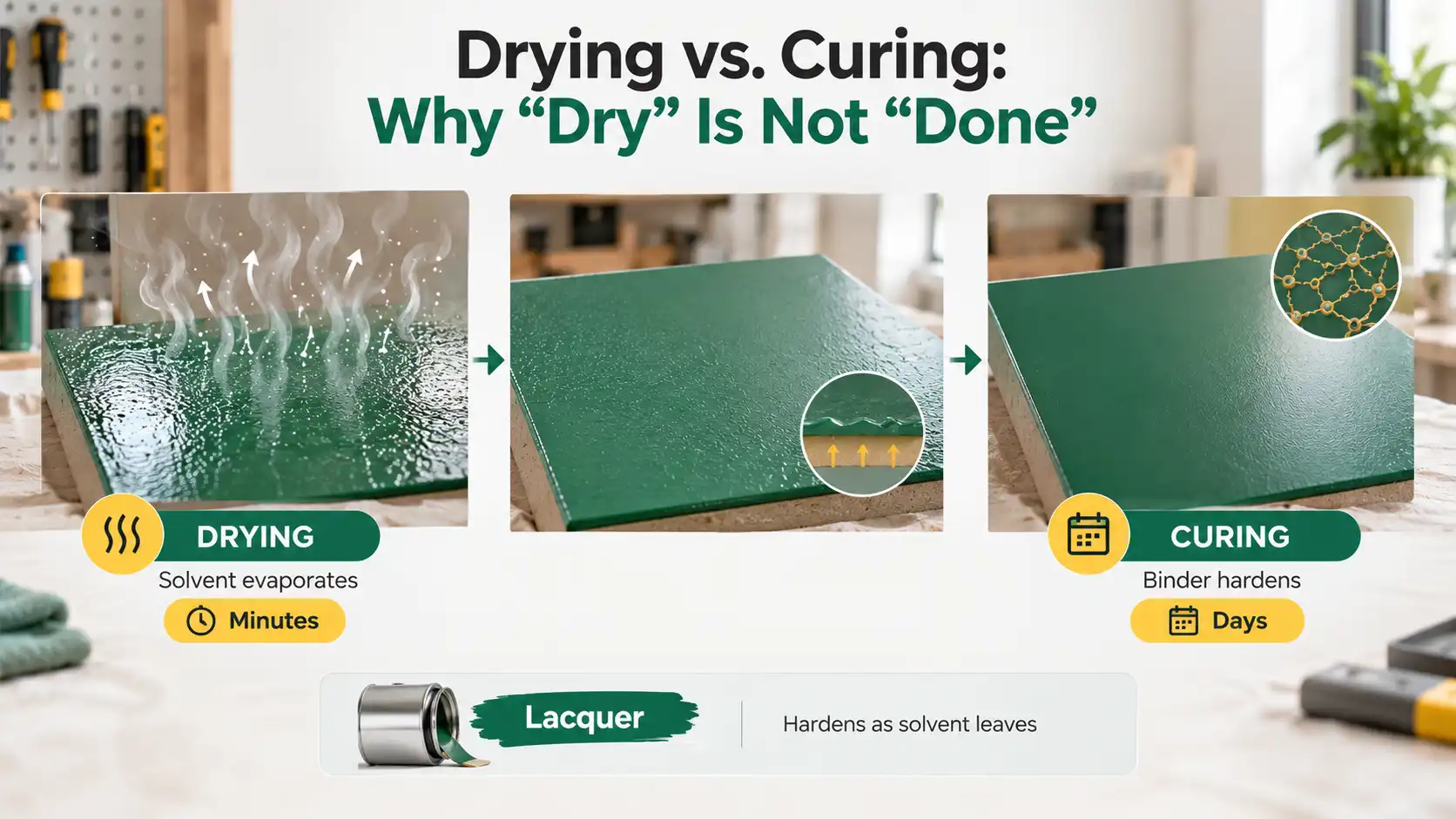
- Drying is physical. The solvents evaporate, and the film stops feeling wet. Aerosol solvents are highly volatile, so this part happens fast. Spray cans dry within minutes because their solvents evaporate quickly.
- Curing is chemical. Most general-purpose spray paints, such as Rust-Oleum Painter’s Touch 2X and Krylon COLORmaxx, are alkyd or modified-alkyd enamels. Their binders react and link together over days, not minutes. Only after that reaction finishes does the paint reach its rated toughness.
Lacquers are the exception. They harden as their solvents leave, without a slow chemical reaction.
The Recoat Window: The Rule Most People Break
Look closely at a paint can, and you will see an odd instruction. It tells you to apply a second coat within 1 hour or after 48 hours. That gap in the middle is not a typo. It is the danger zone.
Fresh paint quickly forms a skin on top while the layer underneath is still drying. If you spray again too soon after that skin forms, the solvents in the new coat break through it. The half-dry layer softens, swells, and shrivels. The result is wrinkling or lifting.
Inside the first hour, both layers are still soft enough to blend into one film. After 48 hours, the first layer is hard enough to resist the new solvents. Between those points, the paint is at its most vulnerable.
How to Avoid Recoat Problems
- Plan all coats in one session. Apply light coats a few minutes apart and finish inside the first hour.
- Missed the window? Walk away. Come back after the full waiting period listed on the label, scuff lightly, then continue.
- Stay in one product system. Primer, color, and clear from the same brand line are designed to work together. Mixing chemistries, such as lacquer over an enamel, can cause lifting.
- Lacquer is the exception. Acrylic lacquers like Rust-Oleum Specialty Lacquer can be recoated at any time.
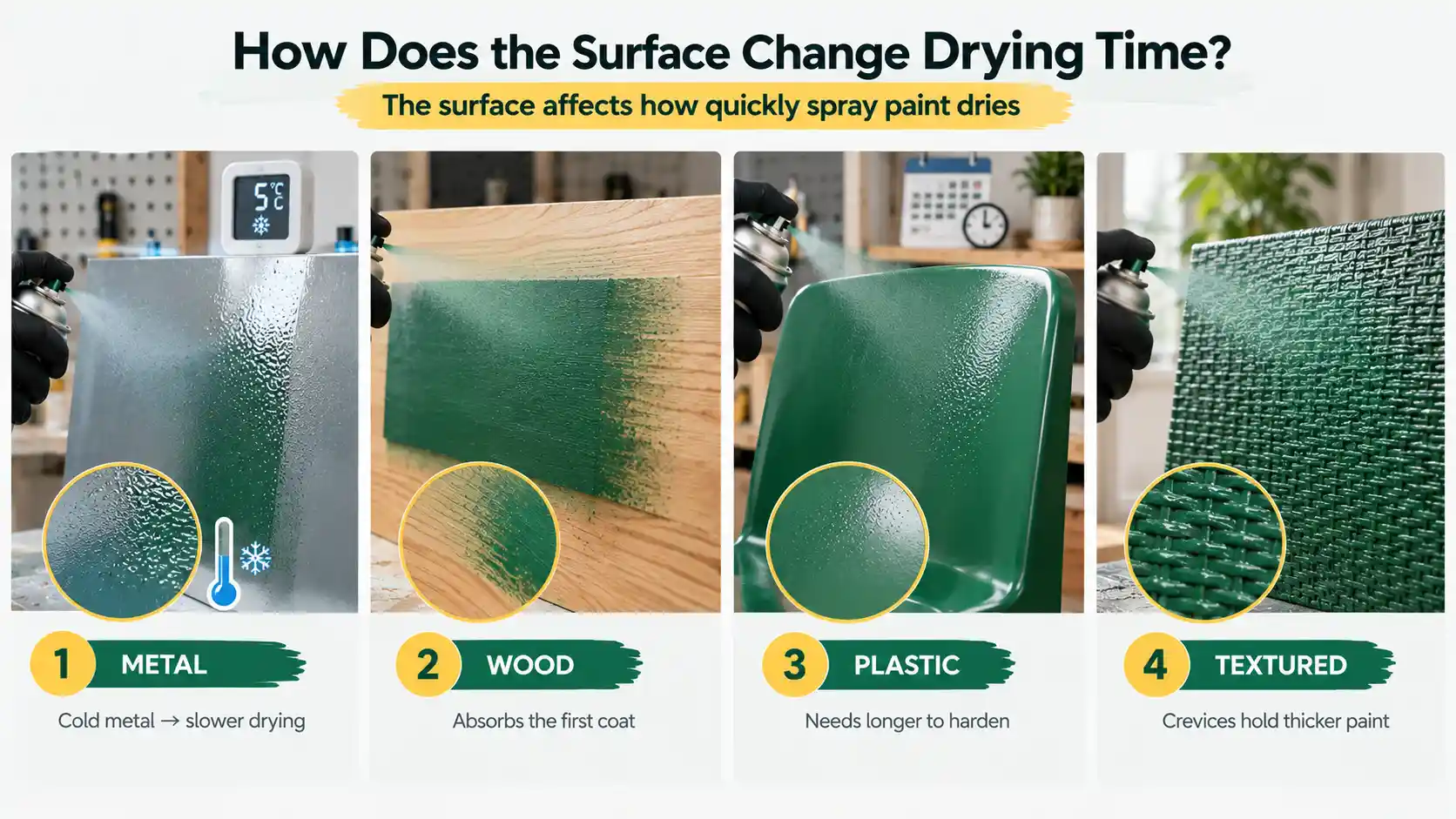
How Does the Surface Change Drying Time?
Different materials directly impact spray paint drying times based on porosity and thermal conductivity. Nonporous surfaces like metal trap solvents, while porous materials like wood quickly absorb the initial coat.
Metal
Metal is nonporous, so every bit of solvent has to escape upward through the film. Metal also holds temperature. A steel railing left in a cold garage overnight stays cold long after the air warms up, and that slows drying. In direct summer sun, the opposite happens: hot metal can flash the top layer dry too quickly and trap solvent underneath.
Wood
Raw wood is porous and absorbs part of the first coat. That can make the first coat feel dry sooner, but it also means you often need an extra coat for even color. Priming bare wood gives you a consistent base and more predictable dry times for the coats that follow.
Plastic
Plastic is the slowest surface to reach full strength. Rust-Oleum notes that on plastic, maximum paint adhesion and durability take 5 to 7 days. The brand also warns that some polyethylene plastics, like storage containers, resist paint adhesion, so test a hidden spot first. Handle painted plastic gently for the entire first week.
Smooth vs. Textured Surfaces
Paint dries faster on smooth surfaces than on textured ones, according to Family Handyman. Wicker, rough castings, and textured plastics trap more paint in crevices, which creates thicker spots that take longer to dry.
Common Drying Problems and How to Fix Them
| Problem | Likely Cause | Fix |
| Paint still tacky after hours | Heavy coat, cold air, high humidity, or an incompatible surface | Move the piece somewhere warm and dry with good airflow. Give it time. If it stays tacky for days, strip and repaint. |
| Wrinkling or lifting | Recoating inside the danger zone, heavy coats, or mixing incompatible products | Let the paint cure fully, sand the area flat, clean it, and respray within the recoat window. |
| Milky or cloudy finish | High humidity or cold temperatures, especially with lacquer | Wait for a warm, dry day, lightly sand the hazy area, and apply a fresh light coat. |
| Fingerprints or dents | Handling the piece before it was dry to handle | Let it cure, sand the marks smooth, and apply one more light coat. |
| Pieces stuck together | Stacking or placing items on paint before full cure | Wait the full cure time before stacking. Touch up any torn areas after curing. |
Final Words
Spray paint works fast, but only if you respect its stages. Expect dry to the touch in 10 to 30 minutes, dry to handle in about an hour, fully dry in 24 hours, and fully cured in 5 to 7 days. Check your can’s recoat window before you start, spray thin coats in mild, dry weather, and wait a full week before hard use. Follow those steps, and your project will look better and last longer.
Frequently Asked Questions
How long should spray paint dry between coats?
For most enamels, apply the next coat within 1 hour or wait until the label’s long window, often 24 to 48 hours. Light coats a few minutes apart work best. Lacquers can be recoated at any time.
How long before I can apply a clear coat over spray paint?
Follow the same recoat window as the color coat. For Rust-Oleum Painter’s Touch 2X High Gloss, the label says to add a clear coat within 1 hour or after 48 hours.
How long does spray paint take to dry in cold weather?
Every stage takes longer, and manufacturers do not publish exact cold-weather times. Most general-purpose aerosols list a minimum of 50°F to 55°F (10°C to 13°C). Below that, the paint may never dry properly. Warm the space and the object first, and keep the surface at least 5°F above the dew point.
Does spray paint dry faster in the sun?
Moderate warmth helps, but strong direct sun can overheat the surface. That dries the top layer too fast, traps solvent, and can cause wrinkles or a rough finish. Shade on a warm day is the better choice.
How long does spray paint take to dry on plastic?
Plastic is usually dry to the touch in about 20 minutes, similar to other surfaces. However, Rust-Oleum states that maximum adhesion and durability on plastic take 5 to 7 days, so treat the piece gently for a full week.
Can rain ruin fresh spray paint?
Yes. Water on paint that has not dried can spot it, dull it, or weaken adhesion. Keep outdoor projects covered until they are at least dry to the touch, and ideally for the first 24 hours.
How long does spray paint smell after drying?
The odor comes from solvents still leaving the film. It is strongest in the first hours and fades as the paint dries and cures. Good ventilation shortens the smell and protects your lungs.