
How Long Should Curtains Be? Lengths, Sizes & Measuring Guide
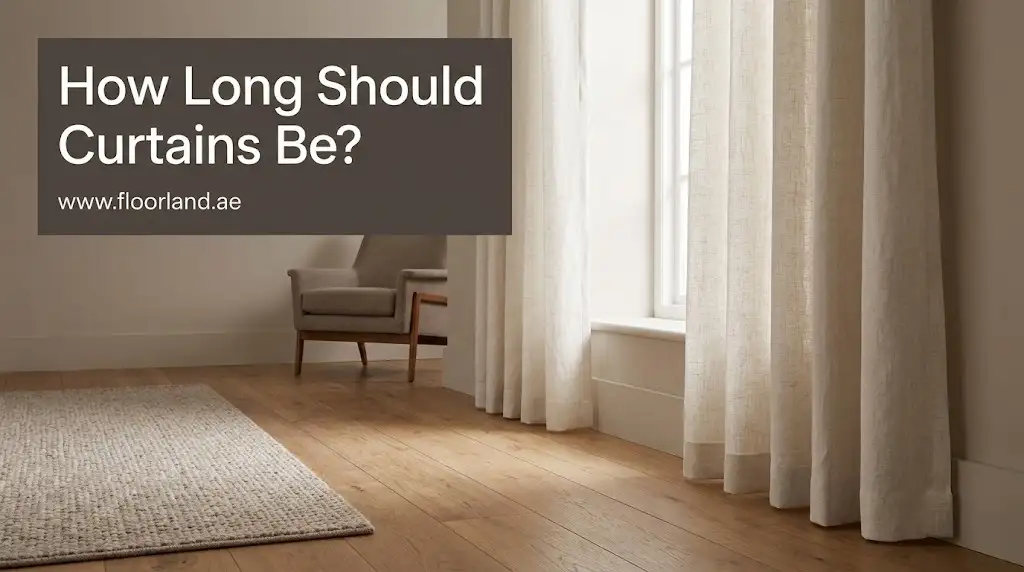
For most living rooms and bedrooms, curtains should end 0–1 inch above the floor for a clean, tailored look. This is the most versatile curtain length for apartments, houses, bedrooms, living rooms, and dining spaces. If you prefer a softer appearance, curtains can lightly touch the floor or extend slightly beyond it for a relaxed break or puddled effect.
Getting the length right starts with measuring from the curtain rod to the floor, not from the window. Rod height, heading style, fabric weight, and the desired finish can all change the final drop. This guide by Floor Land explains how long curtains should be, how to calculate the correct measurement, standard ready-made sizes, and how to handle curtains that are too short or too long.
The Six Curtain Lengths and When Each One Works
Curtain lengths fall into six main categories. Three of them end near the window, and three end at or below the floor. Each one creates a different effect, so choose based on how the room works, not just how it looks in a photo.
| Length | Where It Ends | Best For | Watch Out For |
| Sill length | About ½ inch above the window sill | Kitchens, bathrooms, windows above counters or sinks | Can look short on large windows |
| Apron length | 3 to 6 inches below the sill | Windows above radiators, window seats, or furniture | Easy to cut too short and look like a mistake |
| Float | ½ to 1 inch above the floor | Busy rooms, homes with pets or robot vacuums | Uneven floors make gaps obvious |
| Kiss | Just touching the floor (0 to ¼ inch) | Living rooms, bedrooms, dining rooms | Needs precise measuring |
| Break | 1 to 2 inches onto the floor | Relaxed, lived-in rooms with linen or cotton | Fabric bends slightly and collects dust |
| Puddle | 3 to 8 inches onto the floor | Formal rooms that people rarely walk through | Hard to clean, trips feet, not for pets |
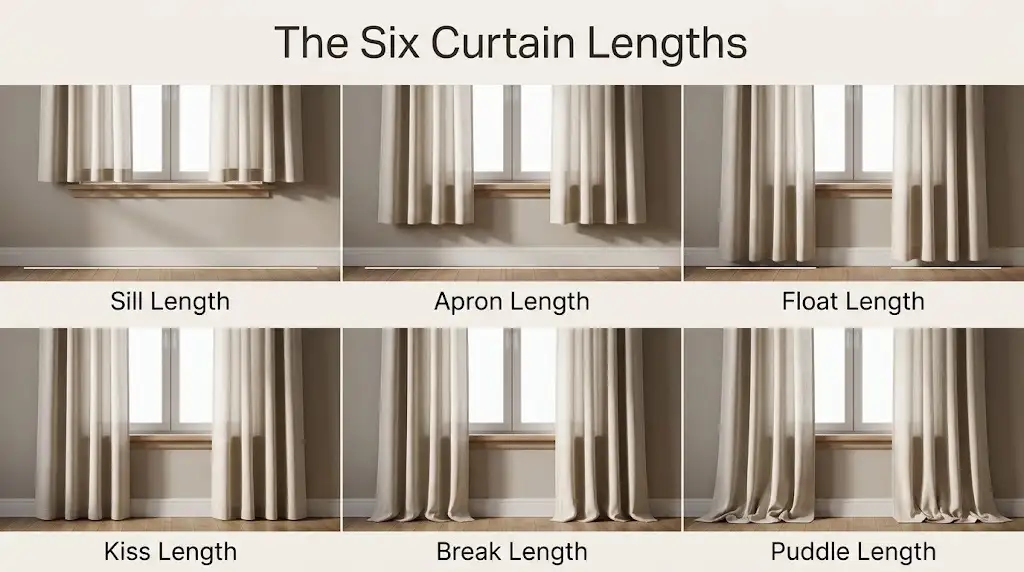
- Sill Length
Sill-length Custom Curtains stop just above the window sill. They work well where floor-length fabric would get in the way, such as over a kitchen sink or a bathtub. Keep them about half an inch above the sill so the hem does not rest on the ledge and crease over time. Café curtains, which cover only the lower half of a window, are a variation of this length.
-
Apron Length
Apron-length curtains extend a few inches past the sill. This length hides the bottom edge of the window trim and looks more deliberate than sill length. Use it when something blocks the floor below the window, such as a radiator, a built-in bench, or a desk. The key is commitment. A hem that falls 4 inches below the sill looks intentional. A hem that falls 18 inches below the sill but 20 inches above the floor looks like a sizing error.
-
Float Length
Floating eyelet curtains hover just above the floor. From across the room, they read as full length. Up close, they leave a small gap that keeps the hem clean. This makes float length the most practical choice for families, pet owners, and anyone who uses a robot vacuum.
-
Kiss Length
Kissing curtains barely touch the floor. Interior designers favor this length because it looks custom-made. It also takes the most care to get right. Even a ¼-inch error becomes visible, so measure at several points along the rod before you order them.
-
Break Length
A break adds an inch or two of extra fabric, so the hem bends gently where it meets the floor. Think of it like a trouser hem resting on a shoe. It softens the look and hides small measuring errors or slightly uneven floors. Break length suits relaxed fabrics like washed linen far better than stiff silks.
-
Puddle Length
Puddled sheer curtains pool on the floor. They create a romantic, old-world effect in formal living rooms and primary bedrooms. However, they suit rooms where the curtains stay closed or open most of the time. Every time you draw pleated curtains, you need to rearrange the pleats by hand. They also trap dust and attract pets, so skip this length in high-traffic spaces.
How to Measure for Curtain Length?
Accurate measuring prevents nearly every curtain length problem. Follow these steps in order.
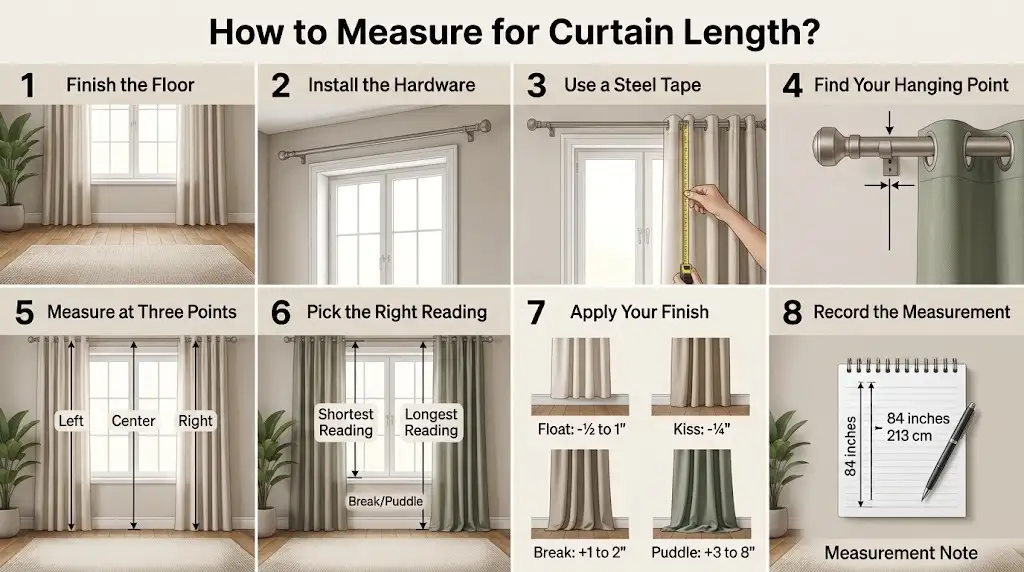
- Finish the floor first. Measure after you lay new flooring, carpet, or a large rug. A thick carpet can raise the floor level by an inch or more.
- Install the hardware. Mount the rod or track before you measure. Positions that look fine on paper often shift once you find studs or hit obstacles.
- Use a steel tape measure. Fabric tapes stretch and give inaccurate readings over long drops. Ask someone to hold the other end.
- Find your hanging point. Use the heading table above to decide whether to start at the top of the rod or at a ring eyelet.
- Measure at three points. Take readings at the left, center, and right of the rod. Floors and ceilings are rarely perfectly level.
- Pick the right reading. Use the shortest reading for float and kiss lengths, so no part of the hem drags. Use the longest reading for break and puddle lengths, so no part looks short.
- Apply your finish. Subtract ½ to 1 inch for a float. Subtract up to ¼ inch for a kiss. Add 1 to 2 inches for a break, or 3 to 8 inches for a puddle.
- Write it down with units. Record each measurement in inches or centimeters, and label which window it belongs to.
Standard Curtain Lengths and What They Fit
Ready-made curtains come in fixed lengths. In the United States, the common sizes are 63, 84, 95, 96, 108, and 120 inches. In the UK and Europe, retailers usually list the drop in centimeters, with sizes such as 137 cm (54 in), 183 cm (72 in), and 229 cm (90 in). Always confirm which unit a product uses before you buy.
The table below shows how each US size lines up with typical rod heights for a floor-length finish.
| Panel Length | Rod Hanging Point Height (for float/kiss) | Typical Use |
| 63 in | About 63 to 64 in | Sill or apron length on standard windows, or short windows in older homes |
| 84 in | About 84 to 85 in | Floor length with the rod near a standard 80 in window top; common in rentals |
| 95 or 96 in | About 95 to 97 in | Floor length in 8-foot (96 in) rooms with the rod hung high |
| 108 in | About 108 to 109 in | Floor length in 9-foot (108 in) rooms, or a break/puddle in 8-foot rooms |
| 120 in | About 120 to 121 in | Floor length in 10-foot (120 in) rooms or tall living spaces |
Curtain Length by Ceiling Height
Your ceiling height gives you a fast starting point. Use these ranges, then confirm with a tape measure once the rod is up.
| Ceiling Height | Suggested Rod Height | Panel Length to Start With |
| 8 ft (96 in) | 84 to 92 in from the floor | 84 in (lower rod) or 95/96 in (higher rod) |
| 9 ft (108 in) | 92 to 104 in from the floor | 96 in or 108 in |
| 10 ft (120 in) | 104 to 116 in from the floor | 108 in or 120 in |
| Over 10 ft | Near the ceiling or at a visual break line | Custom length or 120 in with added hem |
Why Rod Height Decides Your Curtain Length
Most people start by measuring the window. That is the first mistake. Your curtain hangs from the rod, so the Curtain Rod Position sets the length you need. Change the rod height by 3 inches, and your ideal curtain length changes by 3 inches too.
Designers follow a simple principle: hang it high and wide. A higher rod draws the eye upward and makes the ceiling feel taller. A wider rod lets the panels stack beside the glass instead of covering it, so the window looks bigger and lets in more daylight.
- Standard placement: Mount the rod 4 to 6 inches above the top of the window frame.
- Taller look: Mount the rod roughly halfway between the frame and the ceiling, or 2 to 4 inches below the ceiling or crown molding.
- Ceiling mount: Use a ceiling track when the gap between frame and ceiling is small. This gives the maximum height effect.
- Width: Extend the rod 6 to 12 inches past each side of the frame, depending on how bulky your fabric is when open.
Before you mount the rod, check for obstacles. Crown molding, air vents, smoke alarms, and ceiling fans can all limit how high you can go. Plan around them first, then calculate the length.
How Your Heading Style Changes the Measurement
The heading is the top of the curtain, where it attaches to the rod. Different headings hang at different points, so they change where you start measuring. Get this wrong, and even a perfect tape reading will give you the wrong length.
| Heading Style | Where to Start Measuring | What to Know |
|---|---|---|
| Grommet (eyelet) | Top of the rod | The fabric above the grommets rises slightly above the rod, so check the maker’s spec |
| Rod pocket | Top of the rod | Any ruffle or header above the pocket sits above the rod and adds visible height |
| Pinch Pleat or ripplefold on rings | Bottom of the ring eyelet (the small loop) | Rings add 1 to 2 inches of drop compared with measuring from the rod |
| Pinch pleat on a track | Bottom of the track glider eyelet | Tracks sit close to the ceiling or wall, so measure after installing |
| Tab top | Top of the rod | Tab length varies by brand and changes the finished position |
| Back tab | Top of the rod | Hidden tabs let the panel sit slightly higher than a rod pocket |
Tip: Manufacturers of made-to-measure curtains often call this starting point the hanging point. When you order custom panels, confirm exactly where the company expects you to measure from.
Fabric Behavior That Changes Your Finished Length
Curtains do not stay the exact length you measured. Fabric reacts to weight, washing, and humidity. Plan for this, especially with kiss length, where small changes show.
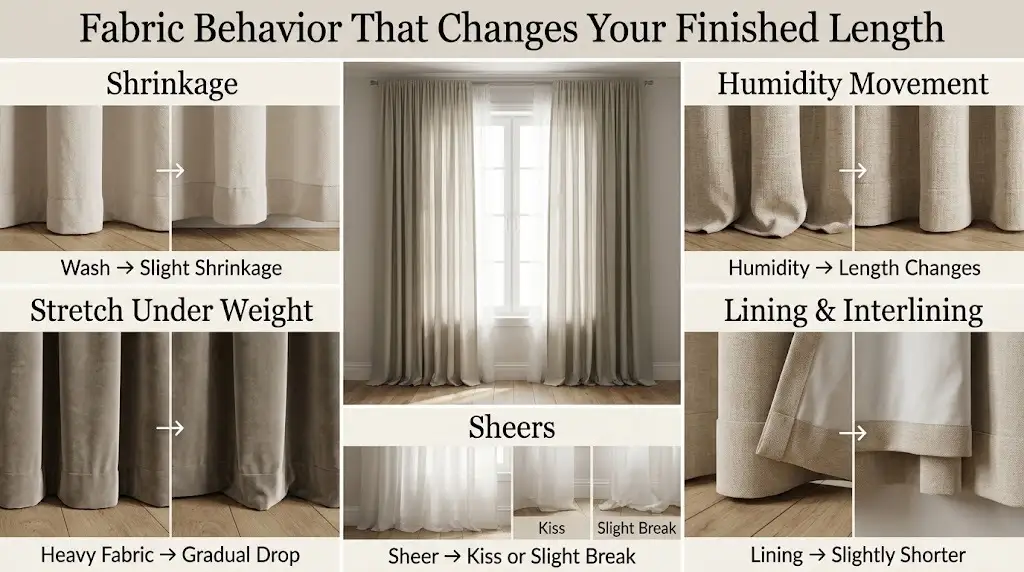
- Shrinkage: Cotton and linen can shrink when washed, especially if the fabric was not pre-washed. Many owners dry-clean long panels or wash them cold and hang them damp to limit shrinkage.
- Humidity movement: Natural fibers such as linen can lengthen in humid weather and shorten in dry weather. On a long drop, the change can reach an inch or more. Break length hides this movement better than kiss length.
- Stretch under weight: Heavy fabrics like velvet and lined blackout panels drop slightly after they hang for a few weeks. Leave them hanging for two to four weeks before hemming.
- Lining and interlining: Linings are often cut a little shorter than the face fabric so they do not peek out at the hem. This does not change your ordered length, but it affects how the hem sits.
- Sheers: Lightweight sheers move easily and look best with a slight break or a precise kiss. A floating sheer can look flimsy.
Curtain Length by Room
Each room places different demands on your curtains. Use these recommendations as a starting point.
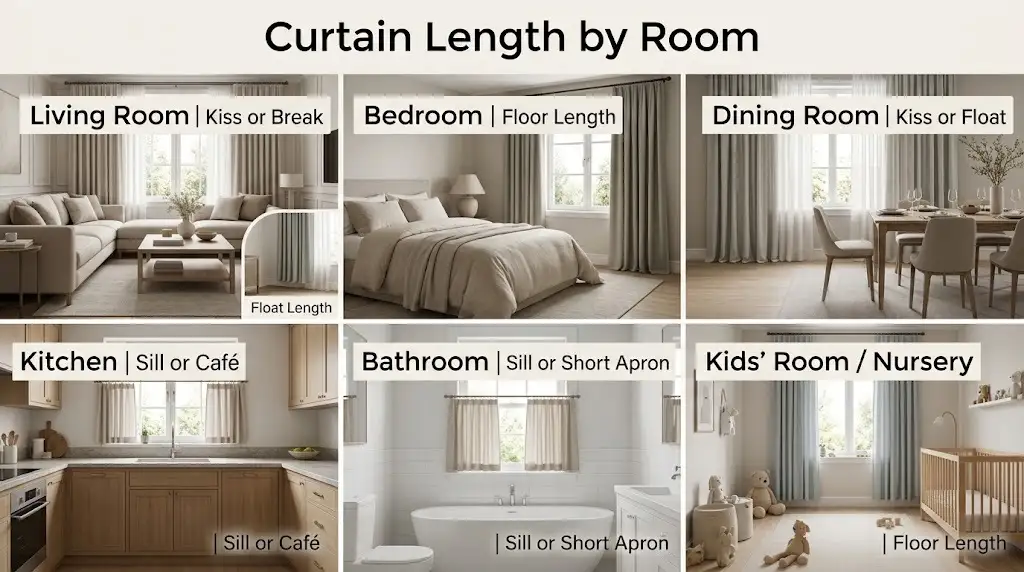
Living Room
Choose kiss or break length. The living room is usually the most visible space in the home, so a tailored length pays off here. If kids or pets play near the windows, switch to a float.
Bedroom
Floor length works best, particularly with blackout curtains. Short curtains leave light gaps at the bottom, which defeats the purpose of room-darkening fabric. Hang the rod close to the ceiling and extend it well past the frame to block side light.
Dining Room
Kiss- or float-length suits dining rooms. Avoid puddles, because chairs slide back and catch the fabric. Food spills also make a clean hemline more practical.
Kitchen
Pick sill length or café curtains. Long fabric near a stove is a fire risk, and splashes from the sink stain hems quickly. If the kitchen has a large patio door, use a float length on that door and keep cooking areas clear.
Bathroom
Use sill length or a short apron length. Moisture encourages mildew on fabric that touches the floor or tub edge. Choose a quick-drying, washable fabric.
Kids’ Rooms and Nurseries
Choose a float length and consider breakaway or short cordless options. Children pull on long fabric, and puddled hems create a tripping hazard for toddlers.
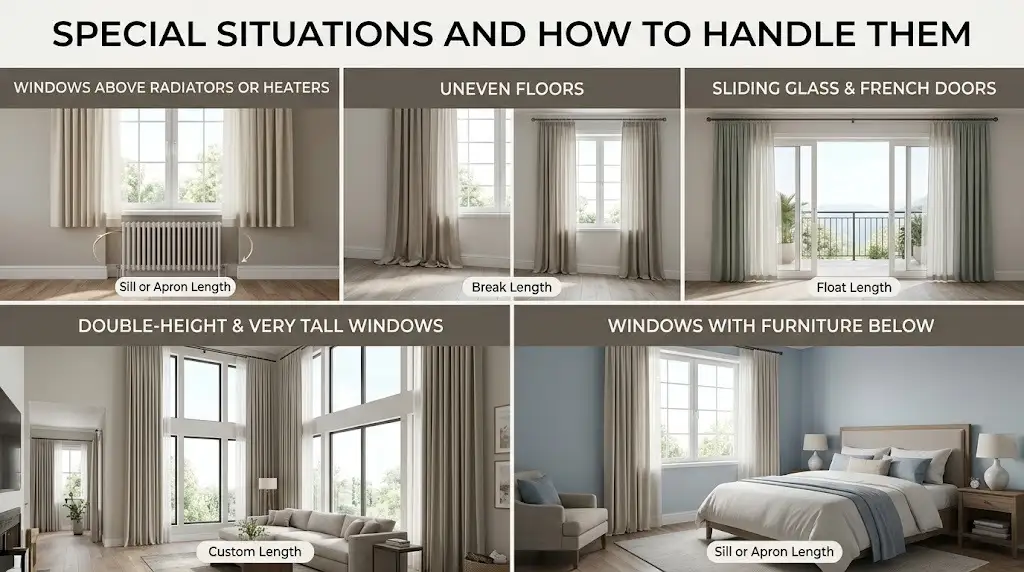
Special Situations and How to Handle Them
Standard window dimensions do not fit every room layout. From radiators and uneven floors to damp bathrooms, learn how to navigate tricky architectural challenges while maintaining safety, function, and style.
-
Windows Above Radiators or Heaters
Never let curtains cover a radiator or baseboard heater. The fabric traps heat against the window and can become a fire risk with some heater types. Choose sill or apron length, or mount the rod further out so floor-length panels hang in front of a clear gap.
-
Uneven Floors
Older homes often have floors that slope several inches across a room. In this case, choose a break length. The extra fabric absorbs the difference, so every panel looks right. If you prefer a clean float, then each panel gets its own measurement.
-
Sliding Glass and French Doors
Use float length so the panels clear the door track and do not catch as you walk through. Mount the rod wide enough for the fabric to stack fully clear of the opening.
-
Double-Height and Very Tall Windows
Standard 120-inch panels often fall short. Order custom lengths, or mount a secondary rod at a visual break line, such as the top of a lower window. Very long panels also get heavy, so check that the rod and brackets can carry the weight.
-
Windows With Furniture Below
If a sofa, bed headboard, or desk sits against the wall under the window, choose sill- or apron-length panels. Floor-length panels squashed behind furniture wrinkle and look untidy.
Common Curtain Length Mistakes
Take a look at the mistakes that you must avoid while measuring the curtains:
- Measuring the window instead of the rod. The rod position sets the length, so always measure from the hanging point.
- Hanging the rod right at the frame. This shrinks the look of the window and the ceiling. Go higher unless an obstacle stops you.
- Accepting a 2- to 4-inch gap. Curtains that stop well short of the floor read as the wrong size. Either reach the floor or stop at the sill.
- Puddling in busy rooms. Puddles belong in formal spaces. In a hallway or family room, people step on them, and they get dirty.
- Measuring before new flooring. A rug or new carpet changes the floor level and can turn a kiss into a drag.
- Hemming too soon. Heavy and natural-fiber curtains settle over a few weeks. Wait before you cut.
- Ignoring the heading. Ring-hung panels hang lower than grommet panels of the same listed length.
How to Fix Curtains That Are Too Short or Too Long
You do not always need to buy new panels. Try these fixes first.
If Your Curtains Are Too Short
- Lower the rod. Move the brackets down to close a small gap. Fill the old holes with spackle and paint.
- Add clip rings. Clip rings drop the panel by 1 to 2 inches compared with a grommet or rod pocket.
- Let down the hem. Many curtains have a deep hem, often 3 to 4 inches. Unpick it and re-hem with a narrower fold.
- Add a fabric band. Sew a contrasting fabric band to the hem or the top. This can look like a deliberate design detail.
If Your Curtains Are Too Long
- Raise the rod. A higher rod shortens the drop and adds visual height to the room.
- Hem them. Sew a new hem, or use iron-on hemming tape for a no-sew fix on lighter fabrics.
- Fold the top. For rod-pocket curtains, fold the excess over at the top to create a small valence effect.
- Embrace the break. If the extra length is only 1 to 2 inches, let it rest on the floor as a soft break.
Final Thoughts
The right curtain length comes down to three decisions. First, choose your rod height, and hang it higher than you think. Second, pick a finish that suits how the room works, from sill length in a kitchen to a kiss in the living room. Third, measure from the true hanging point at several spots, and allow for your fabric’s behavior.
Get those three steps right, and your curtains will frame the window, flatter the ceiling height, and stay practical for everyday life. If a ready-made size falls between two options, adjust the rod or hem the panels rather than accepting an awkward gap.
Frequently Asked Questions
Should curtains touch the floor?
In most living rooms and bedrooms, yes, or they should come within about an inch of it. Floor-length curtains make a room look taller and more finished. In kitchens, bathrooms, and rooms with radiators under the window, shorter curtains work better.
How far below the window should curtains hang?
If you choose a length that ends near the window, stop at the sill or 3 to 6 inches below it. If you want long curtains, take them all the way to the floor. Anything in between tends to look accidental.
What is the most common curtain length?
The 84-inch panel is the most widely sold ready-made length in the US, because it suits a rod placed just above a standard window. However, 95- and 96-inch panels often look better in 8-foot rooms, because they let you hang the rod higher.
What length curtains do I need for an 8-foot ceiling?
Start with 95- or 96-inch panels if you mount the rod near the ceiling. Choose 84-inch panels if you mount the rod about 4 to 5 inches above a standard window. Always confirm with a measurement from the rod to the floor.
Should bedroom curtains be long or short?
Long curtains usually work better in bedrooms. They block more light at the bottom edge and feel softer and more relaxing. Short curtains make sense only if a bed, desk, or radiator sits directly beneath the window.
Are puddled curtains out of style?
Puddling is less common than it once was, but it still suits formal and traditional rooms. A modest break of 1 to 2 inches gives a similar softness with far less upkeep, which is why many designers prefer it today.
How much longer should curtains be than the window?
For floor-length curtains, the window size matters less than the rod height. Measure from the rod to the floor. For sill or apron lengths, add the distance from the rod to the top of the frame, the window height, and 0 to 6 inches depending on the look you want.