
Drapes vs Curtains: Which Is Right for Your Home?

The main difference between curtains and drapes is how they’re constructed. Drapes use heavy, lined fabric and hang from the rod to the floor. Curtains use lighter fabric, often without lining, and can stop at the sill, apron, or floor. That makes drapes better for formal rooms, strong light control, and insulation, while curtains suit casual spaces, easy washing, and tighter budgets.
Retailers use both words loosely, especially in the UAE, where showrooms often list lined floor-length panels as curtains. This guide by Floor Land ranks the ten most important differences, then shows you how to choose with confidence for your windows. Each section gives you specifics you can check on a product label or in a showroom.
Curtains vs Drapes—Have a Quick Look
| Feature | Curtains | Drapes |
| Fabric | Cotton, linen, polyester, sheers | Velvet, silk, wool, heavy blends |
| Lining | Often none | Almost always |
| Length | Sill, apron, or floor | Floor, sometimes with extra fabric |
| Light control | Sheer to black out | Moderate to near-total |
| Insulation | Modest | Better with thermal lining |
| Care | Often washable | Often dry clean only |
| Cost | Usually lower | Usually higher |
| Mood | Casual and airy | Formal and structured |
Top 10 Differences Between Curtains and Drapes
Because the two words overlap, judge any product by its construction, not its label. The ten differences below tell you what to look for.
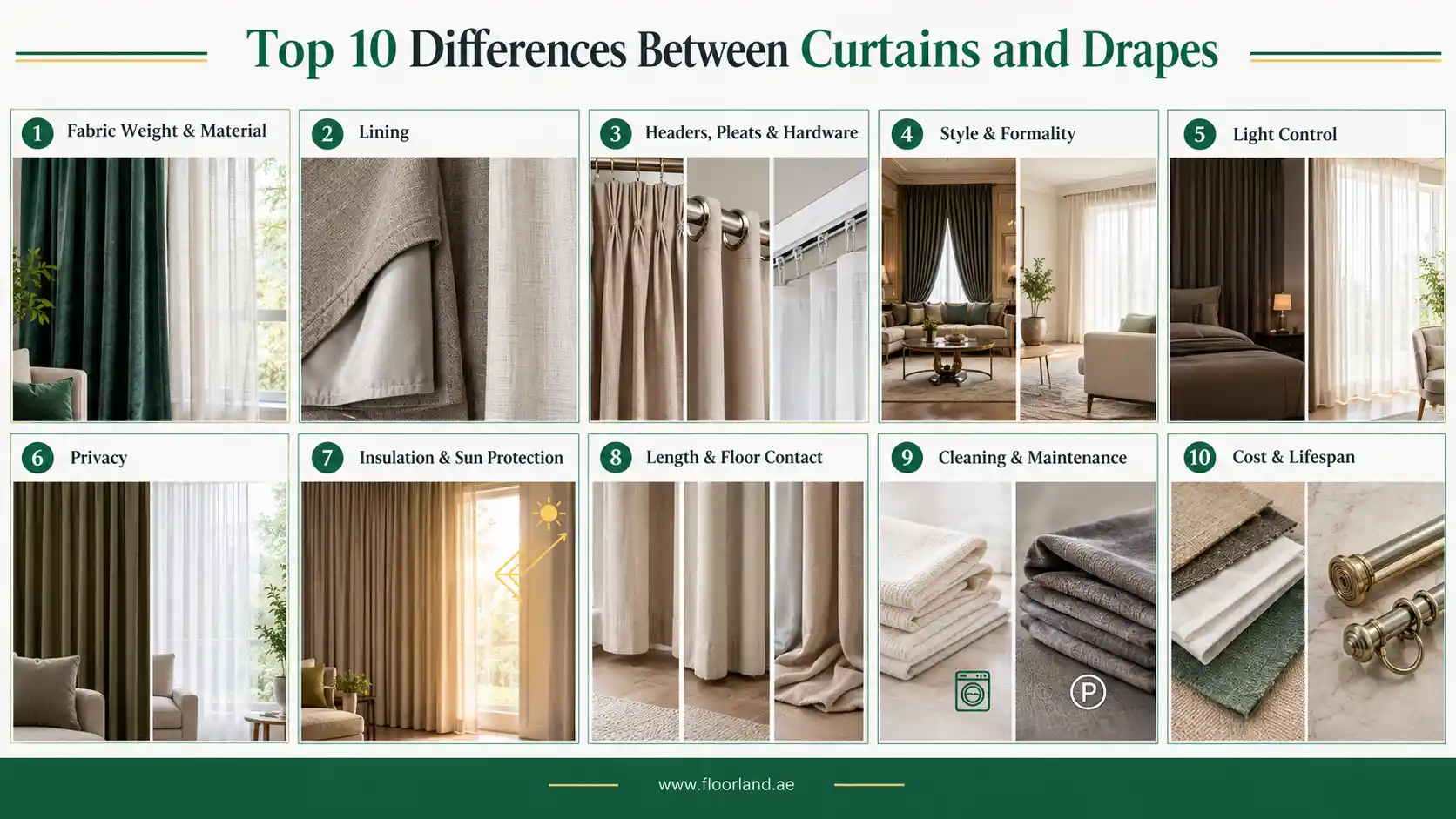
1. Fabric Weight and Material
Curtain Fabric weight shapes almost every other difference. Heavy fabric hangs straight, falls in deep folds, and stays still when someone walks past. Light fabric moves, breathes, and lets the window show through.
- Drapes use velvet, silk, wool, and heavy cotton blends.
- Curtains use cotton, linen, polyester, and sheer voile or chiffon.
A simple test helps in the showroom. Hold the sample up to a window and see how much light passes through it. Then bunch a corner in your fist for ten seconds and release it. Linen will wrinkle, polyester will bounce back, and velvet will show a pressed mark that usually fades. Those few seconds tell you more than the product tag does.
2. Lining
Drapes almost always carry a lining. Custom Curtains often do not. The lining adds body, helps the panel hang evenly, and protects the face fabric from sun damage.
You will usually meet four options:
- Unlined: light, affordable, and good at filtering daylight.
- Standard lining: adds weight and a fuller hang.
- Thermal lining: a denser layer that slows heat transfer through the glass.
- Blackout lining: a tightly woven or coated layer that blocks nearly all light.
If a “drape” feels thin, or a “curtain” feels surprisingly rich, check the lining first. It often explains both the feel and the price.
3. Headers, Pleats, and Hardware
The header is the top edge of the panel; it controls the hang, the slide, and the overall look.
- Pinch pleats and wave folds create ordered, tailored folds for formal rooms.
- Eyelet headers slide on a rod through metal rings, creating even, rounded folds.
- Rod-pocket and tab headers look casual and suit light fabric.
Hardware needs to match the fabric. Heavy panels need a strong rod with sturdy brackets, or a track. Light panels work on slim rods. For large glass walls,motorized curtains let you open every panel with one remote. Compare pinch pleat,wave, and eyelet styles side by side before you commit.
4. Style and Formality
Drapes read as formal, structured, and tailored. Curtains read as relaxed, airy, and approachable. The difference comes from fabric weight, fullness, and header style working together.
Heavy velvet panels with deep pleats suit formal living rooms, dining rooms, and majlis spaces. Soft linen with a simple header suits kitchens, family rooms, and kids’ bedrooms.
Style also depends on the setting around the window. A heavy drape beside light, casual furniture can feel mismatched, and a thin curtain in a grand room can feel unfinished. Hold fabric near your sofa and walls before you decide.
5. Light Control
Light control runs on a scale, with drapes at the dark end.
- Sheer curtains soften daylight and keep rooms bright.
- Lined curtains and thin drapes block a good share of light.
- Heavy-lined drapes block most daylight.
- Blackout-lined panels, in either style, get close to full darkness.
Blackout curtains and blackout drapes perform almost the same. The real difference is weight and look, so choose by style. Even the best blackout panel leaks light around its edges. Mount the rod wider than the frame, choose panels that overlap the window by several inches each side, and hang the rod high to stop light slipping over the top.
6. Privacy
Privacy changes with the time of day, and many buyers miss this. By day,sheer curtains keep people from seeing in, because bright outdoor light hides the room’s interior. At night, the effect reverses. With lights on inside and darkness outside, people can easily see through sheers, so a second, opaque layer solves the problem.
Lined drapes and lined curtains give privacy around the clock. They suit ground-floor windows, rooms that face neighbors, and bedrooms and bathrooms. Treat sheers as a daytime tool, not a privacy solution.
7. Insulation and Sun Protection
Drapes generally insulate better than light curtains, though the figures are modest. The U.S. Department of Energy notes that a drapery’s performance depends on factors such as fabric type and color, so broad generalizations are difficult. It reports that studies show medium-colored draperies with white plastic backing can reduce heat gain by 33%, and that most conventional draperies, when drawn in cold weather, can reduce heat loss from a warm room by up to 10%.
Installation changes the result. Cornell Cooperative Extension reports that lined draperies hung to the sill or floor with a four-inch overlap at the center can be up to 25% effective, while unsealed, conventionally hung draperies reduce window heat loss by no more than 10 percent. That research comes from US homes, so treat the figures as guides for hot climates like Dubai, not exact predictions.
Other benefits include:
- Fade protection: Lined panels shield furniture, rugs, artwork, and wood or laminate floors from strong sun.
- Sound softening: Thick fabric absorbs echo and some noise, but it will not silence traffic. Purpose-built soundproof curtains do more.
Experts also caution that draperies are less cost-effective for saving energy than some other treatments because they cost more and have a low R-value. Buy drapes for comfort and protection, not as a guaranteed way to save on your bill.
8. Length and Floor Contact
Drapes follow a short list of length styles. Curtains follow almost none. Drapes typically use one of three hems:
- Float: the hem stops about half an inch above the floor, looking crisp and staying clean.
- Break: the hem touches the floor and bends slightly for a softer look.
- Puddle: extra fabric, 2 to 6 inches, rests on the floor for a dramatic finish.
Curtains stop at the sill, just below the apron, or at the floor. US ready-made panels commonly come in 63, 84, 96, 108, and 120 inches (roughly 160 to 305 cm), and custom orders get cut to your measurements. The most common length mistake is a curtain that ends a few inches above the floor. It looks like an error. Pick a deliberate length every time.
9. Cleaning and Maintenance
Curtains usually take less work. Many cotton and polyester panels can go in the washing machine on a gentle cycle and be returned to the rod the same day. Lined or trimmed panels need more care, so read the label first.
Drapes often need dry cleaning because heavy fabric, lining, and trim can shrink or lose shape in a home washer. Between cleanings, vacuum lightly with a brush attachment and shake the panels out. Puddled hems collect dust faster than float hems and need more frequent cleaning.
A few habits help either type:
- Open panels during the day so the sun does not hit the same folds all afternoon.
- Test any cleaning method on a hidden hem first.
- Replace worn rings and hooks before they tear the header.
If you live with pets, toddlers, or allergies, give this difference extra weight.
10. Cost and Lifespan
Drapes usually cost more, but the label alone does not set the price. Six factors do:
- Fabric: velvet, silk, and fine linen cost more than polyester or basic cotton.
- Fullness: panels sewn at 2 to 2.5 times the rod width use much more fabric.
- Lining: thermal and blackout layers add material and sewing time.
- Header style: pleats take more labor than simple tabs.
- Hardware: heavy rods, tracks, and motors raise the total.
- Installation: professional hanging adds cost but protects the result.
A custom curtain in premium fabric can cost as much as a drape, and a ready-made drape can cost less than a custom curtain. Compare itemized quotes, and think in cost per year. A well-made lined panel can last many years, while a thin unlined panel may look tired much sooner.
How to Choose Between Curtains and Drapes for Your Home
The ten differences above tell you what each treatment offers. These steps help you decide what your home needs.

1. Start With the Window, Not the Product
Spend ten minutes observing each window before you shop. Note which direction it faces, who can see in, what the glass looks like at 8 a.m. and at 4 p.m., and what you do in that room. A south-facing office with a screen has different needs from a shaded bedroom. Write down the single biggest problem the window causes, such as glare, heat, nosy neighbors, or morning light, and solve that one first.
2. Match the Treatment to the Room’s Daily Use
Every room asks something different from its window. Use this table to turn your list of problems into a starting choice.
| Room | Strong choice | Watch for |
| Living room | Lined drapes, or a sheer layered with a drape | Glare on screens, and stacking space for wide panels |
| Master bedroom | Blackout-lined drapes or blackout curtains | Light leaking around the edges |
| Dining room | Lined drapes in stain-resistant fabric | Cooking odors that cling to heavy fabric |
| Kitchen | Short, washable curtains | Panels that hang near the stove or sink |
| Bathroom | Moisture-resistant curtains, or a different treatment such as a roller blind | Heavy fabric that holds humidity |
| Home office | Light curtains or sheers | Dim rooms, since heavy panels can make a workspace feel closed in |
| Kids’ room | Washable, cordless-operated panels | Safety and frequent cleaning |
| Majlis or formal sitting room | Full-length, lined, pleated panels | Scale, since large rooms need heavy hardware and fuller fabric |
Treat the table as a starting point. A sunny kitchen may need lined curtains, and a shaded study may suit light drapes. The room’s actual light and use should win over any rule.
3. Test Fabric in Your Own Light
Showroom lighting flatters everything. Ask for large samples, tape them to the window, and look at them in the morning, in the afternoon, and under your evening lamps. Leave them up for a couple of days. Colors shift, textures change, and a fabric that looks rich in the store can look flat or harsh at home.
4. Spend Where It Shows
When your budget is limited, invest in the parts you will notice every day: fullness, lining, and hardware. A well-made panel in modest fabric looks better than a thin panel in expensive fabric. Skimping on width makes any material look cheap.
5. Coordinate With Your Floors and Furniture
Window treatments and floors share the same sightline, so plan them together. Match your fabric’s tone to your flooring, rugs, and large furniture, and avoid colors that clash with wood or tile. If you are replacing floors, wait until the new flooring is in before you finalize hem lengths. New flooring can slightly change the finished floor height, and a hem that cleared the old floor by half an inch may drag or hover on the new one.
6. Combine Both With Layering
You do not have to pick one. Layering gives you daylight by day and privacy at night. Hang a sheer curtain on the inner rod and a lined drape or blackout panel on the outer rod. Open the heavy layer in the morning, and close both after dark. You can also swap the outer layer by season, using lighter fabric in summer and velvet in winter.
7. Check Child and Pet Safety Before You Buy
Most drapes and curtains hang from a rod and have no cords, but traversing rods, pull cords, and wands can create hazards. The U.S. Consumer Product Safety Commission (CPSC) recommends cordless window coverings in homes where children live or visit. CPSC data cover more than 200 incidents involving children up to 8 years old over a 13-year period (2009 to 2021), and a child died in 48% of them.
Apply these habits if children or pets share your home:
- Choose panels you open by hand, or cordless and motorized systems, over pull-cord operation.
- Keep any remaining cords out of reach, and never tie them into loops.
- Move cribs, beds, furniture, and toys away from windows and cords, since children can climb to reach them.
- Tie back or tuck long panels so pets cannot tangle or pull them down.
If you buy custom panels, ask the supplier which operating system each window uses and whether cordless options exist.
8. Account for Your Climate and Season
Your region changes how hard each treatment works. In cold US winters, the DOE advises closing draperies at night, plus any that don’t receive sunlight during the day, to limit heat loss. In summer, it advises closing draperies on windows that receive direct sunlight to prevent heat gain.
In the UAE, strong sun and heavy air-conditioning make lined or thermal-lined panels on sun-facing windows worth the extra cost. Coastal humidity can encourage mildew on damp fabric, so avoid heavy, absorbent panels in bathrooms and keep rooms ventilated. In dusty, windy areas, plan to vacuum panels more often.
Many homes in either region benefit from a seasonal swap: lighter, lined panels for the hottest months and a heavier layer for the coldest.
9. Get Specifications in Writing
Before you pay, ask for these details on the quote:
- Fabric composition and care label
- Lining type
- Header style and fullness ratio
- Finished width and length
- Hardware included
- Installation and alteration terms
Written specifications prevent surprises and let you compare quotes fairly.
10. Plan the Installation Before You Order
Good curtain installation makes ordinary fabric look expensive. Follow these guidelines:
- Mount the rod 4 to 6 inches above the window frame, or higher if you want the room to feel taller.
- Extend the rod 8 to 12 inches beyond each side of the frame so the panels clear the glass when open.
- Measure the height at the left, center, and right of the window and use the shortest figure for float hems.
- Check for radiators, vents, furniture, and door swings that could block long panels.
Avoid the Mistakes That Undermine Good Fabric
Even excellent fabric disappoints when these small errors slip in:
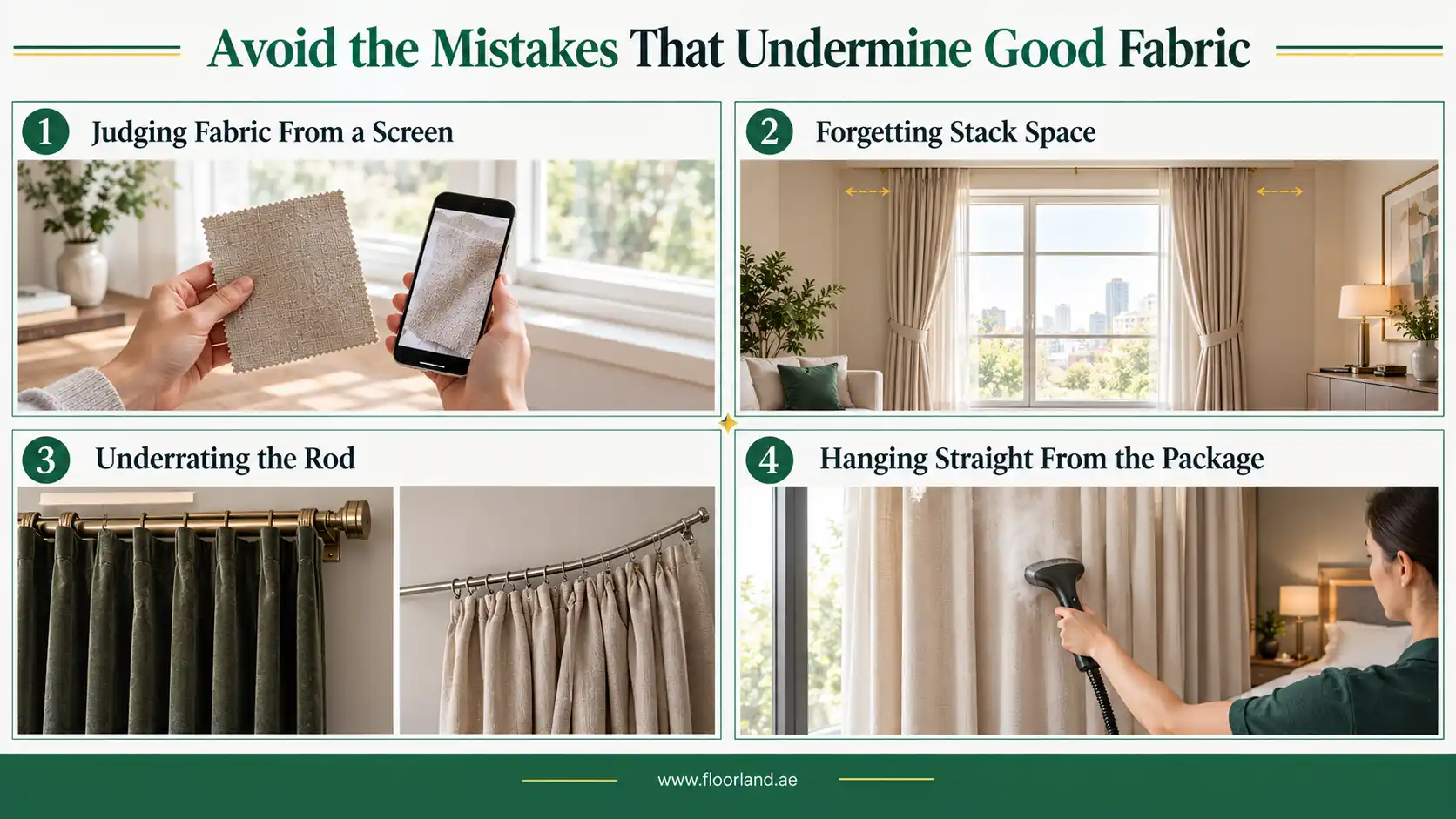
- Judging fabric from a screen. Color and texture shift in real light. Always view a physical sample.
- Forgetting stack space. Open panels need room beside the window. Without it, they cover the glass and cut your daylight.
- Underrating the rod. Heavy lined panels sag thin rods. Match the hardware to the panel weight.
- Hanging straight from the package. Creases from folding can stay for weeks. Steam or press the panels and let them hang before you judge the result.
Final Words
Drapes bring formality, strong light control, and added comfort. Curtains bring flexibility, easy care, and lower cost. Most homes use both, with each room getting the treatment that fits its light, its use, and its style. To choose the best option, start with one window and solve its biggest problem first. Test real samples in your own light, put your budget into fullness, lining, and hardware, and coordinate everything with your floors.
Frequently Asked Questions
Are drapes outdated?
No. Heavy, formal drapes in dated patterns have fallen out of fashion, but lined, floor-length panels in simple fabrics look current. Choose clean headers, solid or softly textured fabric, and a precise hem. Style depends more on the fabric, the fullness, and the fit than on the word “drapes.”
Should curtains be lighter or darker than the walls?
Either works if the choice looks deliberate. Panels close to the wall color blend in and make a room feel larger and calmer. Panels in a darker or contrasting shade add depth and become a feature. Tape a large fabric sample to the wall and view it in morning light and under evening lamps before you commit.
Can I use curtains or drapes with blinds?
Yes, and the pairing works well. Blinds give you precise control over daylight and glare, while curtains add softness, privacy, and insulation. Mount the blinds inside the window frame and hang the curtains on a rod above and beyond the frame, so the panels clear the blinds when open.
What is the best treatment for sliding glass and patio doors?
Use a ceiling-mounted or wall-mounted track and panels wide enough to stack beside the opening. That way the door slides freely, and the panels never block it. Choose a hem that floats just above the floor so the fabric does not drag through the door’s path, and consider motorized curtains for very wide openings.
Do drapes make a small room look smaller?
Not if you choose them carefully. Hang the rod close to the ceiling, extend it beyond the window frame, and pick light or wall-matching colors. Keep the headers simple and avoid puddled hems. Those choices draw the eye upward and outward, which makes a small room feel taller and wider.
How do I know when to replace my curtains or drapes?
Look for four signs: faded color on the sun-facing side, fabric that feels brittle or tears easily, a lining that sags or separates, and headers or rings that fray. If you can see light through a panel that used to block it, the fabric has thinned. Replace worn panels before they damage your hardware.
Can I shorten or alter panels I already own?
Often, yes. Most panels can be shortened by taking up the hem, and many can be adjusted in width or re-pleated. Lengthening depends on how much spare hem fabric the panel has. A professional curtain alteration service can check the hem allowance and tell you what is possible before you buy new fabric.
What works best for renters who can’t drill into walls?
Lightweight panels on a tension rod work well inside a window recess, since the rod needs no screws. Heavy lined drapes need secure brackets, so check your lease and ask your landlord before you drill. If drilling is not allowed, choose light or medium-weight panels and keep the total weight within the rod’s rated limit.
Do curtains and drapes need cords?
Not usually. Most curtains and drapes hang from rings on a rod and open by hand. Traversing rods and some track systems use pull cords or wands. For homes with young children, the CPSC recommends cordless products, so choose hand-drawn or motorized options.