
20 Types of Curtains for Privacy, Light Control & Style in 2027
The main types of curtains include blackout, sheer, eyelet, pinch pleat, pencil pleat, wave, tab top, rod pocket, thermal, layered, and cafe curtains. Each type offers a different balance of privacy, light control, insulation, and visual style.
Blackout curtains block light and provide strong privacy, making them suitable for bedrooms and media rooms. Sheer curtains filter daylight while keeping interiors bright and open. Eyelet and wave curtains create clean, contemporary window treatments, while pinch pleat and pencil pleat styles offer a more traditional finish. Layered curtains combine two fabrics for greater control over light and privacy.
This guide covers 20 types of curtains for 2027, including their key features, ideal room applications, privacy levels, light-control benefits, and style considerations. This will help you choose the right option for your windows.
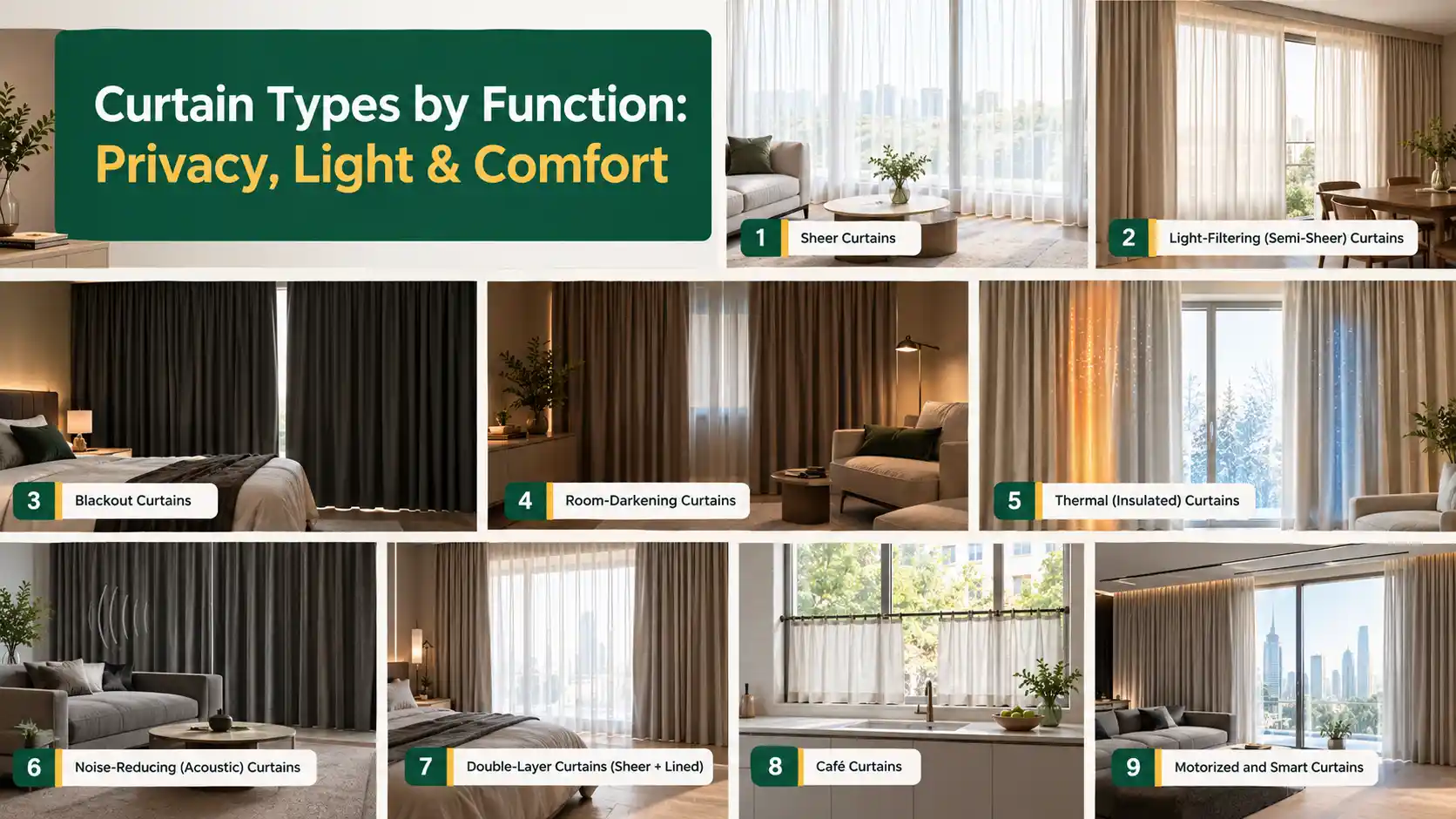
Curtain Types by Function (Privacy, Light and Comfort)
These curtains are chosen for what they do. Think of them as the “job” your window treatment needs to handle.
1. Sheer Curtains
Sheer curtains are the lightest curtains you can buy. They are usually made from voile, chiffon, or fine polyester, and you can see light (and some of the view) right through them. They are great at one thing: making harsh sun feel soft. A bright, glaring window turns into a calm, glowing one. During the day, they also blur the view for people walking past.
Here is the catch most people learn too late. Once it gets dark and your lights are on, sheer curtains offer almost no privacy. Treat them as a daytime layer, not your only layer.
2. Light-Filtering (Semi-Sheer) Curtains
Want privacy without living in a dark room? Light-filtering curtains are the middle ground. They use a tighter weave than sheers, often cotton blends or linen-look polyester. Daylight still fills the room, but outsiders only see blurred shapes. Many people find this is the sweet spot for street-facing windows.
Why people like them:
- The room stays bright and airy
- They cut screen glare, which is handy in a home office
- They look relaxed and work with most decor styles
The trade-off: at night, with lamps on, someone outside may see faint movement. If that bothers you, add a lining or pair them with a blind.
3. Blackout Curtains
If streetlights, car headlights, or a 5 a.m. sunrise keep waking you up, blackout curtainsare the fix. They block light with a very tight weave, a special coated back, or a separate blackout lining sewn behind the main fabric. Here is a surprise for many shoppers: the curtain does not need to be dark. A cream blackout curtain with a proper lining blocks light just as well as a navy one.
To get a truly dark room, stop light leaking around the edges:
- Extend the rod 8 to 12 inches (20 to 30 cm) past each side of the window
- Use a wraparound or return rod so the curtain curves back to the wall
- Mount the rod close to the ceiling, or add a valance or cornice on top
- Let the curtain touch the floor
Blackout window curtains are ideal for bedrooms, nurseries, shift workers, and media rooms. Just know that coated versions can feel a bit stiff and hang less softly than lined ones.
4. Room-Darkening Curtains
People mix these up with blackouts all the time. They are close, but they are not the same. Room-darkening curtains block most light, but a gentle glow still comes through. The room feels dim, not pitch black. They usually drape more softly and cost a little less than full blackout.
So who should pick them? Anyone who wants a calm, shaded room rather than a cave. Think of a child’s nap room, a guest room, or a TV room you use in the daytime.
Quick shop test: Hold the fabric up to a bright window or your phone flashlight. If you can see the light as a soft glow, it is room-darkening. If you see nothing at all, it is a blackout.
5. Thermal (Insulated) Curtains
Thermal curtains are built in layers. There is usually a decorative front fabric, an insulating middle layer (such as foam or a felt-like fill), and a backing. Together, these layers trap air and slow down heat moving through the glass.
Do they actually help? According to the U.S. Department of Energy, most regular draperies can cut heat loss from a warm room by up to 10% when drawn in cold weather. In summer, medium-colored draperies with white plastic backings can reduce heat gain by about 33%. Thermal curtains are designed to push those benefits further.
The same source notes that curtains work best when they hang close to the window and fall all the way to the sill or floor. So placement matters as much as fabric.
Use them wisely:
- In summer, close them on sun-facing windows during the hottest hours
- In winter, open them on sunny days to let warmth in, then close them at dusk
- They are a smart, low-cost upgrade for older or single-glazed windows, and for renters who cannot replace windows
6. Noise-Reducing (Acoustic) Curtains
Let’s be honest first: no curtain will make a room soundproof. What acoustic curtains can do is soften echo and take the edge off street noise, chatter, and traffic hum. They work because of mass and thickness. These curtains use heavy, dense fabrics, often with several layers, and absorb sound instead of letting it bounce around hard walls and glass.
You will notice the biggest difference in rooms with lots of hard surfaces, like tiled floors or open-plan spaces. They are also popular for street-facing bedrooms, home studios, and video-call corners.
Tip: More fabric means more absorption. Choose floor-length panels and go wide, with at least 2.5 times the window width in total fabric.
7. Double-Layer Curtains (Sheer + Lined)
This is the classic answer to the “privacy versus daylight” puzzle. Instead of choosing one curtain, you use two.
How it works:
- Install a double rod or a double track.
- Hang a sheer on the back rod, closest to the glass.
- Hang a lined or blackout curtain on the front rod.
- During the day, open the heavy curtain and keep the shear closed. At night, close both.
You get soft light by day and full privacy by night. It also looks layered and finished, the way hotel rooms often do. Some ready-made panels have both layers sewn into one header. They cost less but give you less control, because both layers move together.
8. Café Curtains
Picture a kitchen window right above the sink. You want sunlight while you cook, but you don’t want neighbors watching you wash dishes. That is exactly where café curtains shine. They cover only the lower half of a window, usually on a slim tension rod set in the middle of the frame. The top half stays open for light, while the bottom half blocks the view at eye level.
Café window curtains have come back in a big way. Gingham, stripes, linen, and scalloped edges are all popular right now. They suit kitchens, bathrooms and any ground-floor window that faces a sidewalk.
9. Motorized and Smart Curtains
Smart curtains open and close with a small motor on a track. You control them with a remote, a phone app, a voice assistant, or a set schedule.
They make the most sense if you have:
- Tall or hard-to-reach windows, like double-height living rooms
- Rooms that overheat in the afternoon (set them to close automatically)
- Small children or pets, since there are no dangling cords
- A wish to wake up with natural light instead of an alarm
The downsides are cost and power. You will need a plug, hardwiring, or a rechargeable battery. If a full system is too much, look at small retrofit devices that clip onto an existing rod or track and pull your current curtains for you. Ripple fold curtains pair especially well with motorized tracks.
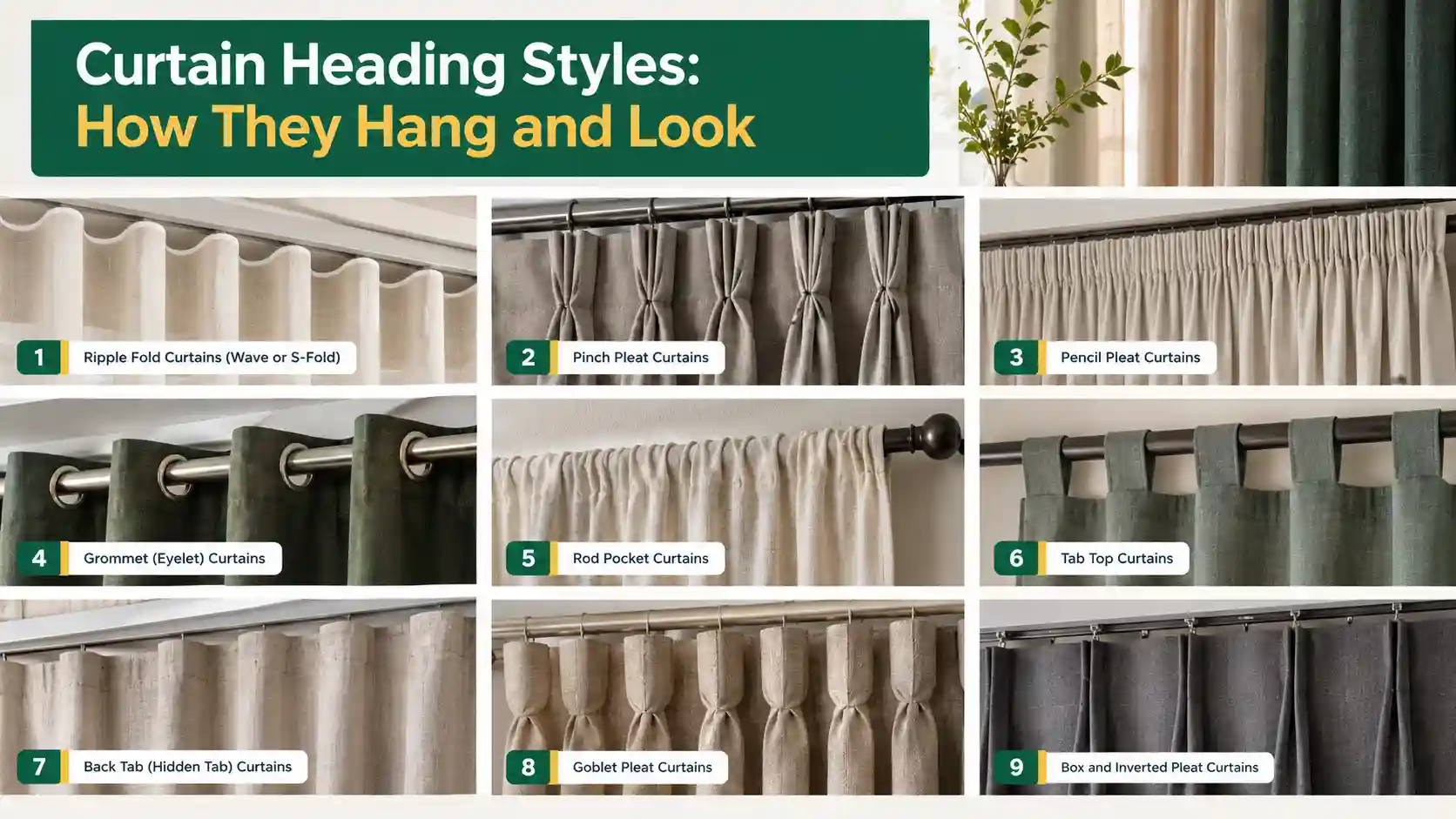
Curtain Heading Styles (How They Hang and Look)
The heading is the top part of the curtain, where it attaches to the rod or track. It shapes the folds, how easily the curtain moves, and the overall feel of the room.
1. Ripple Fold Curtains (Wave or S-Fold)
Ripple fold or wave curtains hang in smooth, even S-shaped waves from top to bottom. They have no visible pleats. The secret is in the hardware. Snaps on the curtain tape clip onto carriers in a special track. The spacing between carriers sets the size of each wave, so every fold looks the same.
Designers love them for modern spaces because they look clean, glide with almost no effort, and stack neatly to the side. They are a top choice for sliding doors, floor-to-ceiling windows, and motorized setups. The one drawback is that you need a matching track, so you can’t just hang them on any rod.
2. Pinch Pleat Curtains
Pinch pleats are one of the oldest and most loved curtain headings. Fabric is gathered into small clusters of two or three folds, then stitched together at the top. You may see them sold as double-pinch or triple-pinch pleats. The result is full, tailored, and polished. They hang on rings or on a track with hooks, and they open and close easily for daily use.
A popular modern take is the Euro or tailored pleat. It is pinched right at the top edge instead of a few inches down, which gives a slimmer, sleeker line. Pinch pleat curtains suit formal living rooms, dining rooms and bedrooms, and they work in both traditional and transitional homes.
3. Pencil Pleat Curtains
Look at the top of a pencil pleat curtain, and you will see tight, narrow folds lined up like pencils in a row. These folds come from a gathering tape sewn on the back. You pull the cords in the tape to bunch the fabric to the width you need, then hook it onto a rod or track. That flexibility makes pencil pleats a smart choice for unusual windows, including bay windows with curved tracks.
The look is soft and classic. It fits bedrooms, cottage-style homes, and anywhere that needs a bit of everyday charm.
Hanging tip: After you pull the cords to the right width, tie them in a loose knot and tuck them behind the curtain. Never cut them. You will need them to flatten the curtain for washing.
4. Grommet (Eyelet) Curtains
Grommet curtains have metal rings punched straight into the top of the fabric. The rod slides through the rings, which creates deep, even folds.
| What works | What to watch |
| Very easy to hang, with no hooks or clips | A thin gap at the top can let light in |
| Slides smoothly on a rod | Rings can scratch the rod over time |
| Modern, casual and tidy look | Will not work on curtain tracks |
| Wide choice of affordable ready-mades | Needs a rod that fits the ring size |
Grommet window curtains are a practical pick for family rooms, kids’ rooms and rentals, where you want something simple that just works.
5. Rod Pocket Curtains
A rod pocket curtain has a sewn channel across the top. You slide the rod through the channel, and the fabric gathers softly along it. Choose a rod pocket when you want the rod hidden, you like a soft, gathered look, or the curtain will stay closed most of the time. They are also very common for café curtains and sheers.
Skip the rod pocket whenyou open and close your curtains every day. The fabric rubs against the rod, so moving them can feel stiff and slow. Some versions add a ruffled band above the pocket for a more cottage-like finish.
6. Tab Top Curtains
Tab top curtains feel relaxed and lived-in. Sew loops of fabric along the top, and the rod passes through them. Because the rod shows between every tab, pick one you like the look of. Wood, black iron, and brushed brass all work well. These curtains suit farmhouse, coastal, and boho rooms.
They don’t slide as smoothly as rings or grommets, so they work best on windows you rarely adjust. A playful cousin is the tie top curtain, which uses fabric ties knotted around the rod. Tie tops look sweet in children’s rooms and cozy reading nooks.
7. Back Tab (Hidden Tab) Curtains
Back tab curtains sit somewhere between tab top and rod pocket. The loops are sewn on the back of the curtain, so they are hidden from the front.
When hung, the rod slips through those back loops, and the front falls into neat, wide folds. It looks surprisingly tailored, a bit like a pleated curtain, but at a ready-made price. You can also hang many back tab curtains through the top pocket, giving you two looks from one pair.
If you want a polished style without paying for custom pleats, this is one of the best value options out there.
8. Goblet Pleat Curtains
Goblet pleats are the dressiest heading on this list. Each pleat is shaped like the cup of a wine glass, and the top is often filled with a little padding to keep its round shape.
They look grand and formal, especially in rich fabrics like velvet, silk, and damask. Rooms with high ceilings, period details, or a formal dining table suit them best.
One practical note: goblet pleats don’t stack neatly when you push them open. Most people use them as fixed side panels, with a blind or shade doing the daily work of controlling light.
9. Box and Inverted Pleat Curtains
These two styles are close relatives, so let’s look at them together.
- Box pleats fold the fabric toward each side to form a flat “box” on the front of the curtain.
- Inverted pleats fold the fabric behind, so the front shows a crisp, flat panel with the folds tucked out of sight.
Both give a neat, structured, almost architectural look. They need less fabric than gathered styles and suit rooms with clean lines and symmetry. Because they don’t stack as compactly, they often work as stationary panels. Pair them with a roller or roman shade if you need everyday light control.
Statement Fabrics That Define the Look
Sometimes the curtain fabric is the main reason you choose a drape. These two have become go-to choices for style-focused homes.

19. Velvet Curtains
Run your hand over velvet, and you will understand its appeal. The thick, soft pile catches light and makes colors look deeper and richer. Velvet is not just pretty, though. That dense pile also blocks a good amount of light, holds in warmth, and soaks up sound. Even without a lining, it does a lot of work.
Jewel tones like emerald and sapphire are classic picks. Right now, muted shades like olive, rust, and chocolate brown feel especially current. Because velvet is heavy, use a sturdy rod with strong brackets. For care, many velvets need dry cleaning, but a vacuum with a soft brush attachment keeps dust off between cleans.
Best for: bedrooms, media rooms, cold climates, and anyone who wants a cozy, luxe feel.
20. Linen and Natural-Fiber Curtains
Linen curtains have been everywhere lately, and that is not slowing down heading into 2027. People love their natural texture, small slubs in the weave, and the easy, airy way they hang.
Unlined linen lets in soft, filtered light, which makes rooms feel calm and bright. If you need privacy, choose a lined version or layer it with a blind.
Before you buy, know these quirks:
- Linen wrinkles easily. Most fans see this as part of the charm.
- Unwashed linen can shrink. Look for “pre-washed” or “stonewashed” labels.
- Strong sun can fade it over time, so a lining helps on sunny windows.
If pure linen is out of budget, linen-cotton blends and linen-look polyester give a similar feel. Cotton and hemp are other good natural options.
Curtain Trends Shaping 2027
Window styling has been moving toward calm, natural, and easy-to-live-with looks. Here is where things are heading.
- Natural textures lead the way. Linen, cotton, wool blends, and textured weaves keep growing in popularity. People want curtains that feel warm and real rather than shiny and synthetic.
- Ceiling-high hanging is the new normal. More homeowners mount rods or tracks right at the ceiling. It is a simple trick that makes even small rooms feel taller.
- Warm, earthy colors. Oatmeal, clay, olive, mushroom, and chocolate brown are replacing cool greys. Soft butter yellows and muted greens are also showing up in kitchens and bedrooms.
- Layering is everywhere. Sheers behind lined panels, or curtains over woven shades, give flexible light control and a richer look.
- Smart curtains go mainstream. Motor prices have dropped, and clip-on retrofit devices make automation possible without replacing anything.
- Patterns return in small doses. Gingham, stripes and soft florals are back, often on café curtains or in one accent room.
- Safer, greener choices. Cordless designs are now the default for family homes. Recycled polyester and fabrics certified free from harmful substances, such as OEKO-TEX-labeled textiles, are easier to find.
How to Choose the Right Curtain Type in 5 Questions
Still not sure which curtain you should choose? Answer these questions in order, and the right choice usually becomes obvious.
- What is the main job? Better sleep points to blackouts. Daytime privacy points to light-filtering or double layers. Heat control points to thermal. Pure looks point to linen, velvet, or a statement heading.
- Who can see in? A ground-floor window facing a street needs more privacy than a third-floor window facing trees.
- How often will you open them? For daily use, pick ripple fold, pinch pleat on rings, or grommet. For curtains that mostly stay put, rod pocket, goblet, or box pleats are fine.
- What is the room’s style? Modern rooms suit ripple fold and grommet. Traditional rooms suit pinch, goblet, and pencil pleats. Relaxed rooms suit tab-top, linen, and café curtains.
- What is your budget? Ready-made grommet and back tab panels are the most affordable. Custom pleats, motorized tracks, and premium fabrics cost more but last longer and fit better.
Final Words
Choosing curtains gets much easier once you split the decision in two. First, decide the job: privacy, darkness, warmth, quiet, or simply style. Then pick a heading that suits how often you will use them and the feel of your room.
A light-filtering linen with ripple folds, a velvet blackout with pinch pleats, or a simple café curtain over the sink can all be the “right” answer. It depends on the window. Measure carefully, hang your rod wider and higher than you think, and you will end up with curtains that work hard and look good for years.
Frequently Asked Questions
What are the most popular types of curtains?
The most popular types are blackout, sheer, light-filtering, and thermal curtains for function, and pinch pleat, ripple fold, and grommet curtains for style. Linen curtains are one of the most popular fabric choices right now.
Which type of curtain gives the most privacy?
Blackout and lined curtains give the most privacy, day and night. If you also want daylight, use a double-layer setup with a sheer behind a lined curtain.
Can people see through sheer curtains at night?
Yes. When it is dark outside and your lights are on, people can usually see shapes and movement through sheer curtains. Add a lined curtain or blind for nighttime privacy.
Do blackout curtains block 100% of light?
The fabric can block nearly all light, but light often leaks around the sides and top. To get close to full darkness, hang the rod wide and high, use a wraparound rod, and let the curtains reach the floor.
What is the difference between curtains and drapes?
Curtains are usually lighter, often unlined and sold in standard sizes. Drapes are typically heavier, lined, floor-length, and more formal. Many people now use the two words interchangeably.
Which curtain heading is easiest to open and close?
Ripple fold curtains on a track are the smoothest. Pinch pleats on rings or a track and grommet curtains are also easy for daily use. Rod pocket and tab top curtains are the hardest to slide.
Do thermal curtains really save energy?
They can help. The U.S. Department of Energy reports that regular draperies can cut heat loss by up to 10% in cold weather, and that medium-colored draperies with white plastic backings can reduce summer heat gain by about 33%. Insulated curtains, hung close to the window and down to the floor, aim to improve on this.
What curtains are best for a small room?
Light-colored, floor-length curtains hung close to the ceiling make small rooms feel bigger. Ripple fold, grommet, or sheer curtains keep the look light and uncluttered.