
What Is Upholstery? Types, Materials, Uses & More
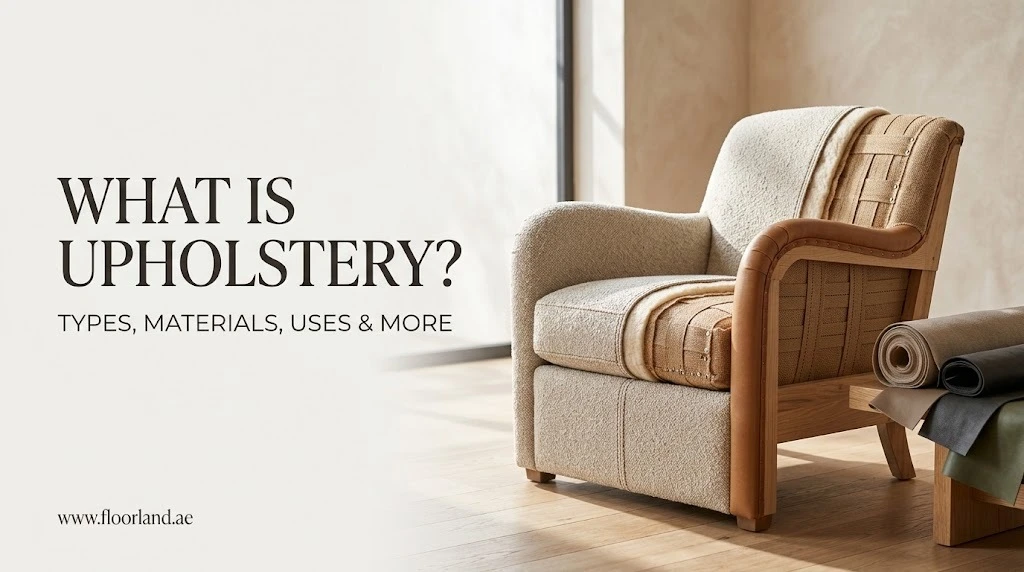
Upholstery is the craft of fitting furniture with a frame, springs or webbing, padding, and an outer cover of fabric or leather to make it soft and comfortable to use. The term covers both the process and the materials involved. Sofas, armchairs, headboards, car seats, and boat cushions are all common examples of upholstered items.
What you see on a sofa is only the final layer. The quality of the frame, suspension, and filling underneath determines how a piece feels on day one and how it holds up ten years later. This guide by Floor Land explains each layer in plain terms, walks through the main types and materials, and shares the practical checks trained upholsterers use when judging a piece of furniture.
Types of Upholstery Know The Difference
Upholstery can be grouped in two useful ways. The first looks at how the piece is built, and the second looks at the finished style.
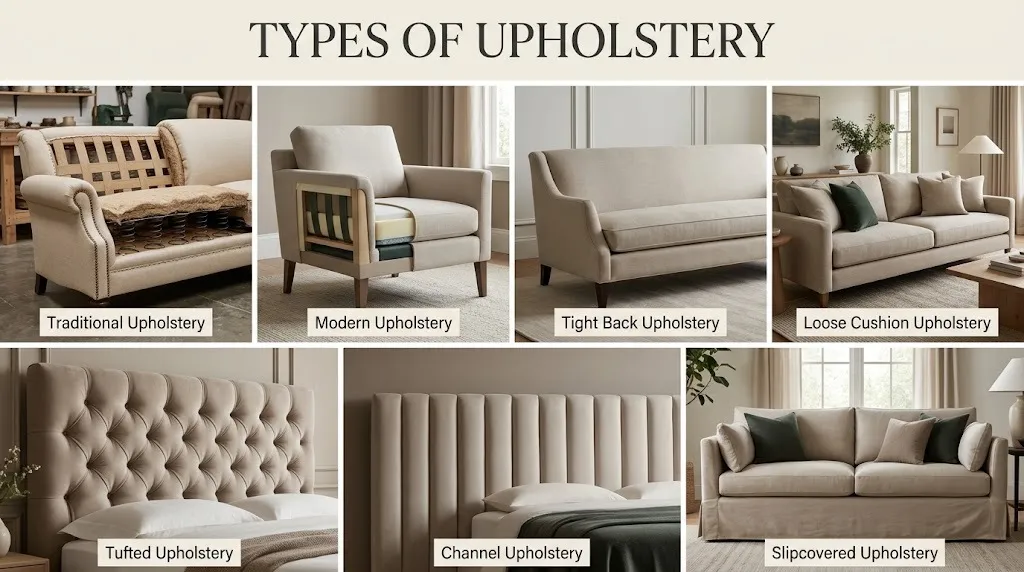
1. Traditional Upholstery
Traditional upholstery follows methods refined over centuries. The upholsterer starts with jute webbing, adds hand-tied coil springs, then builds up the seat with layers of horsehair or fiber, hessian, and cotton wadding. Hand stitching shapes the edges, creating firm, crisp lines that hold their form. This method takes far longer than modern production and costs more, but a well-made traditional upholstered sofa can last fifty years or more before it needs major work. It is the preferred approach for antique restoration and heritage furniture.
2. Modern Upholstery
Modern upholstery replaces many of those natural layers with engineered materials. Foam provides the shape, sinuous springs or elastic webbing provides the support, and staples replace most hand stitching. The process is faster and more consistent, which keeps prices accessible. Quality varies widely within this category, so the frame and foam density matter a great deal when you compare products.
3. Tight Back Upholstery
In a tight-back design, the padding is permanently attached to the frame with no loose back cushions. The result is a clean, tailored silhouette that stays neat without constant fluffing. It suits formal living rooms, offices, and anyone who prefers a structured look.
4. Loose Cushion Upholstery
Loose cushion furniture uses removable seat and back cushions. You can flip and rotate them to spread wear evenly, and many have zippered covers you can remove for cleaning. This style feels relaxed and is a practical choice for busy family homes.
5. Tufted Upholstery
Tufting pulls the fabric and padding inward at regular points, usually with buttons, to create a quilted pattern. Deep buttoning, seen on the classic Chesterfield, produces diamond-shaped folds and a rich, traditional character. Blind tufting skips the buttons for a softer, more modern finish. This is mostly done for headboard upholstery.
6. Channel Upholstery
Channel upholstery divides the padding into long vertical or horizontal sections stitched into the cover. The look is associated with mid-century and Art Deco design, and it has become popular again in modern dining chairs, headboards, and statement sofas.
7. Slipcovered Upholstery
A slipcover is a fitted upholstery fabric cover that slides over an upholstered piece and can be removed completely. Many slipcovers are machine washable, which makes them a favorite in homes with pets, young children, or coastal and farmhouse interiors.
Upholstery Materials: Fabrics, Leather, and More
The upholstery material affects comfort, durability, maintenance, and price. Below is an honest look at the options you will meet most often.
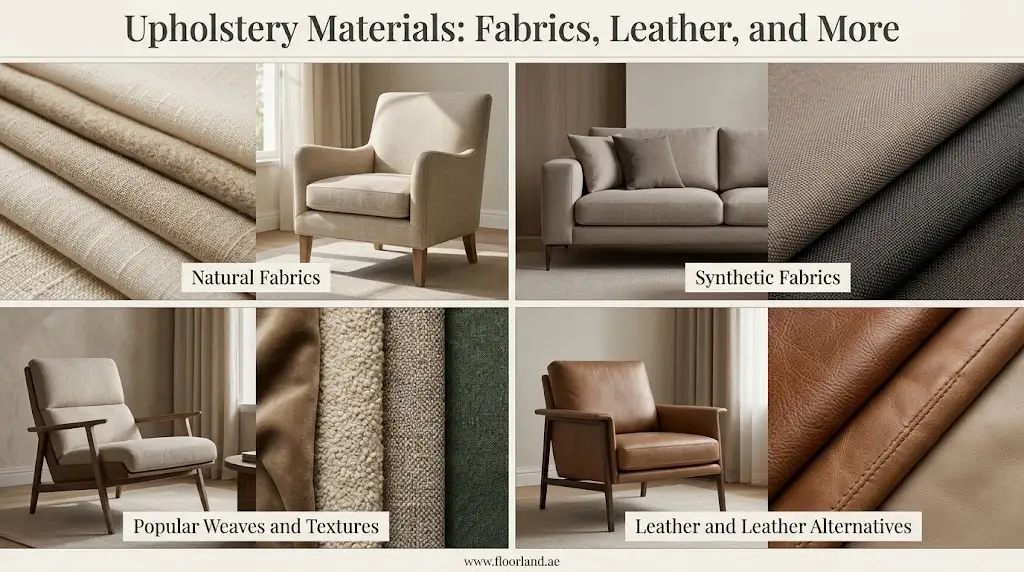
1. Natural Fabrics
Cotton is soft, breathable, and widely available in countless colors and prints. On its own, it can stain and wrinkle easily, so it is often blended with synthetics or treated with a protective finish.
Linen has a cool, relaxed texture and a natural matte look that suits modern and coastal rooms. It creases quickly and can fade in strong sunlight, so it works best in lower traffic areas or as part of a blend.
Wool is warm, resilient, and naturally resistant to flames and soiling. It holds its shape well and is a long-standing choice for high-quality upholstery, although some weaves can feel coarse against bare skin.
Silk offers an elegant sheen but is delicate, light-sensitive, and difficult to clean. It is best kept for decorative chairs and formal rooms that see little daily use.
2. Synthetic Fabrics
Polyester resists fading, wrinkling, and stretching, and it is often blended with natural fibers to improve durability. Lower-quality polyester can pill, so check the weave and rub count.
Nylon is one of the strongest upholstery fibers available. It is rarely used alone but adds real toughness when blended with other materials.
Olefin, also called polypropylene, resists moisture, mildew, and stains very well. It is a common choice for outdoor furniture and busy commercial spaces.
Acrylic was developed as an alternative to wool. Solution-dyed acrylic holds its color exceptionally well in sunlight, which is why it is widely used for outdoor and sunroom furniture.
Microfibre is made from ultra-fine synthetic fibers woven tightly together. It feels soft like suede, resists stains, and stands up well to pet claws because no loose loops catch.
3. Popular Weaves and Textures
Velvet has a short, dense pile that gives colors real depth. Older velvets had a reputation for being delicate, but modern polyester and performance velvets are durable enough for everyday sofas.
Chenille is made from yarns with a soft, fuzzy pile that feels warm and inviting. Bouclé uses looped yarns to create a textured, cloud-like surface that has become a favorite in contemporary interiors, although the loops can snag with pets. Tweed is a woven wool fabric with a rustic, tailored feel, and jacquard uses a complex weave to create detailed patterns directly in the fabric.
Performance fabrics deserve a special mention. These are fabrics engineered or treated to resist stains, moisture, and fading. They have changed the market by making light colors and soft textures realistic for families.
4. Leather and Leather Alternatives
Full-grain leather is the highest grade. It keeps the complete outer layer of the hide, including natural markings, and it develops a rich patina as it ages. Top grain leather is lightly sanded and finished for a more uniform appearance, which makes it slightly less expensive while remaining very durable.
Bonded leather is made from leftover leather fibers bonded to a backing material. It looks convincing when new, but it tends to crack and peel within a few years, so it is best avoided for furniture you want to keep.
Faux leather, usually made from polyurethane, offers a leather look at a lower price and without animal products. Vinyl is tougher, fully wipeable, and highly water resistant, which is why it is standard in restaurants, hospitals, vehicles, and boats.
How to Judge Upholstery Fabric Durability
Labs measure fabric durability with abrasion tests, and the results are usually printed on the fabric specification. Knowing how to read them helps you avoid furniture that looks worn after a single year.
The Martindale test, defined in ISO 12947, is the standard used in the UK and Europe. A machine rubs the fabric in a figure-eight pattern until visible wear appears, and it records the number of cycles as the rub count. The Wyzenbeek test, defined in ASTM D4157, is more common in North America. It rubs the fabric back and forth and reports the result as double rubs. Because the two tests use different methods, don’t compare their numbers directly.
| Martindale Rub Count | Recommended Use |
| Under 10,000 | Decorative cushions and throws only |
| 10,000 to 15,000 | Light domestic use, such as occasional chairs |
| 15,000 to 25,000 | General domestic use, such as everyday sofas |
| 25,000 to 30,000 | Heavy domestic use in busy family homes |
| Above 30,000 | Commercial and contract settings |
For Wyzenbeek results, around 15,000 double rubs is generally considered suitable for residential furniture, while 30,000 double rubs or more is usually rated as heavy-duty. Rub counts are only one part of the picture. Pilling resistance, colorfastness to light, and seam strength also affect how a fabric performs in real life.
Understanding Upholstery Cleaning Codes
Most upholstered furniture carries a label with a cleaning code. These codes tell you which cleaning products are safe for the fabric, and ignoring them is one of the most common reasons for permanent water rings and faded patches.
| Code | What It Means |
| W | Clean with water-based cleaners or upholstery shampoo |
| S | Use solvent-based cleaners only, as water may leave marks |
| W/S or SW | Water-based or solvent-based cleaners are both safe |
| X | Vacuum or light brushing only, with no liquid cleaners |
When in doubt, test any cleaner on a hidden area first and blot rather than rub. For valuable pieces or X-coded fabrics, a professional upholstery cleaner is the safest route.
How Upholstered Furniture Is Built
Every upholstered piece is made in layers, and each layer has a specific job. Understanding them is the single most useful skill when you are buying new furniture or deciding whether an old chair is worth saving.
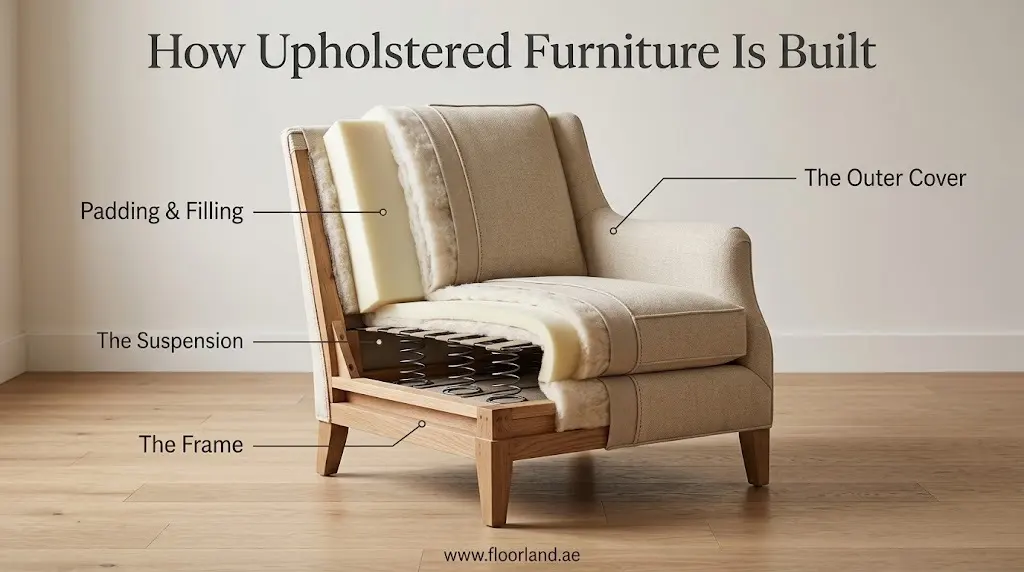
The Frame
The frame is the skeleton that everything else attaches to. Kiln-dried hardwoods such as beech, oak, ash, and maple are the gold standard because the drying process removes moisture that would otherwise cause warping and loose joints. Good frames use dowels, glue, and corner blocks rather than staples alone.
Budget custom furniture often uses softwood, particleboard, or thin plywood. These materials are lighter and cheaper, but they tend to crack under repeated stress, especially along the arms and the back rail. A simple test is to lift one front corner of a sofa a few inches off the floor. If the opposite front leg lifts soon after, the frame is rigid. If the frame twists and the other leg stays down, the construction is weak.
The Suspension
Suspension sits across the frame and carries your weight. It is the part most responsible for long-term comfort, and it is also the part buyers rarely see.
Eight-way hand-tied springs are the most traditional system. Each coil spring is secured to the webbing and then tied to its neighbors with strong twine in eight directions. The result is a seat that distributes weight evenly and feels supportive for decades. It is labor-intensive, which is why it appears mostly in high-end and custom furniture.
Sinuous springs, also called zigzag or serpentine springs, are S-shaped steel wires that run from the front of the seat to the back. They are used in most modern sofas because they are durable, cost-effective, and take up less depth. When made from heavy-gauge steel and properly spaced, they perform very well in daily use.
Elastic webbing is a woven band stretched tightly across the frame. It is common in Scandinavian and contemporary designs where a slim profile matters. Quality webbing is comfortable and reliable, while cheaper webbing can lose tension and cause seats to dip over time.
The Padding and Filling
The filling gives a piece its shape and its feel. Foam is by far the most common option today, and its quality is measured mainly by density. For seat cushions, a density of around 1.8 pounds per cubic foot or higher is a sensible minimum for regular use. High-resilience foam, typically 2.5 pounds per cubic foot or more, recovers its shape faster and lasts noticeably longer. In the United States, the CertiPUR-US certification is a useful signal that foam has been tested for emissions and certain harmful substances.
Feather and down fillings create a sink in softness that many people love, but they need regular plumping to stay in shape. Many manufacturers now wrap a foam core in a layer of down or polyester fiber, which blends support with a softer surface. Polyester fiber is light and affordable, though it compresses faster than foam.
In antique and traditional work, you will still find horsehair, coir made from coconut husk, and cotton felt. These natural materials are breathable and extremely long-lasting when a skilled upholsterer handles them.
The Outer Cover
The cover is the layer you touch and see every day. It sets the style of the piece and determines how easy it will be to clean. Choosing the right cover involves more than color, which is why materials get their own detailed section below.
Where Upholstery Is Used
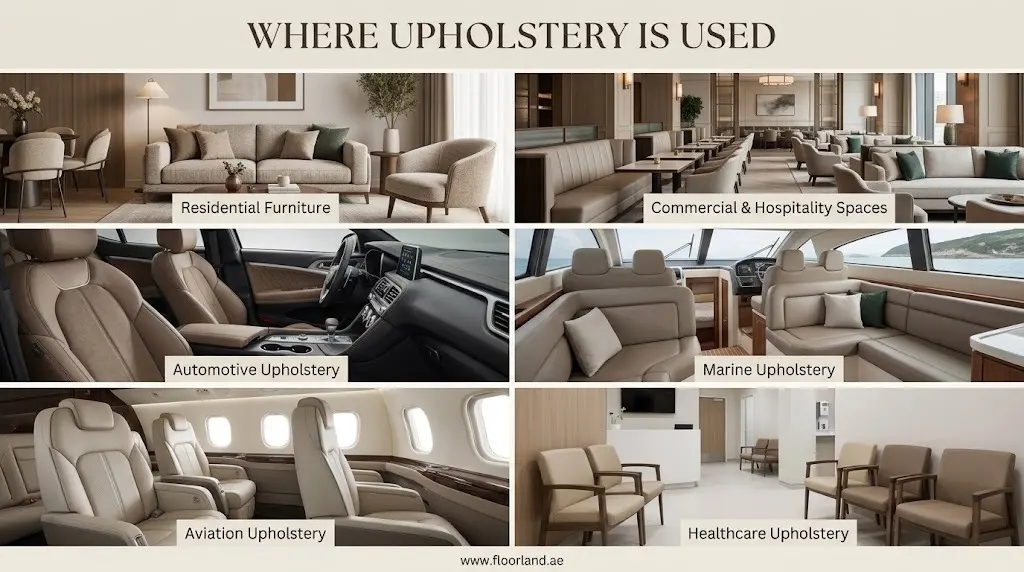
Upholstery creates comfortable, functional seating in homes, luxury hotels, corporate offices, and vehicle interiors. From everyday living room sofas to high-traffic commercial furniture, expert fabric application elevates comfort, style, and longevity.
1. Residential Furniture
Homes account for the largest share of upholstery work. Sofas, sectionals, armchairs, ottomans, dining chairs, headboards, benches, and window seats are all upholstered. In residential settings, the priorities are usually comfort, style, and how well the piece copes with children, pets, and daily use.
2. Commercial and Hospitality Spaces
Hotels, restaurants, bars, cafés, and offices put upholstery under constant pressure. Seating in these spaces is used by hundreds of people and cleaned frequently. Contract-grade fabrics with high rub counts, stain-resistant finishes, and verified fire performance are the norm.
3. Automotive Upholstery
Car seats, headliners, door cards, and dashboards all rely on upholstery. Automotive trimmers work with leather, vinyl, Alcantara-style microsuede, and heavy woven fabrics that resist UV damage and constant friction. Classic car restoration is a specialist field of its own, where matching original materials and stitching patterns matters a great deal.
4. Marine Upholstery
Boats expose materials to sun, salt, and moisture every day. Marine upholstery uses UV-stabilised vinyl, rust-resistant fixings, and open-cell or reticulated foam that lets water drain through quickly and helps prevent mould.
5. Aviation Upholstery
Aircraft seating must be lightweight, durable, and compliant with strict aviation flammability rules. Wool blends and treated leathers are common, and every material is documented and certified before it goes into a cabin.
6. Healthcare Upholstery
Hospitals, clinics, and care homes need seating that can be disinfected many times a day. Antimicrobial vinyls and fluid-resistant fabrics protect patients and staff while still offering comfort in waiting rooms and treatment areas.
Upholstery, Reupholstery, and Recovering: What Is the Difference?
These three terms are often used interchangeably, but they describe different jobs. Upholstery refers to the original process of building and covering new furniture. Reupholstery means stripping an existing piece back to its frame, checking and repairing the joints, and replacing the springs, padding, and cover as needed. Recovering is the lightest option, where only the outer fabric is replaced and the existing padding stays in place.
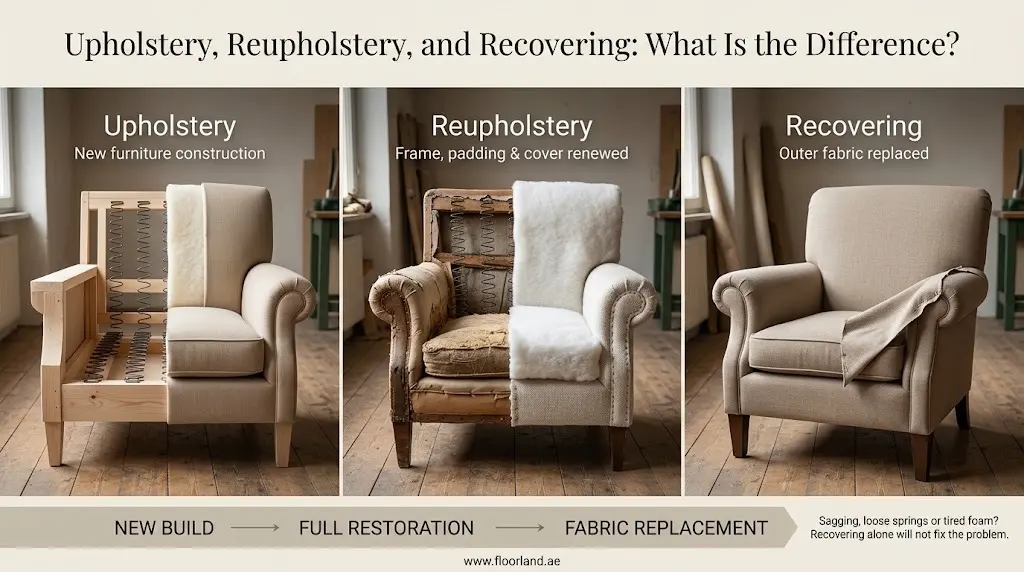
Recovering is cheaper and quicker, but it will not fix sagging seats, loose springs, or tired foam. If a chair feels uncomfortable rather than just looking worn, full reupholstery is usually the better investment.
Signs Your Furniture Needs Reupholstering
Furniture rarely fails overnight. The early signs are usually subtle, such as cushions that no longer bounce back after you stand up or a seat that feels lower than it used to. As wear progresses, you may start to feel springs or the frame through the padding, notice creaking or movement in the joints, or see fabric that has thinned, torn, or faded beyond cleaning.
Reupholstering makes the most sense when the frame is solid and well made. Many older pieces were built with hardwood frames and hand-tied springs that outperform much of the budget furniture sold today. Sentimental value, unusual shapes, and antique pieces are also strong reasons to restore rather than replace.
What Affects the Cost of Upholstery?
Upholstery prices vary widely, and a clear quote usually depends on seeing the piece in person. The item’s size is the starting point, since a three-seater sofa needs far more fabric and labor than a dining chair. Fabric choice is the next major factor, with designer textiles and genuine leather costing much more than standard polyester blends.
The condition of the piece matters too. Replacing springs, rebuilding foam, or repairing a broken frame adds time and materials. Patterned fabrics also increase costs because stripes, checks, and large motifs must be matched across seams, which uses extra fabric. Finally, detailed finishes such as deep buttoning, piping, and channel stitching require more skilled labor.
For an accurate figure, ask for a written quote that separates labor, fabric, and any repair work. This makes it easier to compare upholsterers fairly.
How to Choose the Right Upholstery for Your Home
Start by thinking honestly about how you’ll use the piece. A sofa in a family living room faces spills, snacks, and pets, so a tightly woven performance fabric with a rub count above 25,000 is a sensible choice. A reading chair in a quiet bedroom can comfortably wear a more delicate linen or velvet.
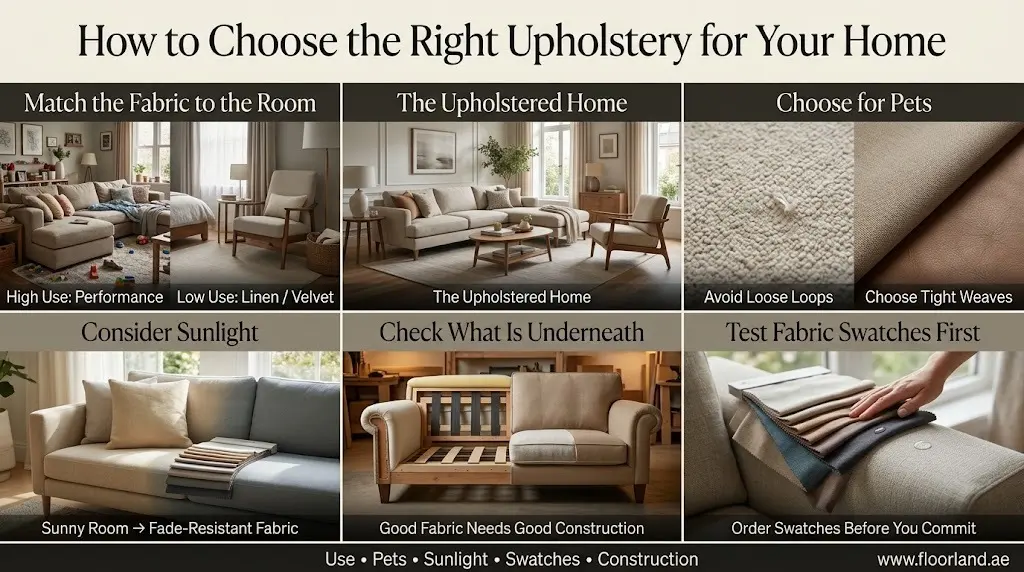
Pets deserve extra thought. Loose weaves and looped textures like bouclé are easily snagged by claws, while microfibre, tight weaves, and leather tend to hold up much better. Light also plays a role. Rooms with strong sunlight can fade natural fibers quickly, so solution-dyed acrylic or olefin will keep their color for longer.
Always order fabric swatches before committing. View them in your own room at different times of day, rub them against your skin, and test how they respond to a drop of water if the cleaning code allows it. Finally, check the frame, suspension, and foam details with the retailer. A beautiful fabric cannot make up for weak construction underneath.
Expert Tips to Make Upholstery Last Longer
Regular care has a bigger impact on lifespan than most people expect. Vacuuming once a week with an upholstery attachment removes fine grit that slowly cuts into fibers. Flipping and rotating loose cushions every couple of weeks spreads wear evenly and stops permanent dips from forming in your favorite spot.
Blot spills immediately with a clean white cloth, working from the outside of the stain inward so it doesn’t spread. Positioning furniture away from direct sunlight or using window film helps prevent fading. For deeper cleaning, a professional service every twelve to twenty-four months keeps fabric fresh and removes the body oils that dull colors over time.
Final Thoughts
Upholstery is far more than the fabric on the outside of a sofa. It is a layered craft where the frame, suspension, filling, and cover all work together to create comfort that lasts. When you understand those layers, you can look past the showroom styling and judge a piece by the things that truly matter.
Whether you are choosing a new sofa, restoring a family heirloom, or specifying seating for a business, focus on solid construction, the right material for the setting, and fabric rated for how it will be used. Those choices will reward you with furniture that looks good and feels right for many years.
Frequently Asked Questions About Upholstery
What is the difference between upholstery and fabric?
Fabric is only the outer material. Upholstery is the complete system of frame, suspension, padding, and cover that turns a bare structure into comfortable furniture.
What is the most durable upholstery material?
Full-grain leather, microfibre, and tightly woven synthetic blends containing nylon or olefin are among the most durable options. For any fabric, check the Martindale or Wyzenbeek rating before buying.
How long does upholstered furniture last?
Well-built furniture with a hardwood frame and high-density foam can last fifteen years or more with good care. Budget pieces with low-density foam may begin to sag within three to five years.
Is it worth reupholstering an old sofa?
It is usually worth it when the frame is solid hardwood and the design suits your space. A quality reupholstered sofa often outlasts a new budget sofa at a similar price.
What does upholstered furniture mean?
Upholstered furniture is any piece that has padding and a soft cover of fabric, leather, or vinyl, as opposed to bare wood, metal, or plastic.
Can you upholster furniture yourself?
Simple projects like recovering a dining chair seat are very achievable with a staple gun and some patience. Sofas, spring work, and antique restoration are best left to a trained upholsterer.
What is the best upholstery fabric for homes with pets?
Microfibre, tightly woven synthetics, performance fabrics, and leather are generally the most pet-friendly. Avoid loose weaves and looped textures that claws can catch.