
Best Curtain Hooks for 2026: 20 Types Compared

Most curtains do not fail due to the fabric but rather because of other factors. Curtain hooks are among the most frequently faulty hardware items. The wrong hook can make a curtain sag, droop, or even break, even if it’s a gorgeous curtain.
There is a growing demand for improved hardware. Mordor Intelligence projects that the window coverings industry will increase from USD 28.96 billion in 2025 to USD 30.14 billion in 2026, and to USD 37.85 billion by 2031. The more curtains that are hanging, the more they are used, and typically not well.
This guide covers the 20 curtain hook types that matter in 2026. You will learn what each one does, how much weight it holds, and exactly when to use it.
What Are The Best Curtain Hooks For 2026?
The most popular curtain hooks for 2026 include stainless steel pin curtain hooks, four-prong pleater curtain hooks that allow adjustment, and wave gliders for modern S-fold curtains. Heavy drapes (over 5kg per panel) require heavy-duty metal hooks suitable for the weight. Lightweight sheers can be used with plastic hooks, S hooks or clip hooks. Hook to header tape, track, or rod then curtain weight.
The basic rule is the header determines the hook family, the fabric weight determines the material, and the track determines the fit.
Curtain Hook Comparison Table: All 20 Types
Use this table to shortlist two or three hook types before reading the detailed sections below.
| Hook Type | Best For | Weight Capacity | Compatible Header | Installation Difficulty |
|---|---|---|---|---|
| Pin Hooks | Pinch pleat drapes | Medium to heavy | Pinch pleat, buckram | Easy |
| S Hooks | Cafe curtains, sheers | Light | Rod pocket loops, rings | Very easy |
| Pleater Hooks | Creating pleats from tape | Medium | Pleating tape | Moderate |
| Plastic Curtain Hooks | Budget, damp rooms | Light | Standard header tape | Very easy |
| Metal Curtain Hooks | Everyday medium drapes | Medium to heavy | Standard header tape | Easy |
| Adjustable Curtain Hooks | Fine-tuning curtain height | Light to medium | Pocketed header tape | Easy |
| Wave Curtain Hooks | S-fold / wave curtains | Light to medium | Wave tape, glider cord | Moderate |
| Pencil Pleat Hooks | Pencil pleat curtains | Light to medium | Pencil pleat tape | Very easy |
| Eyelet Support Hooks | Stabilizing eyelet panels | Light support role | Eyelet/grommet header | Easy |
| Ripple Fold Hooks | Hotel-style ripple fold | Medium | Snap tape carriers | Moderate |
| Heavy Duty Curtain Hooks | Blackout, velvet, thermal | Heavy | Reinforced header tape | Easy |
| Stainless Steel Hooks | Bathrooms, coastal homes | Medium to heavy | Most header tapes | Easy |
| Brass Curtain Hooks | Period and luxury interiors | Medium to heavy | Buckram, header tape | Easy |
| Ceiling Track Hooks | Ceiling-mounted tracks | Light to heavy | Track gliders | Moderate |
| Traverse Rod Hooks | Corded traverse rods | Medium to heavy | Pinch pleat, master slides | Moderate |
| Double Curtain Hooks | Layered curtain + sheer | Medium | Dual header tapes | Moderate |
| Hidden Curtain Hooks | Clean minimalist headers | Light to medium | Concealed tape pockets | Easy |
| Decorative Curtain Hooks | Visible statement hardware | Light to medium | Tab top, loops, rings | Easy |
| Clip Curtain Hooks | No-sew flat panels | Light | Flat panels, no header | Very easy |
| Snap Curtain Hooks | Quick-change panels | Light to medium | Snap tape headers | Easy |
Top 20 Curtain Hooks That Perform Exceptionally
Below is the detailed explanation of the top 20 curtain hooks that are widely used these days.
1. Pin Hooks
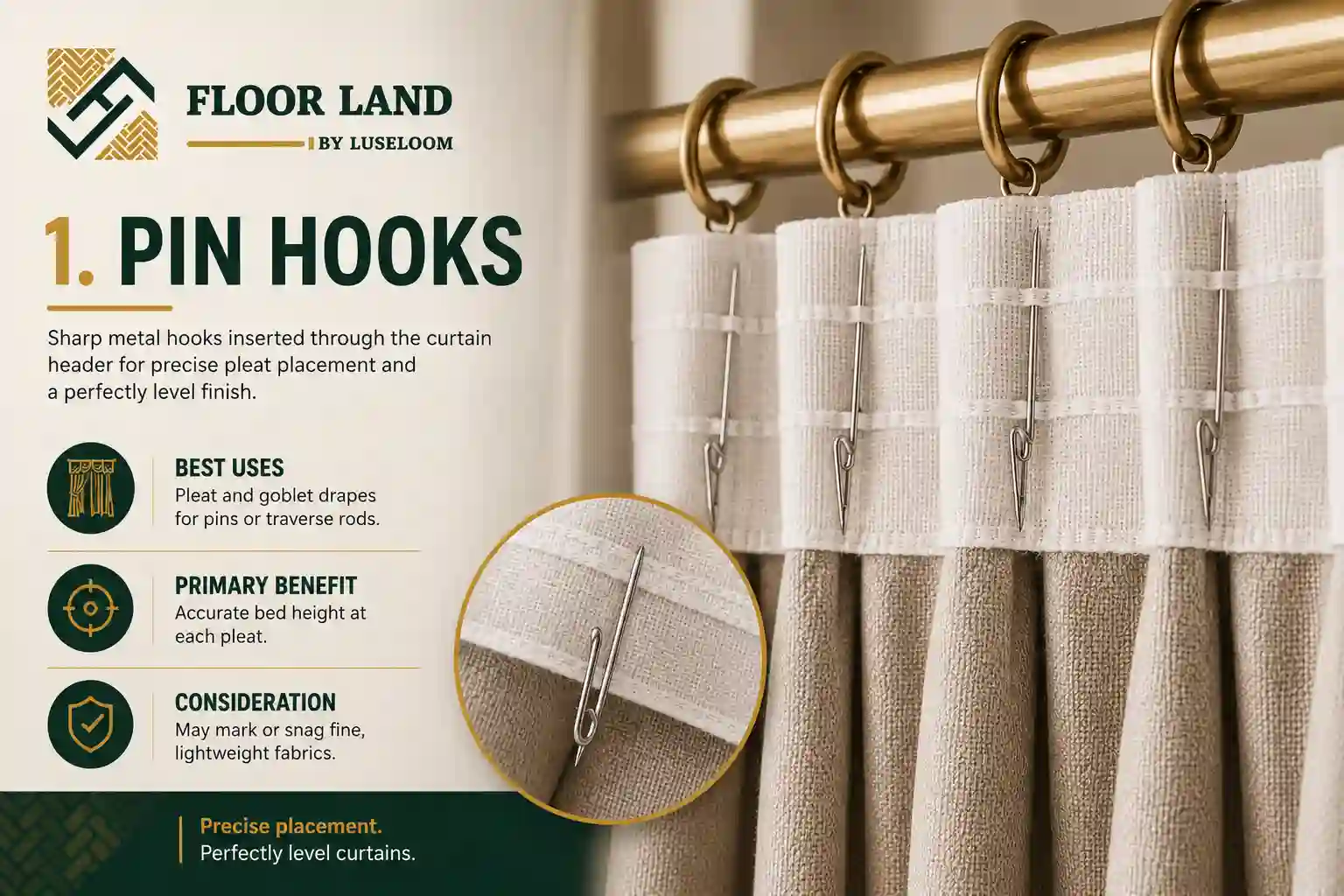
Pin hooks are sharp metal hooks that are driven straight through the back of a pleated curtain header. The pin fits snugly in the buckram stiffener, and the hook arm is suspended on a ring, glider, or traverse carrier.
They are great for pinch pleat and goblet pleat drapes, as you can precisely control where you want the pleat to insert. That way, you can adjust the length of each pleat to create a perfectly level hem. The downside is that they will leave small holes, and they can snag thin fabric. Only use them on medium- and heavy-lined drapes, not on unlined drapes.
- Best uses: Pleat and goblet drapes for pins or traverse rods.
- Primary benefit: Accurate bed height at each and every pleat.
- Possible disadvantage: Fine, lightweight fabrics can be marked and snagged by sharp pins.
2. S Hooks
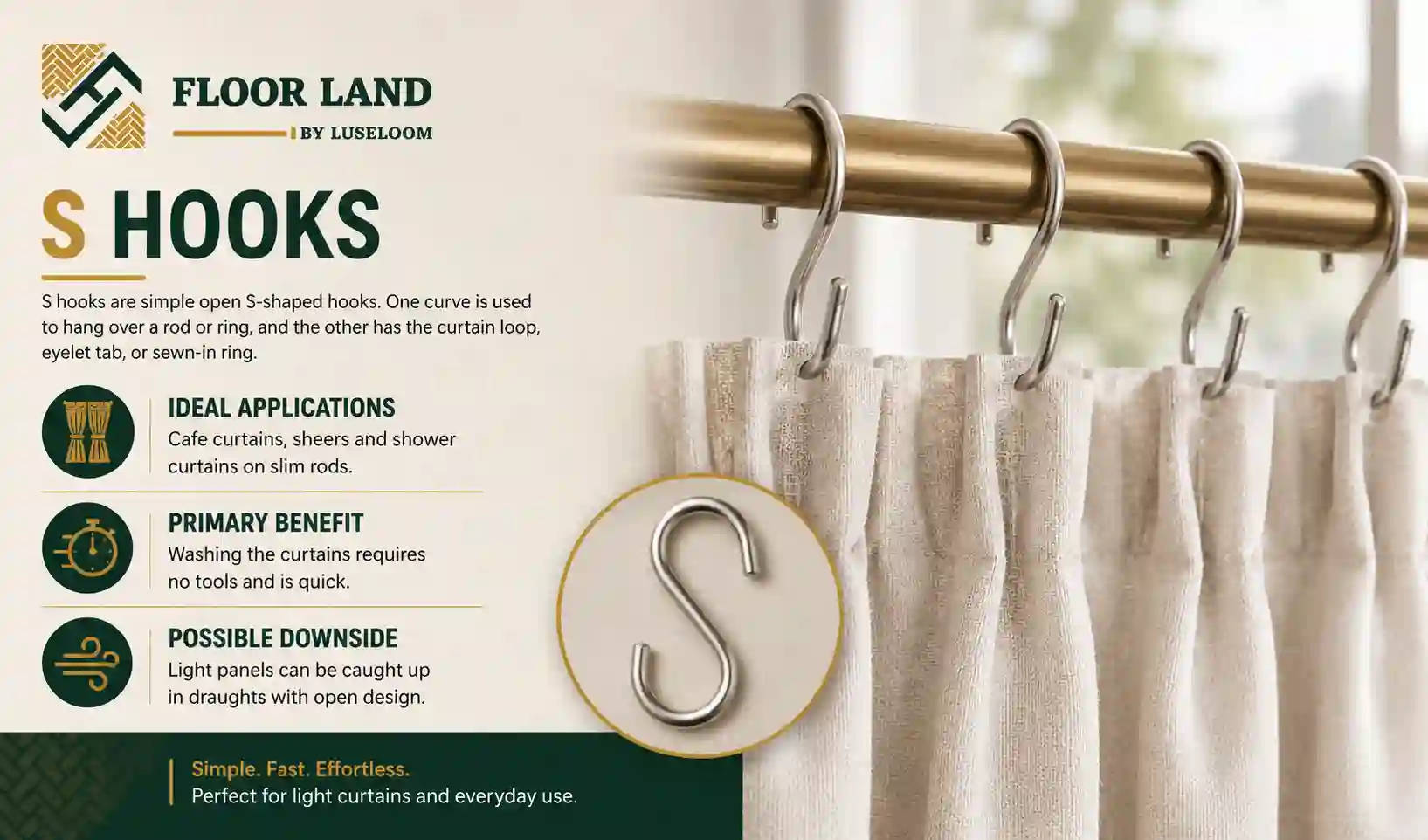
S hooks are simple open S-shaped hooks. One curve is used to hang over a rod or ring, and the other has the curtain loop, eyelet tab, or sewn-in ring.
Nothing installs faster. No piercing, no tape, and no tools. These are ideal for cafe linings, kitchen linings, shower curtains, and casual linen panels. They are easy to detect when there is weight involved: an open hook can bend, and panels can lift off the rod in a strong draught. Store them for light curtains with a total weight of less than 2 kg per curtain, and opt for the closed-gap version near open windows.
- Ideal applications: Cafe curtains, sheers and shower curtains on slim rods.
- Primary benefit: Washing the curtains requires no tools and is quick.
- Possible downside: Light panels can be caught up in draughts with open design.
3. Pleater Hooks
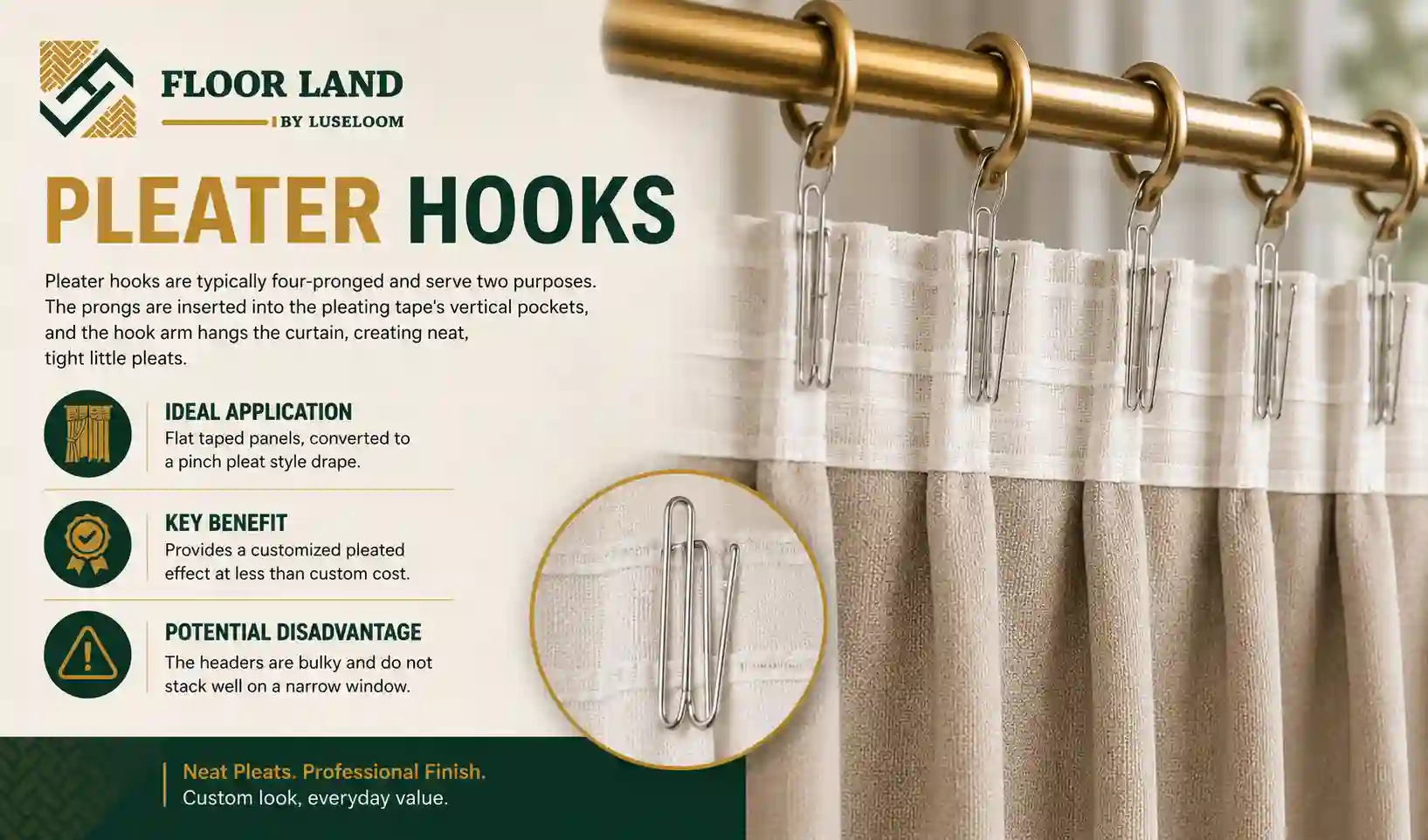
Pleater hooks are typically four-pronged and serve two purposes. The prongs are inserted into the pleating tape’s vertical pockets, and the hook arm hangs the curtain, creating neat, tight little pleats.
They are an inexpensive alternative to custom-made pinch pleats without having to invest in handmade headers. The spacing is important: for fuller pleats, the spacing between the prongs is larger; for flatter pleats, it is smaller. The downside of this is bulkiness. A stiff header can be difficult to stack neatly on narrow windows, as it is with four prongs and tape. Patent on medium-weight lined curtains.
- Ideal application: Flat taped panels, converted to a pinch pleat style drape.
- Key benefit: Provides a customized pleated effect at less than custom cost.
- Potential disadvantage: The headers are bulky and do not stack well on a narrow window.
4. Plastic Curtain Hooks
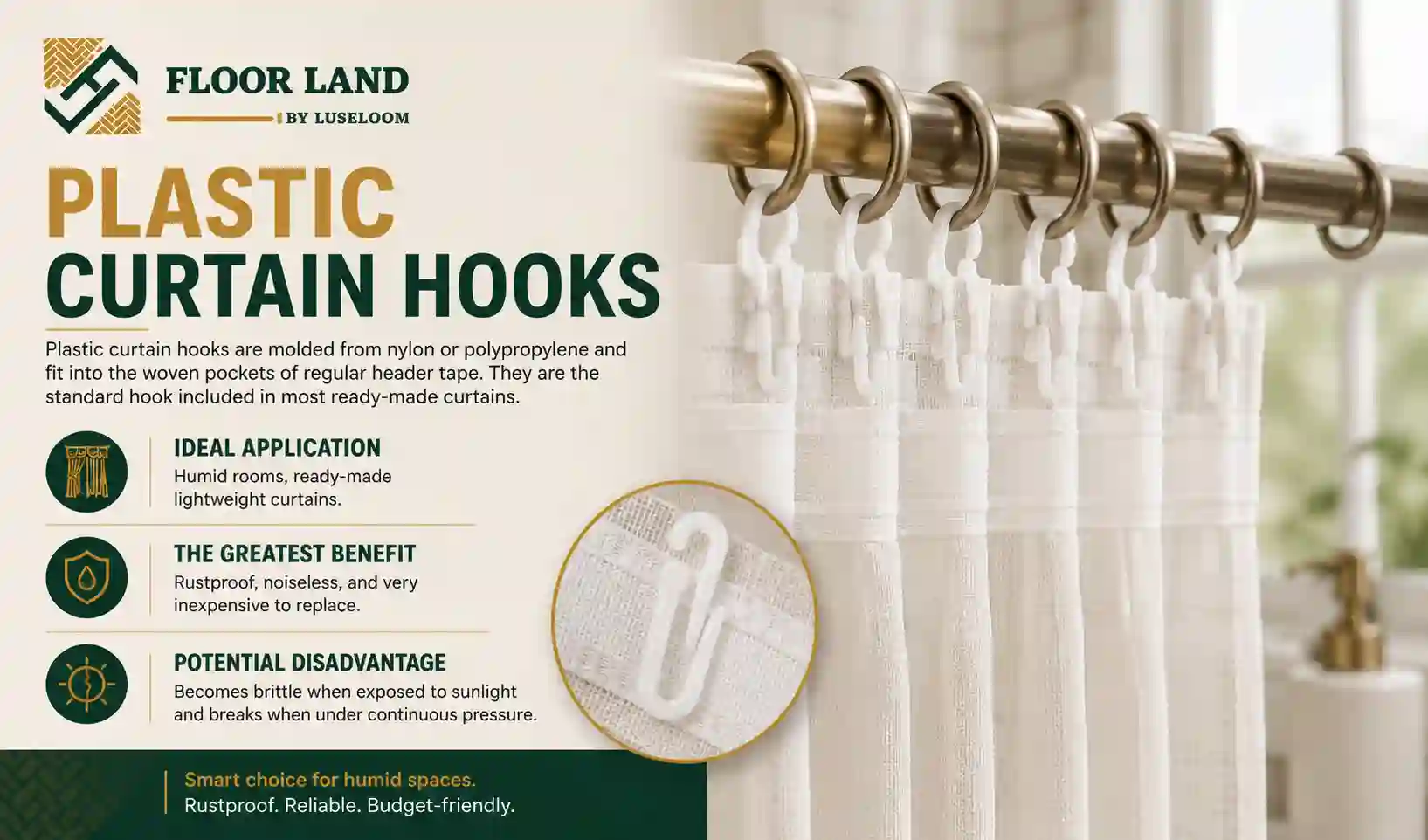
Plastic curtain hooks are molded from nylon or polypropylene and fit into the woven pockets of regular header tape. They are the standard hook included in most ready-made curtains.
They have a good price and corrosion resistance. They do not rust, so my first choice for bathrooms, kitchens, and coastal homes with high humidity and light fabrics. The weakness is tiredness. UV exposure causes cheap plastic to break and snap, typically one of the hooks at a time, leaving a drooping header. Use in sheers, light cottons, and change every 2 or 3 years.
- Ideal application: Humid rooms, ready-made lightweight curtains.
- The greatest benefit: Rustproof, noiseless, and very inexpensive to replace.
- Potential disadvantage: Becomes brittle when exposed to sunlight and breaks when under continuous pressure.
5. Metal Curtain Hooks
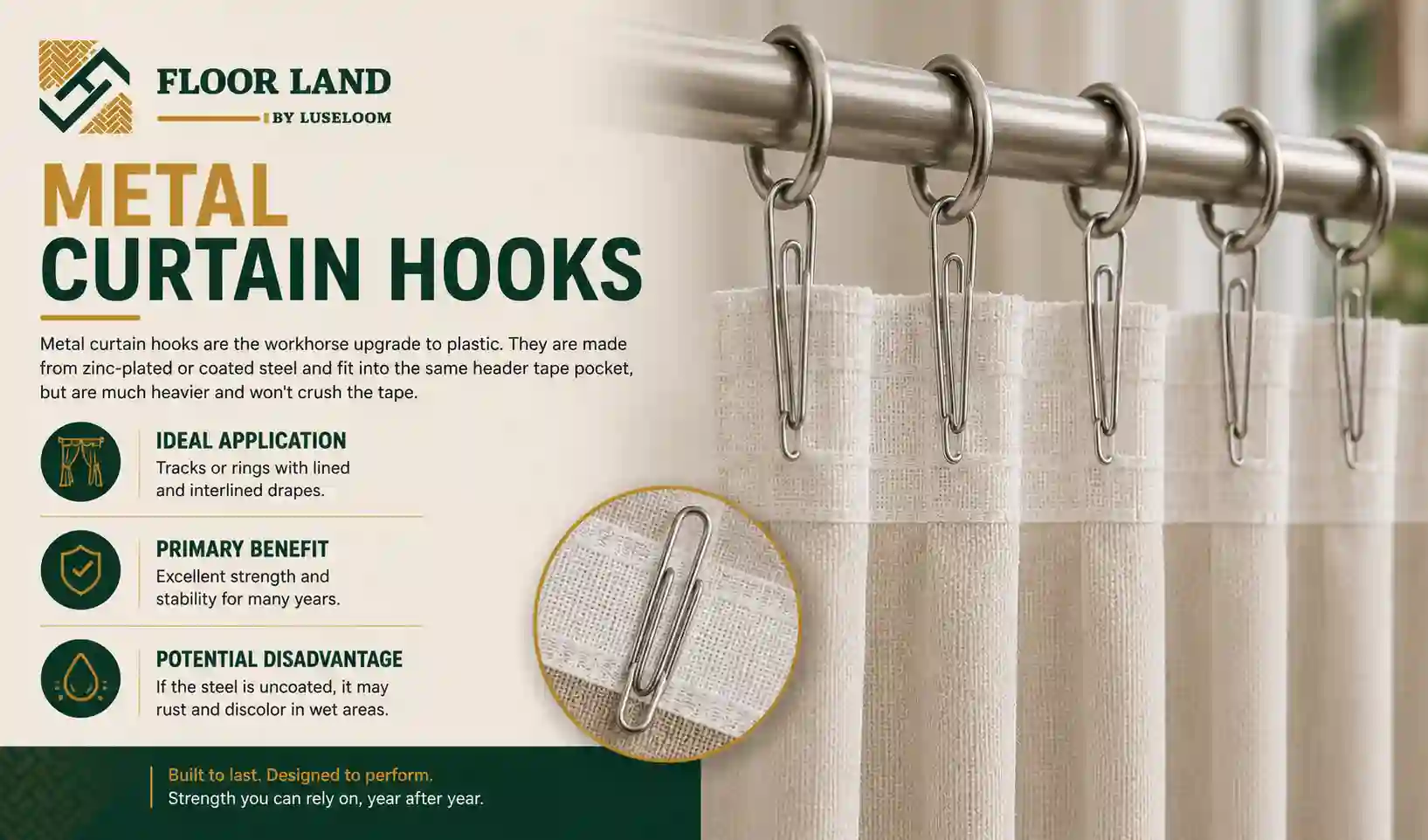
Metal curtain hooks are the workhorse upgrade to plastic. They are made from zinc-plated or coated steel and fit into the same header tape pocket, but are much heavier and won’t crush the tape.
Metal hooks are indicated for any curtain, drape, or panel that is more than 1.5 meters wide, or is lined or interlined. They run on pulley-like tracks of metal and maintain their form for decades. Note: uncoated steel can rust in moist rooms and stain the header tape; on some tracks, metal-on-metal contact can be noisy. Nylon-coated versions have been developed to address both issues at a modest extra cost.
- Ideal application: Tracks or rings with lined and interlined drapes.
- Primary benefit: Excellent strength and stability for many years.
- Potential disadvantage: If the steel is uncoated, it may rust and discolor in wet areas.
6. Adjustable Curtain Hooks
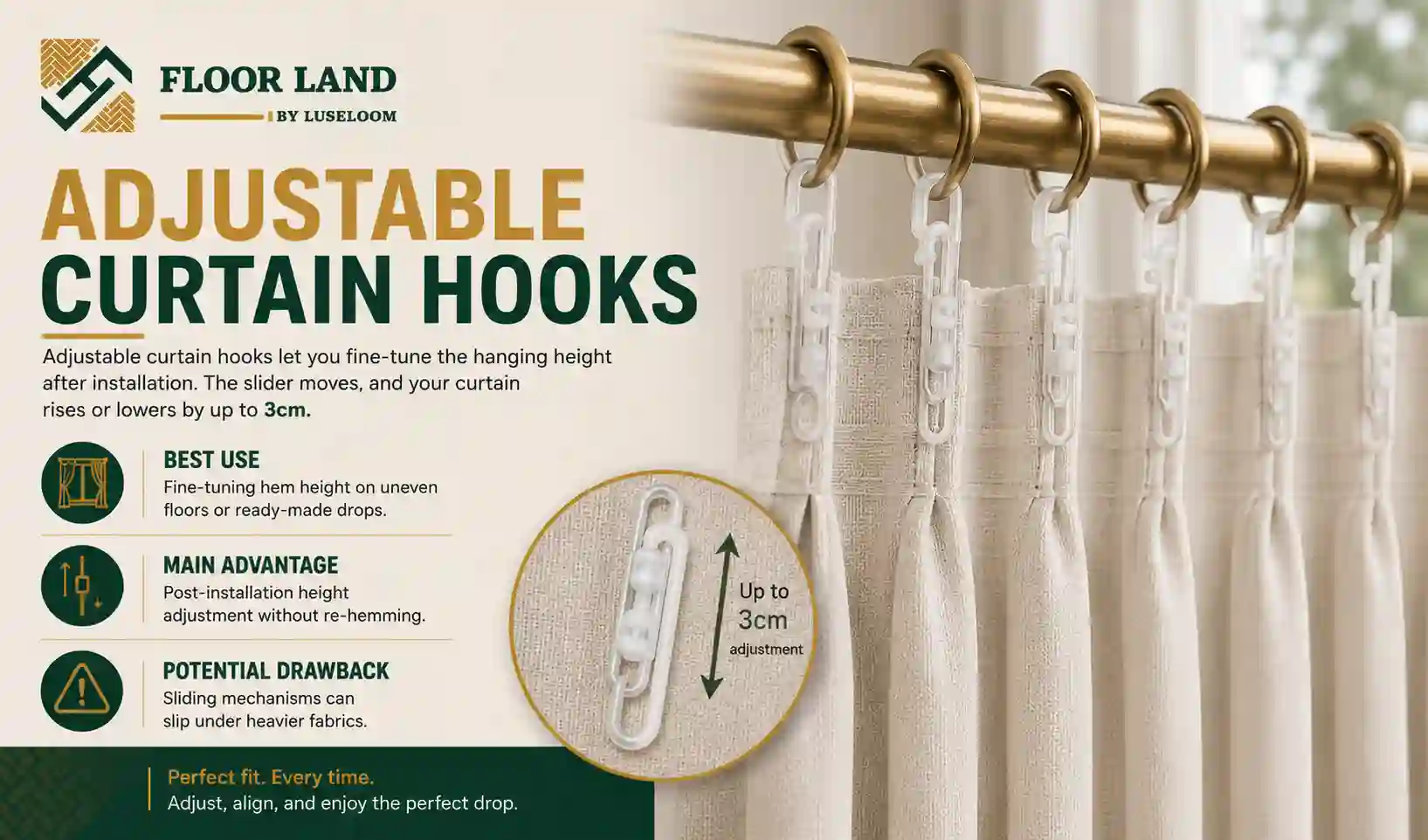
Tackling adjustable curtain hooks is easy and lets you adjust the hanging height once the curtain is up, thanks to their sliders or multiple locking points. The slider moves, and the entire panel will move up or down by up to 3cm.
They’re a lifesaver for older homes, too, where you won’t find a truly level floor or ceiling, and for anyone who had curtains made to order but ended up with a slightly too long or short curtain. A small amount of bulk is added to the mechanism, and the lowest-cost models can fit under thick materials. Use them for light-to-medium curtains where precision in the hems is more important than strength.
- Best use: Fine-tuning hem height on uneven floors or ready-made drops.
- Main advantage: Post-installation height adjustment without re-hemming.
- Potential drawback: Sliding mechanisms can slip under heavier fabrics.
7. Wave Curtain Hooks
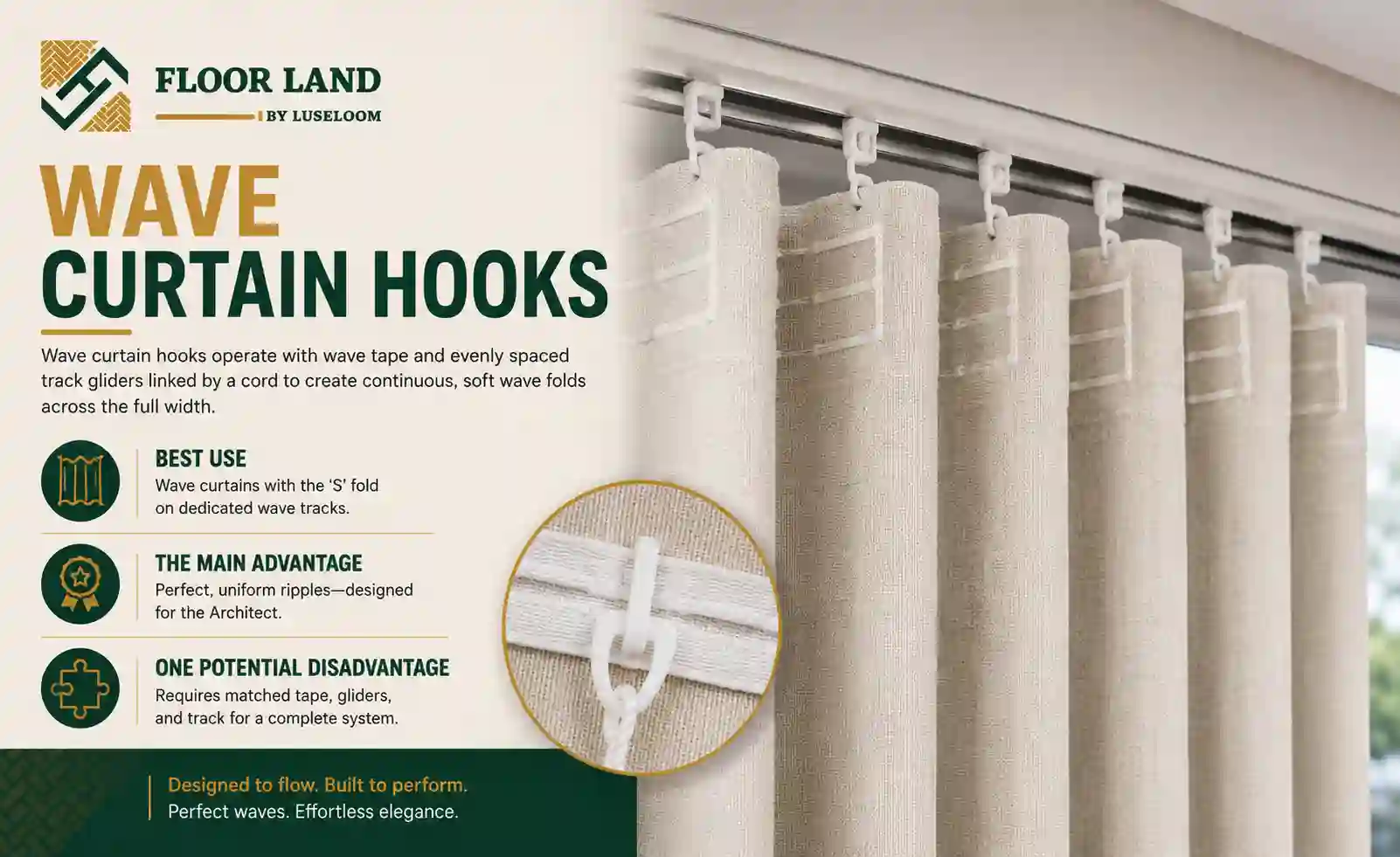
Wave curtain hooks operate in conjunction with a special type of wave tape and evenly spaced track gliders. These gliders are usually connected by a cord to produce the continuous soft wave curtain folds.
The signature style of interior design for 2026 is uniform ripples across the entire width, front and back. The system requires precise glider spacing (typically 60 mm or 80 mm), and hooks, tape, and track must be compatible with the system. They work well with light to medium fabrics; too heavy a velvet will prevent the wave. It will be a little tricky to install, but after that it’s very easy to use.
- Best use: Wave curtains with the ‘s’ fold on dedicated wave tracks.
- The main advantage is that the rippled folds are perfect and have been designed for the Architect.
- One potential disadvantage is that it necessitates matched tape, gliders, and track for a system.
8. Pencil Pleat Hooks
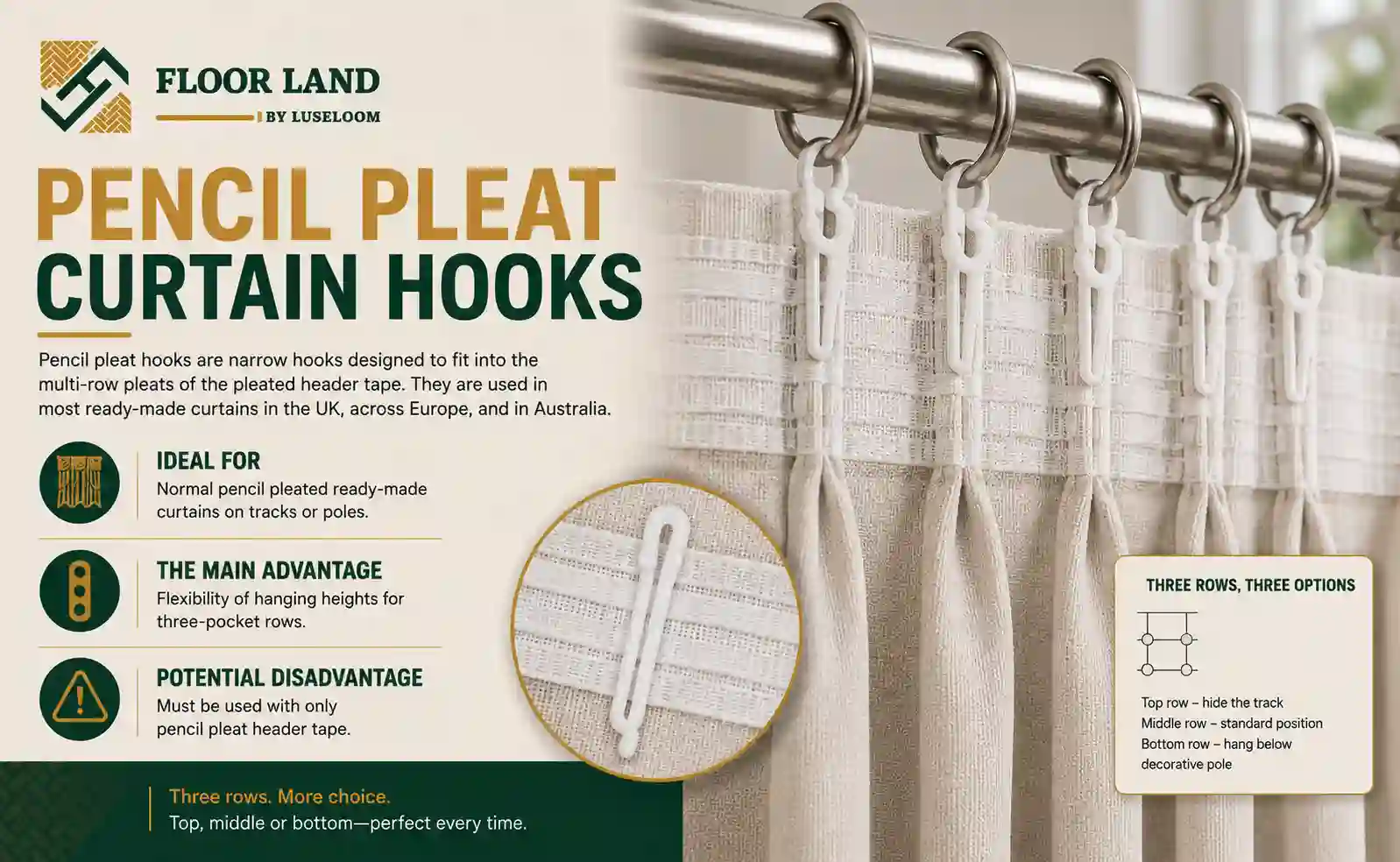
Pencil pleat hooks are narrow hooks designed to fit into the multi-row pleats of the pleated header tape. They are used in most ready-made curtains in the UK, across Europe, and in Australia.
Typically, the tape provides three rows of pockets. To hide a track behind the header, use the top row, and to hang below a decorative pole, use the bottom row. Plastic versions work with sheers curtain and metal versions with cotton-lined. Only accept pencil pleat tape, and plastic tapes that are overloaded will break at the neck.
- Ideal for: Normal pencil pleated ready-made curtains on tracks or poles.
- The main advantage is the flexibility of hanging heights for three-pocket rows.
- Potential disadvantage: Must be used with only pencil pleat header tape.
9. Eyelet Support Hooks
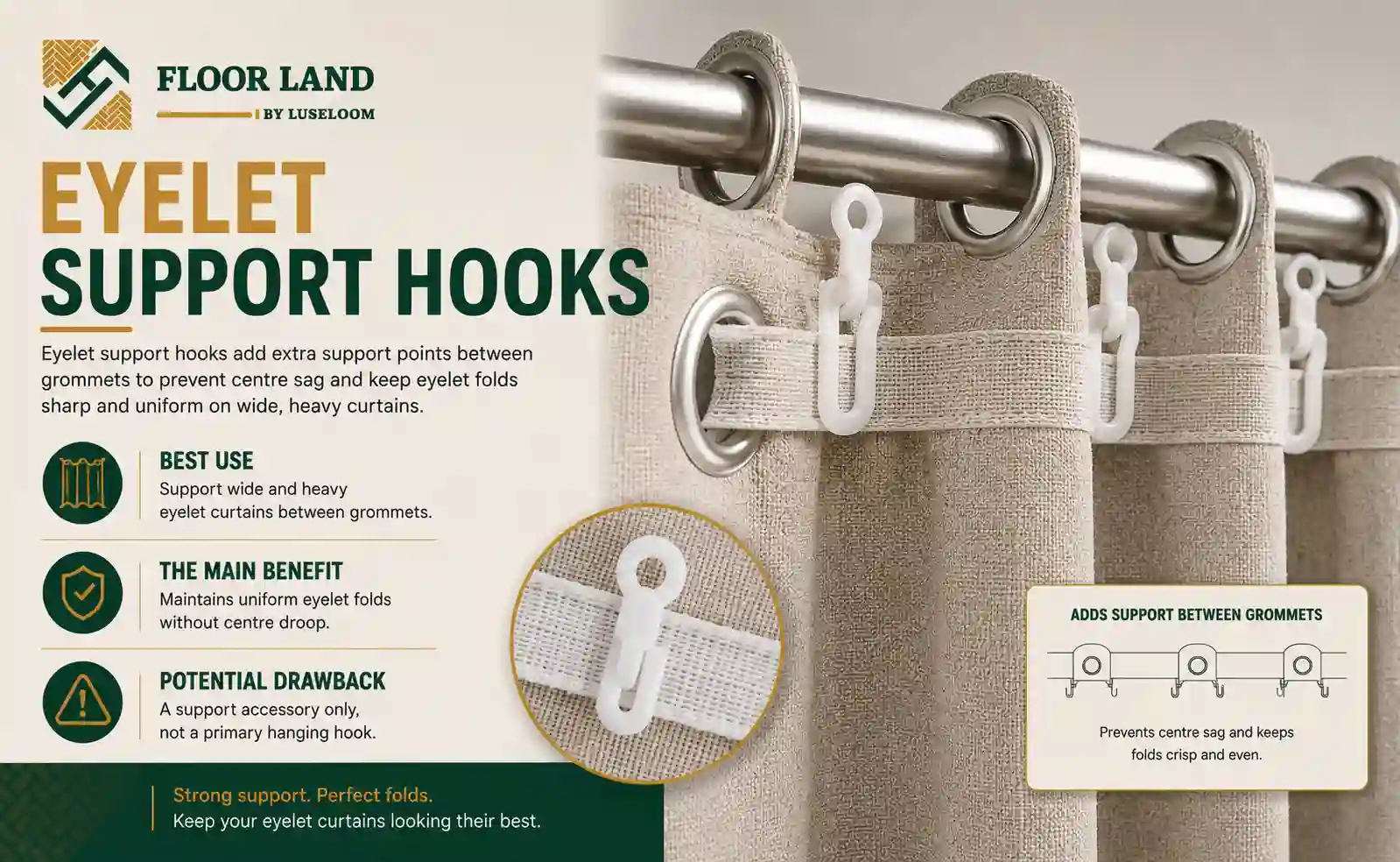
Eyelet support hooks are not the star; they are in a supporting role. Eyelet curtains attach directly onto the pole via the metal grommets, but wide and heavy curtains can drag on the pole in the middle. These are small hooks which attach to the header to provide extra support points or to keep the folds in place.
They maintain a sharp ring-fold pattern on eyelet curtains and prevent the centre sag in curtains longer than 2 meters. They can’t simply be used to replace the eyelets and won’t do anything on short, light panels. I use them primarily in bedrooms on wide blackout curtains with eyelet holes.
- Best use: Wrap wide, heavy eyelet curtains between the grommets.
- The main benefit is that it maintains the uniformity of the eyelet folds without causing center droop.
- Potential drawback: A support accessory only, not a primary hanging hook.
10. Ripple Fold Hooks
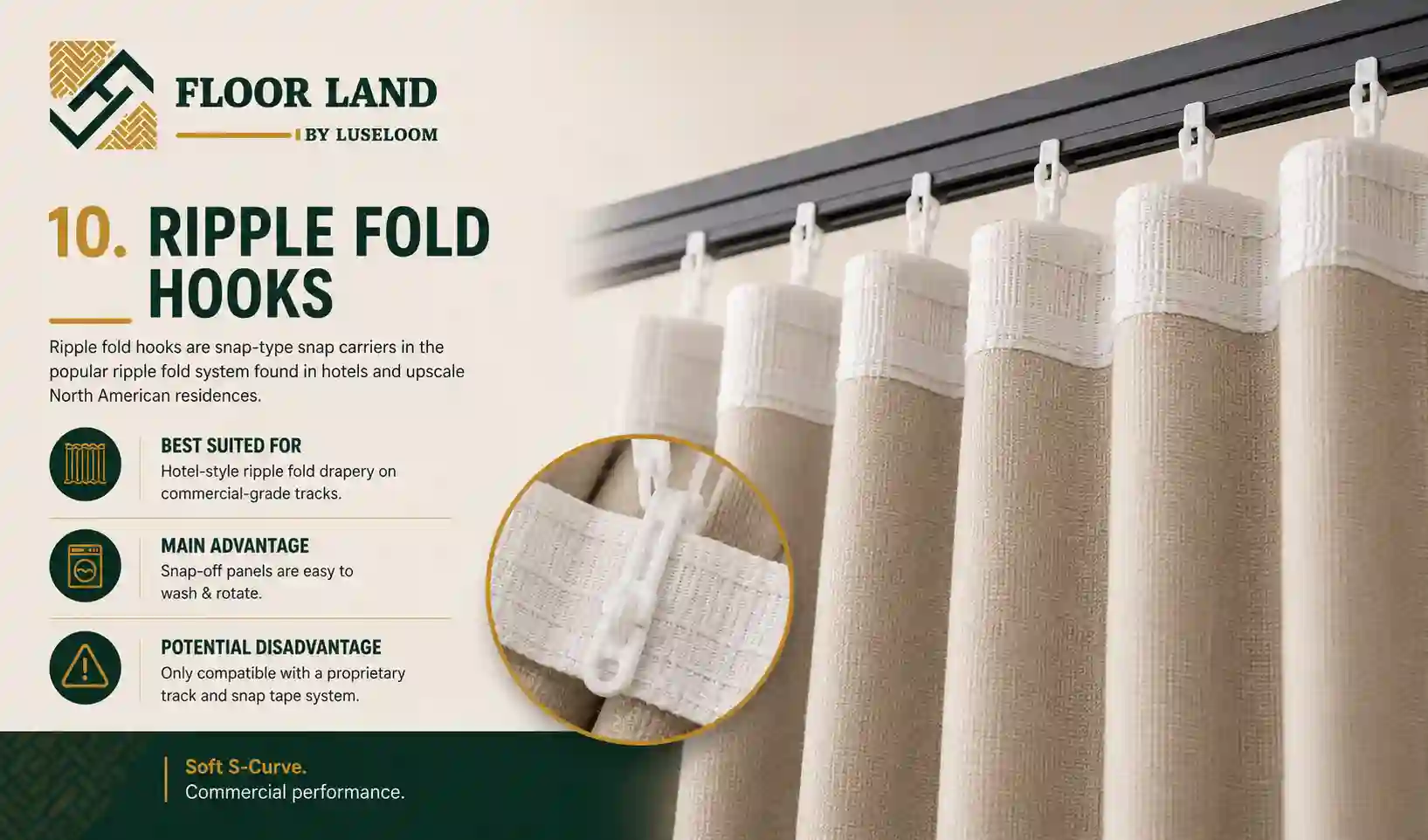
Ripple fold hooks are snap-type snap carriers in the popular ripple fold system found in hotels and upscale North American residences. The curtain header is equipped with snap tape, and each snap attaches to a carrier that runs along a track.
The outcome is the same soft S-Curve as wave curtains, designed for commercial use in a hard situation. Hospitality specifiers are fond of them because they unsnap in seconds for laundering. It does require a compatible ripple-fold track and professionally spaced snap tape, which makes the initial price higher. Works with medium-weight fabrics on very wide looms.
- Best suited for: Hotel-style ripple fold drapery on commercial-grade tracks.
- The main advantage: Snap-off panels are easy to wash & rotate.
- Potential disadvantage: Only compatible with a proprietary track and snap tape system.
11. Heavy Duty Curtain Hooks
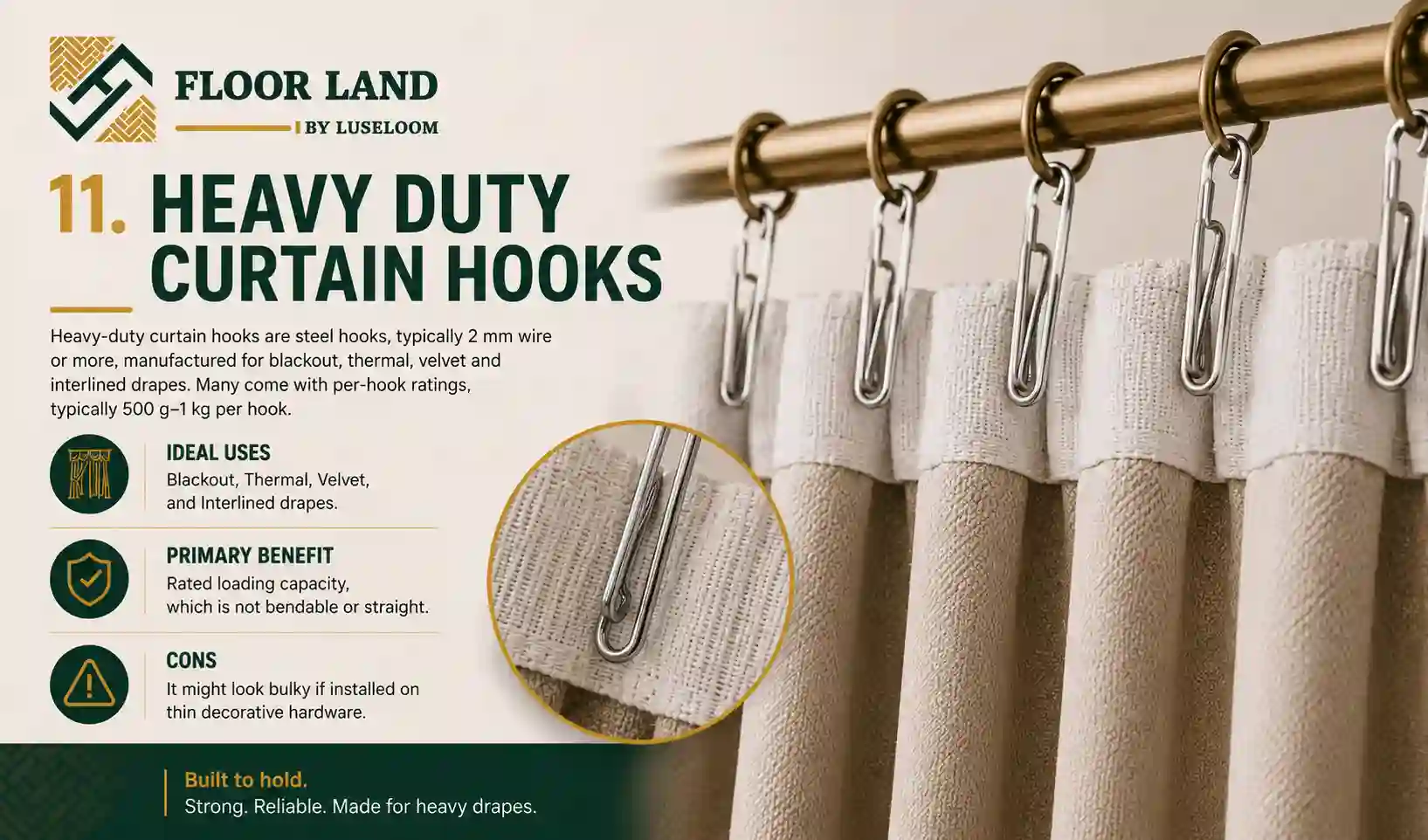
Heavy-duty curtain hooks are steel hooks, typically 2 mm wire or more, manufactured for blackout, thermal, velvet and interlined drapes. Many come with per-hook ratings, typically 500 g-1 kg per hook.
The maths is simple. With a 6 kg velvet panel every 10 cm on a 1.5 m header, it is estimated to be about 400 g per hook, which is well within spec. Regular hooks are loose in the same task and slowly straighten. The only drawbacks are slightly more expensive and a thicker design that will show up on very thin tracks. With heavy curtains, they are a must.
Ideal uses: Blackout, Thermal, Velvet, and Interlined drapes.
Primary benefit: Rated loading capacity, which is not bendable or straight.
Cons: It might look bulky if installed on thin decorative hardware.
12. Stainless Steel Curtain Hooks
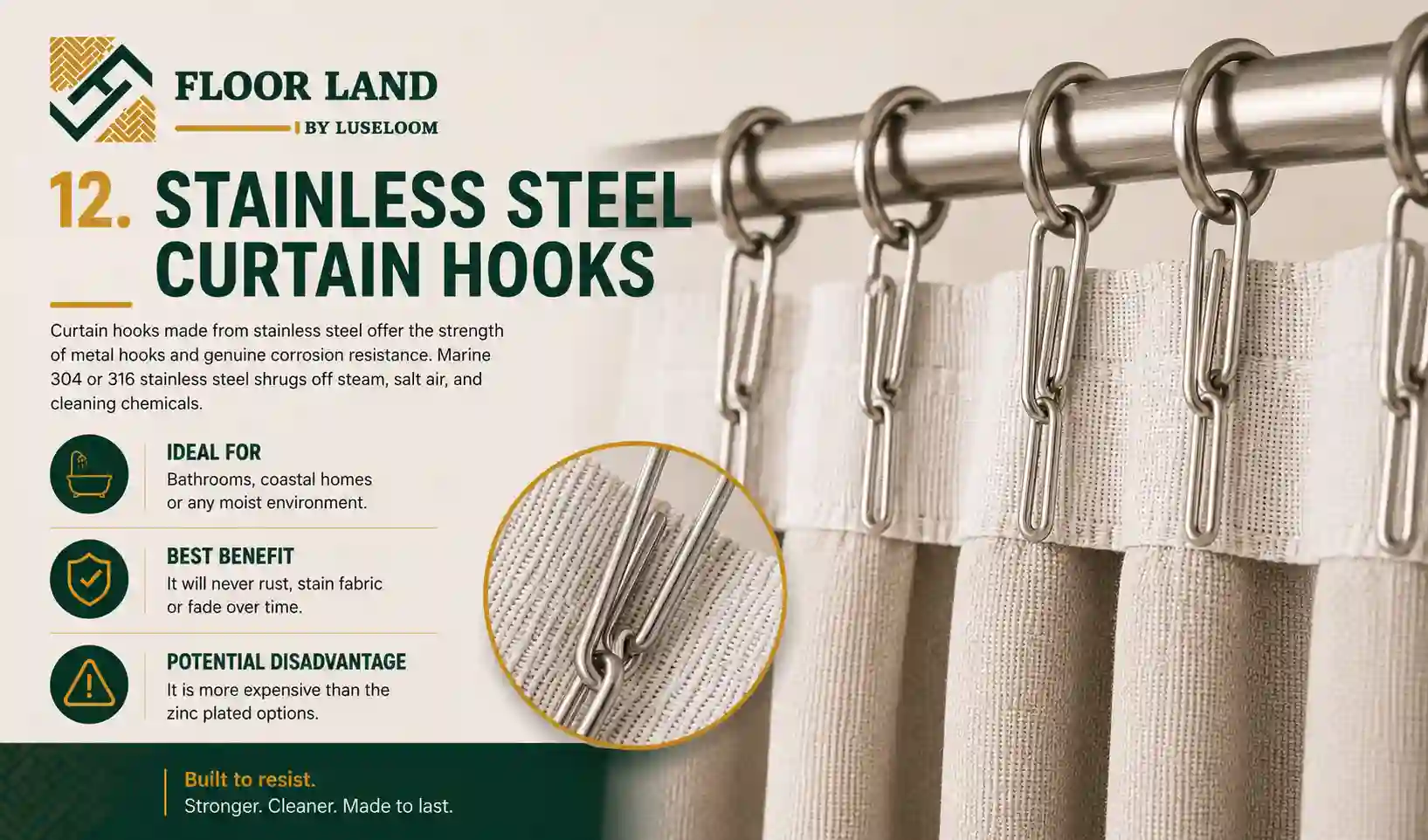
Curtain hooks made from stainless steel offer the strength of metal hooks and genuine corrosion resistance. Marine 304 or 316 stainless steel shrugs off steam, salt air, and cleaning chemicals.
These are my baseline requirements for bathrooms, poolside rooms, boats, and coastal properties, where the zinc-plated hook has rust spots and stains on the header within a year. They can easily carry medium and heavy window curtains and last longer than the curtains. It should cost two to three times as much as plated steel, but that is only a pinch if you’re just purchasing a few hundred.
- Ideal for: Bathrooms, coastal homes or any moist environment.
- Best benefit: It will never rust, stain fabric or fade over time.
- Potential disadvantage: It is more expensive than the zinc plated options.
13. Brass Curtain Hooks
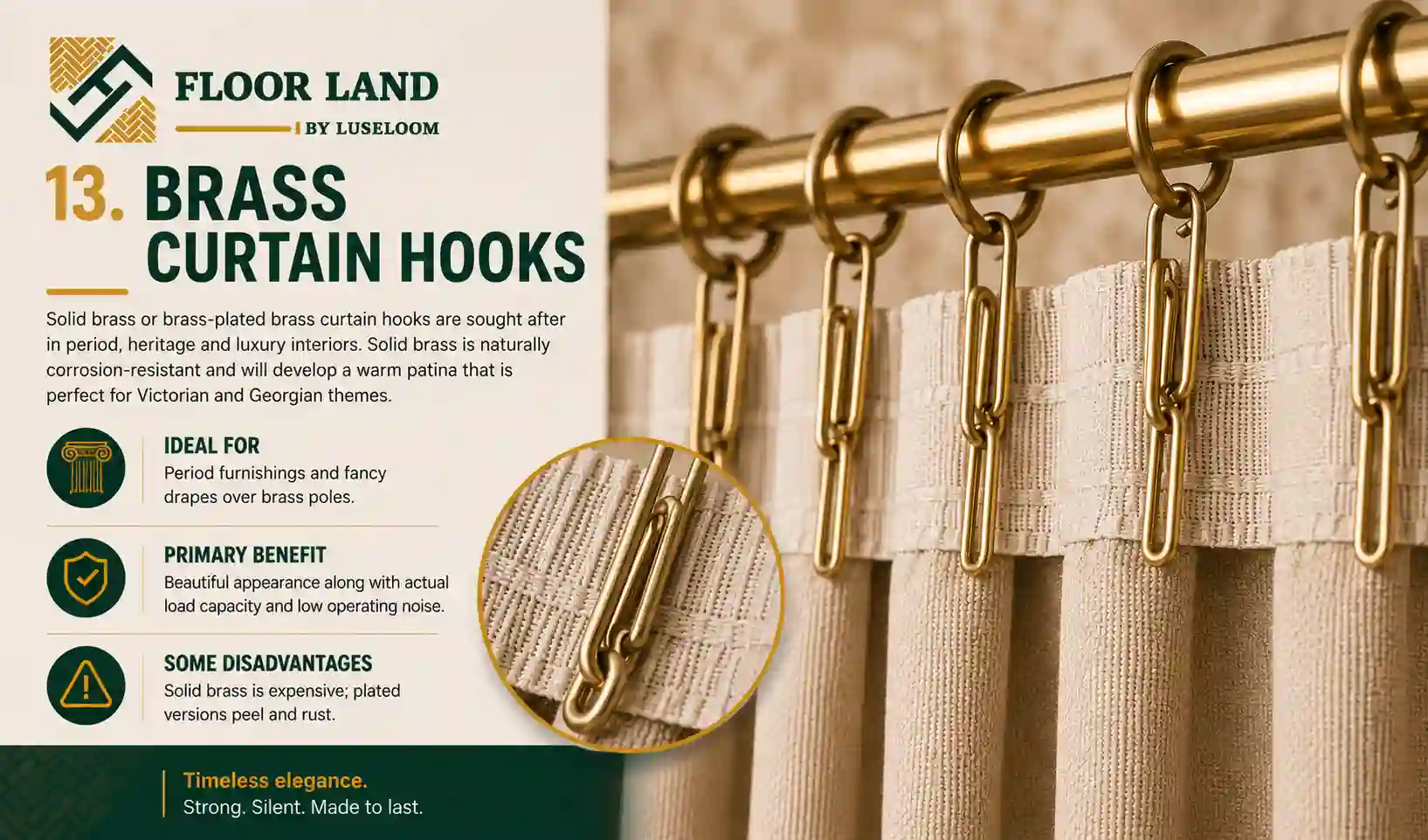
Solid brass or brass-plated brass curtain hooks are sought after in period, heritage and luxury interiors. Solid brass is naturally corrosion-resistant and will develop a warm patina that is perfect for Victorian and Georgian themes.
In addition to its appearance, brass is strong enough to support heavy lined drapes and performs silently on brass poles and rings, thye are recommended to prevent galvanic wear between dissimilar metals. Look out for low-quality brass-plated steel that will chip and then rust. Solid brass may be more expensive but can tarnish in a way some customers may not prefer, though many do.
- Ideal for: Period furnishings and fancy drapes over brass poles.
- The primary benefit is a beautiful appearance along with actual load capacity and low operating noise.
- Some disadvantages: Solid brass is expensive; plated versions peel and rust.
14. Ceiling Track Hooks
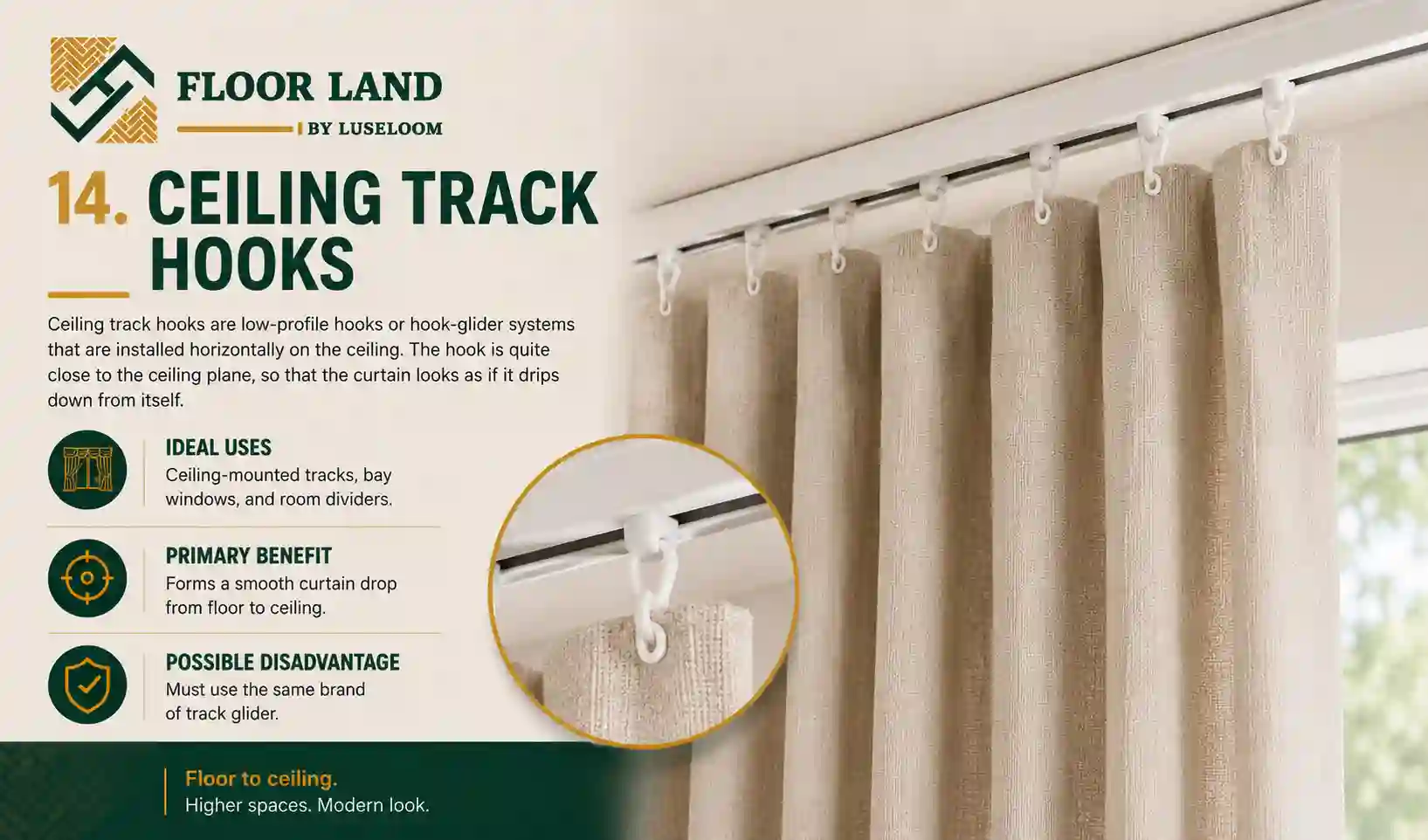
Ceiling track hooks are low-profile hooks or hook-glider systems that are installed horizontally on the ceiling. The hook is quite close to the ceiling plane, so that the curtain looks as if it drips down from itself.
This illusion of height from floor to ceiling will make rooms feel taller and is one of the top interior trends for 2026. They also come in handy for awkward spaces, such as bay windows, room dividers, hospital cubicles, and windows without wall space above the window frame. Fitting involves aligning the hook with the track brand’s glider channel and the roller count; cheap gliders squeak after prolonged use in a day.
- Ideal uses: Ceiling-mounted tracks, bay windows, and room dividers.
- Primary benefit: Forms a smooth curtain drop from the floor to ceiling.
- Possible disadvantage: Must use the same brand of track glider.
15. Traverse Rod Hooks
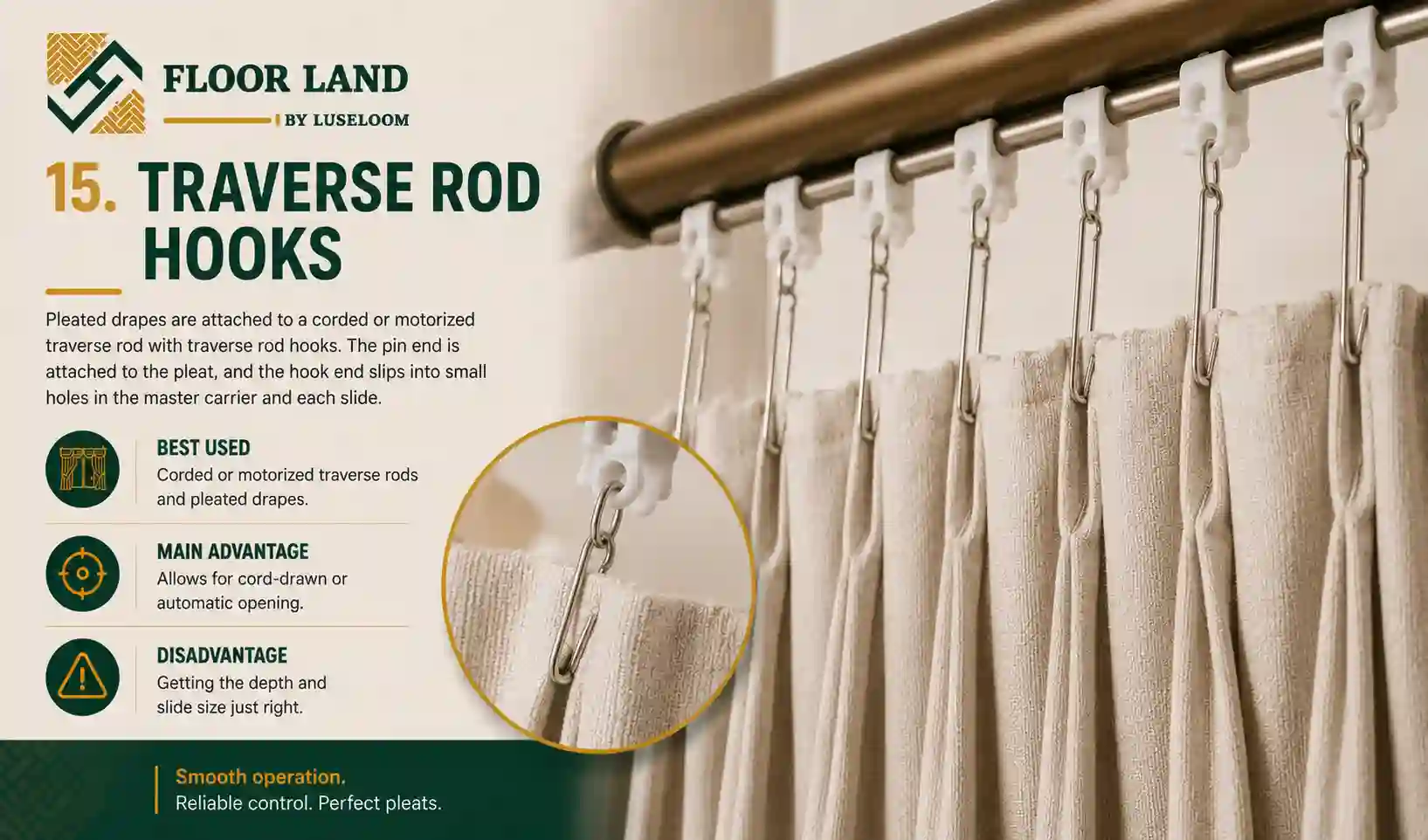
Pleated drapes are attached to a corded or motorized traverse rod with traverse rod hooks. The pin end is attached to the pleat, and the hook end slips into small holes in the master carrier and each slide.
They are crucial to cord-drawn draw drapes, which remain the norm in much of North America, and smart-home rods are enjoying a comeback thanks to motorization. The key to pin depth is to have the header cover the rod when closed. Master carrier overlap needs a bit of practice, and the hook size should match the slide hole size.
- Best used: Corded or motorized traverse rods and pleated drapes.
- Main advantage: Allows for cord-drawn or automatic opening.
- Disadvantage: Getting the depth and slide size just right.
16. Double Curtain Hooks
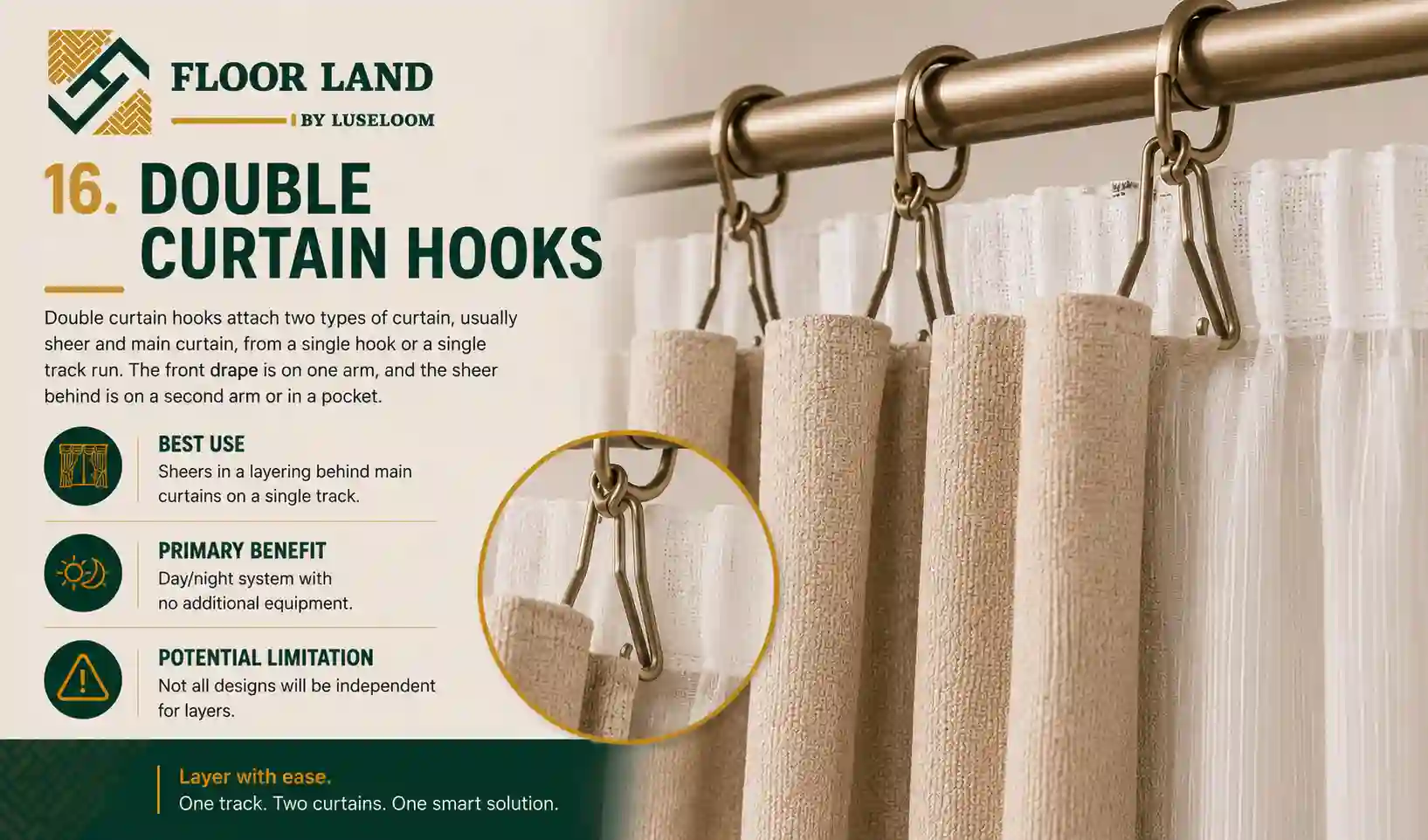
Double curtain hooks attach two types of curtain, usually sheer and main curtain, from a single hook or a single track run. The front drape is on one arm, and the sheer behind is on a second arm or in a pocket.
These are a clever solution where a double track or second pole can’t be accommodated, such as in an apartment with narrow window reveals. Day/night layering is possible with one camera. The trade-off is that both layers move together (unless the design allows them to move independently), and the weights of both layers must be in the medium range.
- Best use: Sheers in a layering behind main curtains on a single track.
- Primary benefit: Day/night system with no additional equipment.
- Potential limitation: Not all designs will be independent for layers.
17. Hidden Curtain Hooks
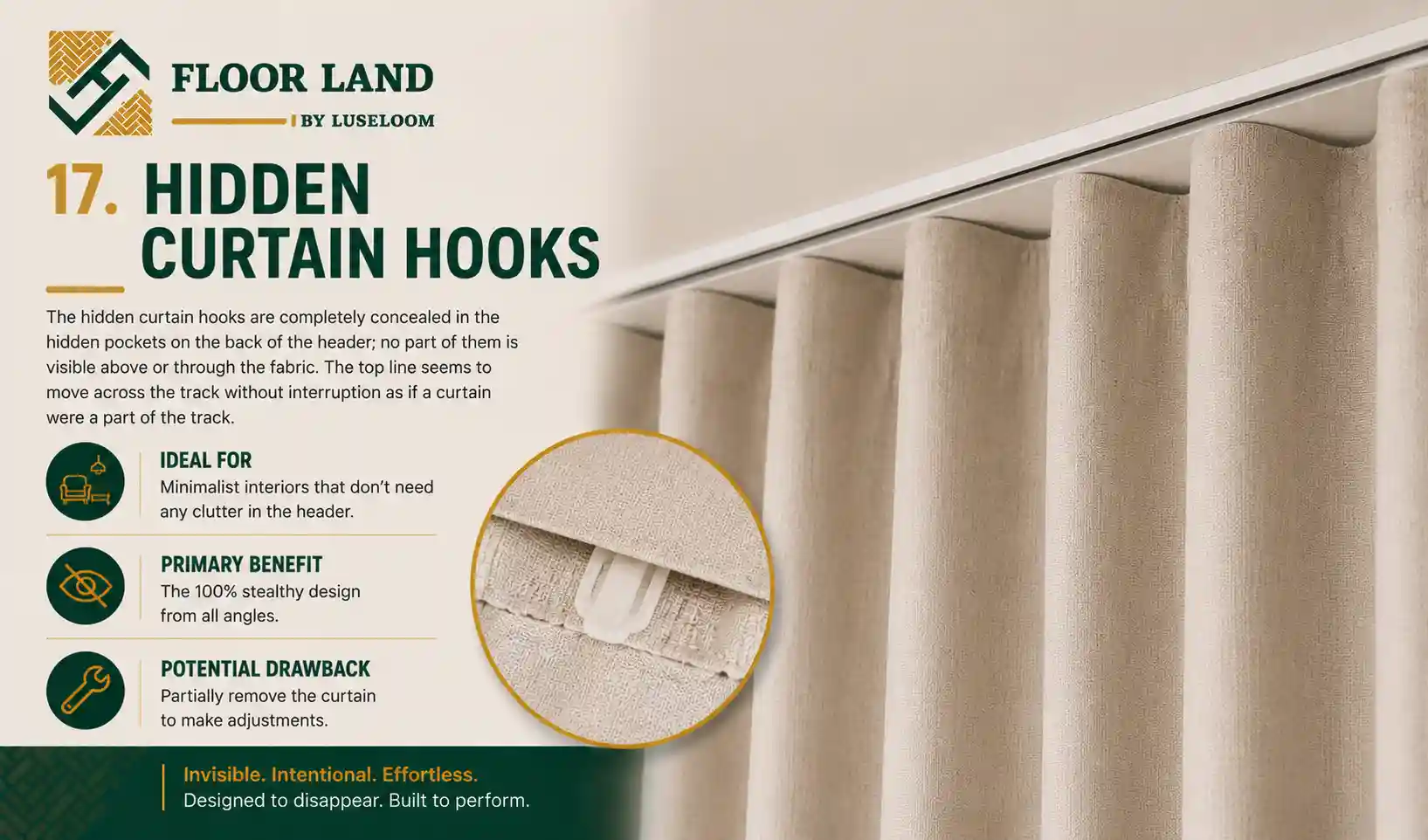
The hidden curtain hooks are completely concealed in the hidden pockets on the back of the header; no part of them is visible above or through the fabric. The top line seems to move across the track without interruption as if a curtain were a part of the track.
The demand for these is high, driven by minimalist and Japandi-style interiors. They are designed to be used with ceiling tracks and wave headers. Accessibility is the challenge: when you need to adjust or replace a hook, you have to remove a portion of the curtain, and they work well with crisp, light-to-medium-weight fabrics.
- Ideal for minimalist interiors that don’t need any clutter in the header.
- The primary benefit is the 100% stealthy design from all angles.
- Potential Drawback: Partially remove the curtain to make adjustments.
18. Decorative Curtain Hooks
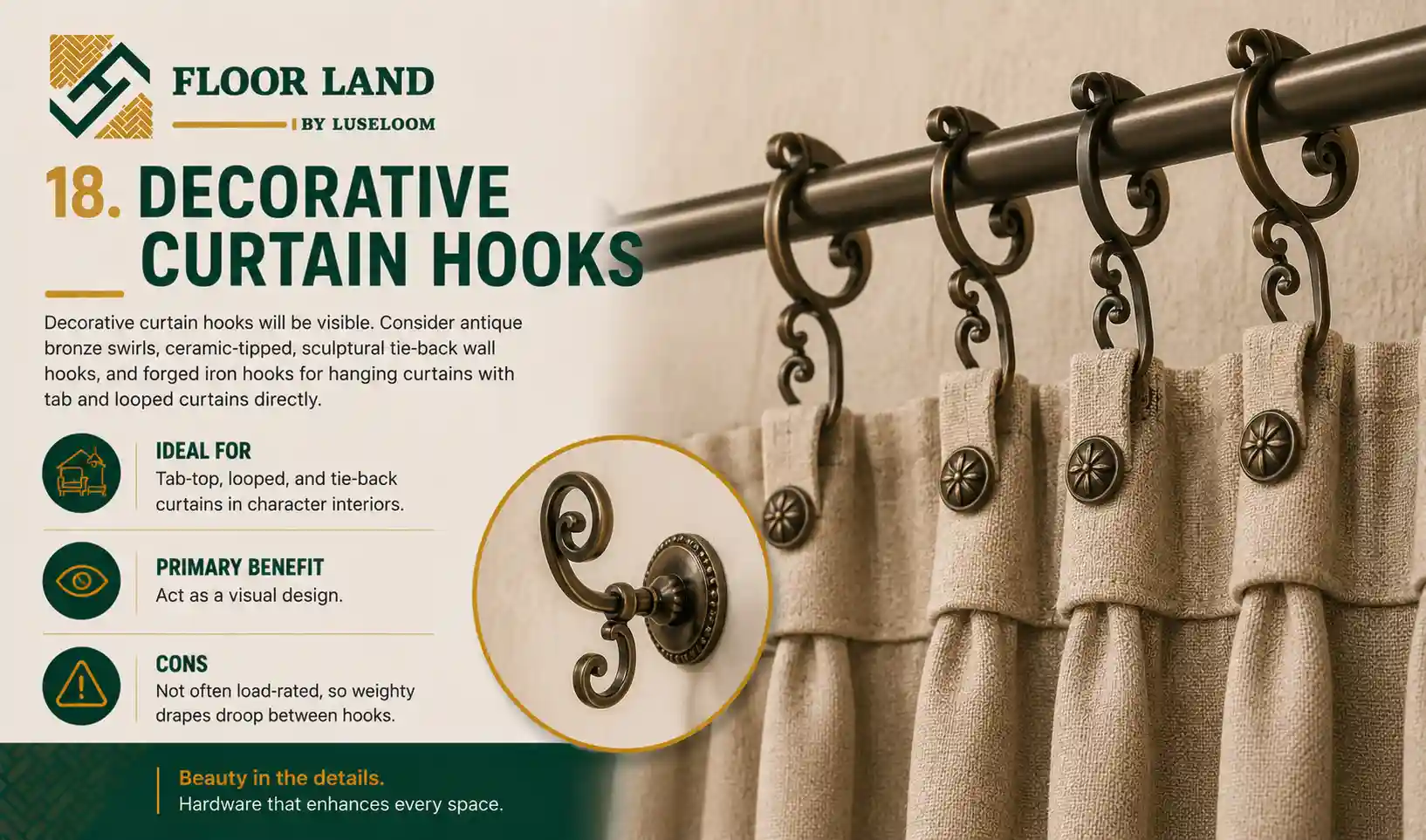
Decorative curtain hooks will be visible. Consider antique bronze swirls, ceramic-tipped, sculptural tie-back wall hooks, and forged iron hooks for hanging curtains with tab and looped curtains directly.
They use hardware as a design element, which is great in farmhouse, boho, and eclectic spaces where it serves as a feature. Here, function follows form: there is little load rating for decorative shapes; wider spacing between shapes and heavier drapes will sag between points. Pair them with light-to-medium window curtains and consider them jewelry!
Ideal for use: Tab-top, looped, and tie-back curtains in character interiors.
Primary benefit: Act as a visual design.
Cons: Not often load-rated, so weighty drapes droop between hooks.
19. Clip Curtain Hooks
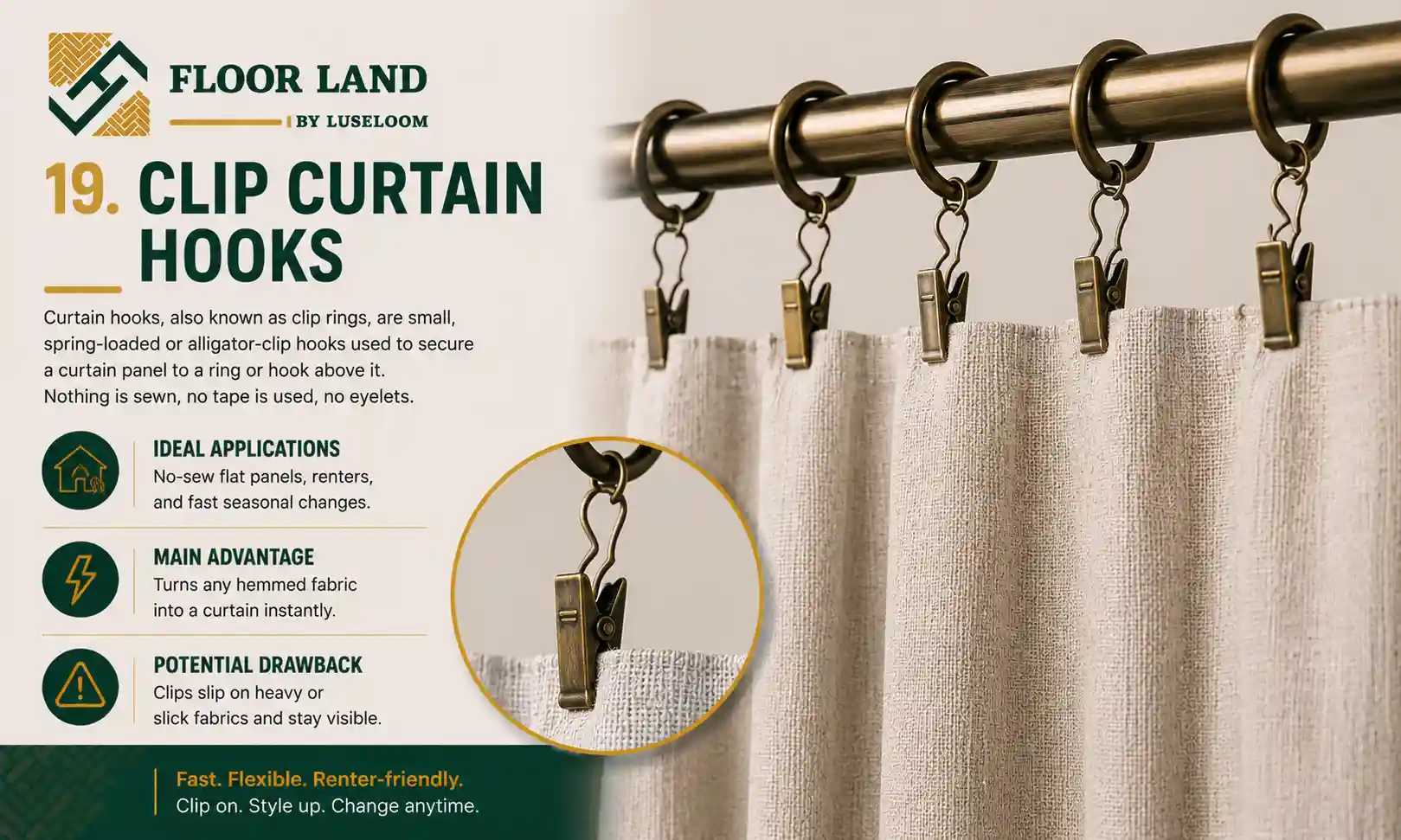
Curtain hooks, also known as clip rings, are small, spring-loaded or alligator-clip hooks used to secure a curtain panel to a ring or hook above it. Nothing is sewn, no tape is used, no eyelets.
They’re the renters’ and DIYers’ best friends. Within minutes, any hemmed fabric- a linen throw, vintage textile, drop cloth- becomes a curtain in minutes and curtains come down too as you want to wash them. Strength of grip, the limit. The clips are used to securely hold light fabrics, but slide in heavy or slippery material, and the clips are visible along the header.
- Ideal applications: No-sew flat panels, renters, and fast seasonal changes.
- Main advantage: Turns any hemmed fabric into a curtain instantly.
- Potential drawback: Clips slip on heavy or slick fabrics and stay visible.
20. Snap Curtain Hooks
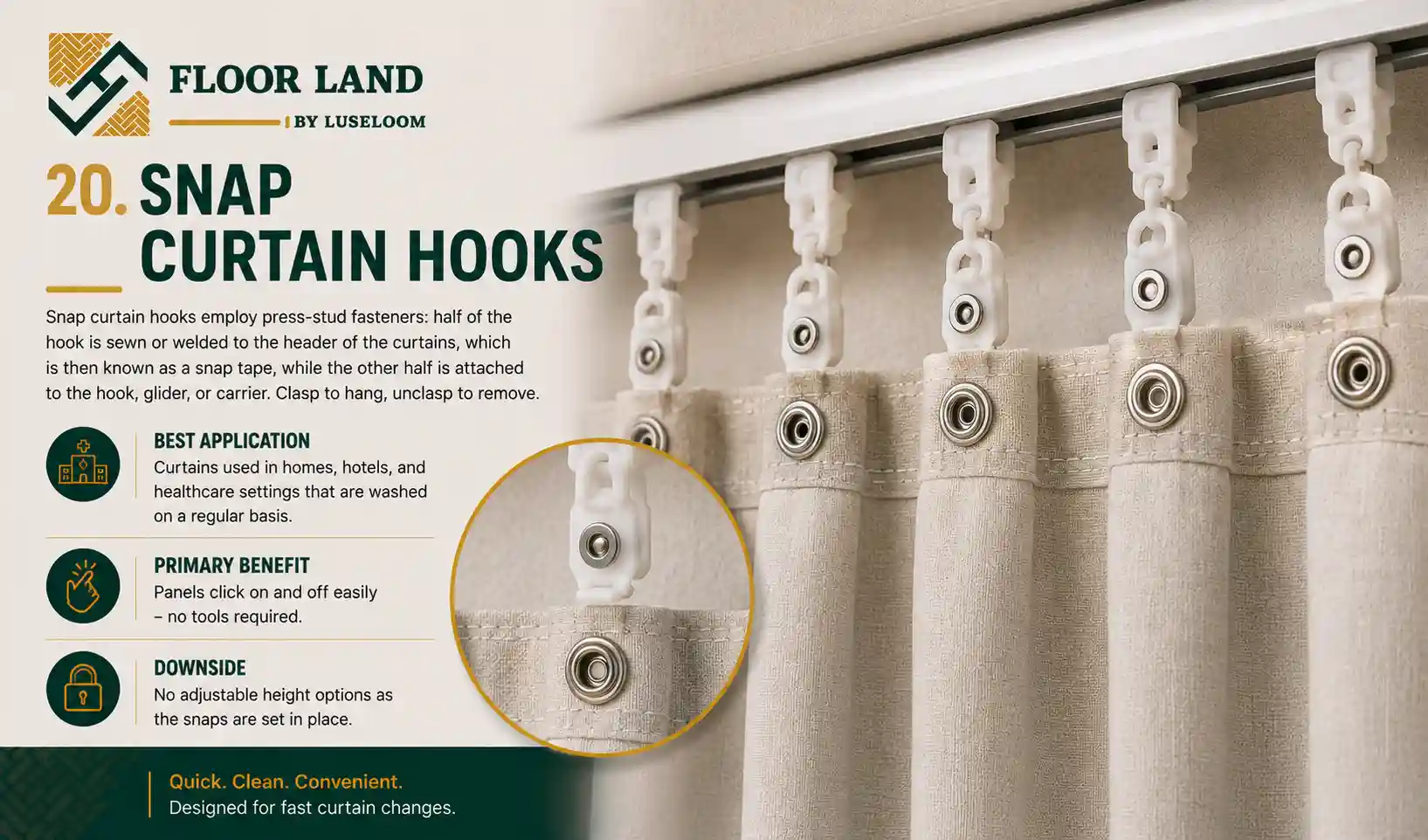
Snap curtain hooks employ press-stud fasteners: half of the hook is sewn or welded to the header of the curtains, which is then known as a snap tape, while the other half is attached to the hook, glider, or carrier. Clasp to hang, unclasp to remove.
They are used in hospitals, on cruise ships, in hotels, etc., because they allow staff to change a room’s curtains in minutes without needing ladders or unthreading hooks. Now that same convenience is available in family homes where the curtains are washed frequently. The tape locks it in place but eliminates the height-adjustable feature. Best for light to medium panels that are frequently laundered.
- Best application: Curtains used in homes, hotels, and healthcare settings that are washed on a regular basis.
- The primary benefit of such panels is that they click on and off essentially without any tools.
- Downside: No adjustable height options as the snaps are set in place.
How Curtain Hooks Affect Curtain Performance
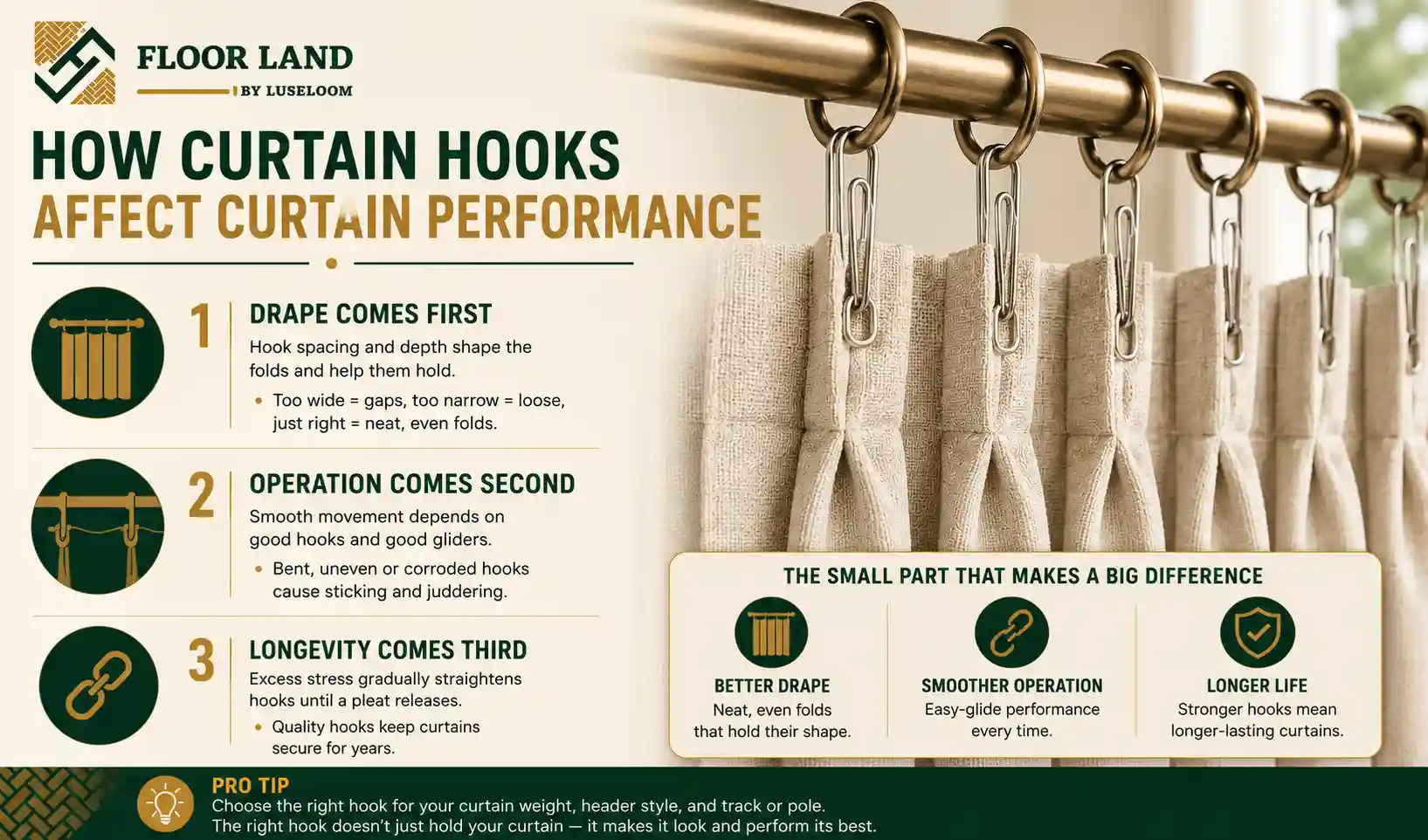
Hooks are the parts of a curtain where it is hung. All their performance levels are passed on in the fabric.
Drape comes first. Fold formation and retention are dependent on the spacing and depth of the hooks. Pin hooks spaced at 5 mm too far apart produce irregular, less tight folds; hooks spaced 10 mm apart produce even, tighter folds, but spacing 15 mm or more apart produces gaps at the top of the header.
Operation comes second. If a curtain sticks or judders, it is likely that the hook is bent, the hooks are not all the same size, or the hooks are corroded and unable to engage the gliders. The ability to run smoothly is a hardware attribute, not a fabric attribute.
Longevity comes third. When too much stress is applied to the hook, it straightens up at a rate of 1 millimeter per millimeter until one pleat releases.
How To Choose The Right Curtain Hook
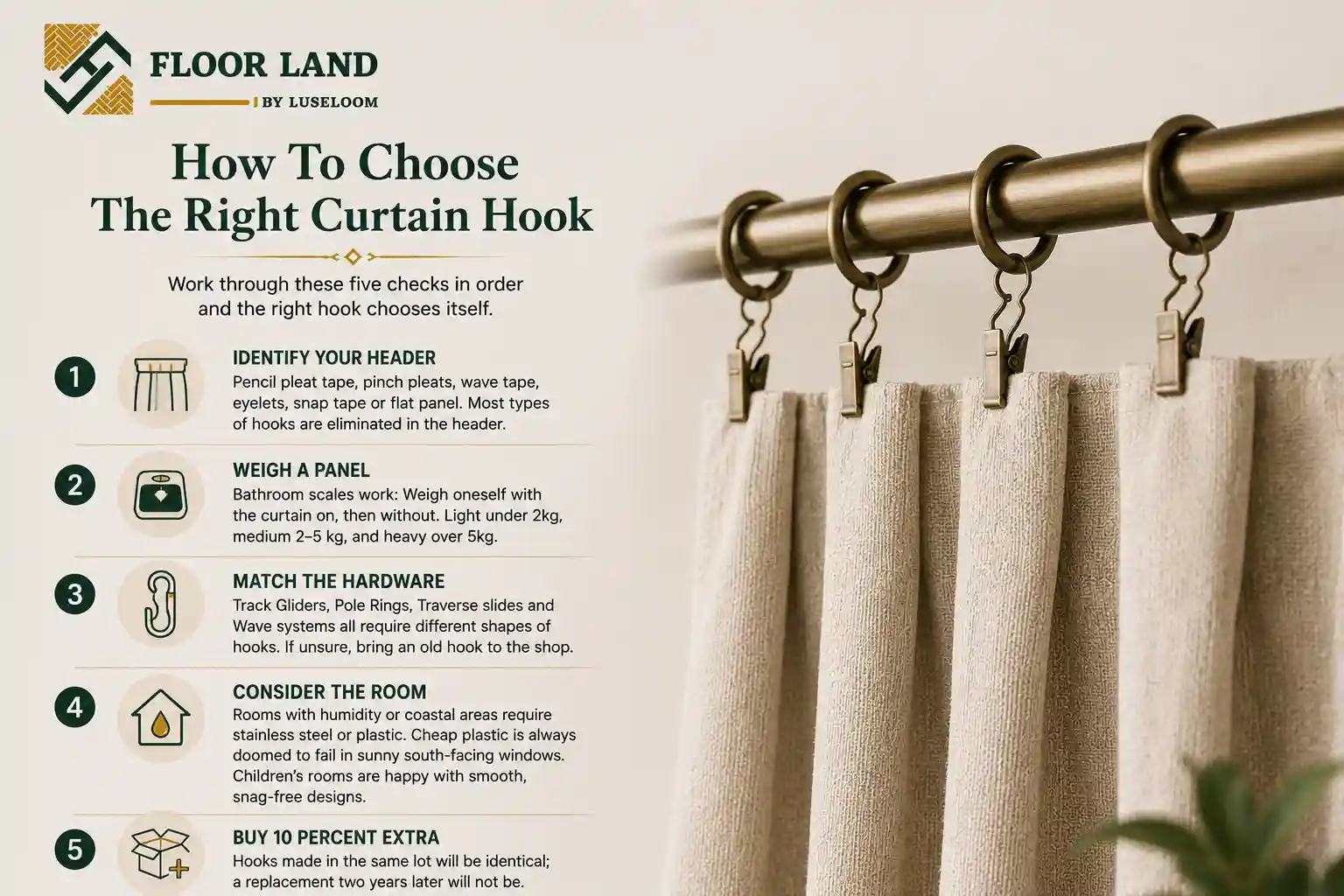
Work through these five checks in order and the right hook chooses itself.
- Identify your header. Pencil pleat tape, pinch pleats, wave tape, eyelets, snap tape or flat panel. Most types of hooks are eliminated in the header.
- Weigh a panel. Bathroom scales work: Weigh oneself with the curtain on, then without. Light under 2kg, medium 2- 5 kg, and heavy over 5kg.
- Match the hardware. Track Gliders, Pole Rings, Traverse slides and Wave systems all require different shapes of hooks. If unsure, bring an old hook to the shop.
- Consider the room. Rooms with humidity or coastal areas require stainless steel or plastic. Cheap plastic is always doomed to fail in sunny south-facing windows. Children’s rooms are happy with smooth, snag-free designs.
- Buy 10 percent extra. Hooks made in the same lot will be identical; a replacement two years later will not be.
Signs It Is Time To Replace Curtain Hooks
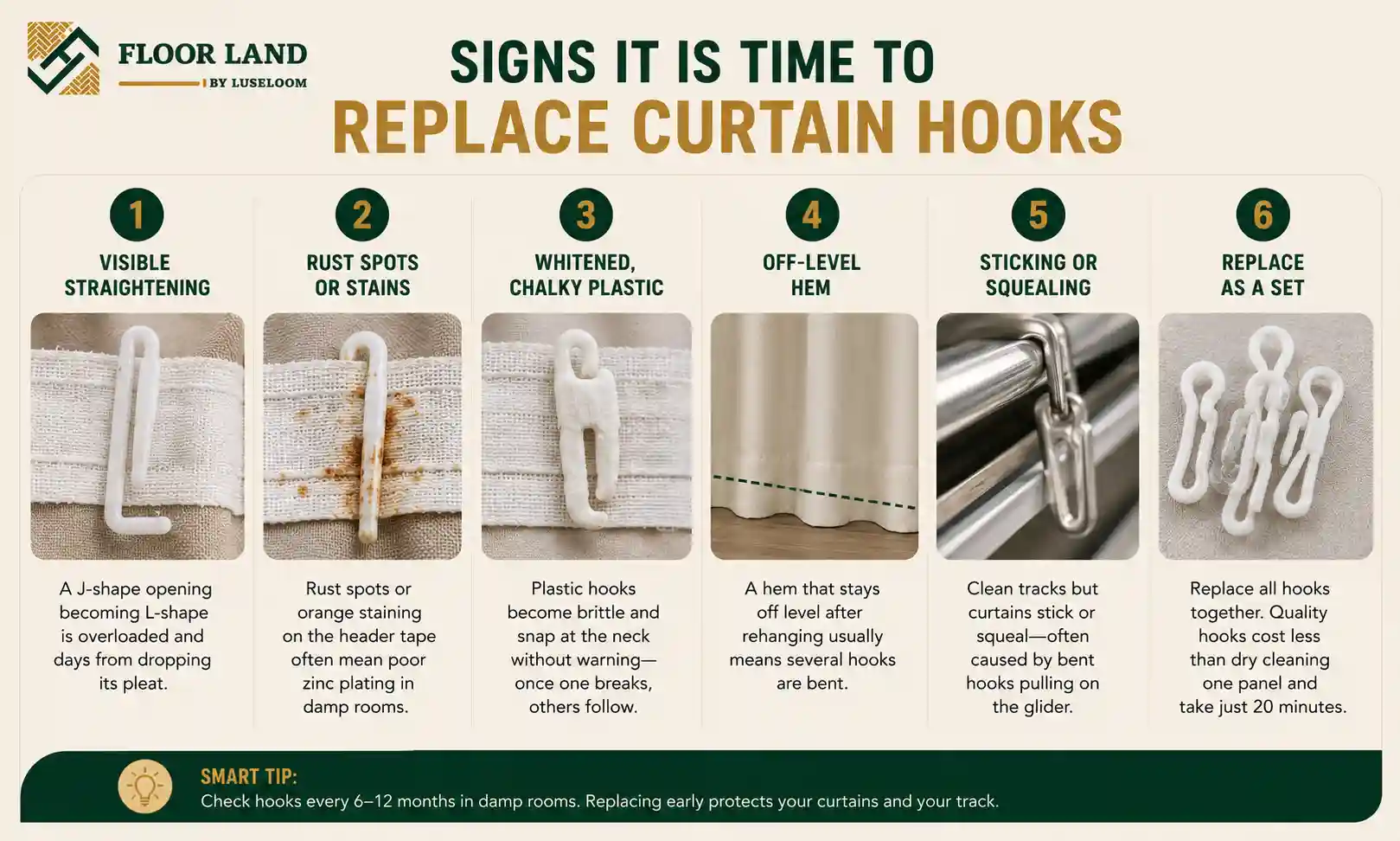
It is highly unlikely that the curtain hooks will all fail at once. They notify you beforehand.
- Visible straightening. An opening in a J-shape to L-shape is overloaded and days from dropping its pleat.
- A common symptom of poor zinc plating in a damp room is rust spots or orange staining on the header tape.
- Whitened, chalky plastic. These plastic hooks tend to break at the snap without warning, and as soon as one hooks, the other hook follows.
- A hem that remains off level after rehanging – typically indicates that several of the hooks have bent out of shape.
- Clean tracks have curtains that stick or squeal to the track – bent hooks pulling the curtains to the glider track.
- Change out sets of hooks. The total cost of quality hooks is less than dry cleaning one panel, and swapping takes 20 minutes.
Conclusion:
The right curtain hook is invisible in the best way: the curtain hangs level, glides quietly, and stays that way for years. At Floor Land, we recommend matching the header first, the weight second, and the track third—because almost every curtain hanging problem disappears when these three elements are correctly paired.
Best overall: Stainless steel pin hooks, precise, rust-proof, and strong enough for nearly any pleated drape.
Best heavy-duty option: Rated heavy-duty steel hooks at 8 to 10 cm spacing for blackout, thermal, and velvet curtains.
Best decorative option: Solid brass hooks paired with brass rings for period and luxury interiors.
Best budget option: Standard plastic pencil pleat hooks for sheers and light ready-made curtains.
Best for modern curtains: Wave curtain hooks on a matched glider track for clean S-fold styling.
Hooks cost less than almost any other part of a window treatment, yet they decide how the whole treatment performs. Spend the extra few pounds on the right set once, and your curtains will thank you every single morning.
Frequently Asked Questions
What type of curtain hook is best overall?
The best all-round option is stainless-steel or coated-steel hooks. They can be easily attached to standard header tape, hung without bending on medium- to heavy-weight curtains, and last for decades. Stainless steel pin hooks will provide accurate height control for pleated drapes. Plastic hooks are only suitable for sheer fabrics and extremely lightweight pre-made curtains.
How many curtain hooks do I need per curtain?
Use 1 hook per 10cm of gathered header width, and 1 at each end. Typically, a 1.4 m (9.8 in) gathered panel requires about 13 to 15 hooks. Heavy blackout or velvet drapes are best when spaced 8 cm apart. The further apart they are, the more money will be saved, but they will look saggy.
Are plastic or metal curtain hooks better?
Metal hooks are more durable, hold longer, and are better for lined or heavy curtains. Plastic hooks are less expensive, quieter, and rust-resistant, making them perfect for bathrooms and kitchens. For curtains that weigh more than 2kg per panel, use metal. Select stainless steel or plastic in moist areas.
What hooks do I use for pencil pleat curtains?
Standard Pencil pleat hooks are used on woven pockets on header tape for sheers and metal for lined curtains. Pick the best pocket row to place a track behind the curtain, or choose the bottom row to hang underneath a decorative pole and not behind it.
Can curtain hooks hold heavy blackout curtains?
Yes, provided that you place heavy-duty steel hooks (rated between 500g and 1kg per hook) at intervals of 8cm to 10cm, and allow for 30 percent over the panel weight for the impact of drawing. Avoid hanging blackout curtains on plastic hooks.
How do I stop curtain hooks from rusting?
In wet areas such as bathrooms, kitchens and houses near water, opt for stainless steel, solid brass or plastic hooks. When the plating on the steel rusts from exposure to air, the rusting will not be removed by the header tape and will stain it permanently. Opening the door and cleaning up condensation on wires also inhibit corrosion of existing equipment.
What is the difference between pin hooks and pleater hooks?
Pin hooks are a single sharp pin designed to pierce an existing pleat, offering precise height adjustment on finished pinch-pleat drapes. Pleater hooks contain 4 prongs that hook into pleating tape pockets and form the pleating as they are inserted. For tailored headers, use pin hooks, and for taped flat panels, use pleater hooks.
Which hooks work with wave or S-fold curtains?
Wave curtains need dedicated wave hooks or gliders matched to wave header tape and a compatible track, with glider spacing of typically 60 mm or 80 mm. Standard hooks cannot produce the continuous S-fold. Buy the tape, hooks, and track as one system from a single manufacturer to guarantee the fold geometry.
How often should curtain hooks be replaced?
Quality metal hooks last 10 to 20 years, while budget plastic hooks in sunny windows may need replacing every 3 to 5 years. Replace the whole set as soon as you spot straightened hooks, rust stains, chalky brittle plastic, or an uneven hem. Mixed old and new hooks hang at slightly different heights.
Can I hang curtains without sewing using hooks?
Yes. Clip curtain hooks grip any hemmed flat panel without sewing, tape, or eyelets, making them perfect for renters and quick makeovers. S hooks also instantly hang loop-top and tab-top panels. Both suit light fabrics; for anything heavier, a sewn or taped header with proper hooks is safer.