
How to Get Pee Smell Out of Carpet? Top 10 Effective Ways
To remove pee smell from carpet permanently, immediately blot up liquid spills and saturate the area with an enzymatic cleaner to digest urine crystals. Then, let it dry completely. Fresh urine requires swift extraction before moisture seeps into the padding beneath. Dried spots need rehydration with cool water before applying enzyme spray for maximum deep-cleaning performance.
Standard household cleaners, vinegar, and baking soda only temporarily mask surface odors instead of eliminating the root cause. When humidity rises, trapped salts reactivate and bring back the foul odor. A targeted enzymatic solution breaks down these organic compounds permanently. It also keeps your carpet fibers, backing, and room fresh, clean, and scent-free for long periods. This blog post by Floor Land is a detailed explanation of removing pee smell from carpet.
Treat Pee Smell on the Carpet (Different Situations)
| Situation | Best approach | Key point |
| Fresh urine | Blot heavily, rinse with cool water, blot again | Remove liquid before it reaches the backing |
| Dried urine | Rehydrate the spot, then apply an enzymatic cleaner | The odor source sits below the surface |
| Dog urine | Enzyme treatment with long dwell time | Volume is usually larger than it looks |
| Cat urine | Enzyme treatment plus inspection of pad and subfloor | Highly concentrated and slow to clear |
| No baking soda on hand | Enzyme cleaner, or cool water flushing and extraction | Baking soda is optional, not essential |
| Smell returns after cleaning | Treat the carpet pad, and check the subfloor | Surface cleaning cannot reach the real source |
What Actually Removes Urine Odor?
Urine is mostly water when it lands. That water evaporates within a day or two, and what stays behind is the problem: urea, salts, uric acid compounds, and bacteria that feed on all of it. As those bacteria break down the urea, they release ammonia. That is why a spot you barely noticed on Monday can smell sharp and sour by Thursday.
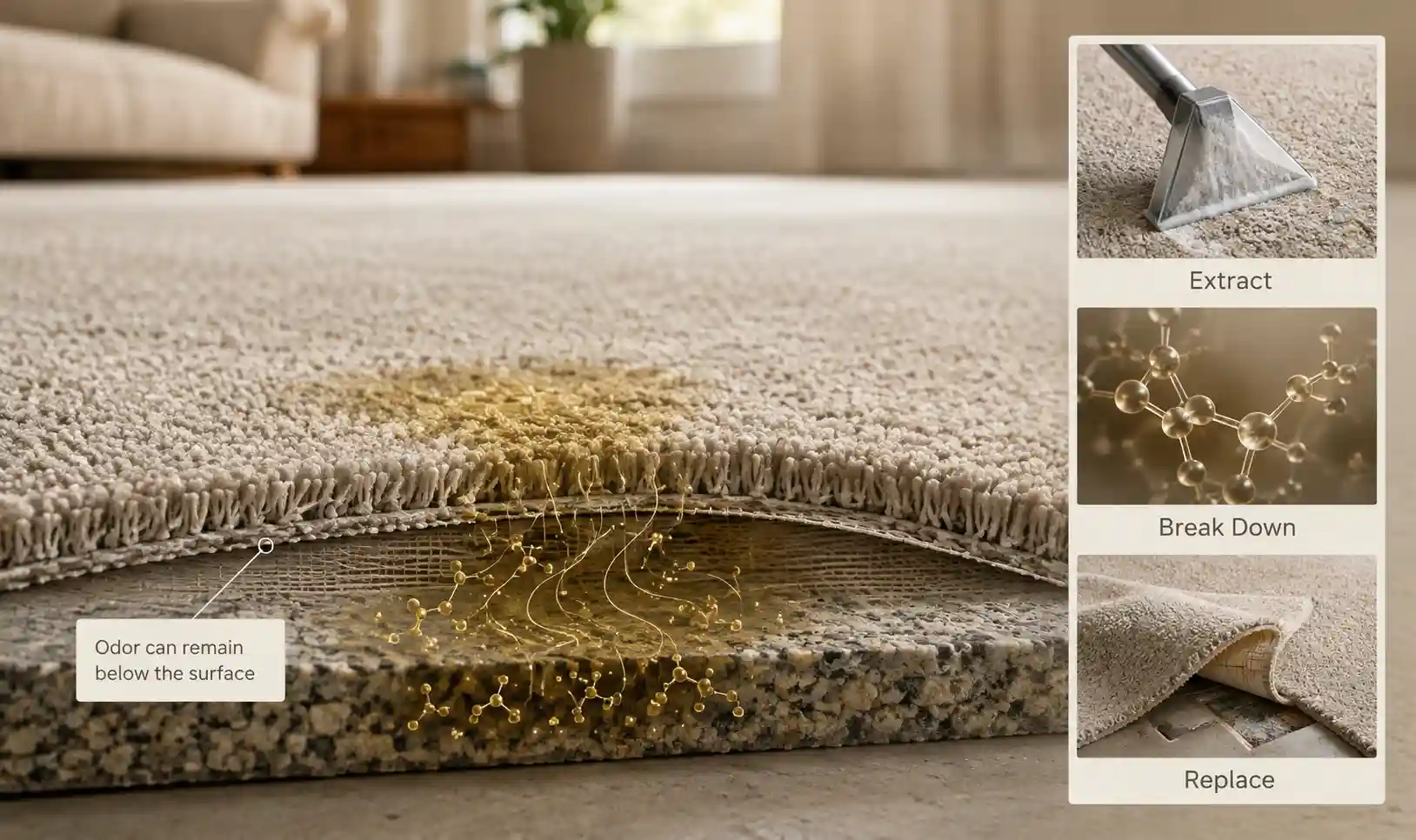
Uric acid compounds are the stubborn part. They bind to carpet fibers and the backing, and plain water doesn’t lift them well. They also sit quietly when everything is dry, then release odor again when humidity rises or when you clean the area with water. That is the exact reason people say the smell “came back” after shampooing. It never left.
So there are really only three things that work:
- Physical removal. Getting the contaminated liquid out of the wall-to-wall carpet by blotting, flushing, and extracting.
- Breaking the compounds down. Enzymatic cleaners contain enzymes and bacteria that digest the organic residue instead of just diluting it.
- Removing the contaminated material. When urine has saturated the padding, the fastest honest fix is to cut out and replace that section.
Everything else falls into a different category. Air fresheners, carpet powders, scented sprays, and air purifiers can make a room more pleasant while you work, and a purifier does help with airborne ammonia. None of them touch the residue in the fibers. If you only do that, the odor comes back the first humid day.
Top 10 Ways to Get Rid Of Pee Smell Out Of Carpet?
Urine odor can be difficult to remove because the liquid does not always stay in the carpet fibers. A larger accident can soak through the backing and into the underlay or padding. Once the moisture dries, urine salts and other residues remain behind and can produce a strong odor, particularly when humidity rises.
The right approach depends on how fresh the accident is and how deeply it has penetrated the carpet.
1. Blot Fresh Urine as Soon as Possible
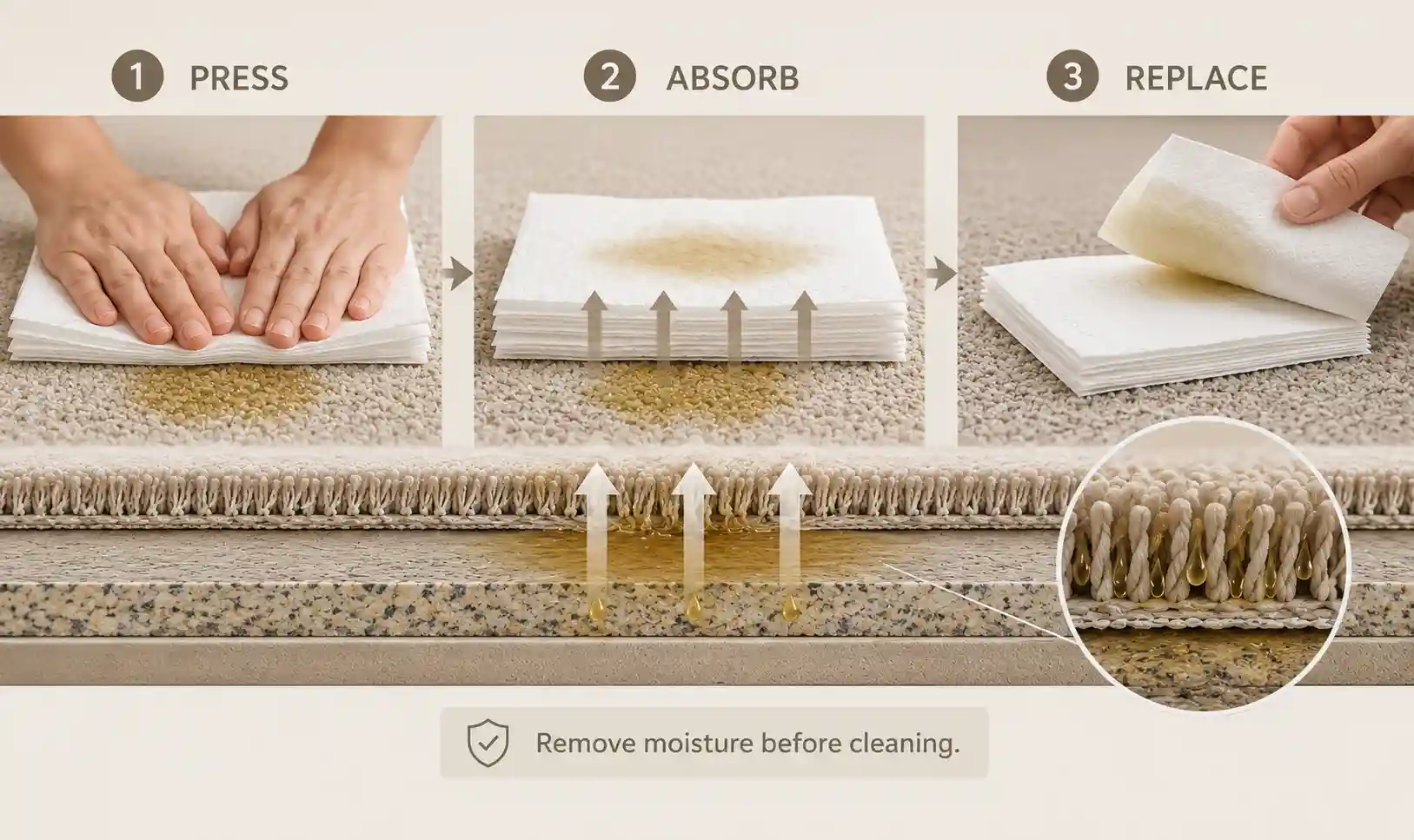
If the urine is still wet, remove as much liquid as possible before applying any cleaner. This is the first and most important step because less urine left in the carpet means less residue to cause odor later. Place several layers of white paper towels or a clean, absorbent white cloth over the wet area. Apply firm pressure with your hands or by standing on the towels. Replace them when they become saturated and continue until very little moisture transfers to the towel.
2. Rinse the Area With Cool Water
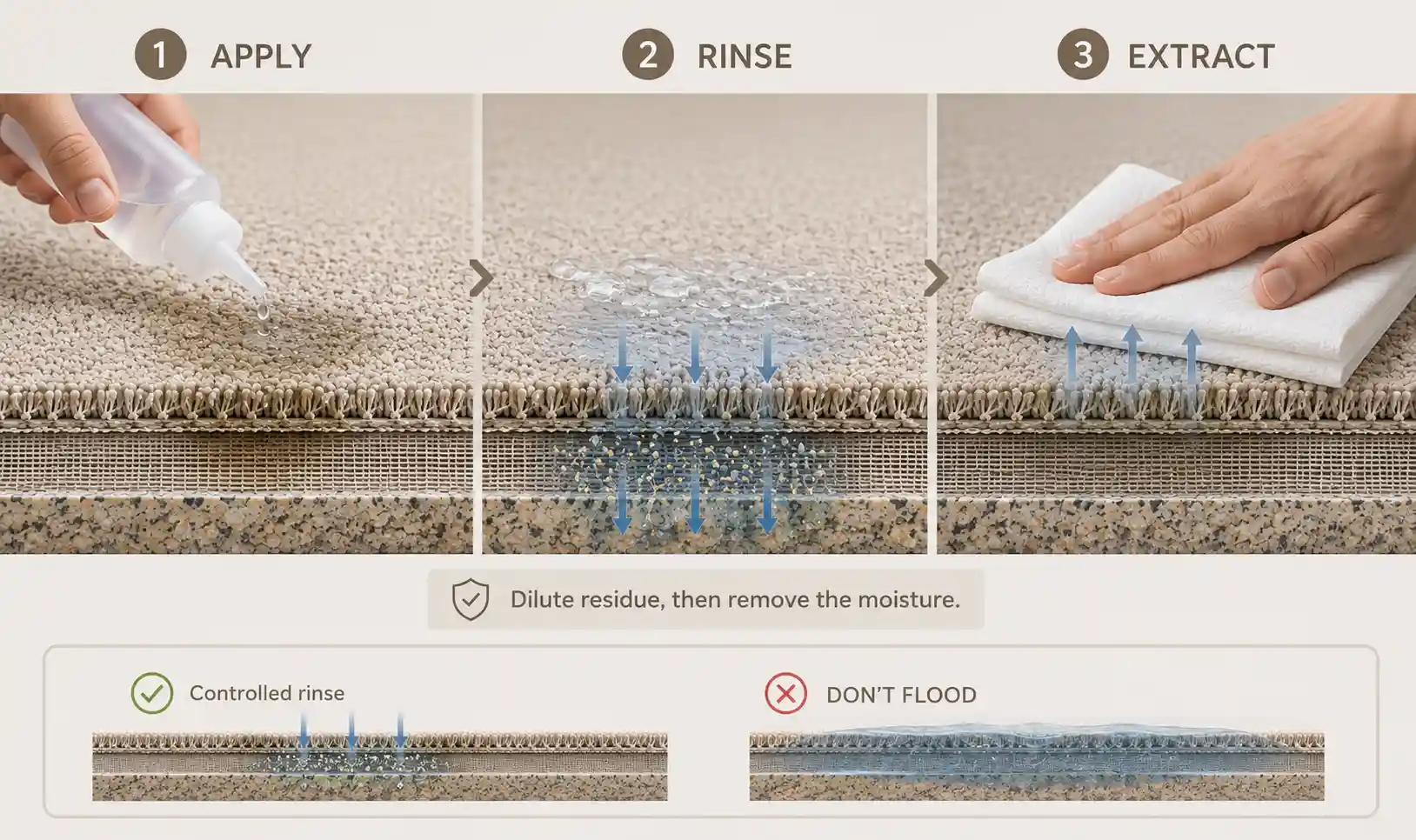
After removing as much urine as possible, rinse the affected area with clean, cool water. The goal is to dilute remaining urine residue and help remove it from the carpet. Apply a controlled amount of water rather than flooding the carpet. Then blot or extract the moisture thoroughly.
For a small spot, you can apply cool water gradually and absorb it with clean towels. For a larger area, a suitable wet vacuum or extraction machine can remove considerably more liquid.
Urine leaves behind soluble residues as it dries. Rinsing and extraction can physically remove some of those residues instead of simply covering their smell. Fresh accidents and areas that have already been treated but still contain surface residue.
3. Apply an Enzymatic Pet Urine Cleaner
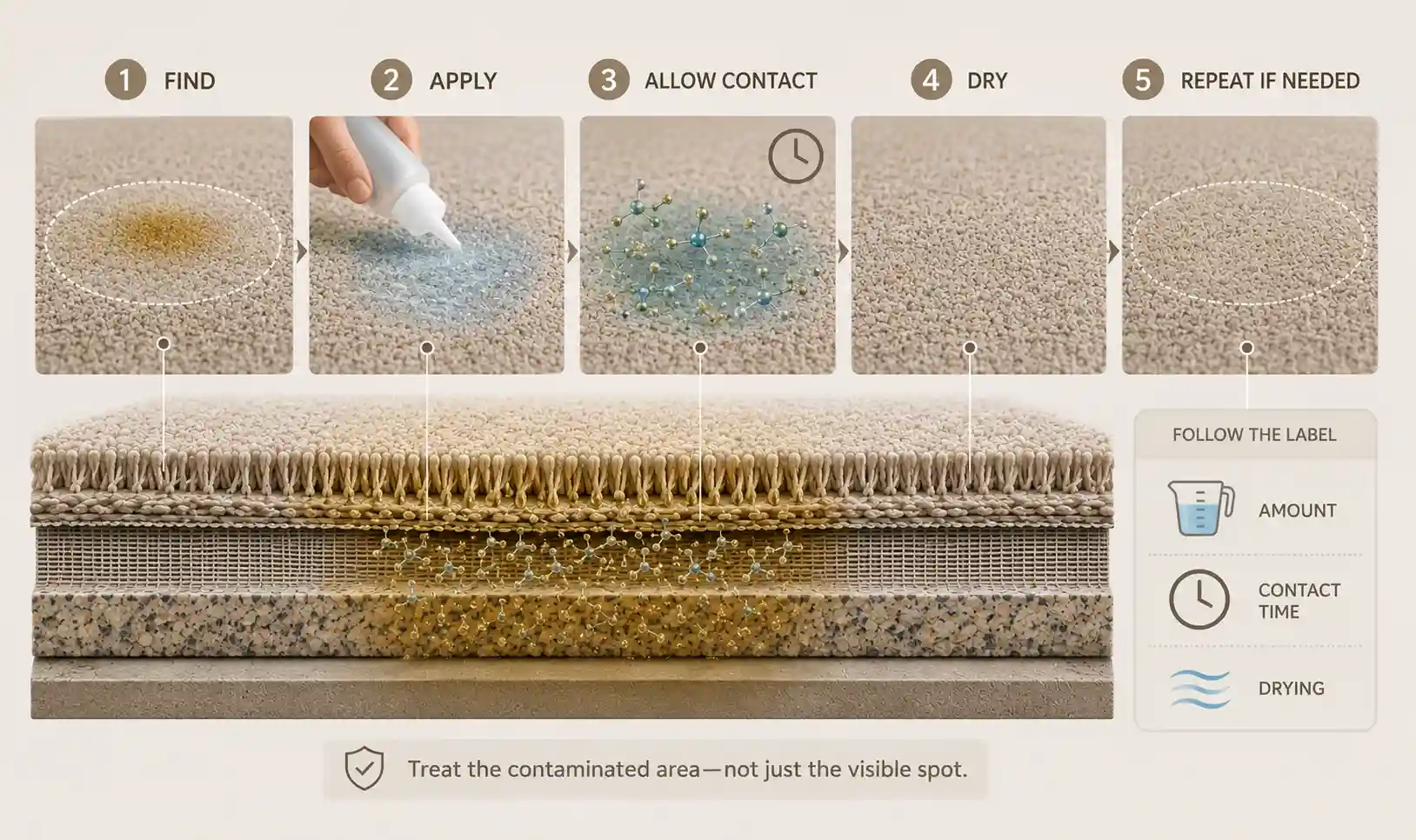
For dried or persistent pet urine, use an enzymatic cleaner designed specifically for pet odor and stains. It is generally a better choice than simply using a fragrance-based carpet cleaner.
Enzyme-based products are formulated to work on organic residues associated with urine. However, they are not all used in exactly the same way, so follow the manufacturer’s directions regarding application, contact time, and drying.
The biggest mistake is applying only a tiny amount to the visible stain when the urine has spread underneath it. Some products require enough solution to reach the contaminated area.
How to use it:
- Remove loose dirt from the area.
- Identify the full affected area.
- Apply the urine-specific enzymatic product according to its label.
- Leave the product on for the required contact time.
- Avoid immediately removing it if the manufacturer’s directions call for extended contact.
- Allow the carpet to dry as instructed.
- Repeat the treatment if the odor remains.
4. Treat the Carpet Backing and Padding When Urine Has Penetrated Deeply
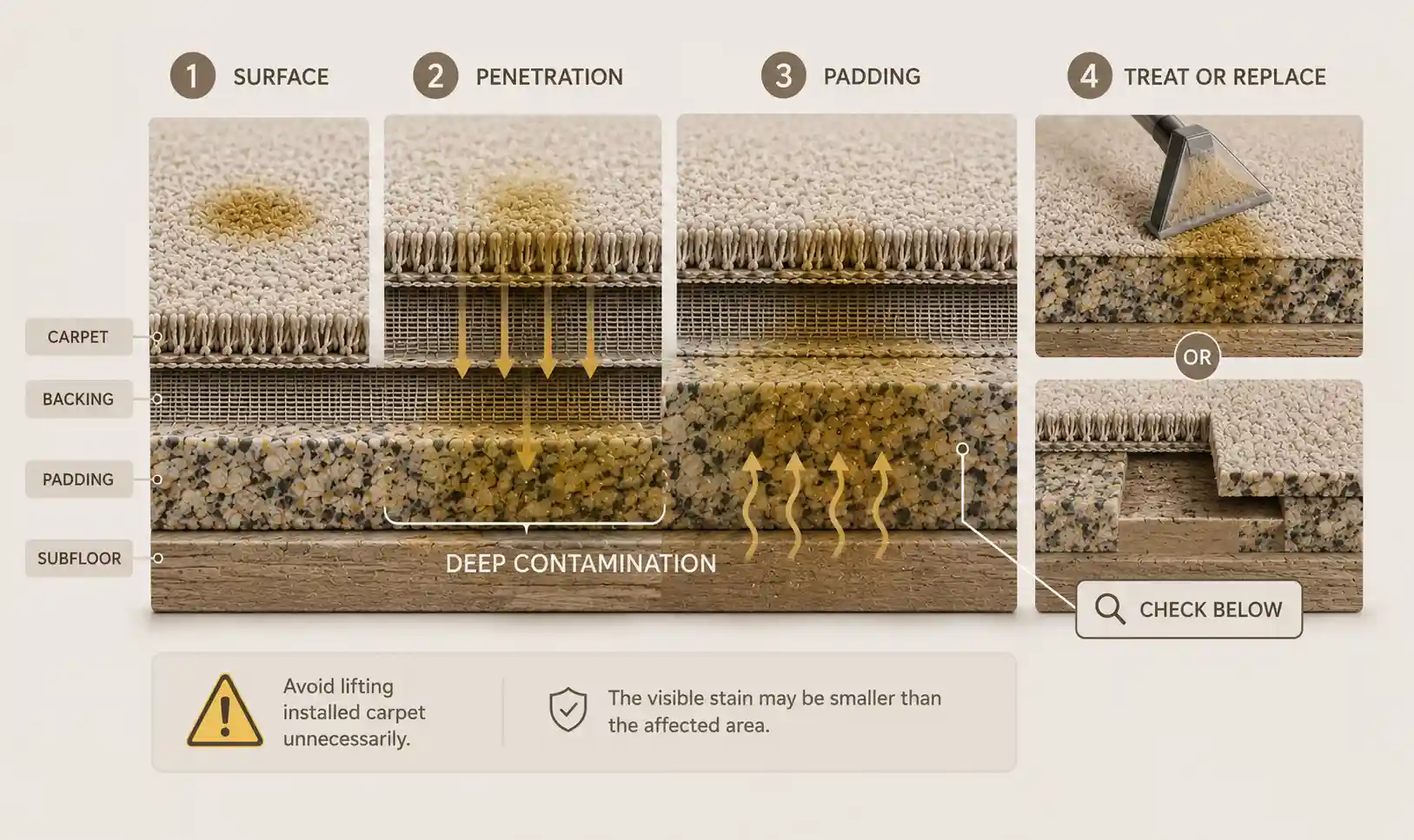
One reason urine odor keeps returning is that the visible carpet stain may not represent the full contaminated area. Urine can travel through the carpet pile and backing and reach the padding underneath. If you clean only the upper fibers, the underlying contamination can continue producing odor.
This is why a small-looking stain can sometimes create a surprisingly strong smell. If the carpet is removable or can be safely lifted, inspect the backing and padding. If contamination has reached these layers, treatment may need to address them as well.
In severe cases, replacing heavily contaminated padding may be more effective than repeated treatment.
Warning: Don’t pull up or manipulate installed carpet unnecessarily. If you’re unsure how the carpet is constructed or secured, professional cleaning is safer.
5. Extract Deeply Soaked Areas With a Wet Vacuum
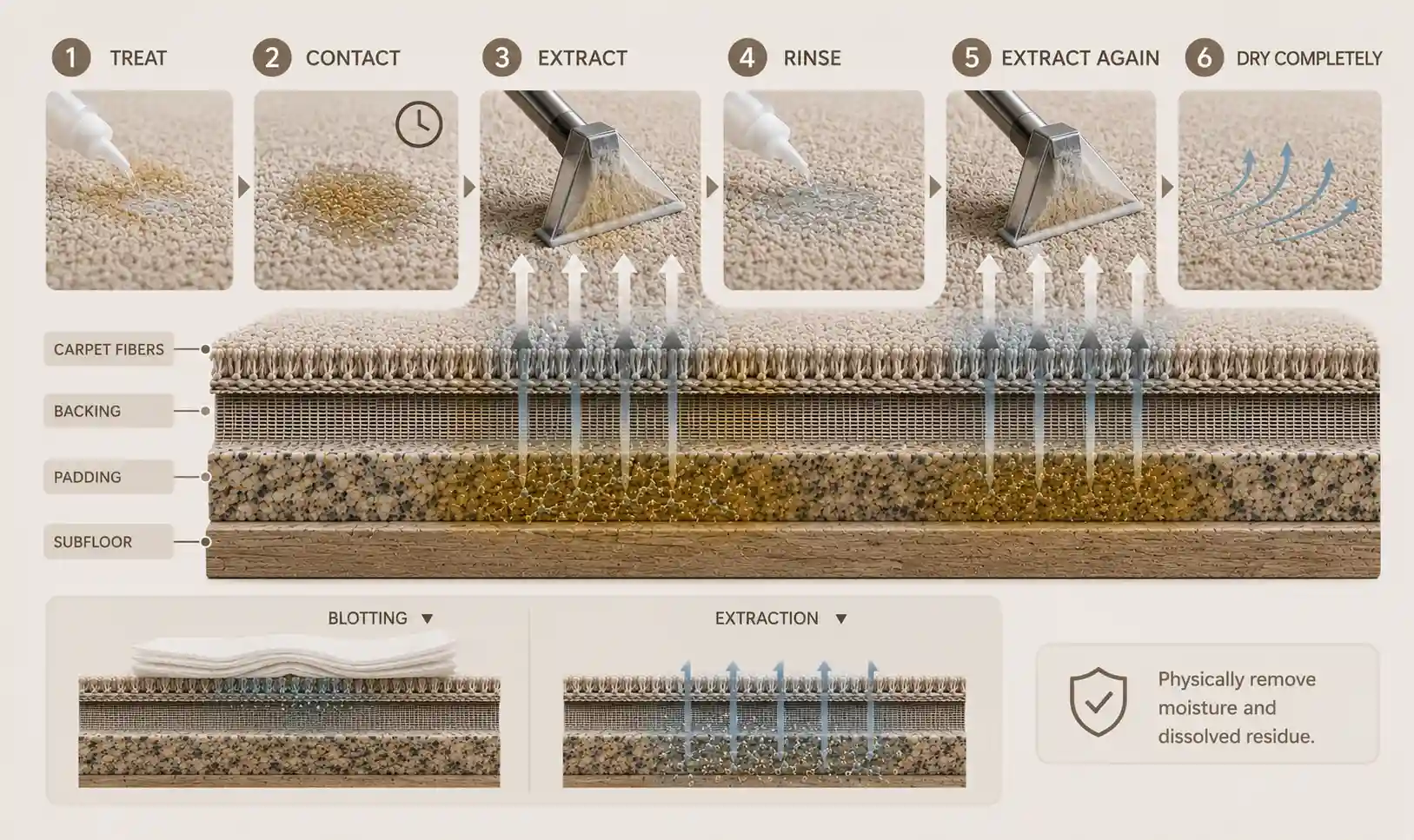
When urine has penetrated beyond the surface, extraction can remove considerably more contaminated moisture than blotting alone. A wet vacuum or suitable carpet extraction machine can help pull liquid from deeper within the carpet system.
The basic process is:
- Apply the appropriate treatment or cleaning solution.
- Give it the required contact time.
- Extract the contaminated moisture.
- Rinse when appropriate for the cleaning method.
- Extract again.
- Allow the carpet to dry completely.
The objective isn’t simply to make the carpet look clean. You want to physically remove moisture and dissolved residue.
6. Use a Mild Carpet-Safe Detergent for Suitable Spots
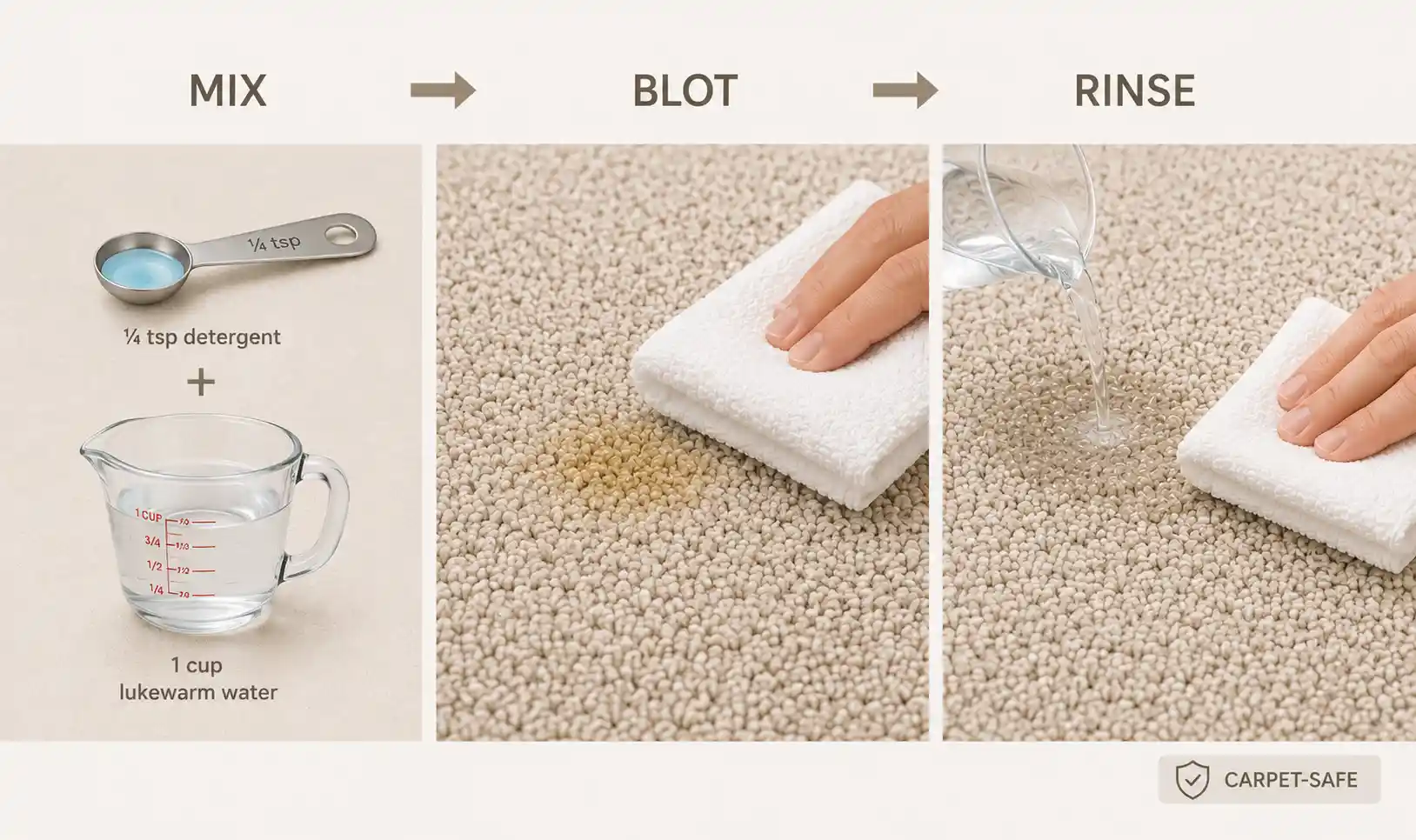
Not every urine spot requires a strong chemical treatment. For certain carpet types and spot-cleaning situations, the Carpet and Rug Institute recommends a very dilute detergent solution.
One of its urine-treatment recommendations uses:
- ¼ teaspoon of non-bleach, non-lanolin liquid dishwashing detergent + 1 cup of lukewarm water.
- Apply a small amount to the affected area and blot rather than scrub. Afterward, rinse the area with clean water and remove the moisture.
- The rinsing step matters because leaving detergent behind can attract dirt and create a sticky residue.
- Do not substitute automatic dishwasher detergent, laundry detergent, bleach, or other concentrated cleaners. They can be inappropriate for carpet fibers and backing.
Best for: Appropriate spot-cleaning situations where the carpet manufacturer permits this type of treatment.
7. Consider White Vinegar Carefully
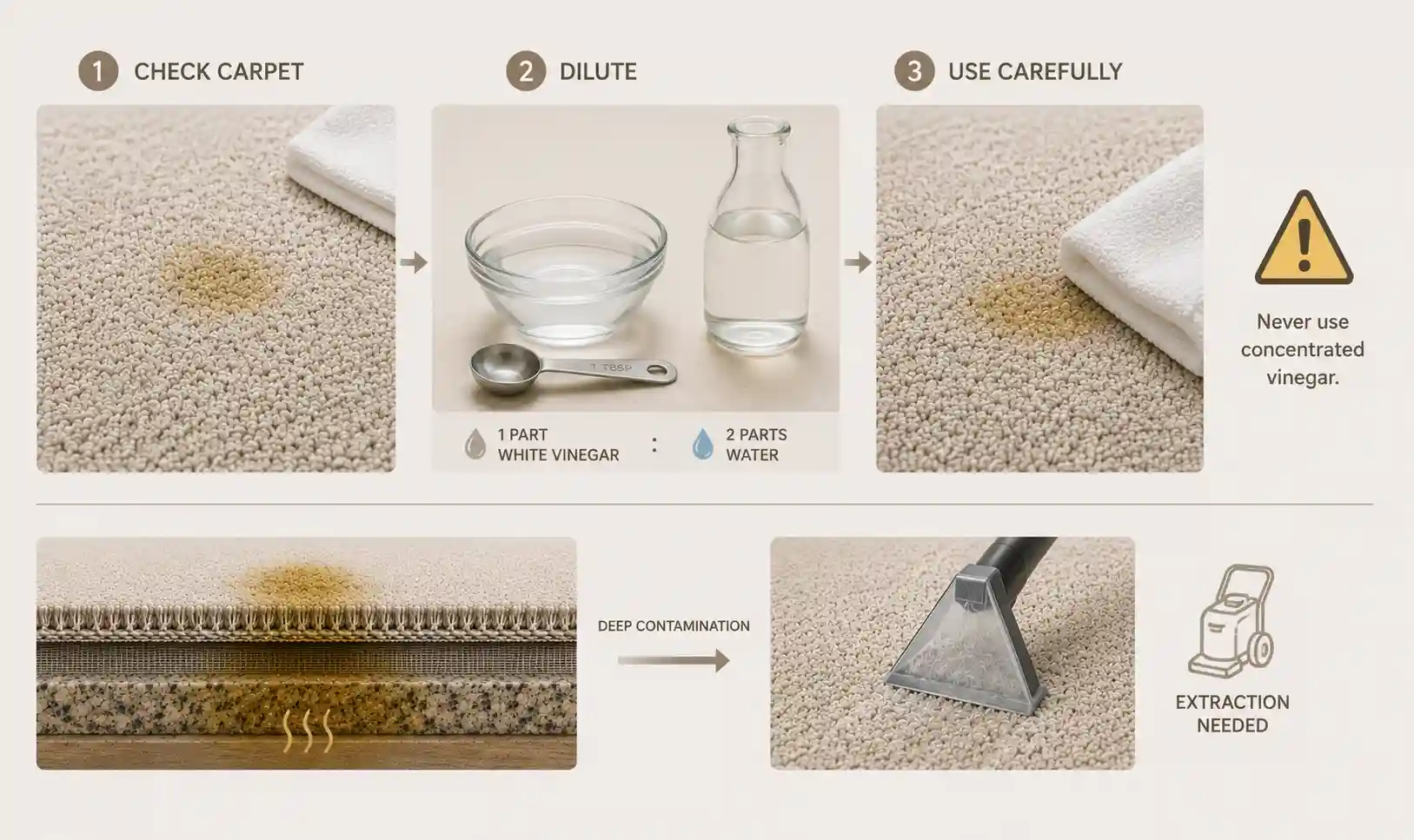
White vinegar is one of the most common recommendations for urine odor, but it deserves a major qualification.
Some carpet-care guidance includes diluted white vinegar as part of specific urine spot-treatment procedures. However, other animal-care guidance recommends avoiding vinegar because its strong smell may not be desirable around pets.
So it would be inaccurate to say “Vinegar always removes urine smell.” It doesn’t. If you choose to use vinegar, check your carpet manufacturer’s care instructions first and use a properly diluted solution rather than applying concentrated vinegar directly.
More importantly, vinegar should not replace proper extraction or an appropriate urine treatment when the contamination is deep.
8. Dry the Carpet Completely After Cleaning
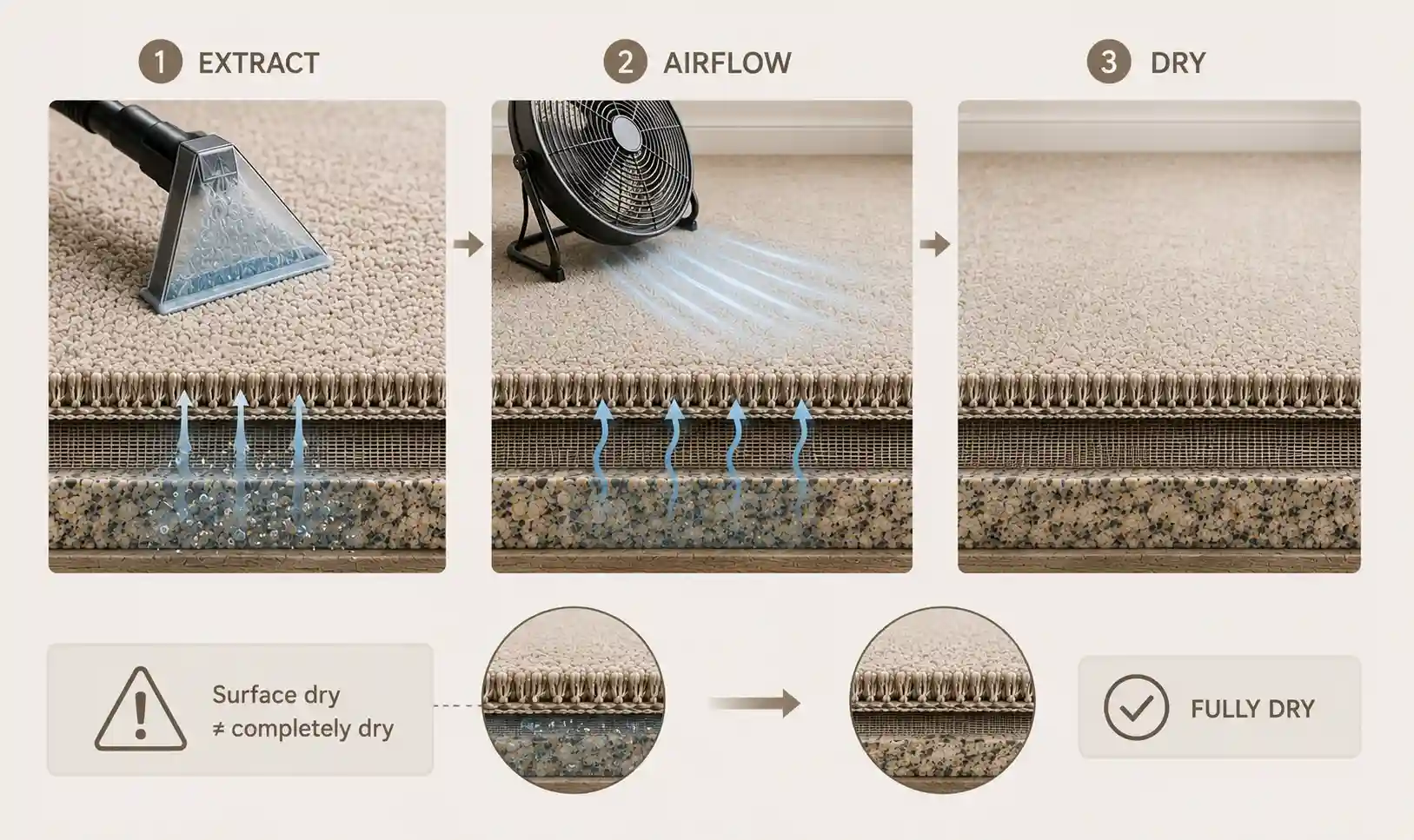
Cleaning the carpet but leaving it damp can create another problem. After treatment, remove as much moisture as possible with towels or extraction equipment. Increase ventilation by opening windows where appropriate and using fans to move air across the carpet.
The drying time depends on how much water or cleaning solution was used, the carpet construction, room temperature, and humidity. Don’t assume the carpet is dry simply because the surface feels dry. Deeper layers can remain damp.
Why this matters: If moisture remains trapped below the surface, odors can linger, and the carpet can develop additional problems.
9. Find Hidden Urine Spots With a UV/Black Light
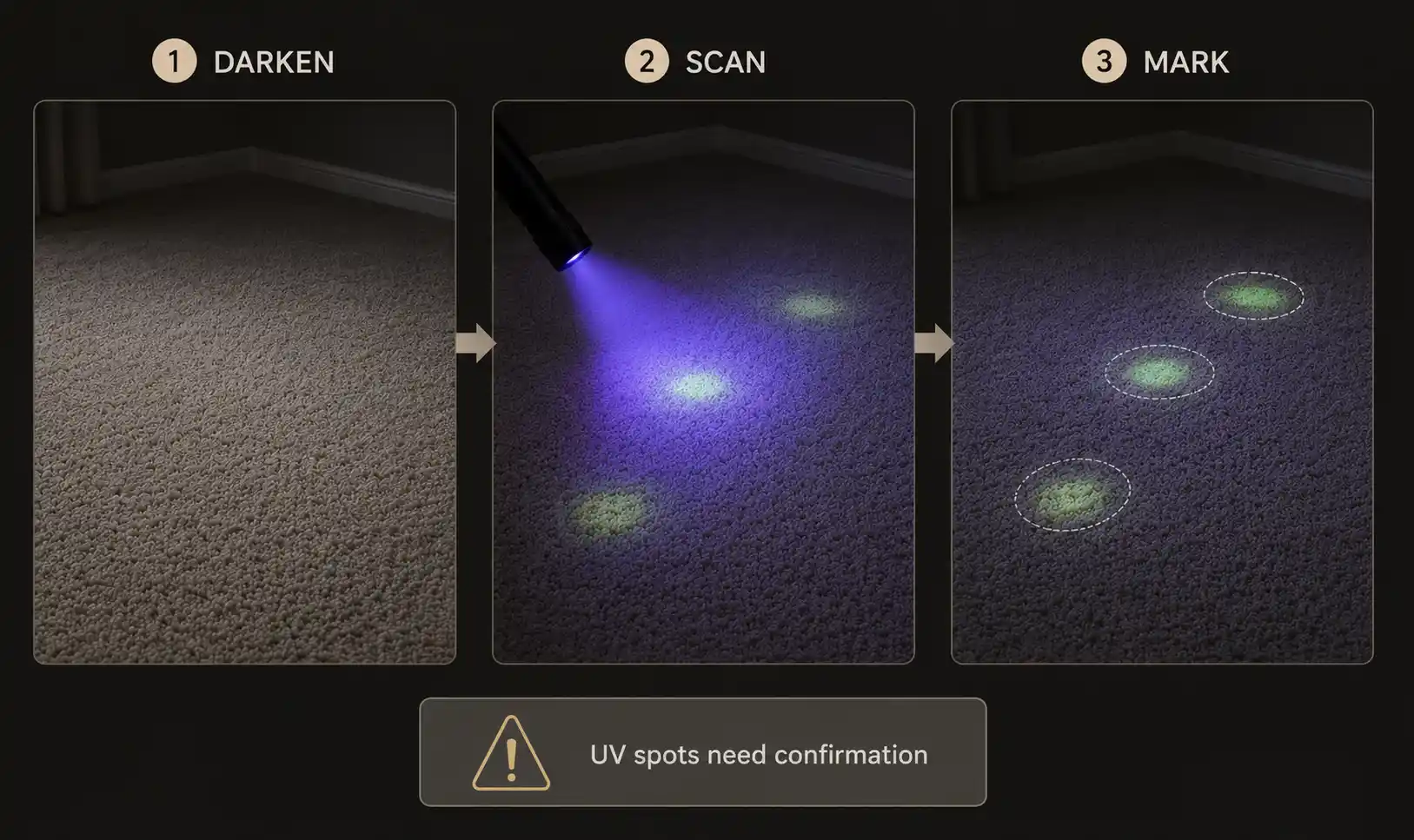
Sometimes the hardest part isn’t cleaning the urine; it’s finding where all of it is. If you can smell urine but cannot see a corresponding stain, a UV/black light can help identify areas that may contain old urine residue.
Darken the room and slowly scan the carpet. Mark suspected areas so you can treat them systematically. However, a UV light isn’t a perfect diagnostic tool. Other substances can also fluoresce, so don’t assume every glowing spot is urine.
10. Get Professional Carpet Cleaning When the Odor Keeps Coming Back
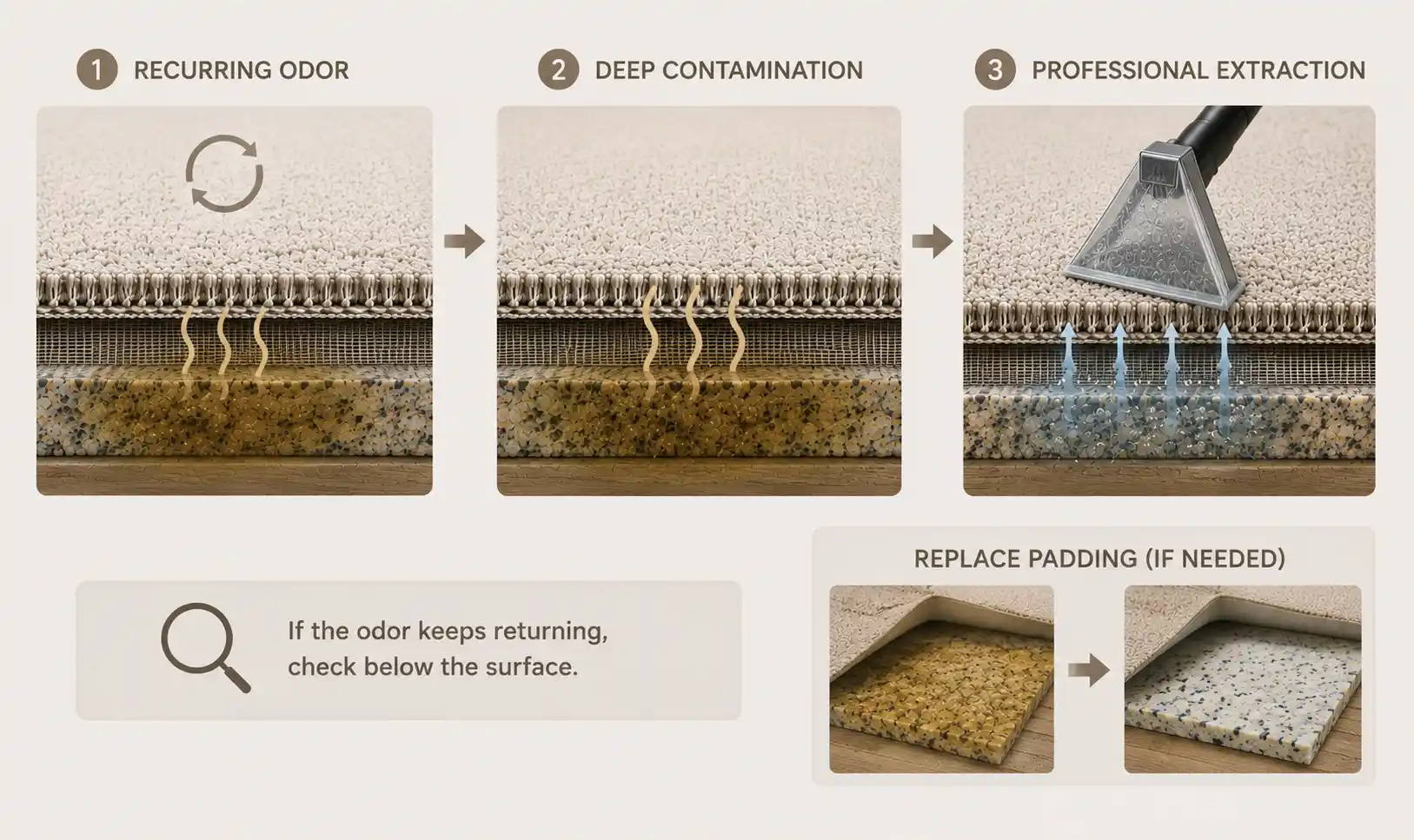
If you’ve treated the carpet correctly but the urine smell keeps returning, the problem may be deeper than the carpet surface.
This is particularly likely when:
- The accident was large.
- The urine remained undiscovered for a long time.
- The smell becomes stronger in humid weather.
- Multiple accidents occurred in the same area.
- The odor disappears temporarily and then returns.
- The carpet padding was also contaminated.
A professional carpet cleaner can assess the carpet construction and use commercial extraction equipment and appropriate treatments.
In severe cases, cleaning the carpet itself may not be enough. Contaminated padding may need replacement, and in extreme situations the underlying flooring may also require attention.
Home Remedies That Help with Dealing With Pee Smell
There are some ingredients that are present in the home and help in masking the pee smell on the carpet.
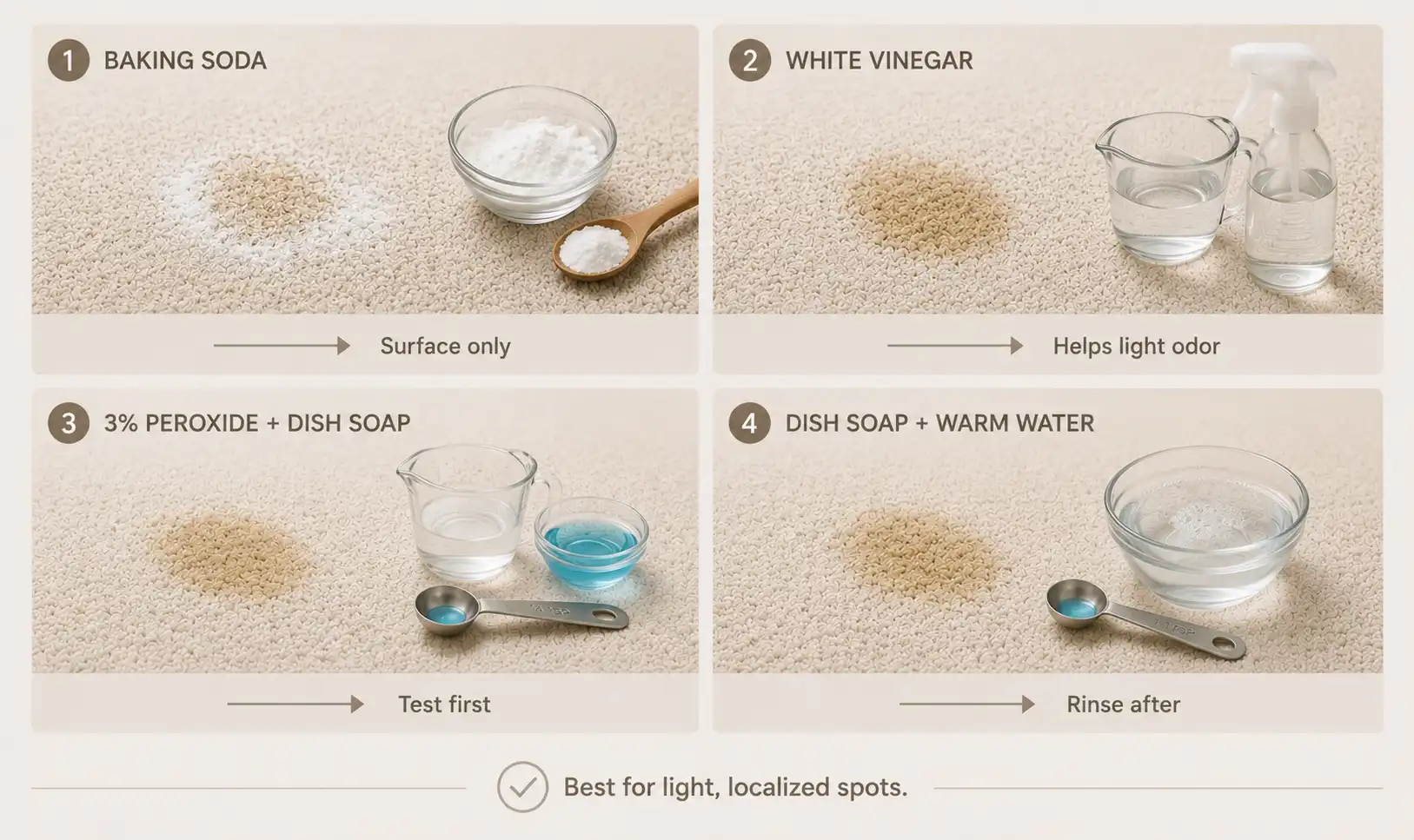
1. Baking Soda
Baking soda absorbs moisture and neutralizes some acidic odor compounds, which is why it helps with light, recent accidents. Sprinkle it over a blotted spot, leave it eight hours or overnight, and vacuum it up thoroughly.
Its limit is simple. Baking soda sits on the surface. It cannot break down uric acid compounds already bound to the fibers, and it will not do anything for urine that reached the pad. Treat it as a helpful finishing step, not a solution on its own. Also vacuum every trace of it, because leftover powder in the backing can dull the carpet and clog a vacuum filter.
2. White Vinegar
A one-to-one mix of white vinegar and cool water helps with light odor, mainly by lowering pH and cutting the ammonia note. It is cheap and safe on most synthetic carpets.
Two honest cautions. Vinegar does not digest uric acid, so on a set-in spot it usually reduces the smell rather than removing it. And if you apply vinegar and baking soda at the same time, they neutralize each other, and you get fizzing instead of cleaning. Use one, let the carpet dry, then use the other if you want both.
3. Hydrogen peroxide and Dish Soap
A mix of 3% hydrogen peroxide with a drop of clear dish soap can help with the yellow discoloration left behind by urine. Peroxide oxidizes stain compounds, so it targets the stain more than the odor.
Test it in a hidden spot first. Peroxide can lighten carpet dyes, and it is not a good idea on wool or wool blends. Never combine it with vinegar in a sealed container.
4. Dish Soap and Warm Water
For a small kid pee accident on a synthetic carpet, a drop of clear dish soap in a bowl of warm water is often enough after thorough blotting. Rinse with plain water afterward, because leftover detergent attracts dirt and the spot turns grey within weeks.
How to Remove Human Urine Smell From Carpet?
Human urine is more dilute than pet urine. Household accidents usually happen once in one place rather than repeatedly. That makes it easier to handle with home remedies.
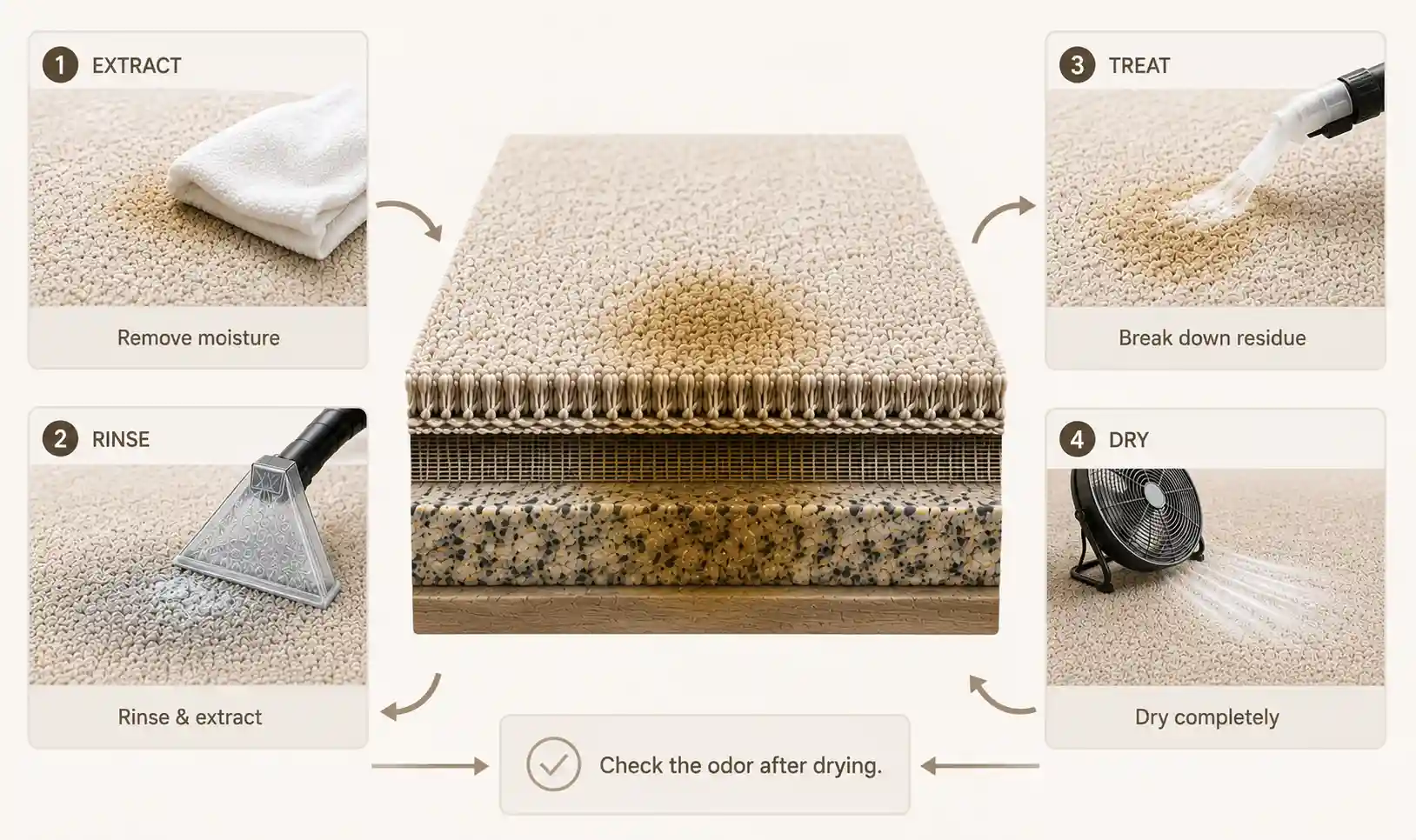
For a child’s accident caught quickly, blotting, a cool-water rinse, and a proper drying cycle often do the trick. If a faint smell lingers a few days later, the urine reached the backing and needs an enzyme treatment.
Step 1: Extract Liquid Immediately
To handle fresh accidents efficiently, absorb excess liquid immediately using thick, folded paper towels or a clean white cotton towel pressed firmly into the carpet. Avoid scrubbing the area, as friction pushes liquid deeper into the carpet backing and pad while damaging cut-pile fibers. Using a wet/dry vacuum to extract the liquid is the fastest, most effective way to pull moisture out from deep within the pile.
Step 2: Flush with Cool Water
Pour a small amount of cool water over the spot to dilute residual urine salts, then immediately extract or blot it up completely. Never use hot water during this step, as heat can permanently set protein residues into synthetic carpet fibers.
Step 3: Treat with an Enzymatic Cleaner
The most effective way to eliminate urine odor permanently is to treat the area with a dedicated enzymatic cleaner. Standard household cleaners and baking soda only temporarily mask surface odors, whereas enzymes digest the underlying uric acid crystals that cause smells to return during high humidity. For dried spots, rehydrate the area with cool water, saturate it with the enzyme solution to match the original spill depth, and cover it with a damp towel for 8 to 12 hours to let the enzymes fully break down organic compounds.
Step 4: Promote Deep Drying and Inspect
Position a floor fan directly over the treated area to maintain continuous airflow and dry the carpet thoroughly. Rapid drying prevents bacterial growth in the backing and stops moisture from pulling old underlying residues back up to the carpet surface. Perform a final inspection at floor level only after the carpet is 100% dry to confirm the odor has been completely eliminated.
How to Get Rid of Dog Urine Smell?
Dog urine is more concentrated than human urine, and the volume is usually larger than the visible stain suggests. A medium dog can leave enough liquid to soak straight through carpet and pad in one accident.
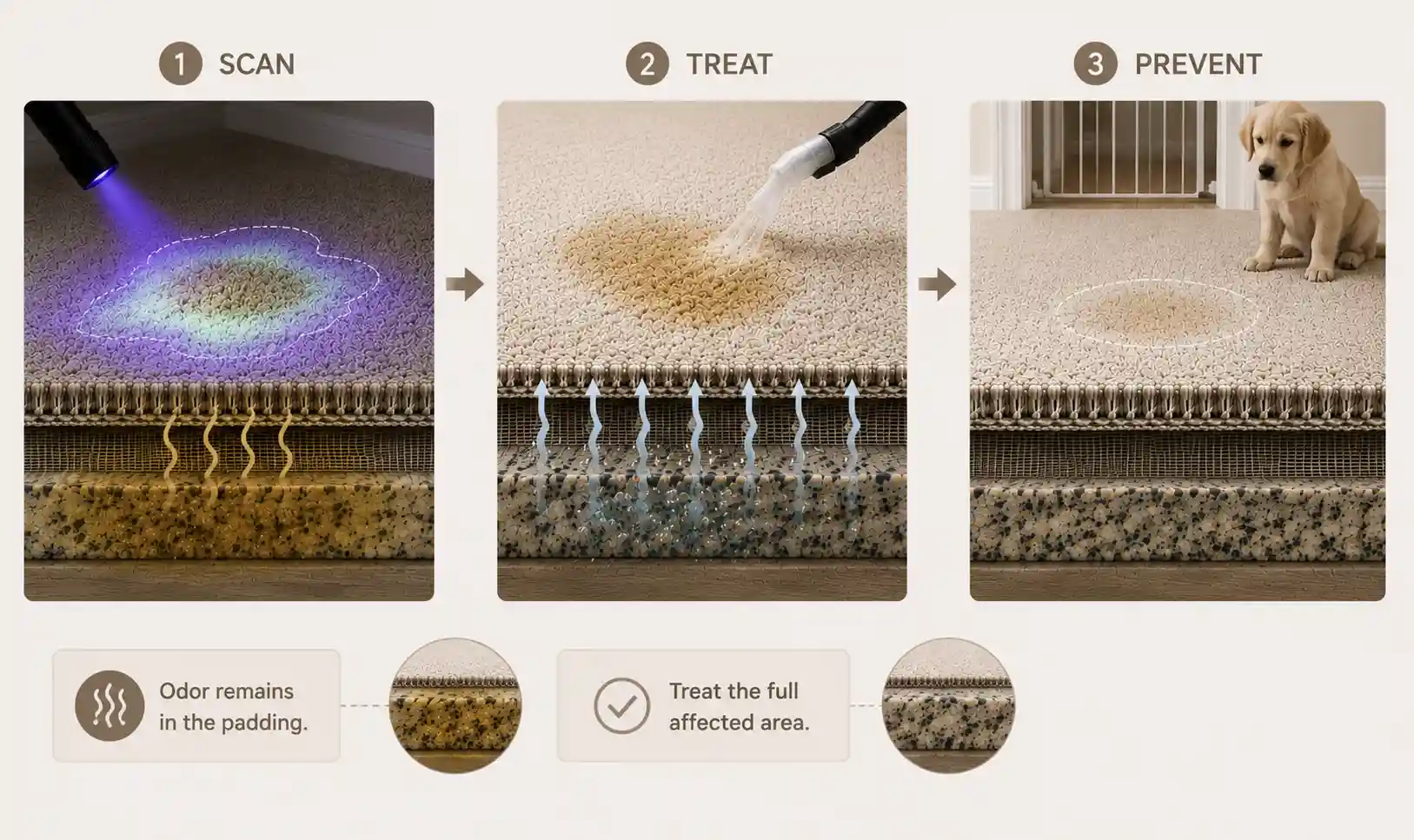
The approach is the same as any dried urine treatment, with two adjustments.
Treat a wider area than you can see. Map the spot with a blacklight before you start and treat the full outline, not just the discolored center.
Address the behavior, not just the carpet. Dogs return to spots they can still smell, even when you cannot. Every repeat accident in the same place adds contamination deeper into the pad, which is how a single incident turns into a permanent problem. If accidents keep happening in the same room, block access to that area while you treat it, and rule out a urinary tract issue with your vet if the pattern is new.
Home remedies help for dog urine, but they are a supporting act. Enzyme treatment with a long dwell time is what does the real work.
Treat Cat Urine Smell After It Has Dried
Cat urine is the hardest case in the house, and it deserves realistic expectations. Cats concentrate their urine heavily, so the same volume carries far more residue than dog or human urine. It also contains sulfur compounds that produce that distinctive sharp smell as it degrades. Once it dries, the residue crystallizes and clings tightly to fibers and backing.
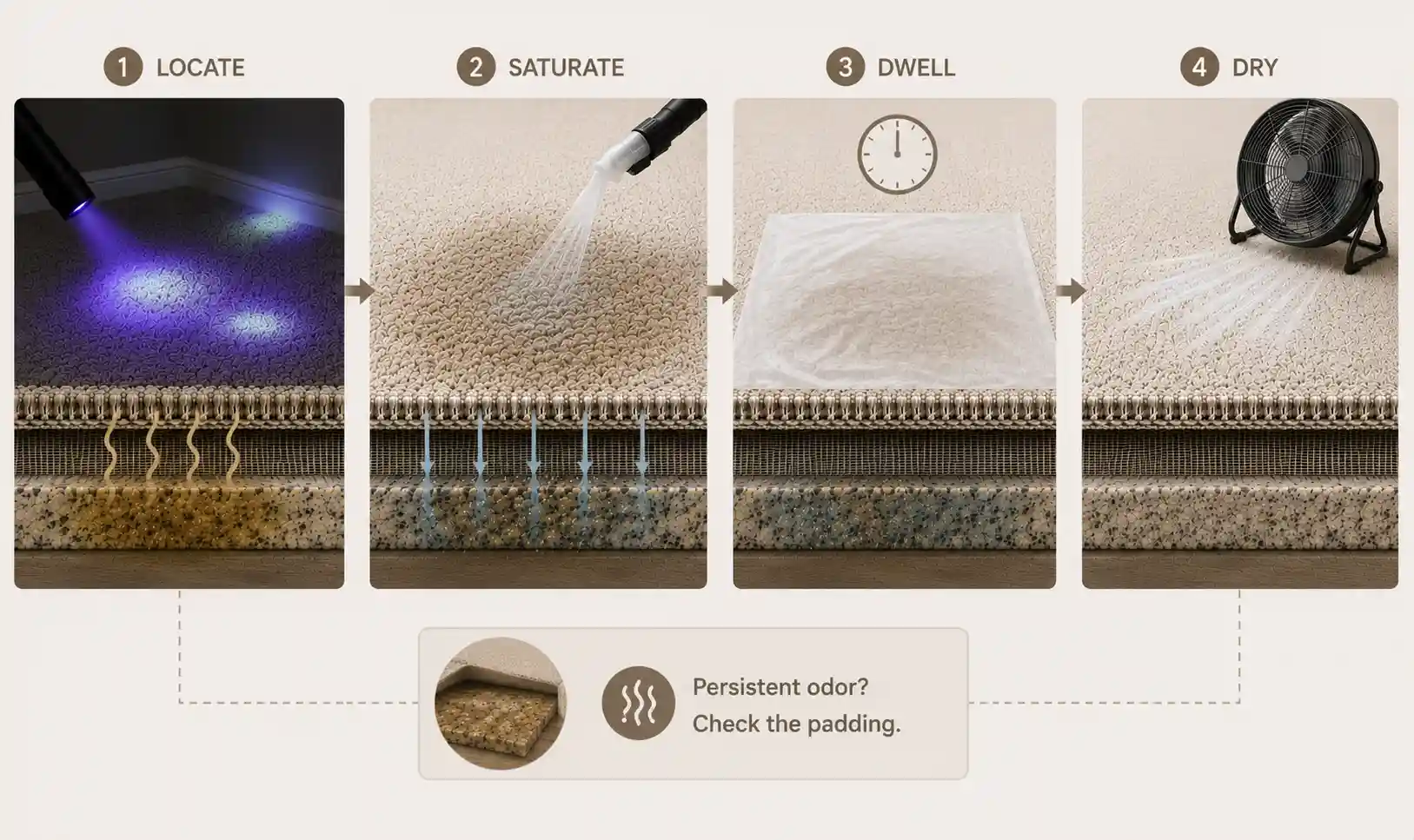
To get cat urine smell out of carpet after it has dried:
- Locate every spot with a blacklight in a dark room. Cats often spray vertically, so check baseboards, walls, and the sides of custom furniture as well as the floor.
- Rehydrate and saturate generously with an enzyme cleaner made for cat urine.
- Cover the area and give it a full overnight dwell. Cat urine typically needs longer than the label minimum.
- Dry with airflow, then re-check by smell at floor level.
- Expect to repeat. Two or three treatments on a bad spot is normal, not a sign you did it wrong.
If the smell persists after several thorough treatments, the pad is almost certainly holding contamination. At that point, continuing to treat the carpet surface is wasted effort.
One more thing worth knowing. A cat that suddenly starts urinating outside the litter box is often telling you something medical or behavioral. Cleaning the carpet perfectly will not stop it if the underlying cause is a urinary tract infection, a dirty box, or stress from a new pet in the house.
How to Treat Dried Urine in Carpet?
Dried urine needs the opposite of speed. It needs moisture and patience. The residue is now crystallized and locked to the fibers. Enzymes only work in a wet environment, so putting a light mist over a dried spot does very little. The treatment has to reach as far down as the urine did.
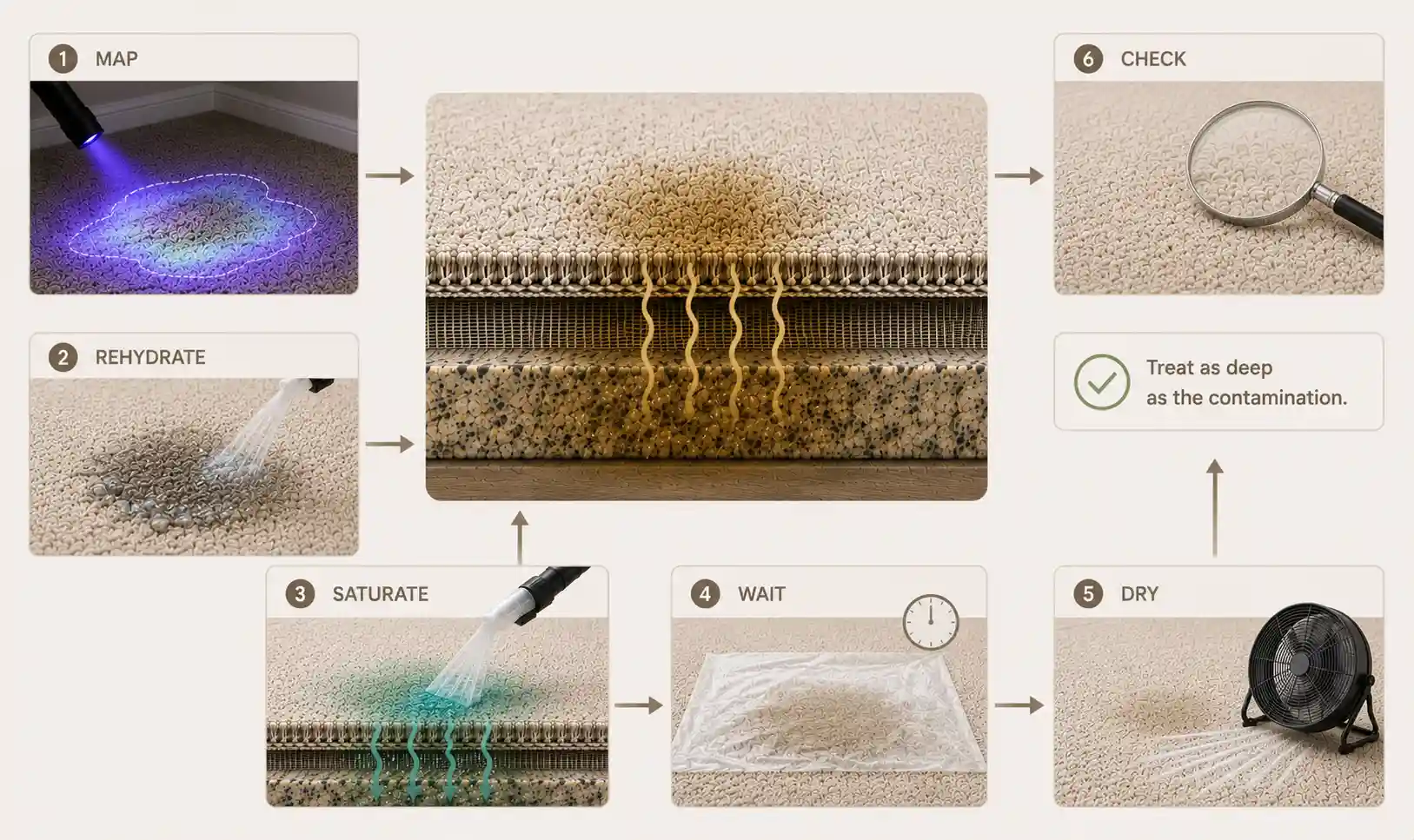
Step 1: Find the real edges. Urine spreads in a cone. The stain you can see is the top, and the contaminated area underneath is wider. Turn off the lights and use a UV blacklight to map it. Urine usually glows a dull yellow-green. Mark the outline with painter’s tape or chalk. Be aware that other residues glow too, so trust your nose as well.
Step 2: Rehydrate the spot. Wet the marked area with cool water and let it sit for a few minutes. This softens and reactivates the dried residue so a cleaner can reach it.
Step 3: Apply enough enzymatic cleaner. This is where most home attempts fail. A few sprays cannot treat contamination that went two inches deep. Pour or saturate the cleaner so it reaches as deep as the urine did, roughly matching the volume of the original accident.
Step 4: Keep it wet and wait. Cover the area with a damp towel or plastic sheet so it does not dry out, and leave it for the time the label specifies. Many products need eight to twelve hours. Enzymes work slowly, and they stop working as soon as the surface dries.
Step 5: Blot and dry. Blot up the excess, then dry the area with a fan. Do not vacuum until it is fully dry.
Step 6: Check it a day or two later. The verdict comes when the carpet is completely dry, not while it is damp. Put your nose down at carpet level. If you still smell a faint odor, treat it once more before assuming the pad is involved.
What to Do When the Smell Keeps Coming Back
If you have cleaned a spot properly and the odor returns, the urine went deeper than your cleaner did. Carpet is only the top layer of a three-layer system: fibers, backing, and pad, sitting on a subfloor. Liquid passes through the first two quickly, and the pad acts like a sponge.
- Check the carpet pad: If it smells or feels contaminated, you may need to remove and replace the affected section.
- For deeper contamination: Professional sub-surface extraction can remove urine from beneath the carpet.
- Check the subfloor: If urine reached the wood or concrete underneath, clean and dry it thoroughly before treating it with a suitable odor-blocking sealer.
- Avoid repeated surface cleaning: It can temporarily mask the smell without removing the source.
If the odor keeps returning, find and treat the deeper source rather than repeatedly cleaning the carpet surface.
Common Mistakes That Make Urine Odor Worse
Using hot water, scrubbing the pile, spraying ammonia, and failing to allow proper enzyme dwell time are the primary mistakes that permanently set urine stains and worsen carpet odors.
| Common Mistake | Why It Makes Urine Odor Worse |
| Scrubbing the stain | Pushes urine deeper and can damage carpet fibers. |
| Using too little cleaner | Leaves deeper urine residue untreated. |
| Removing enzyme cleaner too quickly | Does not give the enzymes enough time to break down urine residue. |
| Mixing cleaning products | Some products can interfere with each other or cause unwanted reactions. |
| Using too much heat | Can make some set-in stains harder to remove. |
| Over-wetting the carpet | Can push urine deeper into the pad and slow drying. |
| Checking while the carpet is wet | Moisture can temporarily hide the odor, making the result seem better than it is. |
| Masking the odor | Covers the smell without removing the urine residue causing it. |
When to Call a Professional or Replace the Carpet
Home treatment handles most single accidents. Call in help when you see these signs:
- The odor persists after two or three thorough enzyme treatments done correctly.
- You can smell urine when you walk into the room rather than only near the spot.
- Multiple pets have used the same area over months or years.
- The affected area is larger than a couple of square feet.
- The stain is dark, spreading, or the carpet feels stiff and crusty when dry.
- You have identified pad or subfloor contamination.
A professional brings tools you do not have at home: moisture meters to map how far contamination spread, sub-surface extraction equipment that flushes and recovers liquid from the pad, and stronger oxidizing treatments. Ask specifically whether they treat pet urine at the sub-surface level, because a standard cleaning appointment usually will not solve it.
Replacement becomes the practical choice when urine has bleached the carpet dye, when the carpet is already near the end of its life, or when multiple large areas are contaminated. Repeated cleaning attempts on a badly saturated area often cost more over time than replacing that section outright.
Final Words
Removing pee smell from carpet comes down to one question: how deep did it go? Fresh accidents are a blotting-and-rinsing job, and speed decides the outcome. Dried urine needs moisture, an enzymatic cleaner, and enough patience to let it work overnight. When the smell keeps returning no matter how carefully you clean, stop treating the surface and start looking at the pad and the subfloor, because that is where the odor is actually living.
Be honest with yourself about the point of diminishing returns. If you have treated a spot properly two or three times and the room still smells when you walk in, another bottle of cleaner is not going to change that. A carpet cleaner that works with pet urine at the sub-surface level, or a small pad replacement, will cost less than months of repeat attempts and will actually end the problem.
Frequently Asked Questions
It helps with light or recent odor by absorbing moisture and neutralizing acidic compounds, but it cannot break down uric acid residue bound to the fibers. Use it as a finishing step after blotting or enzyme treatment, not as your only method.
Rehydrate the area with cool water, saturate it with an enzymatic cleaner to the same depth the urine reached, cover it to keep it damp, and leave it for the full dwell time. Dry with airflow and re-check once the carpet is completely dry.
An enzymatic cleaner is the most reliable option. Flushing with cool water and extracting with a wet/dry vacuum also removes real residue. Oxidizing cleaners help with the stain, and a vinegar rinse works for mild cases.
Usually because the urine reached the backing or pad and the cleaning only treated the surface. Water-based cleaning can also reactivate residue below, which is why some carpets smell worse right after shampooing. Check for pad contamination before cleaning again.
It reduces mild odor and helps neutralize ammonia, but it does not break down the uric acid compounds responsible for lingering smell. It is a reasonable first response for a fresh accident, not a fix for a set-in one.
Find every spot with a blacklight, rehydrate, saturate with an enzyme cleaner made for cat urine, cover it, and let it work overnight. Plan on repeating the treatment. If the odor survives several proper attempts, the pad is involved.
Often, yes, but only if the contamination is treated at the right depth. A standard surface clean will not reach urine in the pad. Ask for sub-surface extraction and urine-specific treatment when you book.
The odor gets stronger in humid weather, the smell seems to come from the floor, the stain reappears larger after drying, or a lifted carpet corner shows a stained pad. Pressing a white paper towel into a dampened spot and seeing heavy yellow transfer is another clear sign.
It can. Urine is alkaline as it degrades, and it can strip dye from carpet fibers, leaving a permanent lightened or orange patch even after the odor is gone. Prompt treatment prevents most of this.