
Modular Sofa vs Sectional: Which Is Better for Your Space?
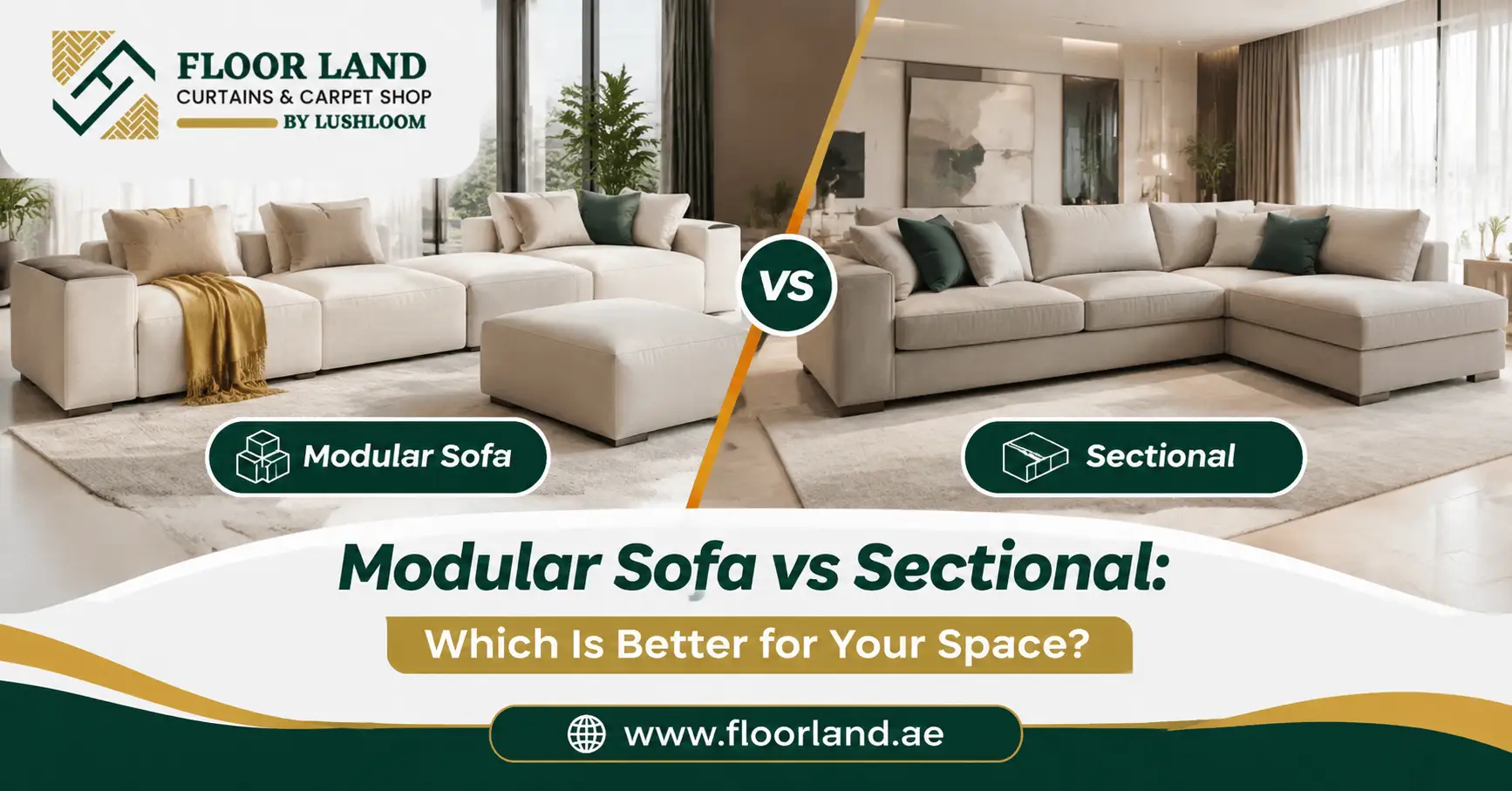
A modular sofa is better if you want flexibility, since its separate pieces can be rearranged, added to or split across rooms. A sectional is better if you want one large, fixed corner sofa that stays put and often costs less per seat. For a small apartment, a rented home or a growing family, modular usually wins. For a large living room with one set layout, a sectional is the simpler choice.
The two terms get mixed up in shops and online, which makes buying harder than it should be. This guide explains what each one is, compares them side by side, and shows which suits rooms, families and UAE homes, with a measuring plan and checklist before you buy.
What Is a Modular Sofa?
A modular sofa is a seating system made of separate units that join together and can be taken apart again. Each unit is a complete piece on its own, such as a single seat, a corner seat, an armless seat, a chaise or an ottoman. You decide how many pieces to use and how to arrange them.
The pieces are held together with connectors. Depending on the maker, these can be metal clips, brackets or magnets fitted under the seat. Good connectors keep the units from drifting apart when people sit down, yet still let you unclip them when you want a new layout.
Common Modular Layouts
- Straight sofa: two to four seats in a row with an arm unit at each end.
- L shape: a row of seats with a corner unit or chaise on one side.
- U shape: seats on three sides, useful for large family rooms.
- Island or pit: pieces facing each other or forming a deep lounging area.
- Split layout: a sofa in the living room and a chair or two in a bedroom or study.
The main appeal is that the sofa can change when your home does. A three-seat row in a studio flat can become an L-shaped corner sofa after a move, then gain an extra seat when the family grows. If you are planning a custom sofa, thinking about the pieces you may want later is a good place to start.
One point to check: “modular” only works if the maker sells matching pieces and keeps making them. Ask whether you can buy extra units later in the same fabric and size before you commit.
What Is a Sectional Sofa?
A sectional sofa is a large sofa made of two or more big sections that fit together into one set shape, usually an L or a U. The sections are split mainly so the sofa can be delivered and carried into the house. Once in place, it is meant to stay in that arrangement.
Most sectionals are built in one of these shapes:
- L-shaped sectional: two sections meeting at a corner. A popular choice for corner walls, and the most common style of L-shaped sofa in living rooms.
- Chaise sectional: a sofa with an extended lounge seat at one end for stretching out.
- U-shaped sectional: seating on three sides, giving the most seats in one piece.
- Curved sectional: a rounded shape that suits open-plan rooms and conversation areas.
What RAF and LAF Mean
When you order a sectional, you will often see the letters RAF and LAF. RAF means right arm facing and LAF means left arm facing. They describe which side the arm or chaise sits on when you stand and face the sofa, not when you sit on it. Getting this wrong is one of the most common sectional mistakes, because a fixed sectional cannot simply be flipped.
A large U-shaped sofa works well when the whole family watches TV together or you host often. It gives everyone a seat facing the same point without adding loose chairs.
In many UAE homes, the same idea appears as low seating running around the edges of a room. An Arabic majlis sofa is the traditional version of that layout and follows the same fixed-shape logic as a sectional.
Modular Sofa vs Sectional: Key Differences
The biggest difference is flexibility. A modular sofa is built to change, while a sectional is built to stay in one shape. The table below shows how that plays out in daily life.
| Feature | Modular sofa | Sectional sofa |
|---|---|---|
| Structure | Many smaller, independent units | Two to four large sections |
| Rearranging | Units can swap places or move to another room | Usually fixed; chaise side chosen at purchase |
| Adding seats later | Possible if matching units are still made | Rarely possible |
| Connection | Clips, brackets or magnets between each unit | Brackets between the few large sections |
| Seams | More seams, one between each unit | Fewer seams, a smoother look |
| Moving and delivery | Easier through narrow doors, lifts and stairs | Harder, large sections need clear access |
| Replacing damaged parts | One unit can be replaced or reupholstered | A whole section usually needs attention |
| Cost per seat | Often higher | Often lower |
| Best room type | Small, open-plan or changing spaces | Large rooms with a settled layout |
In short, you pay for flexibility with a modular sofa and for simplicity with a sectional. Neither is better in every home. The right choice depends on your room, how long you plan to stay and how your family uses the space.
It also helps to know that some shops use the two words as if they mean the same thing. A product called a “modular sectional” is usually a modular sofa arranged in a sectional shape. Check whether the pieces can be separated and rearranged before you assume it is modular.
Pros and Cons of Modular Sofas
Modular sofas solve the problem of a home that keeps changing. Their weak points come from the same feature: many separate parts.
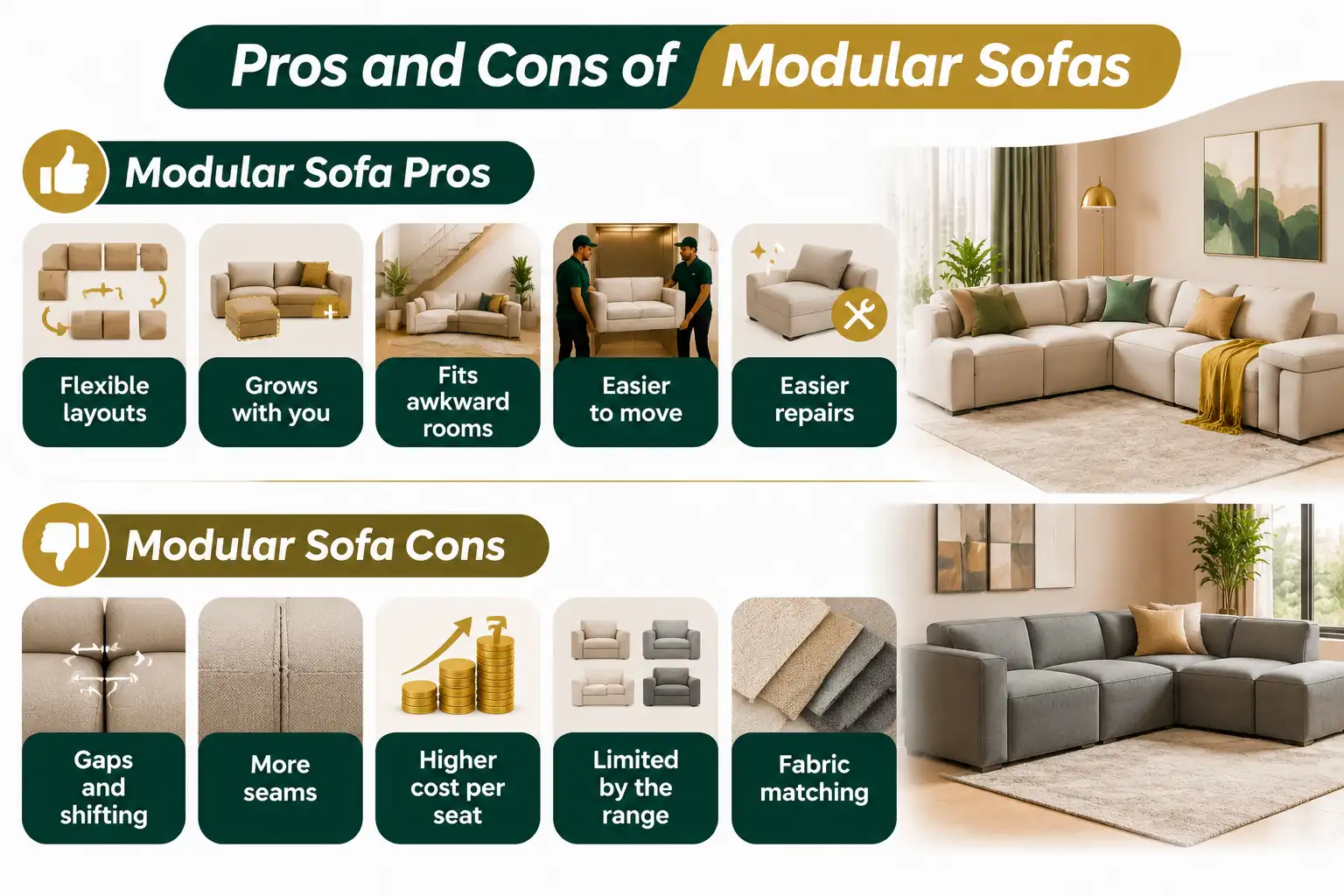
Modular Sofa Pros
- Flexible layouts. Change from a straight sofa to an L or U shape, or pull pieces apart for guests.
- Grows with you. Add a seat or an ottoman later instead of buying a new sofa.
- Fits awkward rooms. Smaller units work around columns, radiators, AC units and odd corners.
- Easier to move. Single units fit in lifts and through apartment doors, which matters in high-rise buildings.
- Easier repairs. A stained or worn unit can be cleaned, recovered or replaced on its own.
These strengths make modular seating a strong fit for studios and one-bedroom flats, where every piece needs to earn its space. Our guide on how to decorate a small apartment covers more ways to plan furniture in a tight room.
Modular Sofa Cons
- Gaps and shifting. Units can drift apart over time, especially on smooth tiles or marble, if the connectors are weak.
- More seams. The look is less continuous, and crumbs or small items can drop between units.
- Higher cost per seat. Each unit has its own frame, arms or backrest, which adds to the total.
- Limited by the range. You can only add pieces the maker offers, and a fabric or model can be discontinued.
- Fabric matching. A unit bought a year later may not match exactly, because fabric batches and fading vary.
If you have pets, the fabric choice matters as much as the sofa type. Claws catch on loose weaves, and seams collect hair. Our comparison of leather and fabric for pet owners explains which materials hold up better.
Pros and Cons of Sectional Sofas
A sectional is the more traditional choice. It trades flexibility for a solid, continuous sofa that anchors the room.
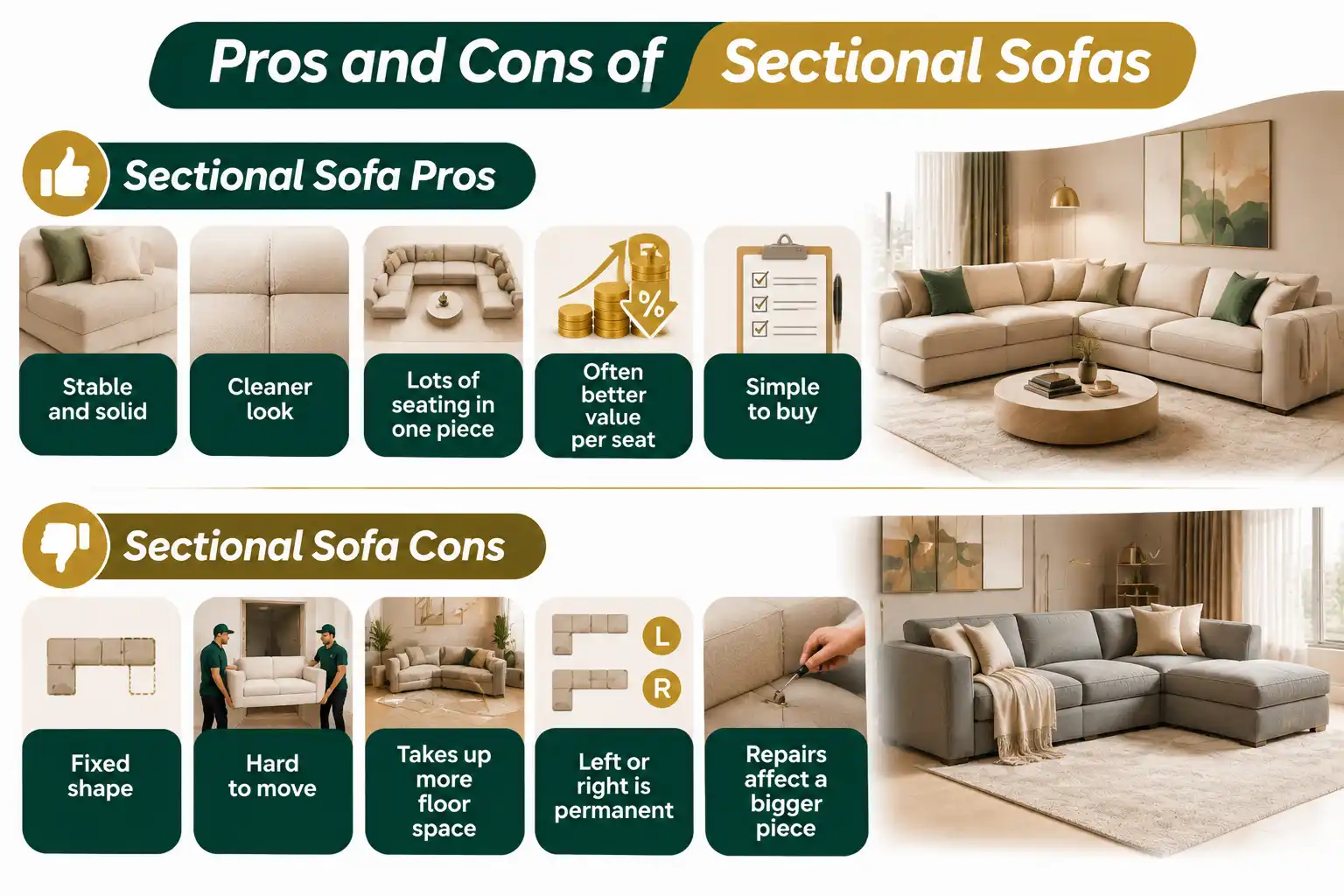
Sectional Sofa Pros
- Stable and solid. Fewer, larger sections mean less movement and fewer gaps when people sit down.
- Cleaner look. Fewer seams give a smoother, more tailored line.
- Lots of seating in one piece. A U-shape or large L seats a whole family without extra chairs.
- Often better value per seat. Fewer frames and arms usually mean a lower cost for the same number of seats.
- Simple to buy. You choose one shape and size instead of planning every unit.
A sectional also makes it easy to define a living area in an open-plan room. Placed with its back to the dining space, it creates a clear edge without a wall. For more ideas on arranging the rest of the room around it, see our living room furniture ideas.
Sectional Sofa Cons
- Fixed shape. If you move to a home with a different layout, the sofa may no longer fit.
- Hard to move. Large sections can struggle with narrow corridors, lifts and staircases.
- Takes up more floor space. A large sectional can make a small room feel crowded.
- Left or right is permanent. Choose the wrong RAF or LAF side and you cannot simply swap it.
- Repairs affect a bigger piece. A damaged section is larger and costlier to fix than one modular unit.
That last point has a practical fix. When the fabric on a sectional wears out but the frame is still sound, sofa upholstery can give it a new cover instead of replacing the whole sofa.
Which Is Better for Your Space?
The best choice depends less on the sofa and more on your room and your plans. Here is how the two compare in the situations buyers face most often.
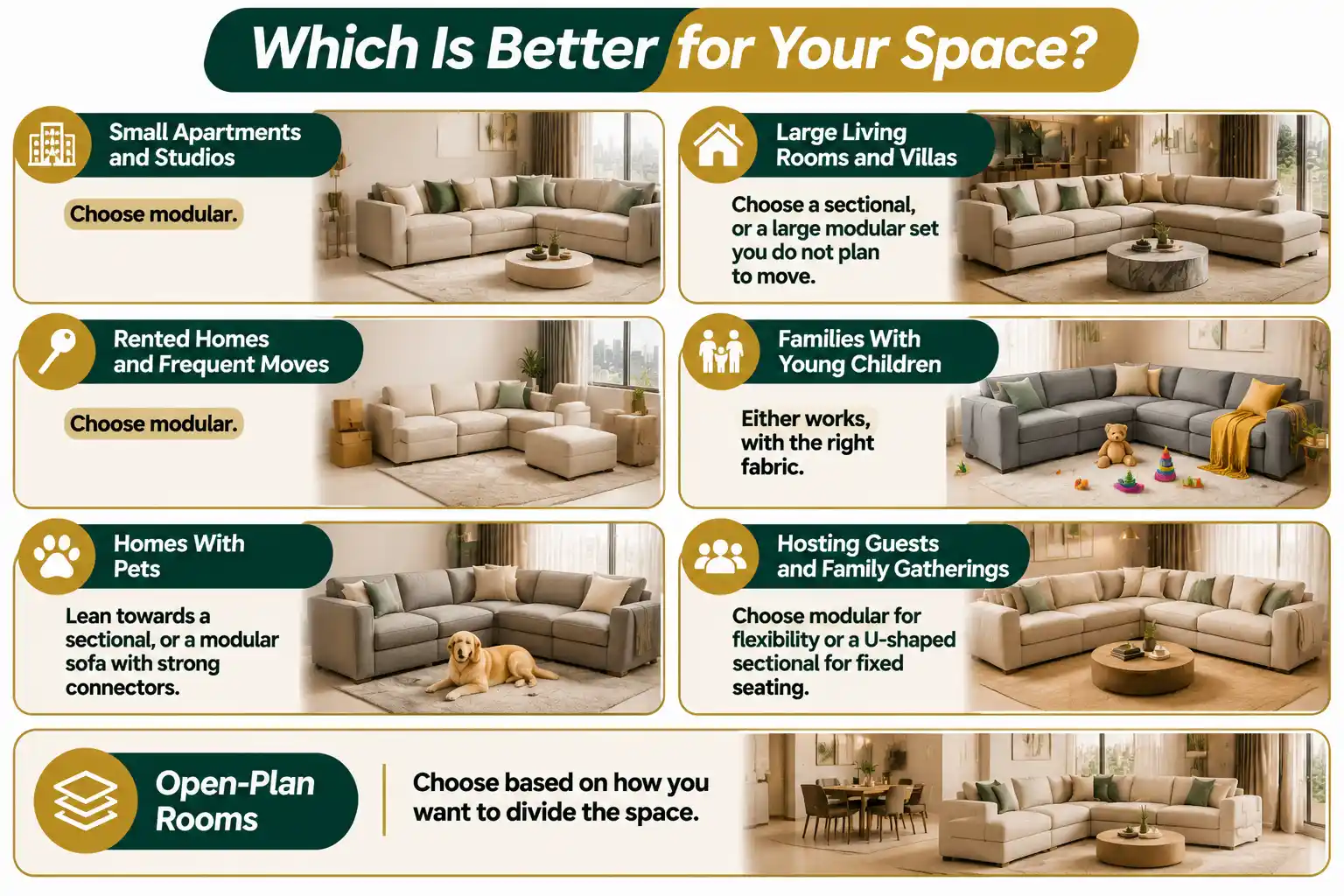
Small Apartments and Studios
Choose modular. Small rooms need furniture that can adapt. A compact modular sofa can sit against one wall during the week and open into a corner layout when friends visit. Single units also get through narrow building corridors and small lifts more easily.
Large Living Rooms and Villas
Choose a sectional, or a large modular set you do not plan to move. In a big room, a sectional fills the space well and gives a clean, built-in look. If the layout will stay the same for years, the extra flexibility of modular adds cost without much benefit.
Rented Homes and Frequent Moves
Choose modular. Renters often move every few years. A modular sofa can be reshaped to suit each new floor plan, and the units are easier to carry. A large sectional chosen for one apartment may not fit the next one.
Families With Young Children
Either works, with the right fabric. Modular wins on easy repairs, since one stained unit can be cleaned or recovered on its own. A sectional wins on stability, with fewer gaps for small hands and toys to slip into. In both cases, a durable, easy-clean fabric matters more than the sofa type.
Homes With Pets
Lean towards a sectional, or a modular sofa with strong connectors. Pets jumping on and off can push loose units apart. Fewer seams also mean fewer places for hair to collect.
Hosting Guests and Family Gatherings
Choose modular for flexibility or a U-shaped sectional for fixed seating. Modular pieces can be pulled out into extra seats or set around a room. A U-shaped sectional seats more people in one spot but stays in that shape.
Open-Plan Rooms
Choose based on how you want to divide the space. A sectional creates a strong, fixed boundary between living and dining areas. A modular sofa lets you shift that boundary when you rearrange the room.
How to Measure and Plan the Layout
Most sofa mistakes are measuring mistakes. Whichever type you choose, plan the layout on paper and on the floor before you order.
- Measure the wall or walls the sofa will sit against. For an L or U shape, measure each side from the corner.
- Mark where doors, windows, AC units and sockets are. A sofa that blocks a balcony door or a floor socket is a daily annoyance.
- Plan the walkways. Common interior design guidance is to keep main walkways about 75 to 90 cm wide, and side paths at least 75 cm.
- Leave space for the coffee table. A gap of roughly 35 to 45 cm between the sofa and the coffee table lets you reach it without bumping your knees.
- Check the seat depth. Deeper seats are good for lounging, but a very deep sofa eats into the room and can be hard for older family members to get out of.
- Mark the outline on the floor. Use masking tape to show the full shape, then walk around it for a day.
- Measure the way in. Check the width and height of the building entrance, lift, corridor and front door. This matters most for a sectional, whose sections are larger.
For a modular sofa, measure each unit you plan to buy, including any width taken up by the connectors. For a sectional, confirm the RAF or LAF side against your floor plan before you order.
Common Mistakes to Avoid
These are the problems that most often turn a new sofa into a regret. Most of them have nothing to do with whether it is modular or sectional.
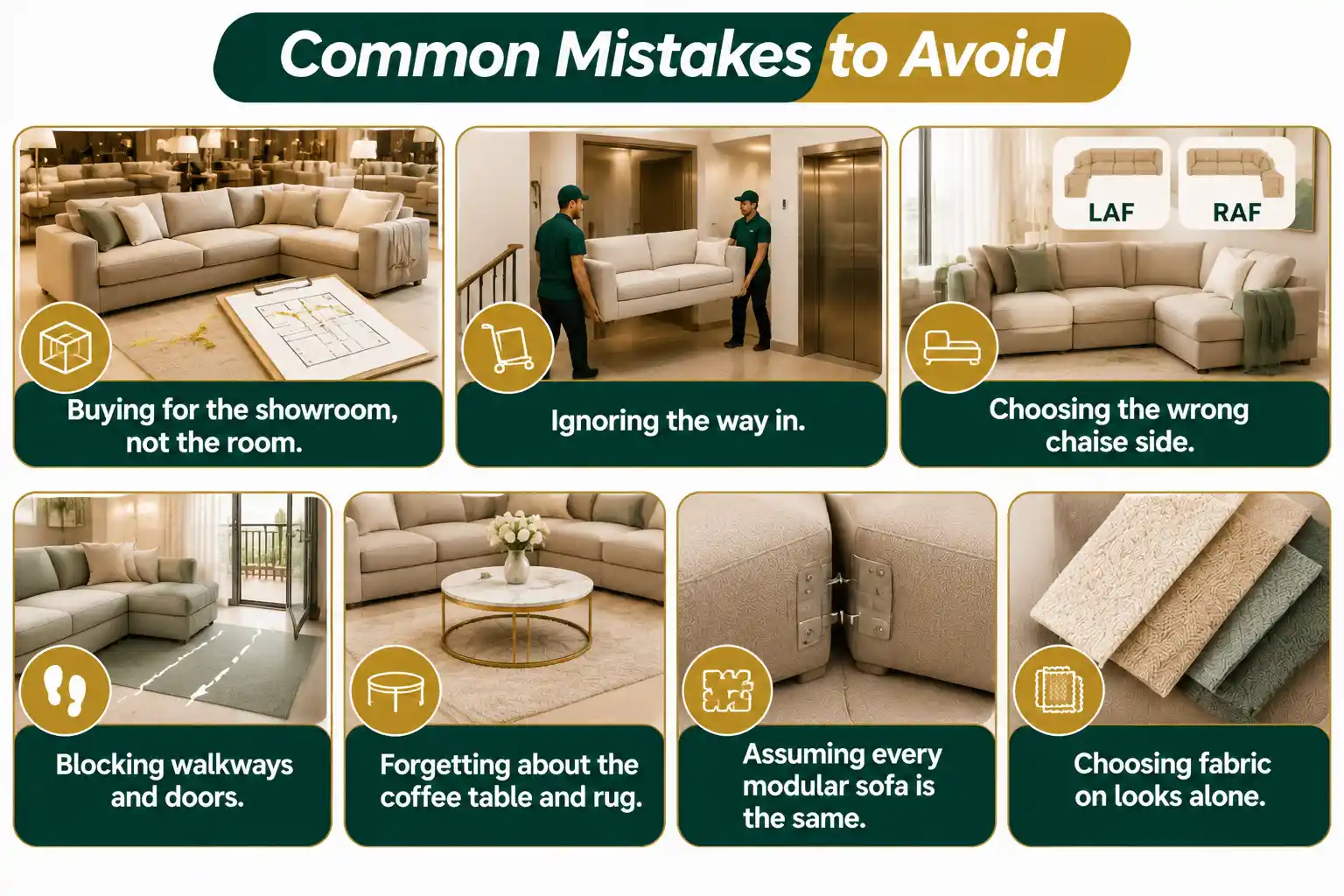
- Buying for the showroom, not the room. A sofa looks smaller in a large store. Always compare its measurements with your floor plan.
- Ignoring the way in. A sectional that cannot turn the corner of a corridor or fit in the lift will not reach your living room, however well it fits the wall.
- Choosing the wrong chaise side. For a fixed sectional, check RAF or LAF twice. Stand facing the spot where the sofa will go and note which side the chaise needs to be on.
- Blocking walkways and doors. A large L or U shape can cut across a path to the balcony, kitchen or hallway. Keep the main routes clear.
- Forgetting about the coffee table and rug. The sofa, table and rug work as one group. Plan them together so the table sits within easy reach and the rug is large enough for at least the front legs of the sofa.
- Assuming every modular sofa is the same. Connector quality, unit sizes and the choice of pieces vary a lot. Check what you can add later before you buy.
- Choosing fabric on looks alone. A pale, loose-weave fabric may look beautiful but struggle with children, pets and sun. Think about daily use first, colour second.
Taking a few extra minutes to check these points usually saves a costly return, a sofa stuck in a corridor or a layout that never quite works.
What to Check Before You Buy
The sofa type decides the layout. Build quality decides how long it lasts. Check these points for either option.
- Frame. Ask what the frame is made of. Solid hardwood or good-quality engineered wood holds up better than soft, thin boards.
- Connectors (modular). Look under the seat. Metal brackets or strong clips keep units together better than plastic hooks. Ask how they handle smooth tile and marble floors.
- Section joints (sectional). Check that the sections lock firmly and line up at the same height.
- Cushion filling. Firm foam keeps its shape longer. Softer fillings feel inviting at first but may flatten sooner. Ask whether cushion covers zip off for cleaning.
- Seat height and depth. Sit on it if you can. Your feet should rest flat on the floor with your back supported.
- Fabric for the UAE climate. Strong sun through large windows can fade colours, so lighter or fade-resistant fabrics suit sunny rooms. Tightly woven, easy-clean fabrics cope better with dust and daily use.
- Extra units (modular). Confirm that matching pieces will be available later.
- Delivery and assembly. Ask who carries the sofa in, who connects the pieces and whether that is included.
Is a Custom Sofa Worth Considering?
If no ready-made sofa fits your wall or your layout, a custom-made sofa is worth looking at. A maker can build a modular or sectional sofa to your exact measurements, chosen fabric and preferred seat depth. It usually takes longer than buying from stock, so allow for production time in your plans.
Frequently Asked Questions
Is a Modular Sofa the Same as a Sectional?
Not quite. A modular sofa is made of independent units you can rearrange. A sectional is made of larger sections that fit together in one fixed shape. A modular sofa can be arranged as a sectional, but most sectionals cannot be rearranged like a modular sofa.
Are Modular Sofas Comfortable?
They can be just as comfortable as a sectional. Comfort depends on the cushion filling, seat depth and frame, not on whether the sofa is modular. The only difference you may feel is the seam between units.
Do Modular Sofas Come Apart Easily?
Good ones stay together in daily use. Units with weak connectors can drift apart, especially on smooth floors. Strong metal connectors and non-slip pads under the feet help.
Which Is Better for a Small Living Room?
A modular sofa is usually better. You can buy only the pieces that fit and rearrange them when needed. A compact chaise sectional can also work if it suits the wall length.
Can You Add Pieces to a Sectional Later?
Usually not. Most sectionals are sold as a set shape. If you think you will want more seats later, a modular sofa is the safer choice.
Are Modular Sofas More Expensive?
They often cost more per seat because each unit has its own frame and parts. Over time, the ability to reuse and rearrange the same sofa in a new home can balance that out.
Which Lasts Longer, a Modular Sofa or a Sectional?
Neither lasts longer by design. Lifespan depends on frame quality, cushions, fabric and care. Modular sofas have one advantage: a single worn unit can be repaired or replaced on its own.
Which Is Easier to Clean, a Modular Sofa or a Sectional?
A modular sofa is usually easier to deep clean, because you can separate the units and reach every side, including the floor underneath. A sectional has fewer seams for dust and crumbs to collect in day to day. For both types, removable, washable cushion covers make the biggest difference.
Final Thoughts
A modular sofa is the better choice if your home, your family or your address is likely to change. It adapts to new rooms, moves more easily and lets you repair or add one piece at a time. A sectional is the better choice if you have a large room, a settled layout and want a solid, continuous sofa at a lower cost per seat.
Before you decide, measure the room and the way in, picture how you will use the space in two or three years, and check the frame, cushions, connectors and fabric. Those details matter more than the label on the sofa.
Planning a New Sofa for Your Home?
Floor Land designs and builds custom sofas in L-shaped, U-shaped, multi-seater and majlis styles, made to your measurements and fabric choice. Share your room size and the layout you have in mind, and our team will help you work out which option fits your space best.