
20 Floor Tile Patterns: Best Layout Ideas Worth Copying
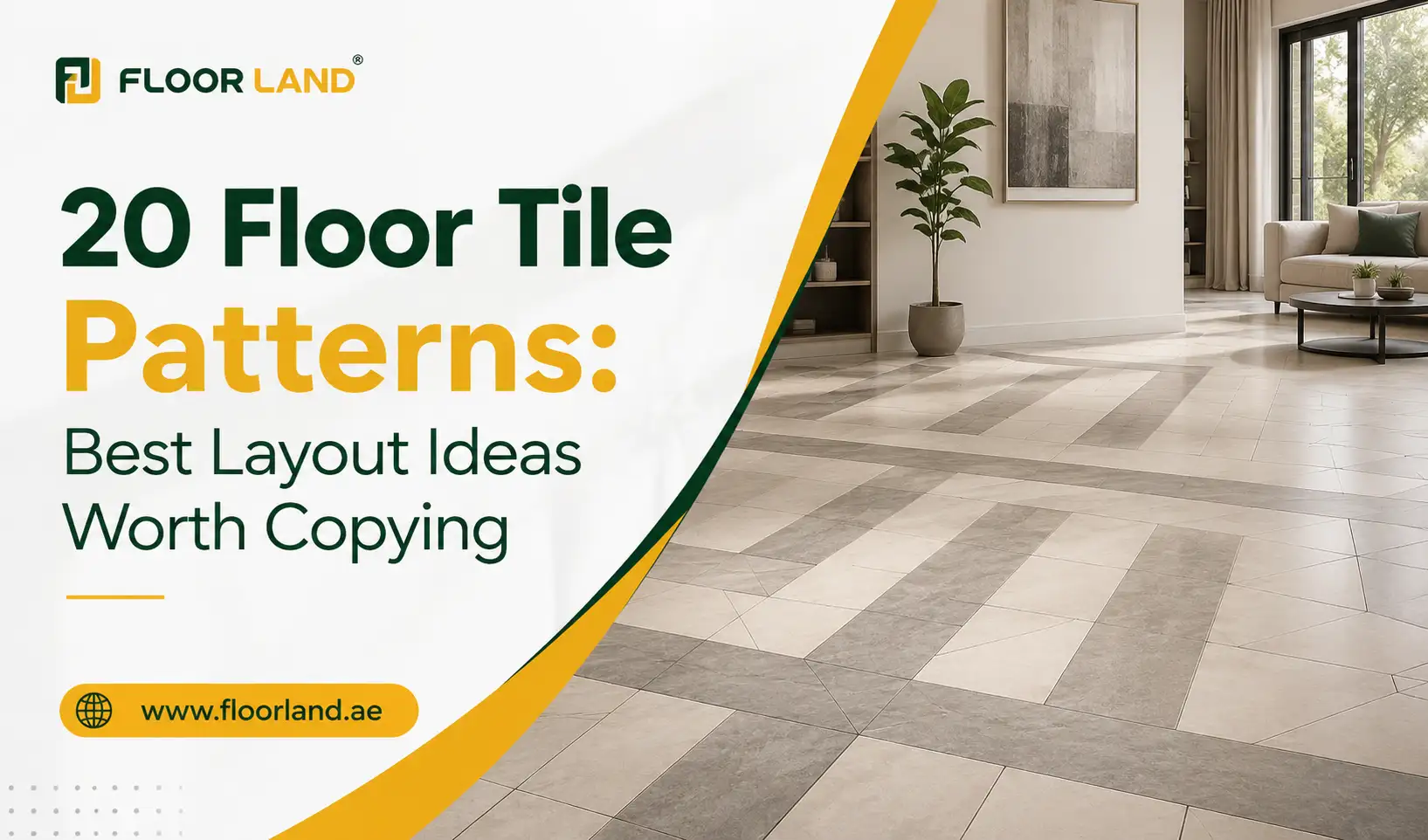
Floor tile patterns decide how a room feels before anyone notices the tile itself. Two homes can use the exact same porcelain slab and still look completely different, simply because one floor was laid straight and the other was set on a diagonal or woven into a herringbone. Layout affects sightlines; it affects how light bounces across a surface, and it affects whether a narrow hallway feels cramped or a small bathroom feels open.
Getting the pattern right matters just as much as picking the right color or finish. Because once tiles are set in mortar, that decision stays on the floor for the next fifteen or twenty years. This guide by Floor Land walks through the floor tile patterns worth knowing. You will also get an idea of how to pick one that actually fits your room instead of just your Pinterest board.
Trendy Floor Tile Patterns
| Pattern | Visual Effect | Installation Difficulty |
| Straight Lay | Clean, calm, orderly | Easy |
| Diagonal | Widens the room, softens straight walls | Moderate |
| Running Bond (Brick) | Adds rhythm without feeling busy | Easy–Moderate |
| Herringbone | Movement, texture, classic-meets-modern | Difficult |
| Double Herringbone | Bold, dramatic, high-end | Difficult |
| Chevron | Sharp, directional, elegant | Difficult |
| Basket Weave | Woven, textural, quietly ornate | Moderate–Difficult |
| Pinwheel (Hopscotch) | Playful, structured, detailed | Moderate |
| Versailles (French Pattern) | Old-world, sophisticated, varied | Difficult |
| Windmill | Structured yet dynamic | Moderate–Difficult |
| Hexagon Layout | Honeycomb texture, softens hard edges | Moderate |
| Diamond Pattern | Formal, elongating, elegant | Moderate |
| Modular Pattern | Organic, less repetitive | Moderate |
| Checkerboard | High contrast, graphic, bold | Easy–Moderate |
| Offset Grid | Subtle rhythm, forgiving of size variation | Easy |
| Step Ladder Pattern | Linear, staggered, contemporary | Moderate |
| Parquet Tile Pattern | Warm, wood-like, intricate | Difficult |
| Mixed Size Tile Layout | Organic, handcrafted, irregular | Difficult |
| Large Format Continuous | Seamless, spacious, few grout lines | Easy–Moderate |
| Geometric Combination | Custom, artistic, one-of-a-kind | Difficult |
Use the table to shortlist two or three patterns, then read the full breakdowns below before you commit to one.
1. Straight Lay
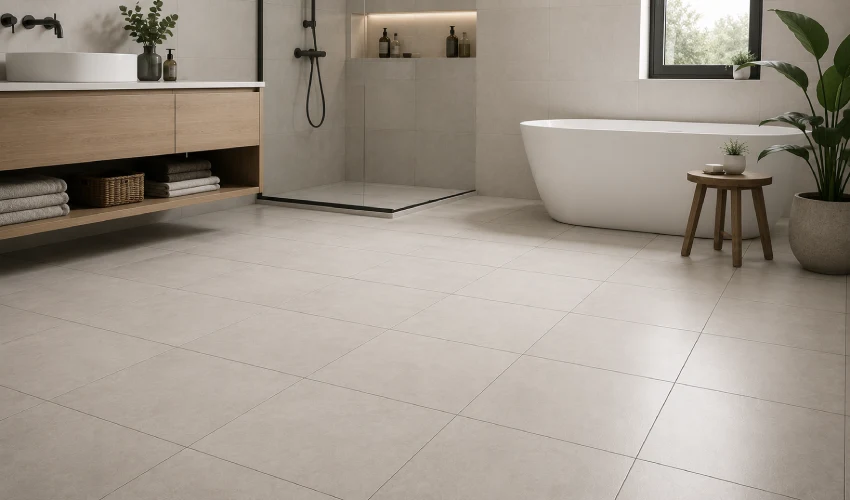
Straight lay, sometimes called a grid or stack bond, lines tiles up in even rows and columns with grout joints that run continuously in both directions. It is the layout most tile setters learn first. And it is also the one that shows the least waste during installation because there is very little cutting once the first row is squared to the room.
A straight grid reads as calm and uninterrupted. Because the eye doesn’t have to follow any diagonal movement, the floor recedes into the background and lets furniture, wall color, or a statement rug take center stage. This flooring layout is best for bathrooms, laundry rooms, mudrooms, and any small space where you want the floor to disappear rather than perform.
- Suitable materials: Porcelain, ceramic, and large-format vitrified tiles all work well, since straight lay hides seams less than diagonal layouts do, so uniform coloring matters more than pattern variation.
- Design style compatibility: Minimalist, Scandinavian, contemporary, and transitional interiors.
- Installation considerations: Squaring the first row to the longest, most visible wall is critical. A floor that’s slightly out of square becomes obvious fast with a grid layout, since every line amplifies the error.
- Maintenance: Continuous grout lines in both directions mean more total grout to seal and clean, so choose a stain-resistant grout or an epoxy grout in high-traffic areas. Also follow a proper grout cleaning routine.
2. Parquet Tile Pattern
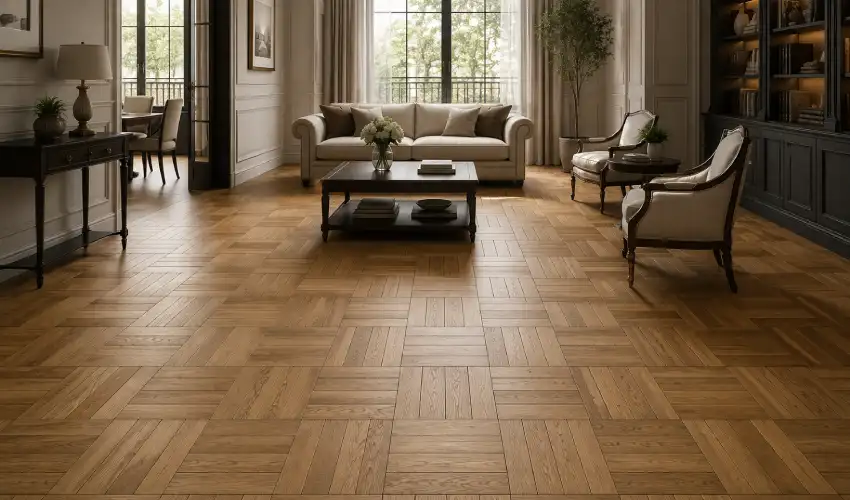
Parquet pattern arranges small rectangular tiles into repeating geometric blocks. It often features a basket-weave or herringbone motif to mimic traditional wood parquet flooring, either in real wood tile or wood-look porcelain. Parquet brings warmth and old-world craftsmanship to a floor, with more intricate detail than a standard herringbone since the blocks themselves often repeat in a secondary pattern. This pattern is best for living rooms, studies, and formal dining rooms, especially in traditional homes.
- Suitable materials: Solid or engineered wood tile, or wood-look porcelain for better moisture resistance in humid climates.
- Design style compatibility: Traditional, classic European, and library-study interiors.
- Installation considerations: This is a high-skill layout best left to an installer with parquet-specific experience, since each block needs to align precisely with its neighbors.
- Maintenance: Real wood parquet needs periodic refinishing; wood-look porcelain needs only standard grout care and offers far easier long-term upkeep.
3. Diagonal Pattern
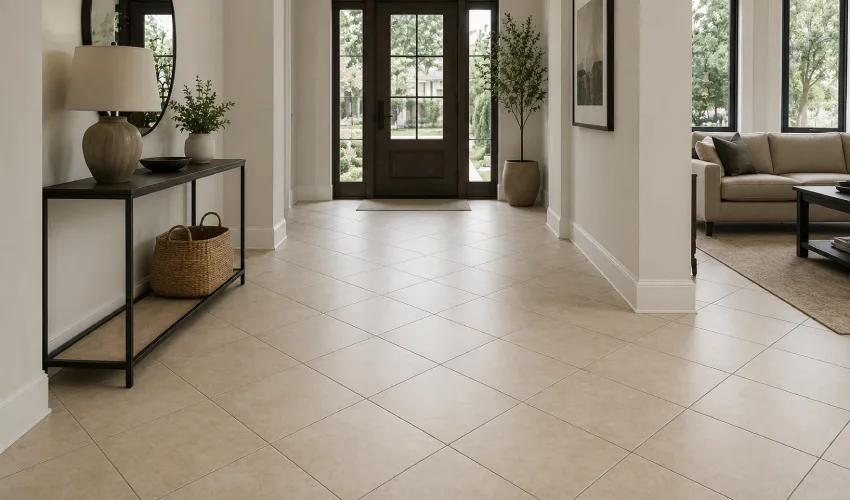
A diagonal layout takes the same square tile as straight lay but rotates it 45 degrees. This way, the grout lines run corner to corner instead of wall to wall. Diagonal lines lead the eye toward the corners of a room rather than along its walls, which tricks the brain into perceiving more floor area than actually exists. It’s one of the most effective tricks for making a narrow hallway or a boxy small room feel wider.
- Suitable materials: Square porcelain or ceramic tiles between 300mm and 600mm work best; very large tiles waste too much material on corner cuts.
- Best rooms: Entryways, narrow hallways, small kitchens, and galley-style bathrooms.
- Installation considerations: Expect roughly 15% more tile waste than straight lay because of the triangular cuts needed along every wall, so order extra material and budget more labor time.
- Expert tip: Diagonal layouts read best with a tile that has minimal pattern variation. Busy stone-look tiles fight the diagonal line instead of supporting it.
4. Running Bond (Brick)
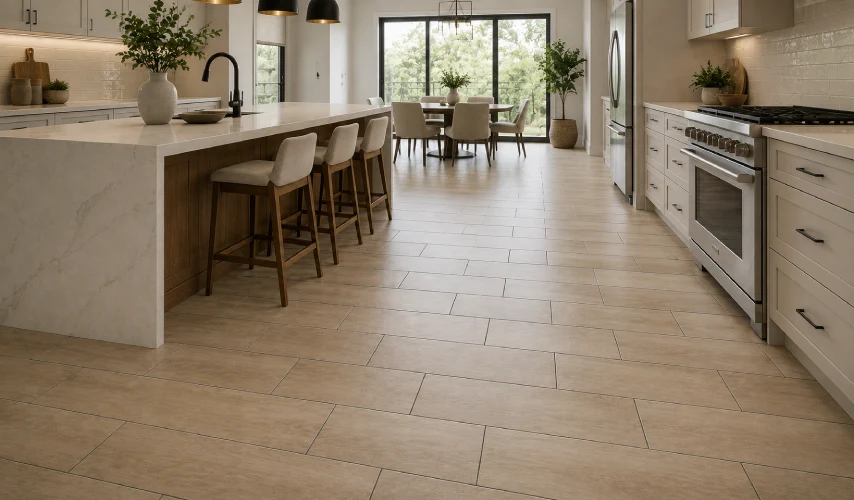
Running bond offsets each row by half a tile length, the same way bricks are laid in a wall, which is why it’s often just called a brick pattern. This pattern is best to be used in kitchens, hallways, and bathrooms, especially with subway-style rectangular tile. Rectangular tiles with a 2:1 length-to-width ratio (like a standard subway tile) are the classic choice, though wood-look floor planks also work well in this layout.
The staggered joints break up the monotony of a straight grid without introducing the complexity of a diagonal or herringbone layout. It reads as classic and a little more relaxed than a strict grid, and the offset seams naturally disguise minor size variation between tiles.
- Maintenance: Standard grout care applies; darker grout hides dirt better in high-traffic kitchens.
- Expert tip: For long, rectangular plank tile, lay the pattern so the joints run parallel to the longest wall or the main light source. It elongates the room and reduces visible lippage under raking light.
5. Herringbone
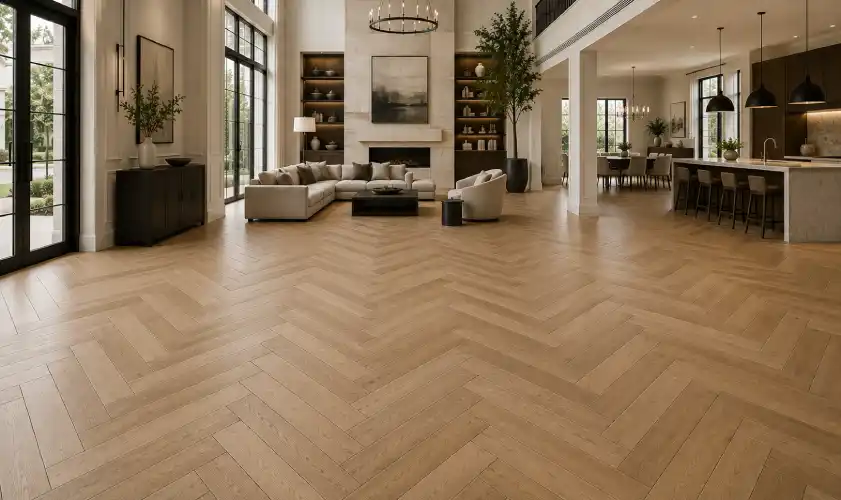
Herringbone arranges rectangular tiles at right angles to one another in a repeating zigzag, so each tile points toward the next in a broken-arrow shape. The most suitable materials for these tiles include rectangular porcelain, ceramic, natural wood, or wood-look plank tile in a 2:1 or 3:1 ratio.
Herringbone requires far more cutting than straight or brick layouts, especially where the pattern meets walls at an angle. So it demands a tile setter experienced with the layout; mismatched points are very noticeable.
- How it changes a room: Herringbone is one of the most visually active layouts on this list. It adds movement, energy, and a sense of craftsmanship that a flat grid simply can’t match, while still reading as a classic pattern with centuries of history behind it. It works especially well at directing the eye down a hallway or across an open floor plan.
- Best rooms: Entryways, kitchens, and bathrooms where the floor is meant to be a design feature rather than a backdrop.
- Design style compatibility: Parisian, classic European, transitional, and modern farmhouse.
6. Double Herringbone
Double herringbone pairs two tiles side by side at each step of the zigzag instead of one, essentially doubling the width of every “arm” in the pattern. The extra width slows the visual rhythm down and gives the pattern a chunkier, bolder presence than standard herringbone. It reads as more architectural and less delicate, which suits larger rooms where a single-tile herringbone might look too fine-grained to register.
- Best rooms: Large open-plan living areas, expansive kitchens, and grand entry halls.
- Suitable materials: Wood-look plank porcelain and natural stone strips work particularly well because the doubled width shows off the material’s grain or veining.
- Expert tip: Keep grout color close to the tile color in double herringbone. The bold geometry already carries the visual weight, and high-contrast grout can make the floor feel busy rather than striking.
7. Chevron
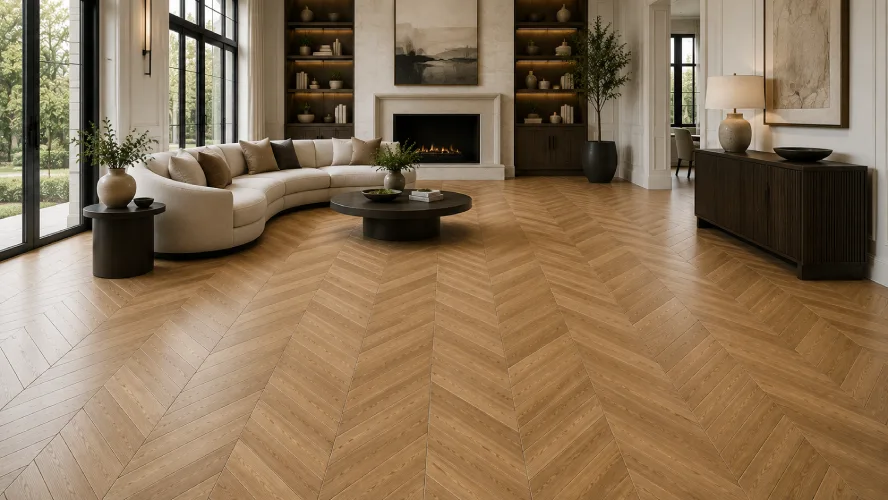
Chevron looks similar to herringbone at a glance, but the tile ends are cut at an angle so they meet in a continuous, unbroken V shape rather than a stepped zigzag. This tile pattern is sharper and more formal than herringbone. The unbroken lines create a strong sense of direction, which makes it a favorite for drawing the eye toward a focal point, such as a fireplace or a floor-to-ceiling window.
- Suitable materials: Pre-cut chevron tile (porcelain or engineered wood) is far easier to install correctly than field-cutting standard rectangular tile into angled points.
- Installation considerations: This is one of the most labor-intensive patterns to install correctly because every tile end needs a precise matching angle; buying pre-mitered chevron tile from the manufacturer avoids costly on-site cutting errors.
- Maintenance: Standard care, though the continuous lines make even small grout discoloration more visible than in a broken pattern like herringbone.
8. Basket Weave
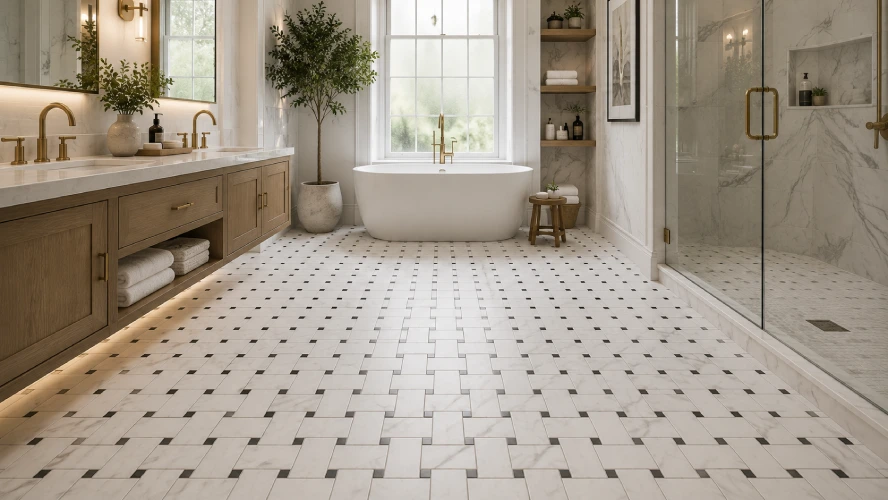
Basket weave alternates pairs of tiles. One pair laid horizontally, the next laid vertically to mimic the over-under look of a woven basket. The alternating orientation creates a soft, textural rhythm that feels more traditional and less graphic than herringbone or chevron. It has enough visual interest to anchor a room without overwhelming it.
- Best rooms: Bathrooms, kitchens, and mudrooms in traditional or transitional homes.
- Design style compatibility: Traditional, Victorian, and transitional interiors.
- Maintenance: No special requirements beyond standard grout sealing.
- Expert tip: A contrasting dot tile at each intersection (often in a different color or a natural stone) adds a subtle luxury touch without changing the overall pattern’s footprint.
9. Pinwheel (Hopscotch)
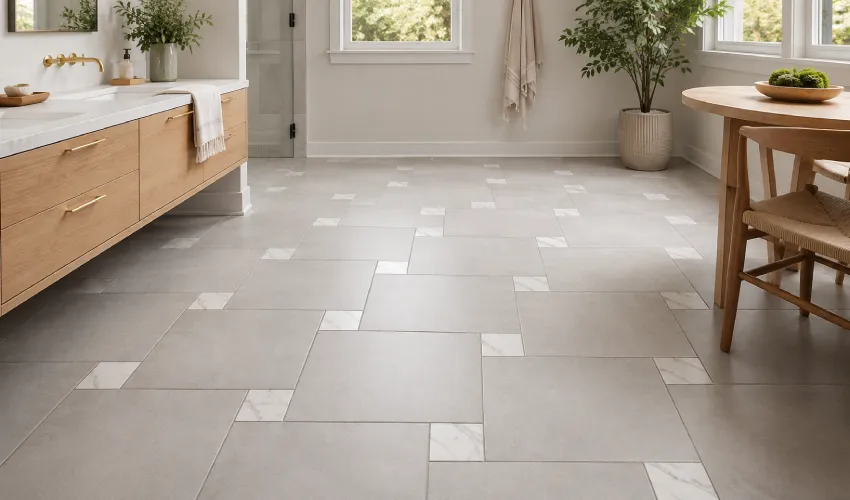
Pinwheel, also called hopscotch, surrounds a small square tile with four larger rectangular tiles arranged so they rotate around it like the blades of a pinwheel. Precise spacing around the accent tile is what makes or breaks this layout. Ultimately, it works best with tile sizes that divide evenly into the room’s dimensions.
- How it changes a room: The small central tile, often in a contrasting color, adds a playful, detailed accent without requiring a full mosaic. It’s structured enough to feel intentional but has more personality than a plain grid.
- Best rooms: Bathrooms, mudrooms, and kitchen accent zones like a breakfast nook.
- Suitable materials: A common combination is a large-format square or rectangular field tile with a small square or penny-round accent tile at the pinwheel’s center.
- Design style compatibility: Traditional, cottage, and eclectic interiors.
- Maintenance: Standard care; the accent tile is a good place to use a more delicate material like marble since it sees less direct wear at the edges.
10. Versailles (French Pattern)
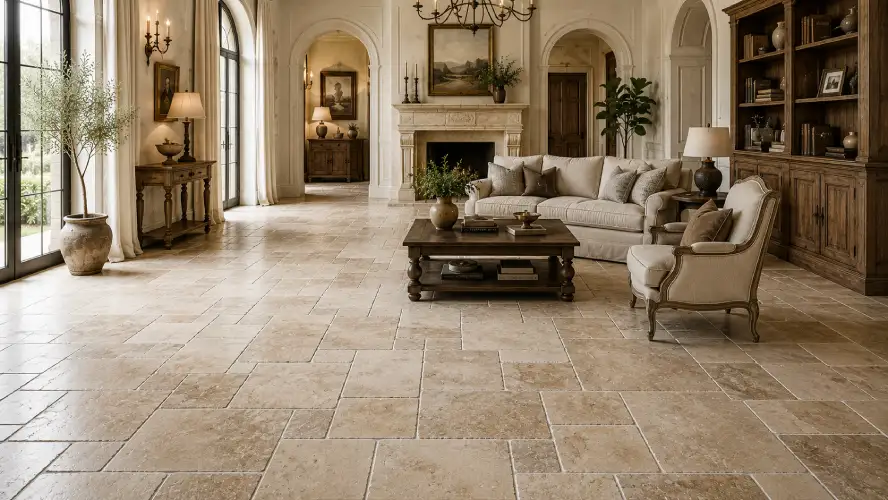
Named after the palace floors it originated from, the Versailles pattern combines tiles of several different sizes and shapes. Because the pattern mixes tile sizes rather than repeating one shape, it reads as less uniform and more organic than any other layout on this list. It gives a floor an old-world, custom-built feel that’s hard to fake with a single tile size.
- Best rooms: Formal living rooms, libraries, and large entry halls, particularly in homes leaning traditional or European.
- Design style compatibility: French country, traditional, and old-world European.
- Installation considerations: This is one of the most complex layouts to plan and lay. Since it requires multiple tile sizes cut to exact modular proportions
- Maintenance: Natural stone versions need regular sealing; porcelain versions need only standard grout care.
- Expert tip: Order your Versailles kit as a pre-packaged modular set from the tile manufacturer rather than buying individual sizes separately. The size ratios are precise, and buying piecemeal almost always leads to shortages of one size.
11. Windmill
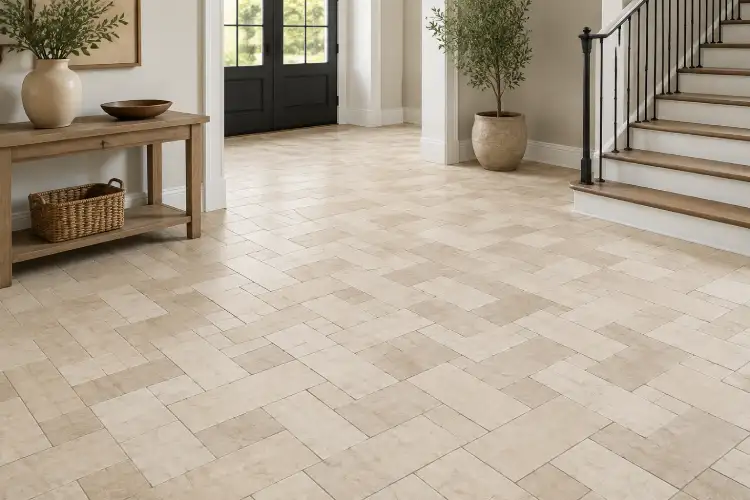
Windmill layout surrounds a central square tile with four rectangular tiles arranged around it in a rotating, pinwheel-like block, then repeats that block across the floor. It is similar to pinwheel but built as a continuous modular pattern rather than an isolated accent.
- How it changes a room: The repeating rotation gives the floor a structured yet dynamic energy, more formal than a basket weave but less busy than a full Versailles pattern.
- Best rooms: Kitchens, foyers, and transitional spaces where you want texture without full ornamentation.
- Suitable materials: Natural stone or porcelain in a two-size set (one square, one rectangle at double the square’s width).
- Design style compatibility: Traditional, Mediterranean, and transitional interiors.
- Installation considerations: Like Versailles, this pattern depends on exact size ratios between the square and rectangular tiles, so it’s best purchased as a matched set.
- Maintenance: Standard care for porcelain; sealing required for natural stone.
12. Hexagon Layout
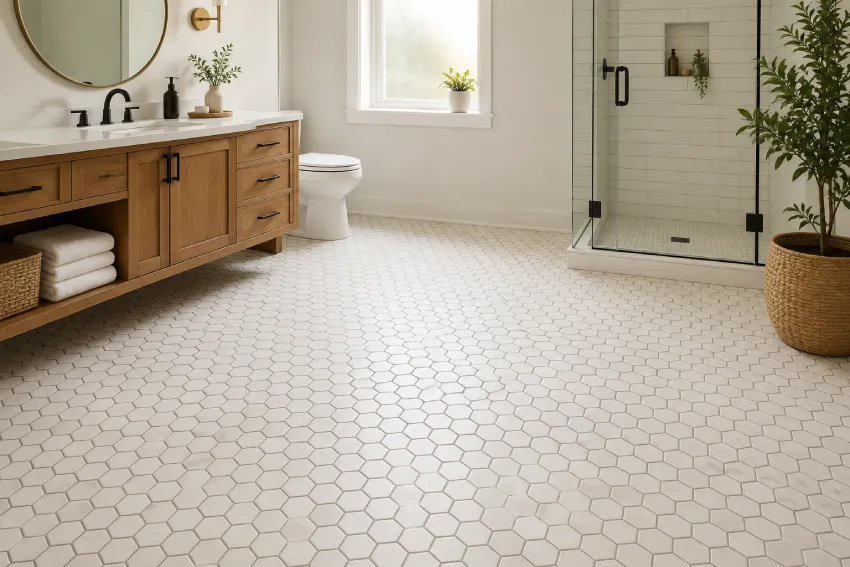
Hexagon tiles interlock edge to edge in a honeycomb formation, with no straight grout lines running the full length of the room in any direction. The honeycomb shape softens a room’s hard, rectangular edges and adds organic texture underfoot. Because the grout lines break up constantly, hexagon floors tend to feel busier up close but calmer from a distance, since there’s no single dominant line for the eye to track.
- Best rooms: Bathrooms, powder rooms, and retro-inspired kitchens.
- Suitable materials: Small-format hexagon tile (2–8 inches across) in porcelain, ceramic, or classic penny-tile mosaic sheets.
- Design style compatibility: Mid-century modern, retro, bohemian, and eclectic interiors.
- Maintenance: More grout lines per square foot than most other layouts, so seal thoroughly, especially in wet rooms.
13. Diamond Pattern
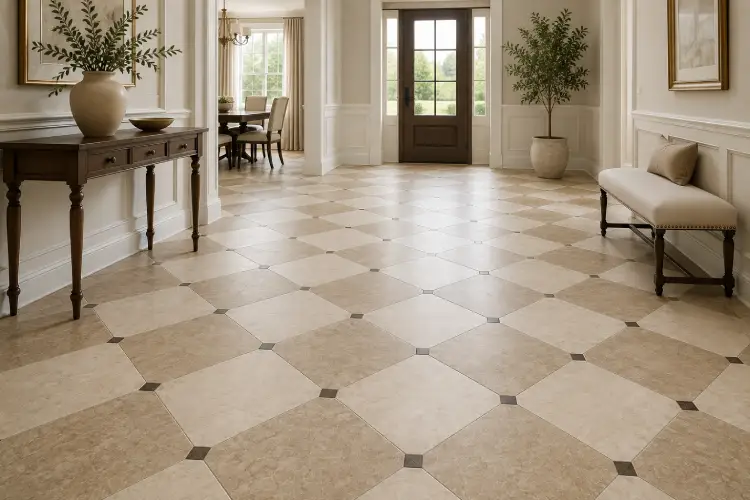
Diamond pattern rotates rectangular or square tiles 45 degrees like a diagonal layout, but typically alternates two tile sizes or colors to create a pointed, diamond-shaped repeat rather than a plain rotated grid. If using two tile colors, keep the contrast subtle (two shades of the same neutral, for example) unless you specifically want a bold, checkerboard-adjacent look; high-contrast diamonds can visually shrink a room instead of elongating it.
The pattern elongates a room along its diagonal axis and adds a formal, tailored look, especially when two tones are alternated to sharpen the diamond shapes. This layout is best for entryways, formal dining rooms, and hallways.
- Suitable materials: Square porcelain or natural stone tile, often alternated with a smaller square “dot” at each diamond’s point.
- Design style compatibility: Traditional, colonial, and classic transitional interiors.
- Installation considerations: Like diagonal layout, expect increased tile waste from corner cuts, plus extra planning time if you’re alternating two colors to keep the pattern symmetrical.
- Maintenance: No special requirements beyond standard care.
14. Modular Pattern
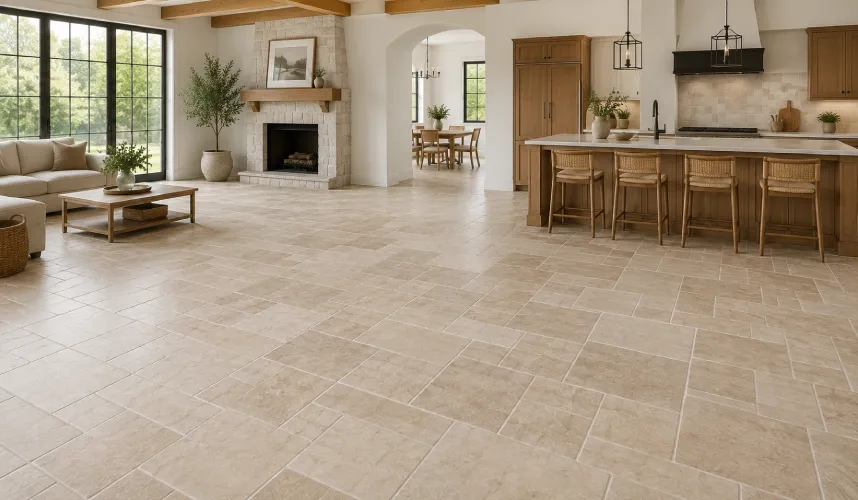
Modular layout combines several different tile sizes from the same collection. For example, three or four rectangle and square formats into a repeating block that avoids the look of a single, obviously repeated tile. Because no single tile size repeats in a predictable rhythm, the floor reads as more organic and less manufactured, closer to natural stone flooring than to a uniform tile grid. Most large tile manufacturers sell modular sets specifically designed for this layout. Check the product line before mixing sizes on your own.
- Best rooms: Open-concept living areas, large kitchens, and great rooms where a single repeating tile size would look monotonous over a big footprint.
- Design style compatibility: Contemporary, Mediterranean, and rustic-modern interiors.
- Installation considerations: Manufacturers typically supply a layout diagram with modular sets; following it precisely avoids awkward size repeats near walls.
- Maintenance: Standard care, though more total grout lines than a large-format continuous layout.
15. Checkerboard
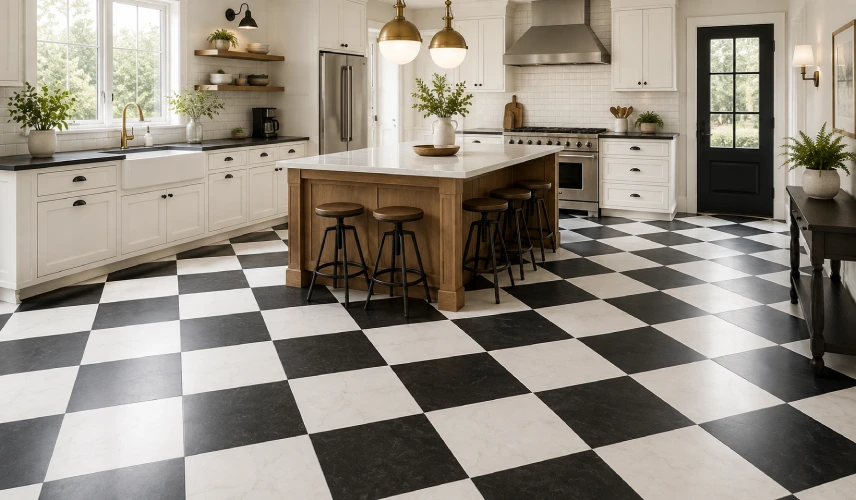
Checkerboard alternates two contrasting tile colors. These colors are mainly black and white in a straight grid so each tile sits diagonally next to a tile of the opposite color. Few patterns are as instantly graphic as checkerboard. It adds strong visual energy and works as a statement floor in its own right, though it also demands a room confident enough to support that much contrast. Classic square porcelain or ceramic tile in two contrasting colors, though marble checkerboard is a common upscale variation.
- Best rooms: Kitchens, bathrooms, and retro or diner-style spaces.
- Design style compatibility: Retro, art deco, farmhouse, and eclectic interiors.
- Installation considerations: Precise squaring is critical, since any misalignment is far more visible with high-contrast colors than with a monochrome grid.
- Maintenance: Light-colored tiles show scuffs and grout discoloration faster than dark ones, so choose a mid-tone grout that won’t stain visibly against either color.
16. Offset Grid
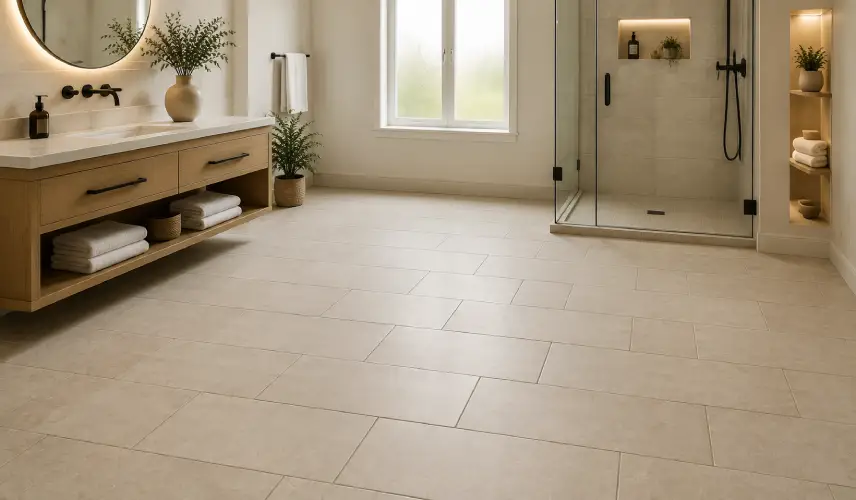
Offset grid is a milder cousin of running bond, staggering rows by a smaller fraction. It is often a quarter or a third of the tile’s length, rather than a full half. The smaller offset creates subtle visual rhythm without the strong directional pull of a true brick pattern, making it a forgiving, versatile choice for almost any room.
- Best rooms: Bathrooms, commercial spaces, and any room where you want texture without commitment to a bolder pattern.
- Suitable materials: Works with nearly any rectangular tile, including large-format plank tile.
- Design style compatibility: Contemporary, transitional, and commercial-modern interiors.
- Installation considerations: A quarter or third offset reduces lippage risk compared to a full half-offset, which matters most with larger, thicker tiles.
17. Step Ladder Pattern
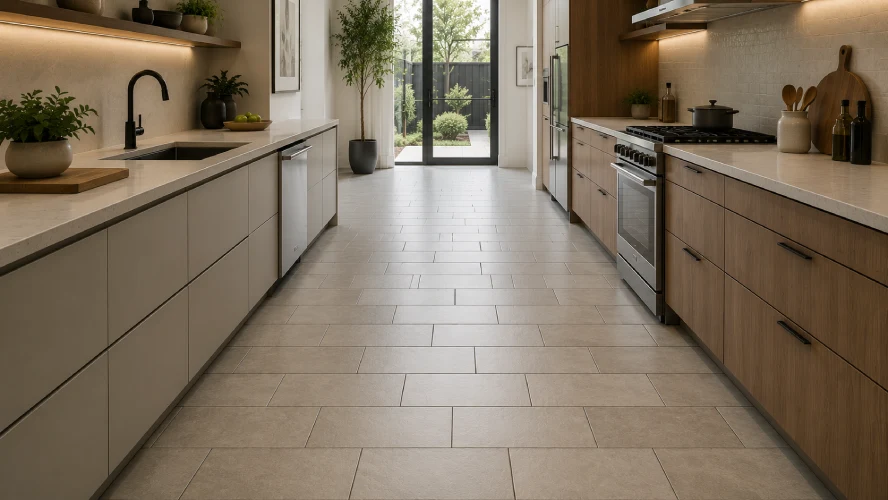
Step ladder pattern lines up rectangular tiles in staggered rows that shift consistently in one direction, so each row steps slightly to the side of the one before it, similar to a ladder laid on its side.
- How it changes a room: The consistent stagger creates a strong sense of directional flow, guiding the eye down a room’s length, which makes it particularly useful in narrow spaces.
- Best rooms: Kitchens, laundry rooms, and galley-style layouts.
- Design style compatibility: Contemporary and industrial interiors.
- Installation considerations: The offset amount needs to stay consistent row to row, so this pattern benefits from a chalk-line layout plan before any tile is set.
18. Mixed Size Tile Layout
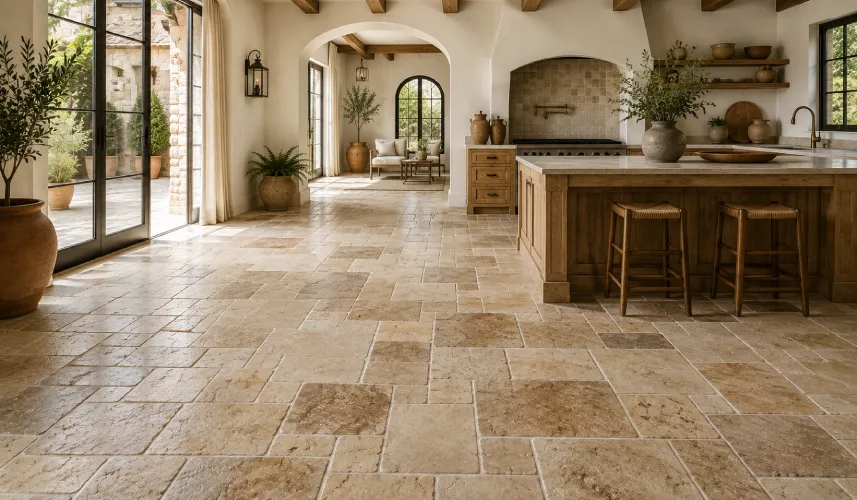
Mixed size layout combines irregular or varied tile sizes. Sometimes even irregular shapes from a single material family, often used with natural stone like travertine or slate. The irregularity gives the floor a handcrafted, quarried look that reads as authentic and organic rather than manufactured, closer to a stone courtyard than a factory tile grid. Natural stone (travertine, slate, flagstone) is the classic choice; some porcelain lines now replicate the look with rectified irregular-format tiles.
- Best rooms: Rustic kitchens, sunrooms, courtyards, and Mediterranean or farmhouse-style interiors.
- Installation considerations: This layout takes considerably longer to install than any uniform pattern. Since every tile placement is a custom decision rather than a repeating rule, budget more labor hours accordingly.
- Maintenance: Natural stone versions require regular sealing and are more porous, so spills should be wiped promptly to avoid staining.
- Expert tip: Dry-lay the tiles across the floor before setting any of them permanently. Mixed-size layouts have no repeating rule to fall back on, so seeing the full arrangement in place first prevents awkward size clusters.
19. Large Format Continuous Layout
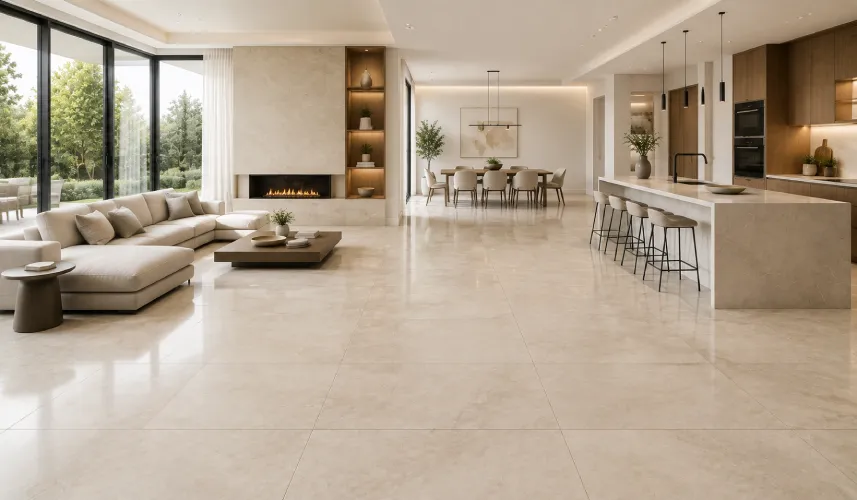
Large format continuous layout uses oversized tiles or slabs. These tiles are often 24 inches and up, sometimes full-room porcelain slabs laid in a simple grid with minimal grout lines. Fewer grout lines mean fewer visual interruptions, so the floor reads as one continuous surface. This is currently one of the most requested layouts for open floor plans because it visually connects adjacent rooms and makes the whole footprint feel larger.
- Best rooms: Open-concept living areas, modern kitchens, and any space where a seamless, minimalist look is the goal.
- Installation considerations: Subfloor flatness matters enormously with large tile, since even small dips or humps show up as lippage across a bigger surface.
- Maintenance: Fewer grout lines mean less grout to clean and reseal over time, which is one of the layout’s biggest long-term advantages.
20. Geometric Combination Pattern
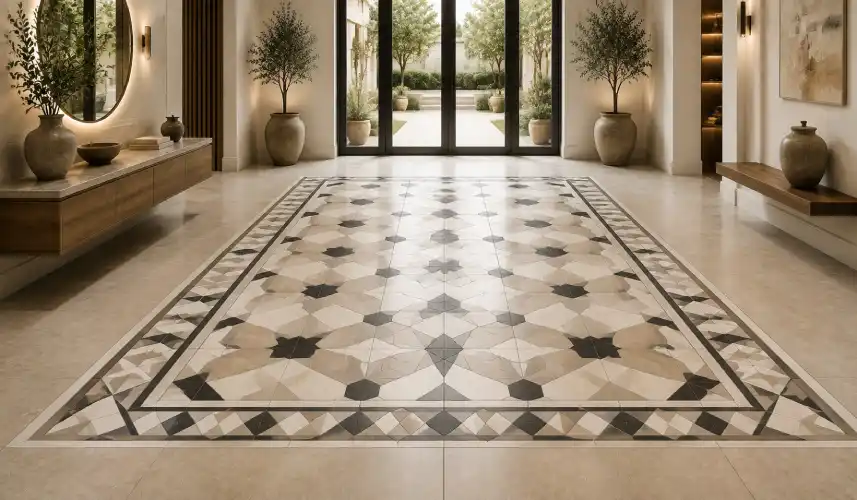
Geometric combination layouts blend two or more shapes like hexagons with triangles, squares with diamonds, or custom tile shapes arranged into a bespoke design. It is usually used as a feature within a larger floor rather than across an entire room. This is the most artistic and least repeatable layout on this list. It turns the floor into a focal point in its own right, similar to a rug or a piece of art embedded permanently into the room.
- Best rooms: Statement entryways, courtyards, spa bathrooms, and feature zones within a larger open floor plan.
- Installation considerations: This layout almost always requires a custom plan drawn up before installation begins, and it benefits from an installer experienced in mixed-shape work. Treat it as a design project, not a standard tile job.
- Maintenance: Depends heavily on the material chosen; encaustic cement tile needs periodic sealing, while patterned porcelain needs only standard care.
How to Choose the Right Floor Tile Pattern
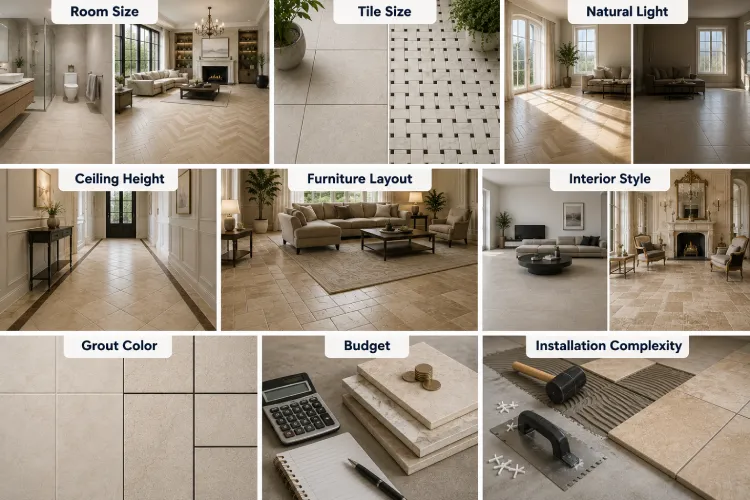
There’s no single “best” pattern, only the best pattern for your specific room. Work through these factors before you decide.
Room Size
Small rooms generally do better with straight lay, diagonal, or offset grid patterns that read as calm rather than busy. Larger rooms can handle herringbone, chevron, or geometric combinations without feeling cluttered.
Tile Size
Small tiles (under 6 inches) suit intricate patterns like hexagon, basket weave, or parquet. Large-format tiles (24 inches and up) are best kept to straight lay or large-format continuous layout, since cutting oversized tile into diagonal or herringbone shapes wastes a lot of material.
Natural Light
Rooms with strong natural light show off directional patterns like herringbone and chevron especially well, since raking light emphasizes the ridges and grout lines. Dim rooms benefit more from lighter tile and simpler layouts that don’t rely on light to read clearly.
Ceiling Height
Diagonal and diamond layouts tend to visually stretch a room, which can help a space with lower ceilings feel less boxy.
Furniture Layout
If most of the floor will be covered by furniture or a rug anyway, an intricate pattern is often wasted money. So, save the detail for the visible walkway areas.
Interior Style
Match the pattern’s era, not just its color. Herringbone and Versailles lean traditional and European, while offset grid and large format continuous lean modern and minimal.
Grout Color
Grout is part of the pattern, not an afterthought. A matching grout minimizes the visual lines and lets the tile itself be the focus. A contrasting grout emphasizes the pattern’s geometry.
Budget
Complex patterns cost more in both material waste and labor hours. As a rough guide, herringbone, chevron, and Versailles can add 20–40% to installation labor compared with straight lay.
Installation Complexity
Be honest about who’s installing the floor. DIY projects should stick to straight lay, running bond, or offset grid; anything involving angled cuts or multiple tile sizes is worth hiring a professional for.
Common Mistakes to Avoid While Choosing Flooring Patterns
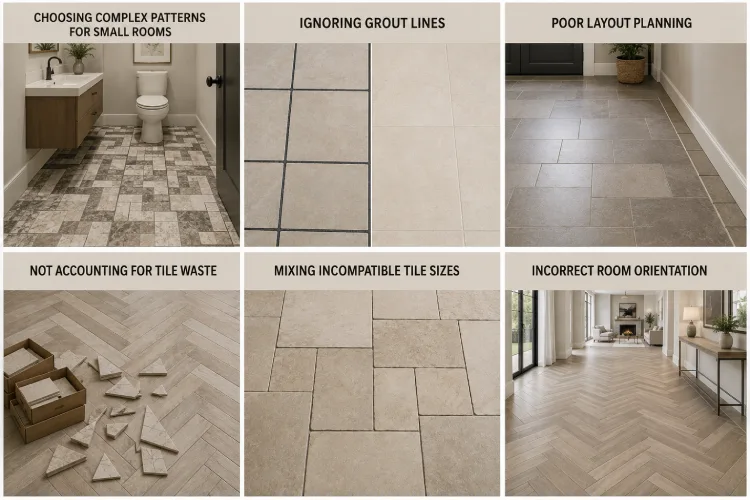
Take a look at the mistakes that people mostly make while choosing the floor tile patterns:
- Choosing complex patterns for small rooms. A full Versailles or double herringbone pattern in a small powder room usually looks cramped rather than luxurious. Intricate patterns need enough floor area to actually read as a pattern.
- Ignoring grout lines. Grout color and width change how a pattern reads as much as the tile itself does. A busy pattern in a dark, high-contrast grout can look chaotic; the same tiles in a matching grout can look calm and intentional.
- Poor layout planning. Skipping a dry layout (arranging tiles loose on the floor before setting them) is one of the most common causes of an uneven pattern near walls, where an awkward sliver of cut tile ends up in the most visible spot in the room.
- Not accounting for tile waste. Diagonal, herringbone, chevron, and hexagon layouts all waste more material than straight lay because of angled cuts. Order 15–20% extra tile for these patterns instead of the standard 10% buffer.
- Mixing incompatible tile sizes. Modular and Versailles patterns depend on exact size ratios between tiles. Buying tile sizes separately instead of as a matched modular set is one of the most common reasons these layouts don’t align properly.
- Incorrect room orientation. Laying a directional pattern (herringbone, chevron, step ladder) without considering the room’s main sightline wastes the pattern’s biggest strength.
Which Tile Pattern Makes a Room Look Bigger?
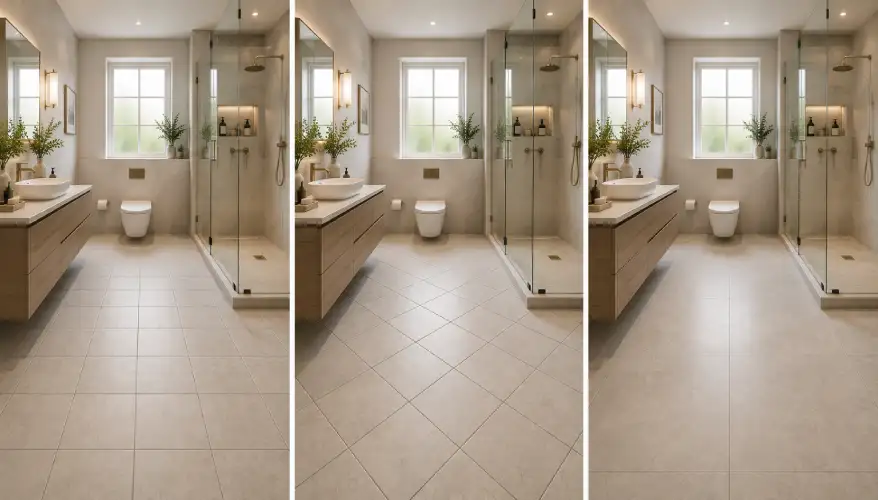
Diagonal layout is generally the most reliable pattern for making a small or narrow room look bigger. It is because the eye follows the grout lines toward the room’s corners instead of stopping at the nearest wall. Large format continuous layout is the second most effective option, since fewer grout lines mean fewer visual breaks across the floor, which reads as more open space.
Herringbone can also widen a narrow hallway when laid so the “arrows” point down the length of the room, though it needs consistent, well-planned lighting to read clearly. What consistently works against a small room, based on real installation experience, is a busy multi-color pattern or a heavily contrasting grout. Both add visual noise that competes with the sense of open space you’re trying to create. If you only remember one rule, remember this: light tile, tight grout lines, and a pattern that leads the eye toward the far corner of the room will do more for a small space than any single tile color choice.
Professional Installation Tips
For the right installation of floor tiles, you need to follow the steps mentioned below:
- A flat, clean, properly cured subfloor is the single biggest factor in how well any pattern turns out. Patterns with directional lines like herringbone, chevron, and step ladder show subfloor unevenness far more obviously than a plain grid does.
- Snap chalk lines from the room’s center point or its most visible entry before setting a single tile, and mark out where cut tiles will fall along each wall.
- Lay a full sample of the pattern loose on the floor first, especially for herringbone, basket weave, Versailles, or any layout mixing tile sizes. This catches sizing or spacing problems before they’re permanent.
- Leveling clips and wedges keep adjoining tile edges flush, which matters most with large-format tile and any pattern where two tiles meet at an angle, like chevron or herringbone.
- Leave the manufacturer’s recommended expansion gap at walls and transitions, particularly over larger floor areas, so seasonal movement doesn’t crack the grout or tile.
- For directional patterns, double-check alignment against the room’s longest wall or main doorway every few rows. Small errors compound quickly across a large floor.
- Budget extra tile based on pattern complexity: roughly 10% for straight lay and offset grid, 15% for diagonal and running bond, and up to 20–25% for herringbone, chevron, hexagon, and mixed-size layouts.
Final Thoughts
After installing hundreds of tiled floors, I have found that 24×48 porcelain tiles in a straight layout remain the most popular choice for modern villas because they reduce grout lines and make large rooms feel more seamless. However, the right floor pattern always depends on the room itself. Consider the size of the space, tile dimensions, natural light, furniture layout, maintenance needs, and your overall design style before making a decision.
Simple layouts like straight and running bond offer timeless appeal with lower installation costs and minimal waste, while herringbone and chevron create a more premium look but require greater precision and a larger budget.
Instead of choosing a pattern because it’s trending, choose one that enhances how your room looks and functions. A thoughtful layout will improve the appearance of your flooring, simplify maintenance, and remain visually appealing for many years.
Frequently Asked Questions
Straight lay is the easiest and most forgiving layout, since it requires minimal cutting and no angled corners. Running bond and offset grid are close seconds and are still manageable for an experienced DIYer.
Straight lay wastes the least material, typically requiring only about a 10% buffer for cuts. Diagonal, herringbone, and hexagon layouts waste noticeably more because of the angled cuts along walls.
Yes, significantly. Complex patterns like herringbone, chevron, and Versailles can add 20–40% to labor costs compared with straight lay, both because of the skill required and the additional time needed for precise cuts.
Yes, and it’s common to use a simpler layout like straight lay or offset grid in secondary rooms while reserving a statement pattern like herringbone or geometric combination for an entryway or feature area. Keep the grout color consistent between spaces to help the transition feel intentional rather than accidental.
Straight lay, diagonal, and offset grid are the most forgiving for small bathrooms. Hexagon in a small format also works well and adds texture without overwhelming the space.
Not usually. Herringbone, chevron, and basket weave depend on a length-to-width ratio that gets harder to execute cleanly as tile size increases, and larger tile in these patterns wastes significant material on cuts. Reserve large-format tile for straight lay or large-format continuous layout instead.
Match the grout closely to the tile if you want the pattern’s geometry to feel subtle, or choose a contrasting grout if you want the pattern itself to be the statement. As a general guideline, busier patterns look calmer with matching grout, while simpler patterns like straight lay or running bond can handle more grout contrast.
Herringbone has been used in flooring for centuries and remains one of the most consistently requested patterns among designers, largely because it works across both traditional and modern interiors. It’s better described as a classic than a trend, which is part of why it holds resale value well.