
How to Measure for Curtains: Width, Drop and Fullness Explained

To get the right curtain size, use the curtain rod or track for the width and the actual hanging point for the drop. The window itself is not the correct starting point. For width, take the full rod or track measurement and account for fabric fullness to create natural gathers. For drop, measure from where the curtain will hang down to the floor or your chosen finishing point. The starting point varies by curtain style.
Eyelet curtains begin at the top of the rod, while pencil pleat curtains usually hang from rings or gliders positioned below it. These differences can affect the final curtain length, even when the measurements are otherwise accurate. This guide by Floor Land explains how to calculate curtain width and drop for different hanging styles, including the measurements and fullness allowances to use before ordering.
What You Actually Need to Measure Curtains
Two numbers get you to a curtain size. Everything else is a style decision.
| What You Need | What to Measure | Where to Measure From |
| Curtain width | Rod or track width | End to end, excluding finials on a rod |
| Curtain drop | Mounting point to desired finished length | Top of rod, or eye of ring/glider |
| Curtain fullness | Nothing; this is a multiplier you choose | Based on heading, fabric and the look you want |
| Eyelet curtains | Rod width, plus a drop taken from the top of the rod | Add the small allowance for fabric above the eyelet |
| Pencil pleat curtains | Rod or track width, plus the hook drop | The eye of the ring or the hole in the glider |
| No rod or track yet | Window width plus your planned extension each side | The outside edges of the window frame or recess |
Write both numbers down in centimeters. Measure each window separately, even if two windows look identical. Then pick the method below that matches your situation.
Tools You Need Before You Start
These are some tools and equipment that you will need for measuring the curtains:
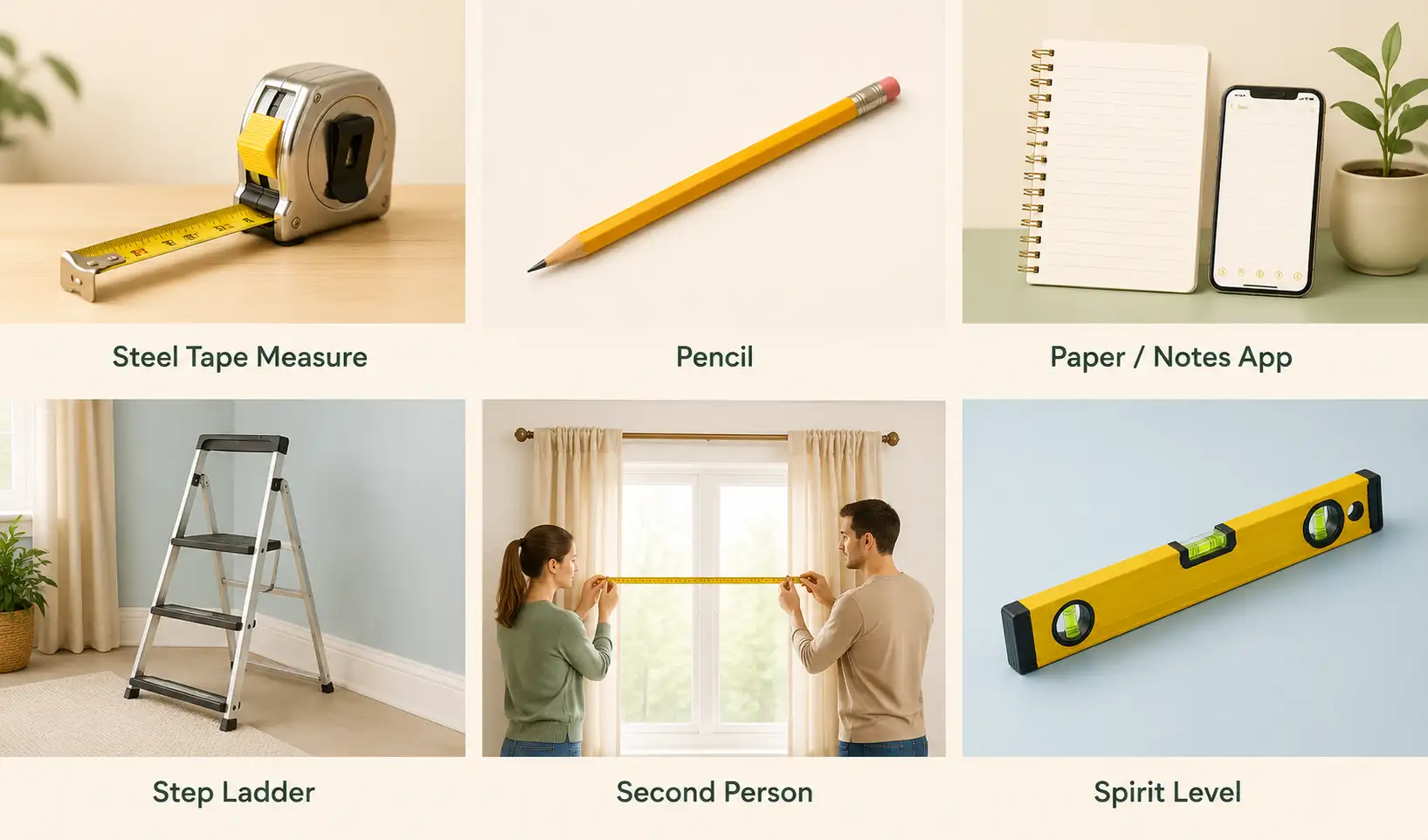
- A steel tape measure. Rigid, accurate, and it stays straight when extended. Fabric and plastic tapes stretch with age and sag over long drops, which quietly adds centimeters to a measurement. Over a 250 cm drop, that error is enough to spoil the result.
- A pencil. For marking mounting heights on the wall and noting figures.
- Paper or a notes app. Record each window separately, with a label for every number.
- A step ladder. Reaching up with a tape from floor level bends the tape and shortens the reading.
- A second person. Essential on wide windows and long drops. One holds the tape at the top while the other reads the bottom.
- A spirit level. Optional, but useful for checking whether a floor or a rod is genuinely level before you blame your measuring.
Method 1: Measuring Curtains When a Curtain Rod Is Already Installed
This is the easiest situation, because the hardware has already decided most of the answer for you.
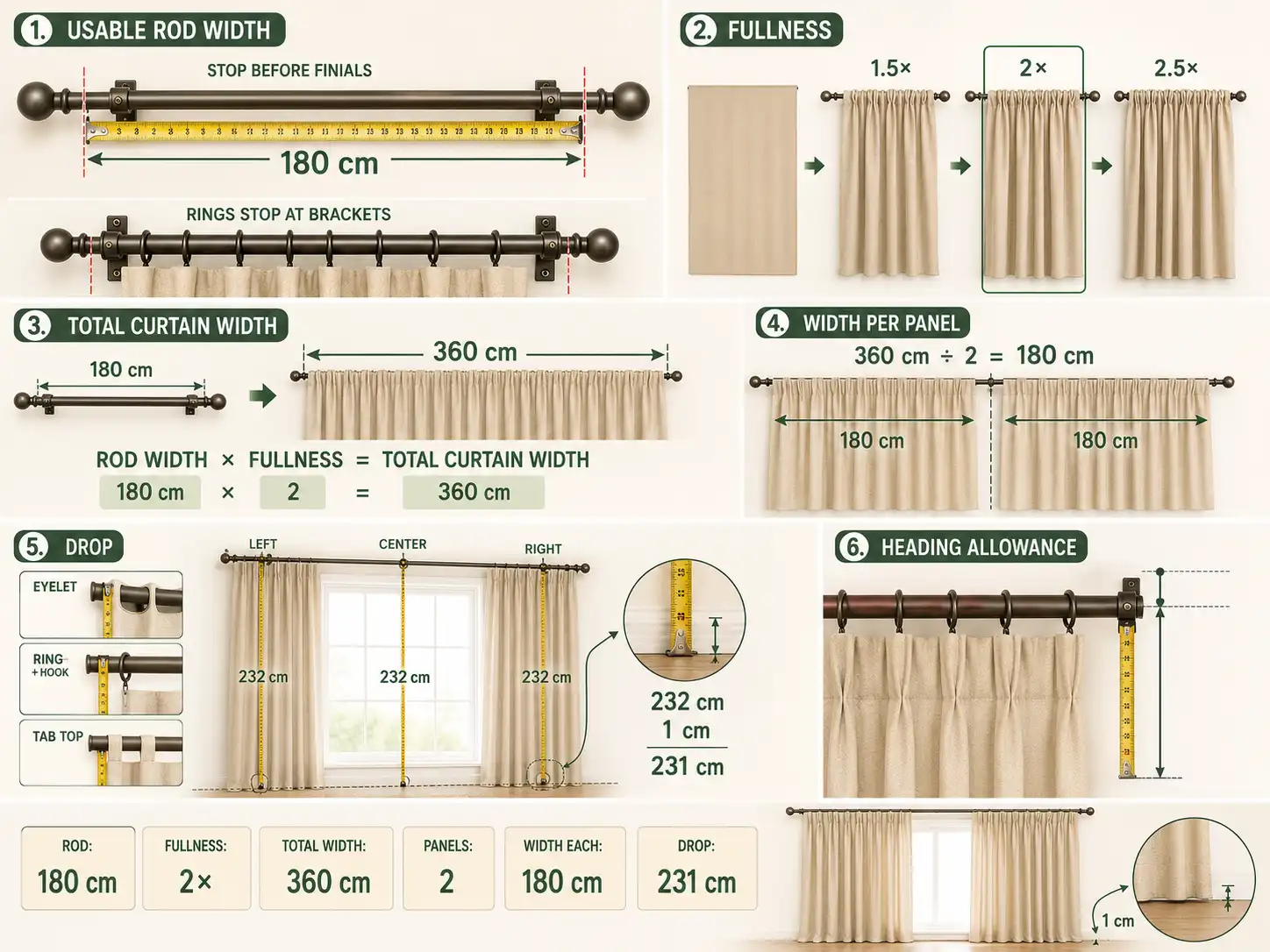
Step 1: Measure the Usable Rod Width
Run your tape along the rod from one end to the other, stopping where the finials begin. Finials are the decorative ends. They are stoppers, not hanging space, so they don’t count toward curtain width.
If your rod uses rings, the usable width is the section the rings can travel along. Look at where the end brackets sit. Rings cannot pass a bracket, so a rod with brackets set 5 cm in from each finial has slightly less usable width than the bare rod length suggests. Measure to the nearest centimeter and write it down.
Step 2: Decide your Fullness
Fullness is how much wider the flat, ungathered curtain is compared with the rod. A custom curtain cut to exactly the rod width will look like a stretched sheet. Fullness is what creates the folds.
Common working ratios sit between 1.5× and 2.5×, and the right one depends on the heading and the fabric. More on this in Method 4.
Step 3: Calculate the Total Curtain Width
After deciding the curtain fullness, calculate the curtain width. To measure the width you can use the formula given below.
Total curtain width = rod width × fullness
Step 4: Divide Between Panels
Width per panel = total curtain width ÷ number of panels
Most windows take a pair. Single panels suit narrow windows, doors, and any window where you want the curtain to stack on one side only.
Step 5: Measure The Drop
Where you start depends on the heading:
- Eyelet curtains: start at the top of the rod
- Rings with hooks: start at the eye of the ring, which is the small hole the hook passes through
- Tab top: start at the top of the rod, then allow for the tab length
Hold the tape at that point and run it down to where you want the curtain to finish. Take this measurement at the left end, the center, and the right end of the rod. Floors and rods are rarely perfectly level. Use the shortest of the three if the curtain must not drag, and the longest if you want a guaranteed floor contact.
Step 6: Account For the Heading
The number you just measured is the drop from the mounting point. The finished curtain drop, meaning the top edge of the fabric to the hem, is often slightly longer, because a small amount of heading sits above the ring or above the rod.
Suppose A rod measures 180 cm between the finials. The customer wants a full, gathered look in a medium-weight lined fabric, so we use 2× fullness.
- Total curtain width: 180 × 2 = 360 cm
- Two panels: 360 ÷ 2 = 180 cm per panel
- Drop from the eye of the ring to the floor: 232 cm
- Wanted finish: 1 cm clear of the floor, so the drop becomes 231 cm
That gives two panels, each 180 cm wide and 231 cm long, before adding any heading allowance.
Method 2: Measuring Curtains When a Curtain Track Is Already Installed
A track is not a rod with a different name. Three things genuinely change: what counts as the width, where the drop starts, and how the mounting position affects the result.
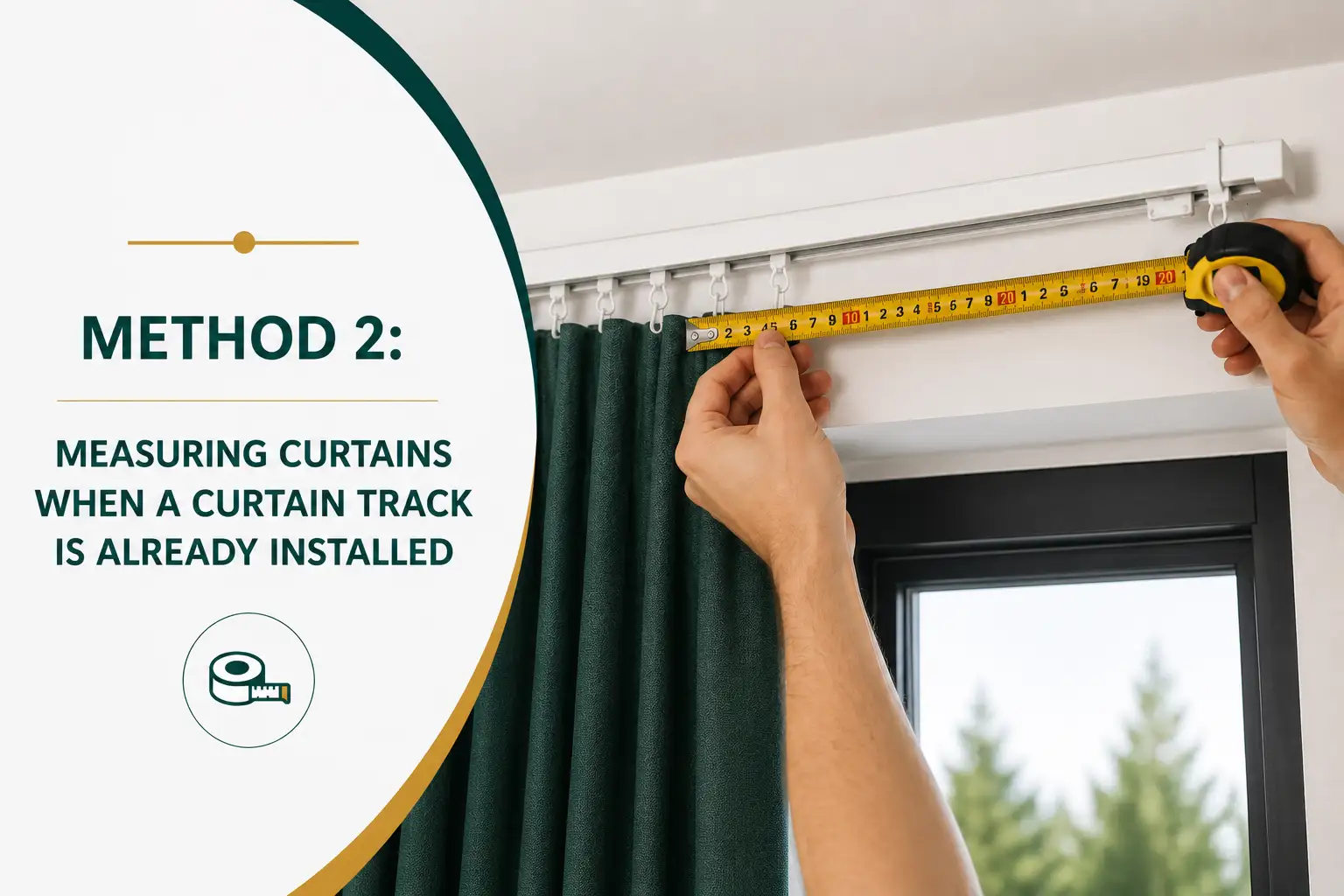
Measuring the Track Width
Measure the full length of the track from end to end. Unlike a rod, there are no finials to exclude, so the whole run is usable.
Two extras to check:
- Overlap arms. Many corded tracks have a small arm at the center that lets one curtain cross in front of the other. That crossover eats roughly 6 to 8 cm of curtain width. If your track has one, allow for it so the curtains still meet cleanly when closed.
- Returns. If the track is fixed to the wall on brackets, there is a gap between the track and the wall. A curtain that wraps back to the wall needs extra width on each end, equal to that gap. Measure from the front face of the track back to the wall.
Ceiling-Mounted Tracks
A ceiling track is fixed to the soffit, so the curtain starts at the ceiling line. Measure the drop from the bottom of the track, or from the eye of the glider if the gliders hang below the track body, straight down to the floor.
Take this measurement in at least three places. Ceilings drop, and floors rise. A 5 mm difference over a 260 cm drop is invisible, but a 2 cm difference is not, and on a long floor-length curtain it shows immediately.
Ceiling tracks also have no clearance behind them, so the curtain hangs flat against the wall with no return. That is normal, and no return allowance is needed.
Wall-Mounted Tracks
A wall track sits below the ceiling on brackets. Measure the drop from the eye of the glider down. Check the bracket depth, because that depth is your return measurement.
Wall tracks give you a choice the ceiling track does not: how high above the window to fix it. Every centimeter you raise the track adds a centimeter to the drop.
Where the Track Position Changes Your Numbers
The track position controls two things at once. Raise it, and the window looks taller, but the drop grows. Extend it wider, and the curtains stack off the glass when open, but the total curtain width grows with it, because width is calculated from the track, not the window.
Fullness On a Track
Fullness works the same way as on a rod:
Total curtain width = track width × fullness
The practical difference is that tracks are usually paired with pleated or gathered headings rather than eyelets, since eyelets need a rod to thread onto. Wave and ripple-fold tracks are the exception worth flagging: they use a fixed carrier spacing, and the fullness is built into that system. If you have one, use the manufacturer’s ratio rather than a general rule.
For Instance, a ceiling track runs 240 cm. It has no overlap arm and no return. The heading is a gathered pencil pleat at 2.2× fullness.
- Total curtain width: 240 × 2.2 = 528 cm
- Two panels: 528 ÷ 2 = 264 cm per panel
- Glider eye to floor, measured at three points: 268 cm, 268.5 cm, 269 cm
- Using the shortest and leaving 1 cm clearance: 267 cm hook drop
Method 3: Measuring Curtains Before Installing a Rod or Track
If the hardware is not up yet, you are measuring a plan rather than an object. You need to settle that plan before you can calculate anything.
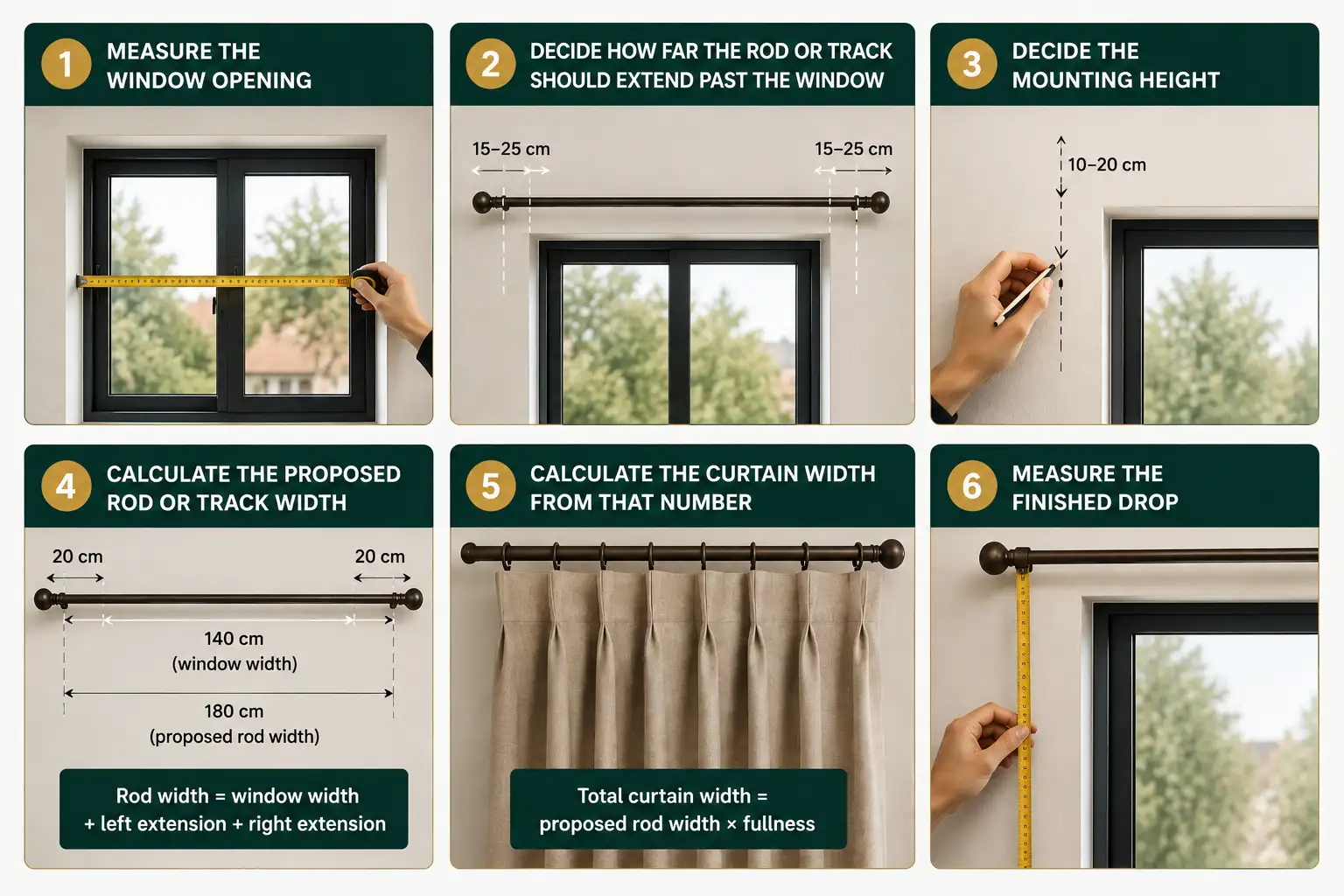
Step 1: Measure the Window Opening
Measure the width of the window across the outside of the frame, not the glass. If the window sits in a recess and you intend to mount inside it, measure the recess width instead, at the top, middle, and bottom.
Step 2: Decide How Far the Rod or Track Should Extend Past the Window
This extension gives the open curtains somewhere to sit. A common working range is 15 to 25 cm beyond the frame on each side, and wider if the fabric is heavy or the window is large. The heavier and fuller the curtain, the more space the stack needs.
Measure the wall you have. There is no point planning a 25 cm extension towards a corner that is only 12 cm away.
Step 3: Decide the Mounting Height
Above the frame, 10 to 20 cm is typical. Higher makes the window look taller. Ceiling-mounted goes as high as it can. Check for coving, ceiling roses, alarm sensors and pipework before you commit.
Step 4: Calculate the Proposed Rod or Track Width
Rod width = window width + left extension + right extension
A 140 cm window with 20 cm on each side needs a 180 cm rod. Remember that a rod is sold by its total length including finials on some ranges and excluding them on others. Check which measurement the product page is quoting, because it changes what you actually get.
Step 5: Calculate the Curtain Width from That Number
Total curtain width = proposed rod width × fullness
Not from the window width. This is the step people skip.
Step 6: Measure The Finished Drop
Mark the planned mounting height on the wall in pencil. Measure from that mark down to the floor, or the sill, or wherever the curtain should end. Then adjust for the heading, since eyelets start at the top of the rod and rings start lower.
Method 4: Measuring Curtain Width
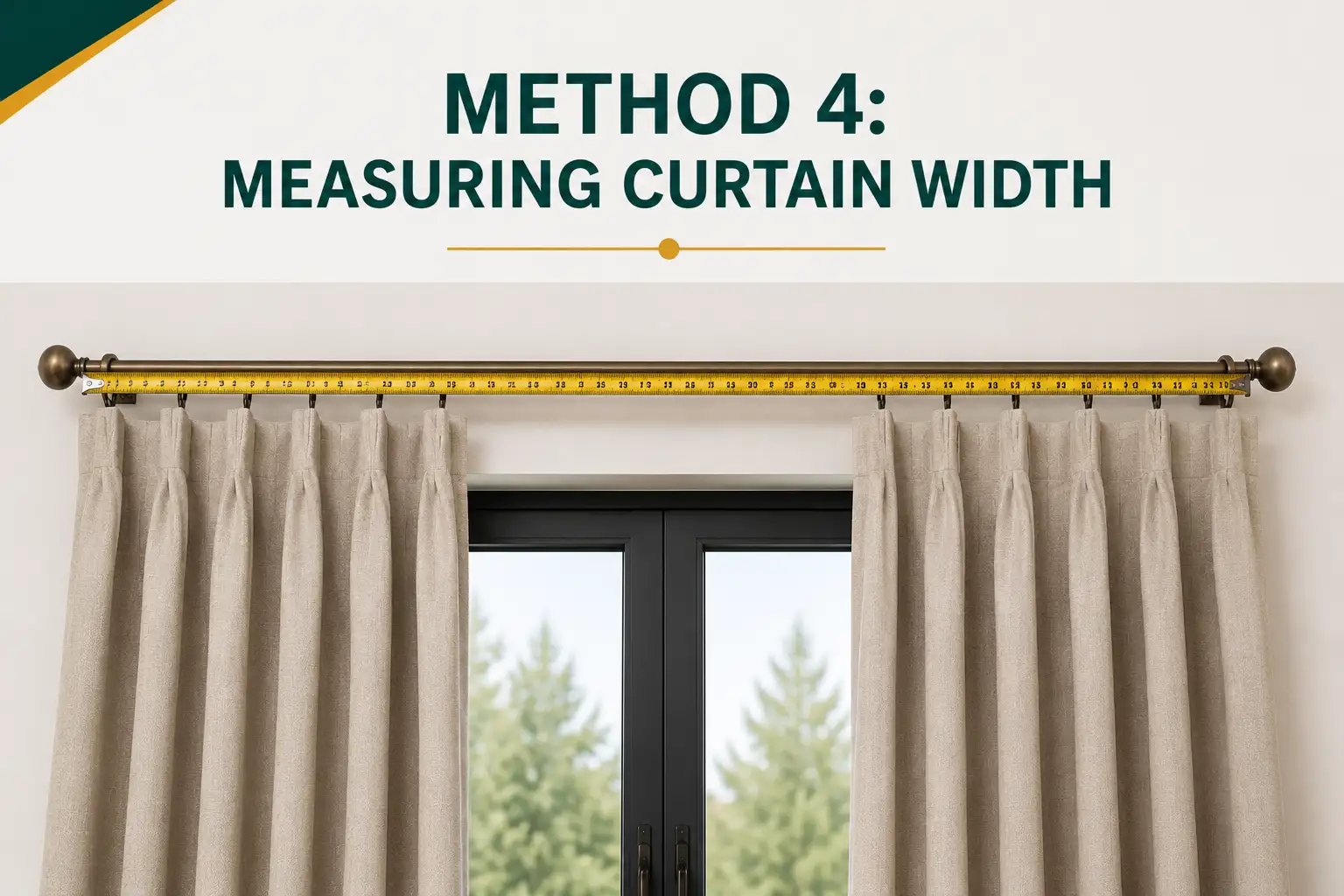
Width causes more ordering errors than drop does, mostly because several different numbers get called “width.”
| Term | What it means |
| Window width | The window itself, frame to frame, or the recess |
| Rod width | The hanging length of the pole, excluding finials |
| Track width | The full end-to-end length of the track |
| Curtain width | Ambiguous; always check whether it means one panel or the pair |
| Total curtain width | The combined flat width of all panels before gathering |
| Width of one panel | Total curtain width divided by the number of panels |
| Fabric width | The width of the roll the curtain is made from, usually 137 cm or 280 cm |
Fabric width matters for made-to-measure. A curtain wider than the roll needs joined widths, and the maker positions those seams. On a patterned fabric, the pattern repeat also affects how much fabric is used. Neither changes what you measure, but both affect the price.
Fullness
Fullness is the multiplier applied to the rod or track width. It decides how deep the folds are when the curtain is closed.
| Fullness | Look it gives | Typically suits |
| 1.5× | Light gather, flatter finish | Tab top, some grommet styles, sheers on a narrow window |
| 2× | Standard gather, even folds | Most eyelet, pencil pleat and pinch pleat curtains |
| 2.5× | Deep, generous folds | Pencil pleat in lighter fabric, formal rooms, voiles |
| 3× | Very full, soft drape | Sheers and voiles only |
These are working ranges, not rules. Fullness depends on three things:
- The heading. Pinch pleats and wave headings have a fixed fullness built into the pleating. Eyelets need enough width for the folds to sit evenly between the rings. Tab tops look better with less gathering.
- The fabric. A heavy interlined velvet at 2.5× can be too bulky to stack neatly. A fine voile at 1.5× looks thin and mean.
- The look you want. Some people want to be tailored and flat. Some want deep folds. Neither is wrong.
If you are ordering made-to-measure, ask the supplier what fullness they include by default. Many quote a fixed ratio and calculate it for you, which means giving them the rod width, not the multiplied figure.
Worked Example
Rod width: 200 cm
2× fullness: 200 × 2 = 400 cm total curtain width
Two panels: 400 ÷ 2 = 200 cm per panel
Note what happened there. Each panel is 200 cm wide, the same number as the rod. That coincidence only holds at exactly 2× fullness with two panels. At 2.5×, the same rod needs 250 cm per panel. Do the calculation rather than reusing the pattern.
Method 5: Measuring Curtain Drop
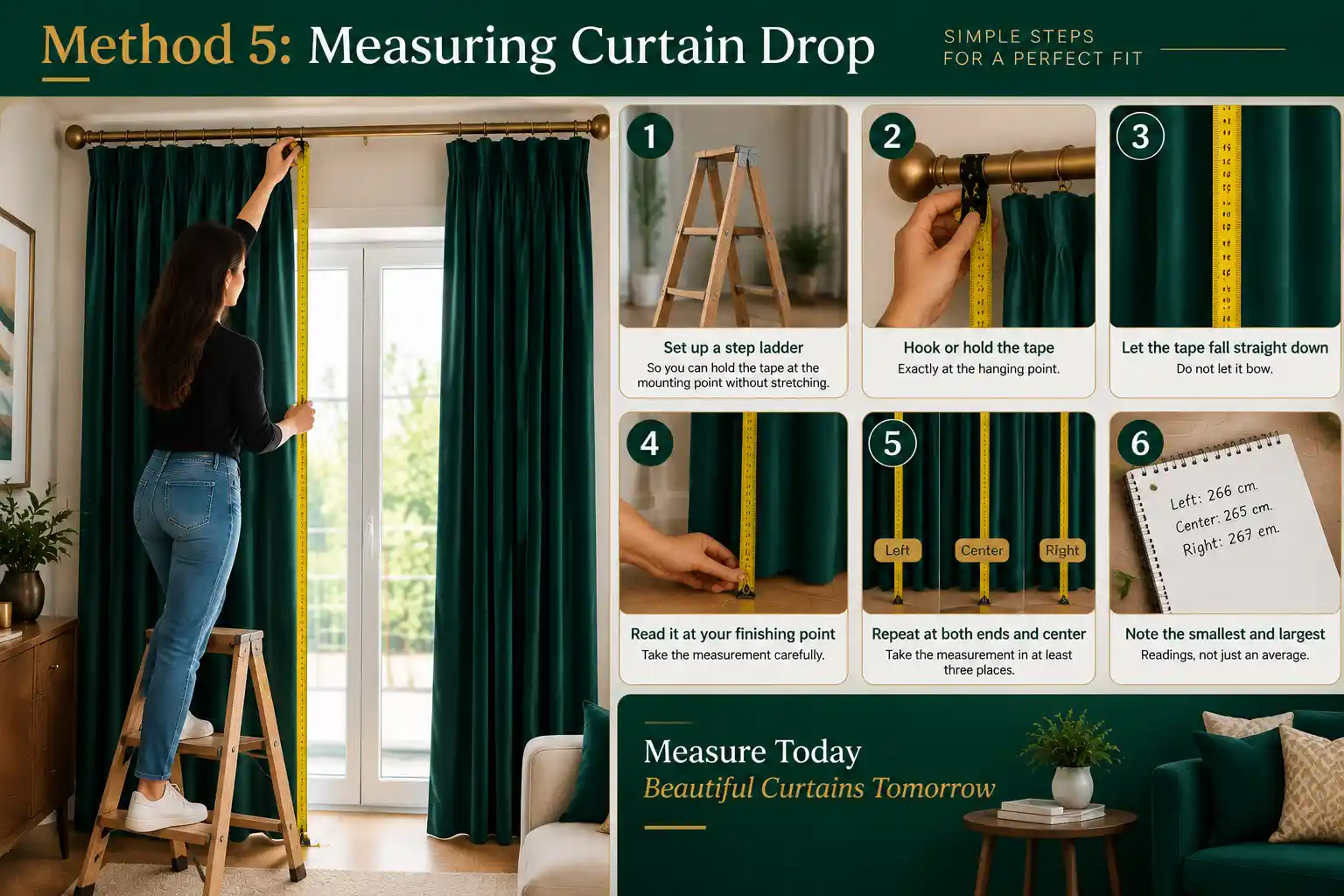
Measurement from the mounting point to the floor is what your tape tells you. It is the raw distance from the top of the rod, or from the eye of the ring, down to the floor.
Finished curtain drop is the length of the made curtain, measured from the very top edge of the fabric to the bottom of the hem.
These two numbers are almost never identical, because part of the heading sits above the point the curtain hangs from. On an eyelet curtain, fabric sits above the rod. On a pencil pleat curtain, the heading tape stands above the ring.
Before you order, be clear about which one the supplier wants. Most made-to-measure suppliers ask for the drop from the mounting point and add the heading allowance themselves. Most ready-made curtains are labeled with the finished drop. Sending a finished drop where a curtain hook drop was wanted, or the reverse, produces a curtain a few centimeters out.
How to Take the Measurement
- Set up a step ladder so you can hold the tape at the mounting point without stretching.
- Hook or hold the tape end exactly at the hanging point.
- Let the tape fall straight down. Do not let it bow.
- Read it at your finishing point.
- Repeat at both ends of the rod and the center.
- Note the smallest and largest readings, not just an average.
Choosing Where The Curtain Finishes
- Floor-length, clear of the floor. Finish 1 to 1.5 cm above the floor. The curtain hangs straight, moves freely, and does not collect dust. This is the safest choice for curtains that get drawn daily.
- Curtains touching the floor. The hem just kisses the boards. It looks tailored, but it needs a level floor and accurate measuring. On an uneven floor, one end drags while the other hangs short.
- Puddle length. Add extra length so the fabric gathers on the floor. A light break needs about 5 cm extra. A soft puddle sits around 10 to 15 cm. A generous puddle can run 20 cm or more. Puddled curtains are for windows you rarely open and close, since the fabric has to be rearranged each time.
- Windowsill length. Finish about 1 cm above the sill so the hem swings clear. If the curtain sits in front of a deep sill, aim for the same clearance measured to the front edge of the sill.
- Below the sill. Take the curtain 10 to 15 cm past the sill. This suits kitchens, bathrooms and any window where floor length is impractical.
- Ceiling-mounted curtains. The drop starts at the ceiling. Measure to the floor and take off your clearance. Because these drops are long, small errors are magnified, so measure at three points every time.
- Rod-mounted curtains. The drop starts at the rod. Rods sit lower than ceilings, so the drop is shorter, and the heading allowance depends on whether you are using eyelets, rings, or tabs.
Method 6: How to Measure for Eyelet Curtains
Eyelet curtains, also called ring top or grommet curtains, thread directly onto the rod. That single fact changes how you measure.
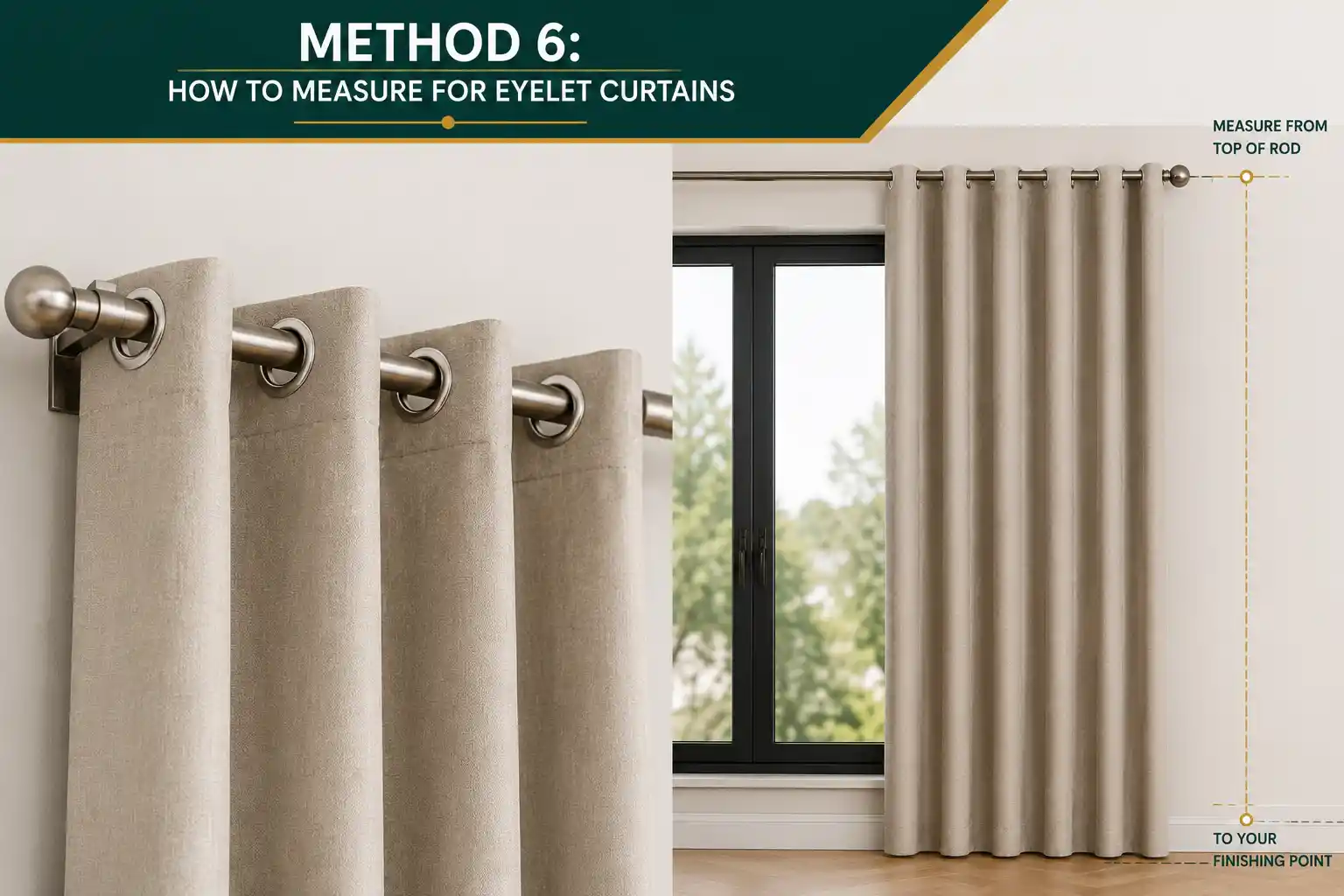
Where The Measurement Starts
At the top of the rod, not the top of the bracket and not the ceiling. The rod passes through the eyelet holes, and the inside top of each eyelet rests on the rod. That is the pivot the whole curtain hangs from.
Why The Top of The Eyelet is Not the Finished Drop
Above each eyelet hole there is a band of fabric. It holds the ring in place, and it stands proud of the rod when the curtain is hung. Typically that band is around 3 to 4 cm from the top of the eyelet hole to the top edge of the curtain, but it varies by manufacturer.
So:
Finished curtain drop = measurement from top of rod to hem + fabric above the eyelet
If you measure 220 cm from the top of the rod to your finishing point, and the curtain has 3.5 cm of fabric above the eyelet, the finished drop is roughly 223.5 cm. Order a 220 cm finished drop, and your curtain hangs 3.5 cm short.
Check the supplier’s specification rather than assuming. Some list a “hanging drop” that already accounts for this. Some list only the finished fabric length.
How Rod Diameter and Eyelet Position Affect the Result
- The eyelet must clear the rod. The inner diameter of the eyelet needs to be larger than the rod. A 28 mm rod does not pass through a 25 mm eyelet, and a rod that is only just smaller will not slide.
- A thicker rod raises the fabric slightly. The curtain rests on the top of the rod, so a chunky pole lifts the hanging point compared with a slim one fixed at the same bracket height. Measure from the rod you will actually use, not the one you have now.
- Bracket position limits the stack. Eyelets cannot pass a bracket, so end brackets set well inside the finials reduce usable width. Center brackets on a wide rod are worse, because a passing bracket is needed for the eyelets to travel over.
- Eyelet spacing controls the fold. The spacing is fixed by the manufacturer. It works with the panel width to produce even waves, which is one reason eyelet curtains behave best at around 2× fullness rather than very high ratios.
Working Out The Width
Total curtain width = rod width × fullness
Width per panel = total ÷ number of panels
Eyelet panels are almost always sold and made in pairs, and each panel needs an even number of eyelets so both curtains turn the same way at the leading edge. A reputable maker handles that.
Method 7: How to Measure for Pencil Pleat Curtains
Pencil pleat curtains have a strip of gathering tape sewn across the top. Pull the cords, and the tape draws the fabric into narrow, upright folds. Hooks slot into pockets in that tape, and the hooks connect to rings on a rod or gliders on a track.

That mechanism is what makes the measuring different from eyelets.
Rod or Track Measurement
Same as before. Measure the rod between the finials, or the full length of the track. Add for an overlap arm if the track has one.
Curtain Width and Fullness
Pencil pleat tape is designed to be gathered hard. Standard practice sits at 2× to 2.5×, and lightweight fabrics carry the higher end well. The tape itself has a minimum it will gather to and still look right, which is why a pencil pleat curtain at 1.5× tends to look under-gathered and slightly limp.
Total curtain width = rod or track width × fullness
Width per panel = total ÷ number of panels
Drop Measurement and Hook Position
Here is the real difference. The curtain does not hang from the top of the rod. It hangs from the hook, and the hook sits in the tape.
Measure the hook drop: from the eye of the ring, or the hole in the glider, down to where the hem should finish.
Standard pencil pleat tape has three rows of pockets. Which row you use changes the height of the curtain:
- Top row of pockets: the heading stands highest above the ring, hiding more of the rod
- Middle row: the usual choice on a track
- Bottom row: the heading sits lower, showing more of a decorative rod
Moving between rows shifts the curtain by roughly 1.5 to 2 cm each time, which is a useful adjustment if a finished curtain hangs slightly long or short.
Above the hook, the heading tape stands up by a few centimeters. On a standard 7.5 cm tape with hooks in the middle row, expect somewhere around 3 to 4 cm of heading above the ring eye. So:
Finished curtain drop = hook drop + heading above the hook
Why The Measuring Point Differs From Eyelet Curtains
An eyelet curtain hangs on the rod itself, so the rod is at the top of the fabric. A pencil pleat curtain hangs from a ring below the rod, so the whole curtain drops lower by the height of the ring. On the same rod, at the same finishing height, a pencil pleat curtain has a shorter hook drop than an eyelet curtain has a rod-top drop. The two numbers are not interchangeable.
When you order made-to-measure, tell the supplier which heading you chose when you give the drop. The measurement only makes sense alongside the heading.
Method 8: How to Measure for Curtains Without a Tape Measure
You can get a workable estimate without a tape. You cannot get an ordering measurement without one.
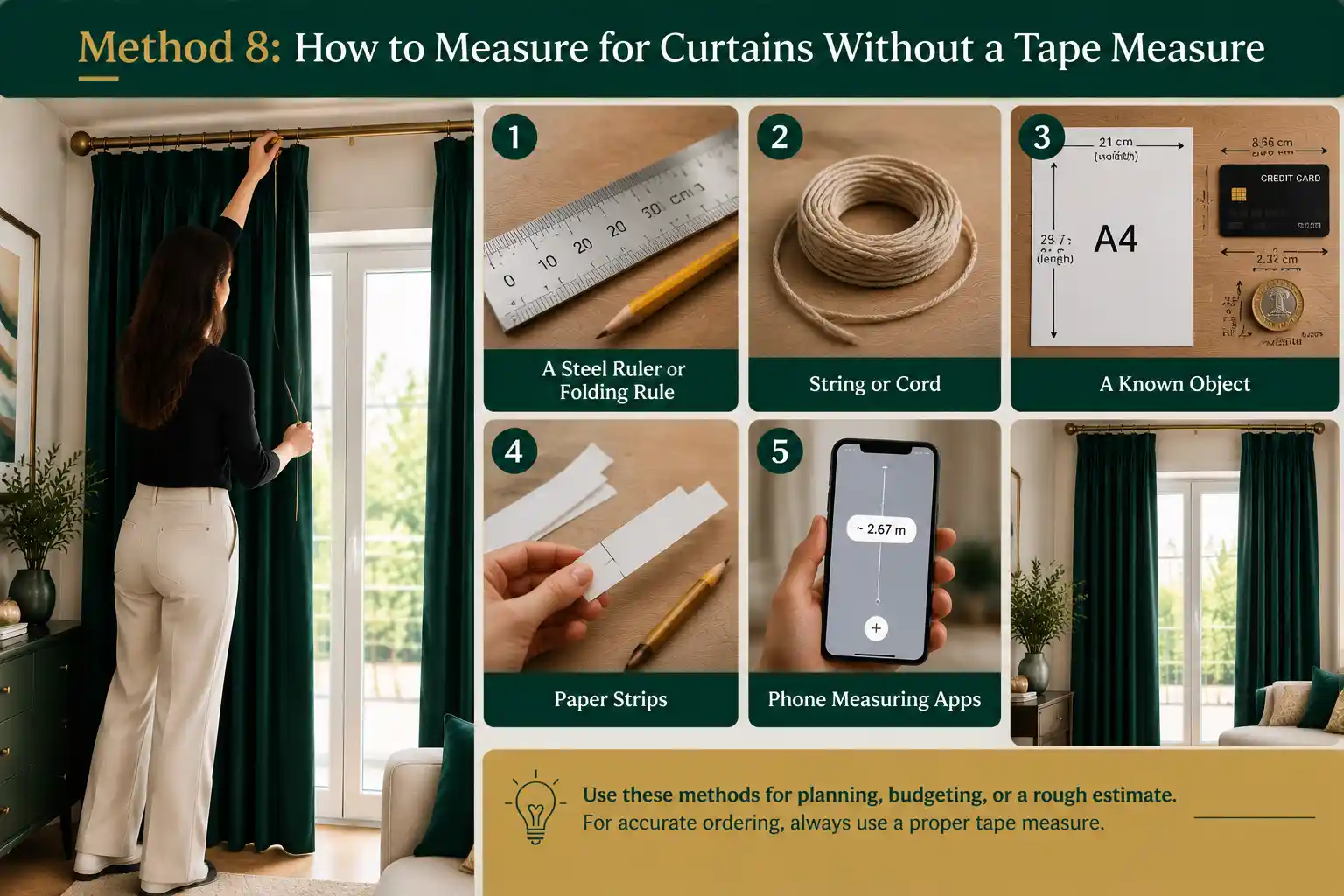
Use these to plan, budget, or check a rough size:
- A steel ruler or folding rule. The most accurate substitute. Mark your start point with a pencil, measure a ruler length, mark again, and repeat. Count the marks. A 30 cm ruler used nine times gives 270 cm. Errors accumulate at every mark, so keep the pencil sharp and the ruler flat against the wall.
- String or cord. Run a length of string from the mounting point to your finish point. Pinch it at the end, take it down, and lay it flat. Measure it against something of a known length. Do not stretch the string, and remember that the sag in a hanging string adds length.
- A known object. A4 paper is 29.7 cm long and 21 cm wide. A standard credit card is 8.56 cm wide. A British £1 coin is 2.32 cm across. A pound coin will not measure a curtain drop, but a sheet of A4 laid end over end up a wall will get you close.
- Paper strips. Tear a strip, hold it to the wall, mark the finishing point on it, and take it to a shop where you can measure it properly. This works well for a drop where the awkward part is holding a tape at height.
- Phone measuring apps. Useful for a ballpark on a wide window. Not reliable to the centimeter, especially in poor light or against plain white walls.
Be honest about what these are for. Made-to-measure curtains are cut to your figures and cannot be returned because the figures were wrong. Ready-made curtains give you more room for error, since you are picking from set sizes, but a drop that is 4 cm off still looks wrong. A steel tape measure costs less than the delivery charge on a pair of curtains. Buy one before you order.
Curtain Measurements: Width or Length First?
Take the width first. It is usually the easier number to establish, because the rod or track is already a fixed object you can measure end to end while standing on the floor. The drop asks you to decide where the curtain finishes, and that decision is easier once you know how wide and how full the curtains will be.
That said, the order doesn’t matter much. What matters is that both numbers are recorded correctly, in the same units, with the correct starting point noted next to each one. Write “rod width, excluding finials, 180 cm” and “drop from ring eye, 231 cm” rather than two bare numbers. Two months later, or on the phone to a supplier, the labels are what save you.
Curtain Size Calculator: Working It Out by Hand

You do not always need software for this. Two formulas cover almost every order.
Total curtain width = rod or track width × fullness
Width per panel = total curtain width ÷ number of panels
Then the drop:
Finished curtain drop = drop from mounting point + heading allowance
Work through these three examples and the pattern will stick.
Example 1: A Standard Bedroom Window Pair of Eyelet Curtains
- Rod width, excluding finials: 150 cm
- Fullness: 2×
- Total curtain width: 150 × 2 = 300 cm
- Panels: 2
- Width per panel: 300 ÷ 2 = 150 cm
- Top of rod to floor: 235 cm
- Clearance: 1 cm, so drop to hem is 234 cm
- Fabric above the eyelet: 3.5 cm
- Finished drop: 237.5 cm
Example 2: A Wide Living Room Track, Pencil Pleat Pair
- Track width: 260 cm
- Overlap arm: yes, allow 7 cm
- Fullness: 2.5×
- Total curtain width: 260 × 2.5 = 650 cm, plus 7 cm overlap = 657 cm
- Panels: 2
- Width per panel: 657 ÷ 2 = 328.5 cm, rounded up to 329 cm
- Glider eye to floor, shortest of three readings: 244 cm
- Clearance: 1.5 cm
- Hook drop: 242.5 cm
Rounding
Round the width up to the nearest centimeter. A little extra fabric gathers away invisibly.
Round the drop to the nearest centimeter, and be careful which way you go. Too long and a floor-length curtain drags. Too short and the gap under the hem shows. When the reading falls between two numbers, take the shorter one for floor-length curtains and the longer one for anything finishing above the floor.
Standard Curtain Drop Sizes in cm
Ready-made curtains come in fixed sizes. Understanding the three terms below stops most sizing disappointments.
- Ready-made curtain drop. A set size chosen by the manufacturer, printed on the packaging. You pick the closest one.
- Made-to-measure drop. Any length you specify, cut and hemmed to your figures.
- Actual finished drop. What the curtain really measures once hung, top edge to them. On a ready-made curtain this should match the label. On a made-to-measure curtain it is your specified drop plus whatever heading allowance the maker adds.
Common ready-made drops in the market:
| Drop | Approximate Imperial | Typical Use |
| 137 cm | 54″ | Sill or just-below-sill windows, kitchens, dormers |
| 160 cm | 63″ | Below-sill windows, shorter bedroom windows |
| 183 cm | 72″ | Below-sill on tall windows, some floor-length in low rooms |
| 229 cm | 90″ | Floor-length in standard-height rooms |
| 274 cm | 108″ | Floor-length with a high rod, tall Victorian windows |
Common ready-made widths per panel are 117 cm, 168 cm, 228 cm and 284 cm. Remember these describe one panel, flat and ungathered. A pair labeled 168 cm gives 336 cm of total curtain width, which suits a rod of roughly 168 cm at 2× fullness.
When To Pick Made-to-Measure Curtains
Ready-made curtains work when your drop is close to one of the standard sizes and the window is a normal shape. Choose made-to-measure when:
- Your drop falls more than about 5 cm away from the nearest standard size
- The window is very wide, very tall, or floor to ceiling
- You are curtaining a bay, a corner or an awkward recess
- You want a heading the ready-made ranges do not offer
- The fabric matters to you more than the price does
A ready-made curtain that is too long can usually be shortened. One that is too short cannot be rescued.
Different Curtain Finishes and How They Change the Drop
The finish is a decision, not a measurement, but it sets the number you write down.
| Style | Where the Curtain Ends | Visual Result |
| Windowsill | About 1 cm above the sill | Neat and practical, keeps the sill usable |
| Below sill/apron | 10 to 15 cm below the sill | Softer than sill length, covers the wall under the window |
| Floor-length | 1 to 1.5 cm above the floor | Clean vertical line, moves freely |
| Touching the floor | Hem just meets the floor | Tailored and formal, needs a level floor |
| Puddle | 5 to 20 cm past the floor | Relaxed, luxurious, fabric pools at the base |
Common Curtain Measuring Mistakes
Before pulling out your tape measure, keep these common measuring missteps in mind to guarantee a perfect drop and fullness on the first try.
- Measuring the glass instead of the rod or track. Once the hardware is up, measure the hardware. Measure the rod between finials, or the full track. Only measure the window before anything is installed.
- Forgetting fullness. A curtain the same width as the rod hangs flat. Multiply by your chosen fullness before you order.
- Including the finals. Finials are stops, not hanging space. Measure to where they begin.
- Measuring from the wrong point. Eyelets start at the top of the rod. Hooks start at the eye of the ring or glider. Write the starting point next to the number.
- Using one drop for every heading. Switching from pencil pleat to eyelet on the same rod changes the drop. Confirm the heading before you calculate.
- Forgetting floor clearance. Measure to the floor, then subtract 1 to 1.5 cm. Skipping this gives you a curtain that drags.
- Assuming two windows are identical. They rarely are, especially in older houses. Measure every window and label every set of figures.
- Measuring once. Measure the drop at three points along the rod and the width twice. Compare before you order.
- Rounding carelessly. Round the width up. Round the drop with the finish in mind, short for floor-length, long for anything above the floor.
- Confusing total width with one panel. Total curtain width covers all panels combined. Divide by the number of panels before ordering. Ready-made labels quote a single panel.
- Ordering before confirming the heading. The heading changes the drop calculation, the fullness, and sometimes the hardware. Decide it first.
- Using rough figures for made-to-measure. A made-to-measure curtain is cut to your numbers and cannot be returned because those numbers were guesses.
Final Words
The correct curtain size starts with the hardware, not the glass. Measure the usable rod width between the finials or the full track length, then multiply it by the chosen fullness to get the total curtain width. For the drop, use the actual hanging point: the top of the rod for eyelets, or the ring/glider eye for hooked headings.
Measure floor-length curtains at three points and allow your chosen clearance. Before ordering, confirm whether your supplier wants the hook drop or finished drop, and check any overlap, return, or heading allowances. These details are what turn a measurement into curtains that fit properly.
Frequently Asked Questions
Compare them with the rod or track, not the window. Multiply the rod width by your chosen fullness, usually between 1.5× and 2.5×, to get the total curtain width across all panels.
From the rod for the eyelet and tab top curtains. From the eye of the ring, or the hole in the glider, for anything that hangs on hooks.
No. Measure the rod up to the point where the finials begin. The finials hold the curtains on; they do not carry them.
Around 2× suits most eyelet and pencil pleat curtains. Go to 2.5× for a fuller gather in lighter fabric, and up to 3× for voiles. Drop to 1.5× only for tab tops or a deliberately flat, tailored look.
Hook drop is measured from the ring or glider to the hem. Finished drop is the total length of the fabric, top edge to hem, which includes the heading standing above the hook. Ask your supplier which one they want.
The usual UK ready-made drops are 137 cm, 160 cm, 183 cm, 229 cm and 274 cm. Standard panel widths are 117 cm, 168 cm, 228 cm and 284 cm.
For a rough idea, yes, using a ruler, string or a known object such as A4 paper. For an actual order, particularly made-to-measure, no. Get a steel tape.
Leave 1 to 1.5 cm for curtains you open and close daily. Kiss the floor for a formal look on a level floor. Add 5 cm or more for a deliberate puddle.
Commonly 15 to 25 cm on each side, more for heavy or very full curtains. The extension gives the open curtains somewhere to stack off the glass.
They are, when your drop lands within a few centimeters of a standard size and the window is a regular shape. Made-to-measure earns its cost on tall windows, bays, unusual drops and specific headings.
Yes, in three respects. Measure the full track length rather than stopping at finials, allow for an overlap arm if there is one, and take the drop from the glider eye rather than the top of a rod.
Measure each straight section of the bay separately, following the line the track will take rather than cutting across the opening. Note the corner angles and plan where the curtains will stack.
Use the narrowest width if you are fitting inside the recess and the longest drop reading if the curtain must not hang short. For anything more than about 1 cm of difference, mention it to your supplier.