
Is Sleeping on the Floor Good for You? Realty Based Pros & Cons
Billions of people lie down to sleep every night. Some of them actually go without a bed. In Japan, Korea, India, and many other countries, sleeping on the floor is normal. It is quietly making its way back in the West.
There’s a reason for that. Low back pain is common. By 2020, an estimated 619 million people had suffered from low back pain, and by 2050, this is expected to rise to 843 million. It is the UNITED STATES’ number one disability. When pain keeps you awake, you start looking for answers. For many people, the floor becomes one of them.
But is sleeping on the floor good for you, or is it just an old habit dressed up as a wellness trend? The honest answer is: it depends. Some people get up to find their backs are sore and stiff, while others feel fine.
Here we list facts about the science of sleeping on the floor, who may benefit, who should avoid it, and how to do it safely if you choose to sleep on the floor. The team at Floor Land has created this guide to help readers make informed decisions. This blog is intended for educational purposes only and is not a substitute for professional medical advice.
Is Sleeping on The Floor Good For You? The Quick Answer

Sleeping on the wooden floor is not a proven cure for anything. To date, there is very little direct research on floor sleeping itself, and most reported benefits are anecdotal.
That said, the floor is a firm surface. A large body of research on firmness tells us something useful: very soft, sagging mattresses are linked to poor sleep posture and back pain. A firmer base often helps. The floor takes that idea to the extreme.
So the floor may help some people, especially those coming off a worn-out, overly soft mattress. For others, it simply trades one type of discomfort for another. Your body type, sleep position, age, and health all change the outcome.
What the Science Says About Firm Surfaces

Most floor-sleeping claims borrow their evidence from mattress firmness studies. The most cited is a landmark trial published in The Lancet in 2003.
Researchers in Spain studied 313 adults with chronic, non-specific low back pain. Each person was randomly assigned to a firm or medium-firm mattress, and neither the patients nor the assessors knew which was which. After 90 days, the medium-firm group had clearly better results. They reported less pain in bed, less pain on rising, and less disability than the firm group.
The takeaway is important and often misunderstood. The study did not say “firmer is always better.” It said medium-firm, not firm. On the firmness scale used in the trial, the firm mattress scored 2.3, and the medium-firm scored 5.6, where 1.0 is the hardest and 10.0 is the softest.
The vinyl floor sits at the very hard end of that scale, harder than the “firm” mattress that was lost in the study. That is a key reason experts are cautious. A survey found that 75% of orthopedic professionals have historically recommended firm mattresses, yet the strongest trial we have points toward the middle, not the extreme.
A 2021 systematic review reached a similar conclusion. Medium-firm is the safest bet for most people, but individual responses vary a lot. In short, firmness helps up to a point. Past that point, more hardness does not mean more benefit.
Is It Good to Sleep on the Floor Without a Mattress?
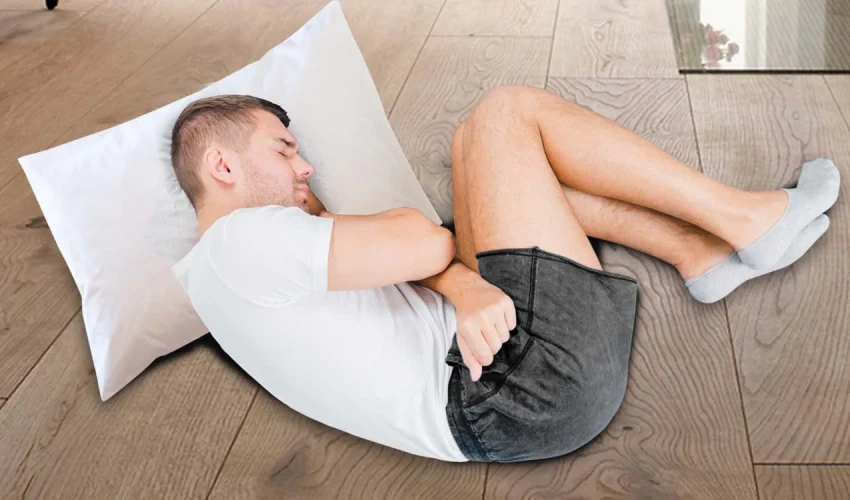
The floor gives you zero sink. Your spine cannot sag into a dip because there is no dip to sink into. For someone whose old mattress has a body-shaped crater in the middle, that flat, even support can feel like relief.
But “no sink” is not the same as “good support.” A healthy spine has natural curves. Your lower back curves slightly inward. On a completely hard surface, that gap is left unsupported unless you fill it. That is why many floor sleepers place a thin pillow or rolled towel under the lower back or knees.
So, is it good to sleep on the floor without a mattress? For a short trial, and for people without joint or mobility issues, it can be fine and even helpful. As a permanent setup with zero padding, it is a hard ask for most bodies. A thin mat, futon, or topper is a sensible middle ground.
Benefits of Sleeping on the Floor Without a Mattress
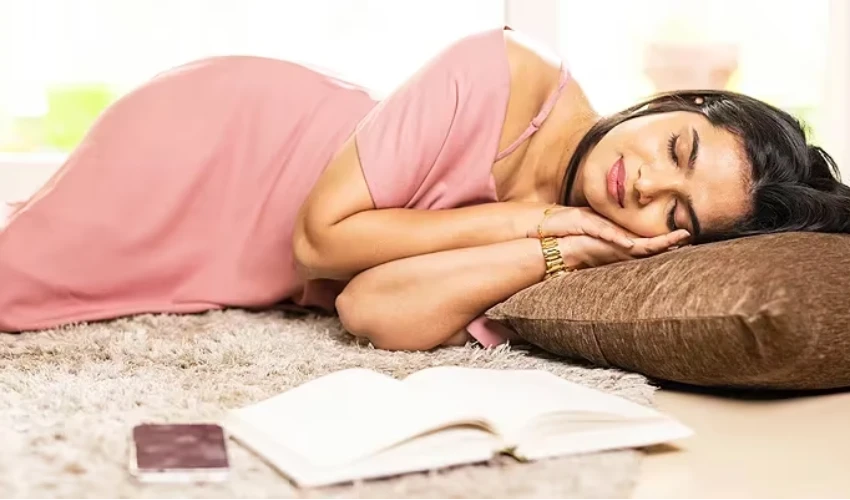
Here are the upsides people report most often. Keep in mind these are largely anecdotal or borrowed from firmness research, not proof that the floor itself is curative.
- Better spinal alignment for some. A flat, non-sagging surface can make it easier to keep the spine straight, especially for back sleepers transitioning off a soft, worn mattress.
- Possible posture support. Some people find that firmer sleep helps their daytime posture, since the back is not curving all night unnaturally.
- A cooler sleep. Heat rises. The air near the floor is often a few degrees cooler. For hot sleepers, this alone can improve comfort and sleep quality.
- Lower cost and minimalism. No expensive mattress, no frame. For people drawn to simple living, the floor is appealing for practical reasons.
- An easy experiment. Trying the floor costs almost nothing. If it helps your back, great. If not, you have lost only a few nights.
Disadvantages of Sleeping on the Floor
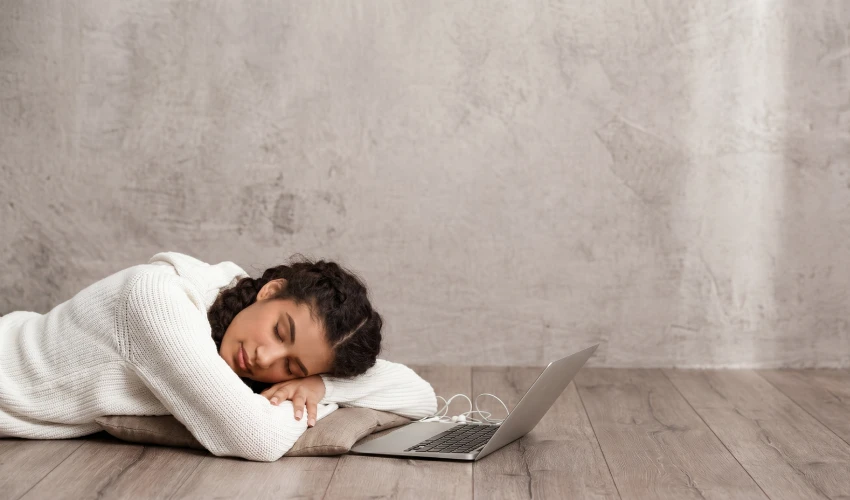
The downsides are just as real, and for some people, they outweigh the benefits.
- Pressure point pain. Side sleepers feel this most. The hips and shoulders dig into the hard surface with nothing to cushion them, which can cause aches and broken sleep.
- It can worsen back pain, not fix it. A hard surface does not match everyone’s spine. For some, the floor makes back pain worse rather than better.
- Cold. A cold floor pulls heat from your body fast. Pleasant in summer, miserable in winter.
- Allergens and dust. The floor is dustier than a raised bed, and carpet is a known reservoir for dust mites, the most common indoor allergy trigger. Most dust mite exposure happens while we sleep. For people with asthma or allergies, sleeping closer to floor-level dust can mean more sneezing, congestion, and poor sleep.
- Hard to get up. This is a serious point for older adults and anyone with mobility issues. Getting down to and up from the floor raises the risk of strain or injury.
- Not for everyone. Pregnancy, certain joint conditions, limited circulation, and reduced mobility all make floor sleeping riskier. When in doubt, ask a doctor first.
Sleeping on the Floor: Pros and Cons at a Glance
| Pros | Cons |
|---|---|
| Flat surface, no sagging | No cushioning for pressure points |
| May help some back sleepers | May worsen pain for others |
| Cooler in warm weather | Cold and uncomfortable in winter |
| Low cost, minimalist | More dust and allergen exposure |
| Easy, low-risk experiment | Hard to get up for older adults |
Is Sleeping on the Floor Good for Your Back?
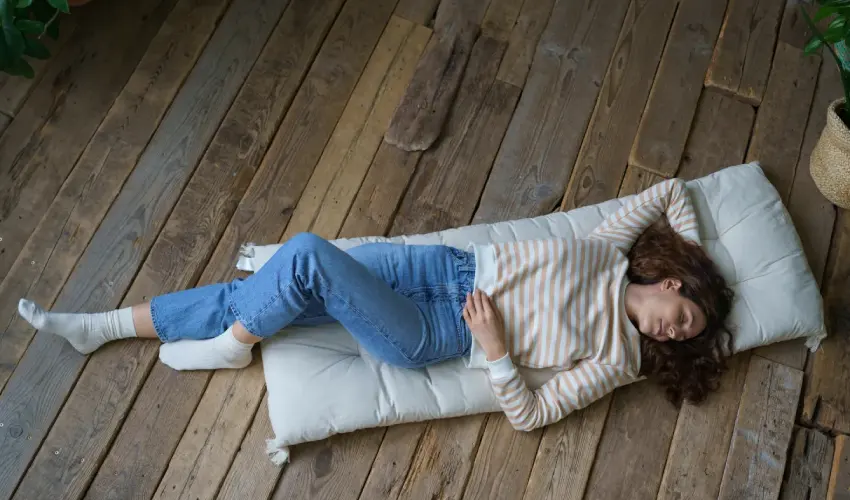
This is the headline question, so it deserves a careful answer.
Sleeping on the floor may help your back if your current mattress is too soft or sagging. By removing the sink, the floor can encourage a straighter, more neutral spine. People with this exact problem often report the most relief.
But the floor is not magic. The research consensus points to medium-firm support as the sweet spot for low back pain, and the floor is firmer than that. Lying flat on something rock-hard leaves the natural inward curve of your lower back unsupported, which can create new aches.
The practical advice from clinicians is refreshingly simple. If the floor relieves your pain, keep doing it. If it does not, stop and try something else. Use a thin pillow under your knees (when on your back) or between your knees (when on your side) to protect your spine. And if back pain is persistent or severe, see a healthcare professional, because the cause may have nothing to do with your mattress.
Is Sleeping on the Floor Good for Your Stomach?
Stomach sleeping is the position most experts already advise against, mattress or no mattress.
When you lie face down, your neck twists to one side for hours, and your lower back arches. On a soft bed, the belly sinks and the strain gets worse. On the floor, the belly cannot sink, so in theory, the lower back stays flatter.
But the neck problem remains. Turning your head to breathe still strains the cervical spine. So while the floor may slightly reduce lower-back strain for stomach sleepers, it does not solve the core issue. If you sleep on your stomach, a very thin pillow or no pillow under the head, plus a slim pillow under the pelvis, eases the load. Better still, try to shift toward back or side sleeping over time.
The Impact Of Sleeping on the Floor on Mental Health
People sometimes ask whether sleeping on the floor helps mental health. There is no direct evidence that the floor itself improves mood or reduces anxiety.
The real connection is indirect and runs through sleep quality. Good sleep supports mental health. Poor sleep undermines it. If the floor genuinely gives you a deeper, cooler, more comfortable rest, you may feel sharper and steadier during the day as a result.
The opposite is just as true. If the hard surface leaves you tossing, cold, and sore, your sleep suffers, and so does your mood, focus, and resilience. There is also a minimalist mindset some people associate with floor sleeping, a sense of simplicity and calm. That is a personal, psychological effect, not a medical one.
The bottom line: chase good sleep, not the floor for its own sake. If the floor delivers better rest for you, the mental benefits follow naturally.
Who Should Avoid Sleeping on the Floor?
The floor is not a good idea for everyone. Take extra care, or skip it entirely, if you are in one of these groups:
- Older adults, because getting up and down raises the risk of strain and falls.
- People with limited mobility or joint conditions, such as arthritis.
- People with poor circulation, since hard surfaces can add pressure.
- People with dust or asthma allergies, who may react to floor-level dust.
- Pregnant women, who should ask a doctor before changing their sleep setup.
- Side sleepers, who often find the lack of cushioning too painful.
If any of these apply to you, talk to a healthcare provider before making the switch.
How to Sleep on the Floor Safely?
If you want to try it, do it the smart way. A careful start protects your body and gives the experiment a fair chance.
- Start with a thin layer. A yoga mat, futon, or thin topper softens the surface without losing the firm support. Going straight to the bare floor is rarely necessary.
- Choose your position wisely. Back sleeping suits the floor best. Side sleeping needs cushioning at the hips and shoulders. Stomach sleeping is the hardest to do comfortably.
- Use pillows to protect your spine. A thin pillow under the knees (for back sleepers) or between the knees (for side sleepers) keeps the spine neutral.
- Keep it clean. Vacuum often, wash your bedding regularly, and keep your sleeping layer off bare carpet if allergens are a concern.
- Stay warm. Use enough padding and bedding so the cold floor does not pull away your body heat.
- Ease in slowly. Try a few nights, then a week. Give your body time to adapt before you judge the result.
- Listen to your body. If pain improves, continue. If it gets worse or does not change after a couple of weeks, stop. That is your answer.
The Bottom Line
So, is sleeping on the floor good for you? It can be, for the right person. If your mattress is old and sagging, if you sleep on your back, and if you have no mobility or allergy concerns, the floor may give you a flatter, cooler, more supportive night’s rest. Research on firmness supports the idea that a sagging, soft surface is bad for backs, and the floor eliminates that problem entirely.
But the floor is harder than the medium-firm surface most experts recommend. It offers no cushioning at pressure points, can be cold and dusty, and is genuinely difficult for older adults. There is no strong proof that the floor cures back pain, helps digestion, or lifts your mood. Most benefits are anecdotal.
The wisest approach is to treat it as a low-cost experiment. Start with a thin mat, protect your spine with pillows, give it a couple of weeks, and let your own body decide. If you have ongoing back pain or a health condition, speak to a doctor first.

