
Best Shower Curtains for Walk-In Showers That Keep Water In and Mildew Out
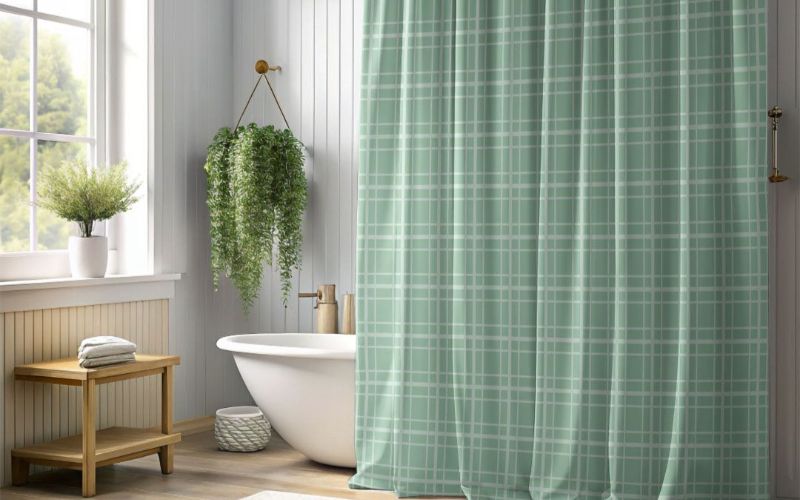
The best shower curtains for walk-in showers are heavy, waterproof PEVA or EVA curtains (8–10 gauge) with a weighted hem, or a water-repellent polyester curtain hung in front of a PEVA liner. Choose a curtain at least 30 cm (12 in) wider than the shower opening and long enough to hang 1–2 cm above the shower floor.
Walk-in showers have no bathtub wall to stop water, so four things matter most:
- Material: PEVA, EVA and vinyl are waterproof; polyester is only water-repellent.
- Weight: an 8–10 gauge sheet or a weighted hem stops the curtain blowing inward.
- Size: common walk-in sizes are 72 × 84 in (183 × 213 cm) and, for narrow stalls, 54 × 78 in (137 × 198 cm).
- Liner: most fabric curtains need a waterproof liner behind them.
This guide compares seven curtain materials and three size and feature options rather than individual branded products. It also covers measuring, rods and tracks, mildew prevention and bathrooms in UAE apartments and villas.
Best choice by situation
- Most walk-in showers: an 8–10 gauge PEVA or EVA liner inside, with a polyester or waffle-weave curtain outside for looks.
- One layer, low effort: a heavy PEVA curtain alone, or a polyester curtain labelled for use without a liner.
- Compact stall: a stall-size curtain, usually 54 × 78 in (about 137 × 198 cm).
- Tall rod or ceiling track: a long (84 in) or extra-long (96 in) curtain.
- Curtain blows inward: a heavier gauge, a weighted hem and a curtain wide enough to overlap the walls.
What Makes Walk-In Showers Different
A walk-in shower usually has a level or low-curb entry and a floor that falls towards a drain. Nothing holds the curtain in or stops water running out underneath, so the curtain has to do all the work. Three things decide whether it works:
- Where the hem lands. The hem should sit inside the sloped wet area, just clear of the floor. Too short and water escapes underneath. Too long and the hem sits in water and grows mildew.
- Where the shower head points. A curtain copes well with spray aimed at a wall. Spray aimed straight at the opening will reach the floor beyond almost any curtain. A fixed glass panel or repositioning the head may solve that better.
- How the floor handles stray drips. Some splashing beyond the curtain is normal, so the bathroom floor itself should tolerate water. See what is a good material for a bathroom floor.
Walk-In Shower Curtain Types Compared
This table compares the materials. Size and feature options (stall-size, extra-long or extra-wide, weighted) are covered separately below, because they come in several of these materials.
| Material | How It Handles Water | Needs a Liner in a Walk-In? | Usual Care | Suits | Watch Out For |
|---|---|---|---|---|---|
| PEVA | Waterproof plastic film | No, it can be the liner | Wipe or rinse; many are machine-washable on a gentle cold cycle (check label) | Everyday and family bathrooms; liner behind fabric | Thin gauges cling, billow and tear at the holes |
| EVA | Waterproof plastic film | No | As PEVA | As PEVA; often sold as a liner | Quality varies by brand more than by name |
| Polyester | Water-repellent; can let water through under direct spray | Usually | Machine-washable; dries quickly | Decorative outer curtain; quick-drying fabric look | Lightweight versions billow |
| Coated or treated polyester | Stronger water-repellent finish | Sometimes not, if the label says so | Gentle wash; the finish can wear over time | A one-layer fabric look | Not fully waterproof; the coating weakens with washing |
| Vinyl (PVC) | Waterproof | No | Wipe clean; hand-wash | Budget heavy-duty, utility and commercial use | Strong smell when new; can stiffen or crack with age |
| Poly-cotton blend | Cotton absorbs some water | Yes | Machine-washable | Soft, textile look | Dries more slowly; mildews if left damp |
| Waffle-weave | Depends on the fibre and weave | Usually | Machine-washable | Hotel-style bathrooms | Texture can trap soap residue |
10 Best Shower Curtain Types for Walk-In Showers
The first seven entries are materials. The last three are size and feature options that come in several of those materials.
1. PEVA (8 to 10 Gauge) Shower Curtains
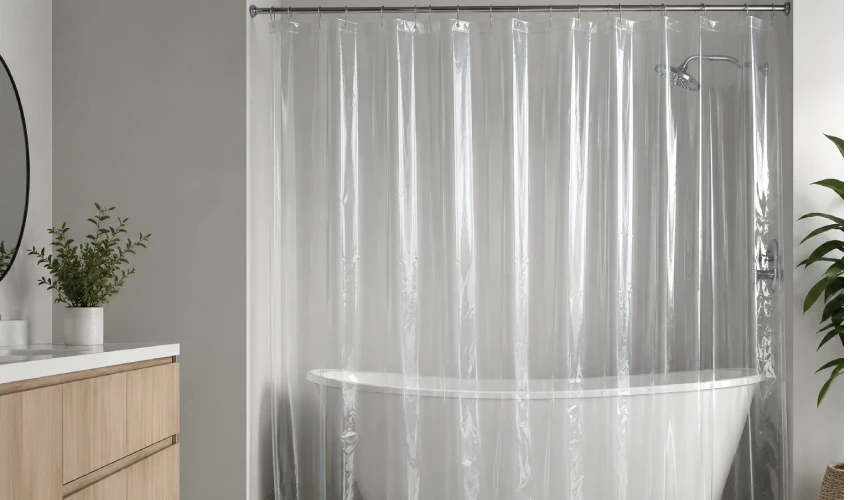
PEVA (polyethylene vinyl acetate) is a flexible, waterproof plastic and the most common liner material. It contains no chlorine, so it is a different plastic from PVC, even though it is often loosely sold as “vinyl”. It usually has less of a new-plastic smell than PVC.
For walk-in showers, thickness matters most. Liners are sold by gauge, and a higher number means a thicker sheet. Very thin 3–5 gauge liners tend to cling to the body and tear at the holes, while 8–10 gauge liners hang straighter and last longer. Gauge labelling is not standardised between brands, so also check the weight, hem and hole reinforcement.
PEVA does not absorb water, so it resists mildew better than fabric. It still collects soap and body-oil film, and mildew grows on that. Rinse it when you clean the shower tiles and wash it about monthly. Choose rust-resistant metal grommets or reinforced holes, because tears usually start there. Clear PEVA lets in more light; frosted or solid PEVA gives more privacy.
2. EVA Shower Curtains
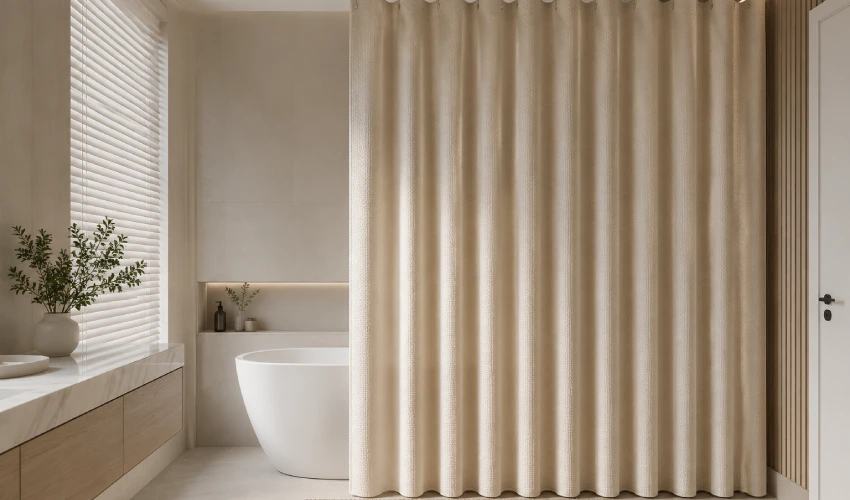
EVA (ethylene vinyl acetate) belongs to the same plastic family as PEVA, and the two names are often used interchangeably on packaging. It is waterproof, chlorine-free and mostly sold as liners or simple stand-alone curtains.
Do not choose between EVA and PEVA on the name. Compare gauge, a weighted hem, reinforced holes and the stated size instead. A new EVA or PEVA liner can still have a faint smell, so airing it out before hanging helps.
3. Polyester Shower Curtains
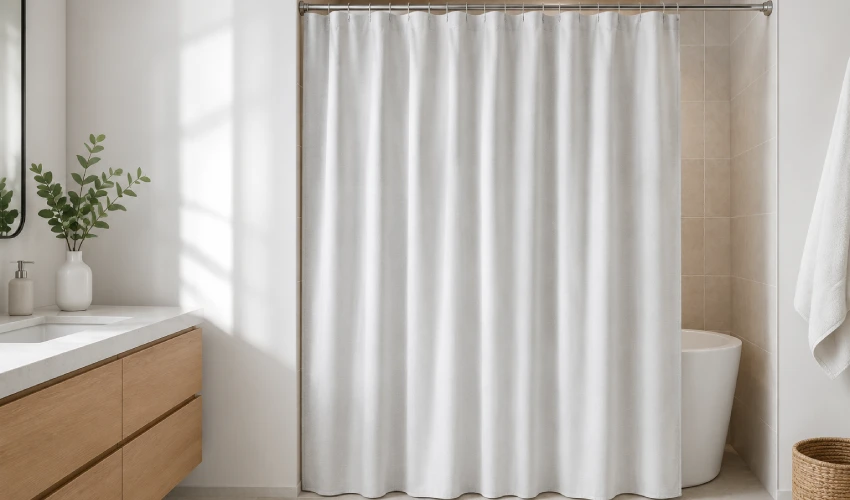
Polyester is the most popular fabric for shower curtains. It is woven, so it looks like a textile, and it sheds water and dries much faster than cotton. Most polyester curtains are machine-washable, which makes them easier to keep fresh than plastic.
Plain polyester is water-repellent, not waterproof. Under direct spray, water can soak through, so in walk-in showers it usually works best as the outer layer with a PEVA liner behind it. Heavier, tightly woven fabrics hang better and billow less than thin ones. If you want to skip the liner, choose a curtain the manufacturer says can be used without one.
4. Coated Polyester Curtains
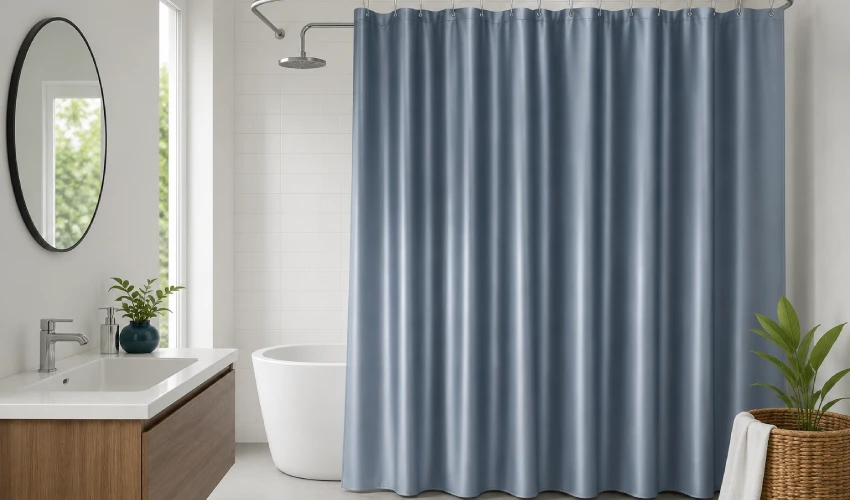
Coated or treated polyester has a water-repellent finish that makes water bead and run off. That makes it the most practical choice if you want a single fabric layer.
The finish is not a waterproof membrane. It works best where the spray is not aimed directly at the curtain, and it can weaken with repeated washing and strong detergents. Follow the care label, usually a gentle cycle with mild detergent and no fabric softener. Like any curtain fabric, it resists mildew only while it is allowed to dry properly between showers.
5. Vinyl Shower Curtains (Heavy Duty)
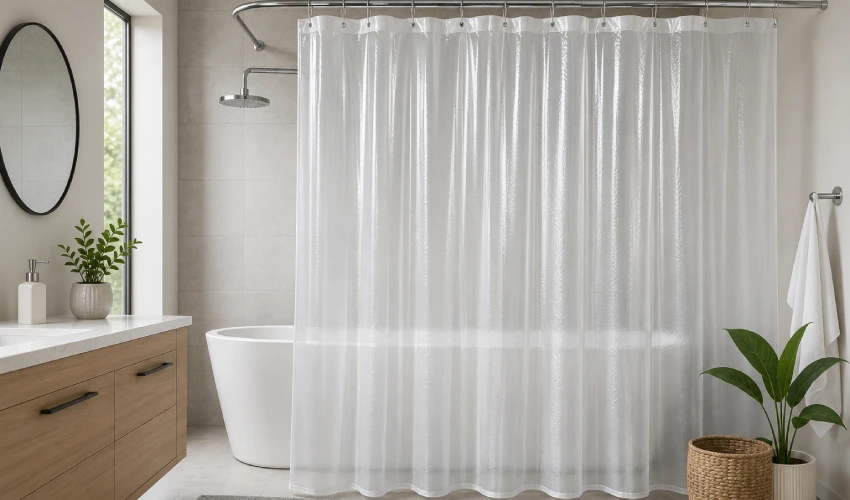
“Vinyl” here means PVC. Heavy PVC curtains are fully waterproof, inexpensive, wipe clean easily and stand up to rough use. That is why they are common in utility bathrooms, rentals and commercial spaces.
The drawbacks are real. PVC usually has a strong smell when new. It is a chlorine-based plastic that often contains softeners, and it can stiffen or crack with age. Many households now choose heavy PEVA, which hangs and performs similarly. If you buy PVC, air it out before use and check the care label, since many cannot be machine-washed.
6. Poly-Blend Shower Curtains
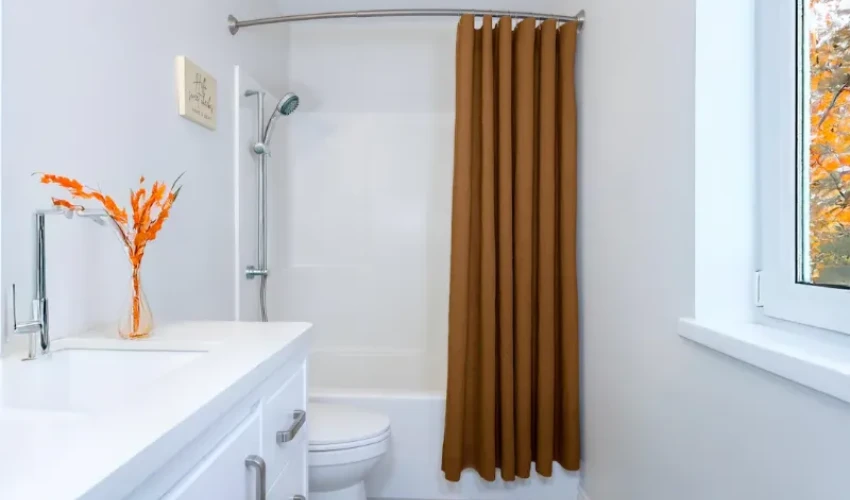
Poly-cotton blends mix polyester with cotton for a softer, more natural-looking fabric. The cotton absorbs some water, so these curtains dry more slowly than pure polyester and need a waterproof liner in a walk-in shower.
They suit bathrooms with good ventilation, where the fabric can dry fully between showers. Wash them regularly according to the label. In a bathroom that stays damp, pure polyester or a plastic curtain is the safer choice.
7. Waffle-Weave Fabric Shower Curtains
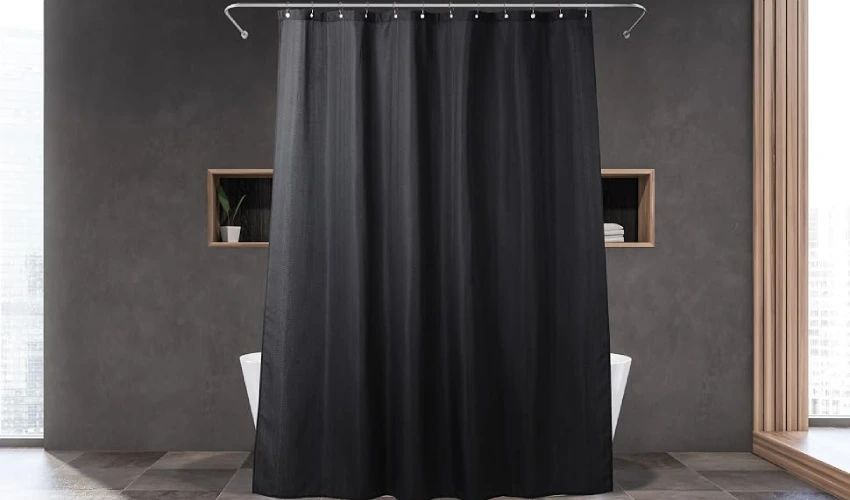
Waffle-weave curtains have a raised grid texture that gives a hotel-style, spa-like look. Most are polyester, though cotton and blended versions exist. The thicker texture adds weight, which helps them hang straight.
In walk-in showers, most waffle curtains are best used with a liner behind them. Wash them regularly, because the texture can hold soap residue. Rust-resistant grommets or hooks help them slide easily and avoid stains.
8. Stall-Size Shower Curtains
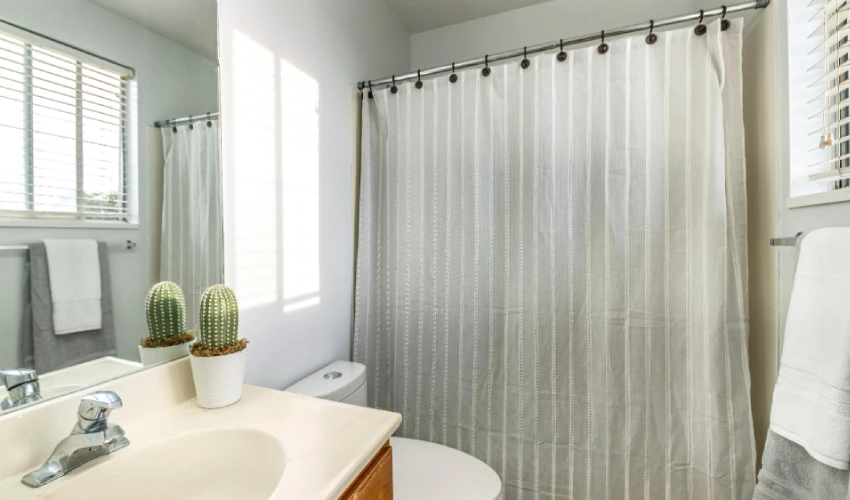
Stall-size curtains are narrower and longer than the standard 72 × 72 in size. The most common stall size is 54 × 78 in (about 137 × 198 cm), and narrower 36-inch-wide versions are also sold. The extra length helps the hem reach a walk-in floor.
A 54-inch curtain suits openings up to roughly 42 in (about 107 cm), leaving enough width to overlap the walls. Stall sizes come in PEVA, EVA and polyester, and matching stall-size liners are easy to find.
9. Extra Long / Extra-Wide Shower Curtains
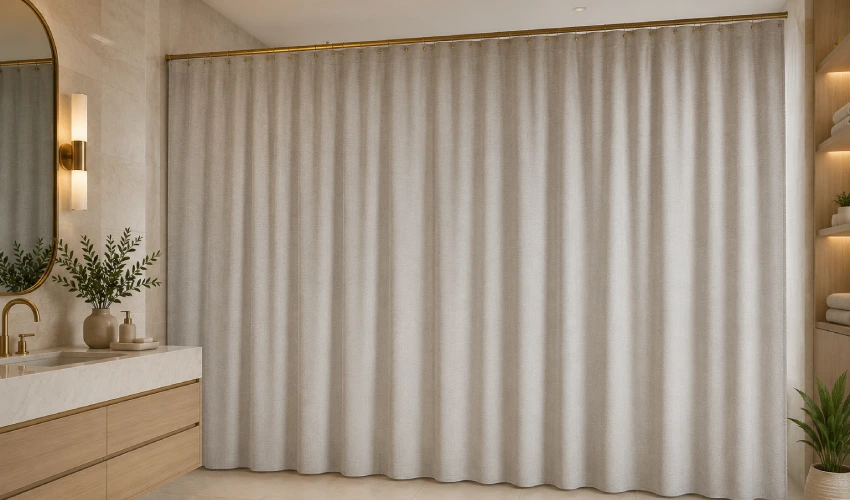
Walk-in showers often have rods or tracks fixed higher than a bathtub rod, so a standard 72-inch drop leaves a gap at the floor. Common longer sizes are 72 × 84 in (about 183 × 213 cm) and 72 × 96 in (about 183 × 244 cm). For a closer look at materials and length, see our guide to the best materials for an extra long shower curtain.
Extra-wide curtains, typically 108 × 72 in (about 274 × 183 cm), cover wide, corner or doorless openings. They are often standard length, though, which can be too short for a walk-in. For openings that are both wide and tall, use two panels on one rod or have a curtain made to measure.
10. Heavy Weighted Shower Curtains
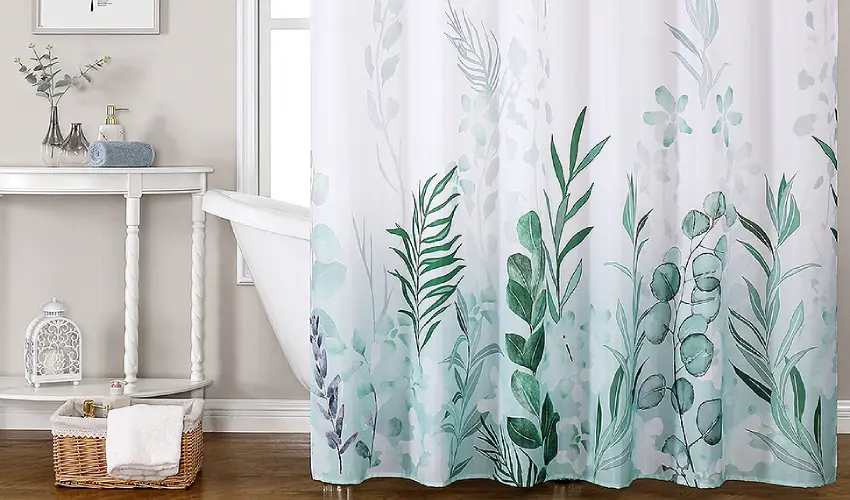
Weighted curtains have a heavier hem, usually a weighted hem tape or small weights sewn into the bottom edge. Some liners also use magnets or suction cups. The extra weight helps the curtain hang straight and stops it drifting inward with the moving air the spray creates.
Magnets only help where they meet metal or each other. On a tiled walk-in floor they do little, so a weighted hem is usually more effective. Weighting is a feature rather than a material, and you will find weighted PEVA, EVA and polyester options.
How to Measure a Walk-In Shower for a Curtain
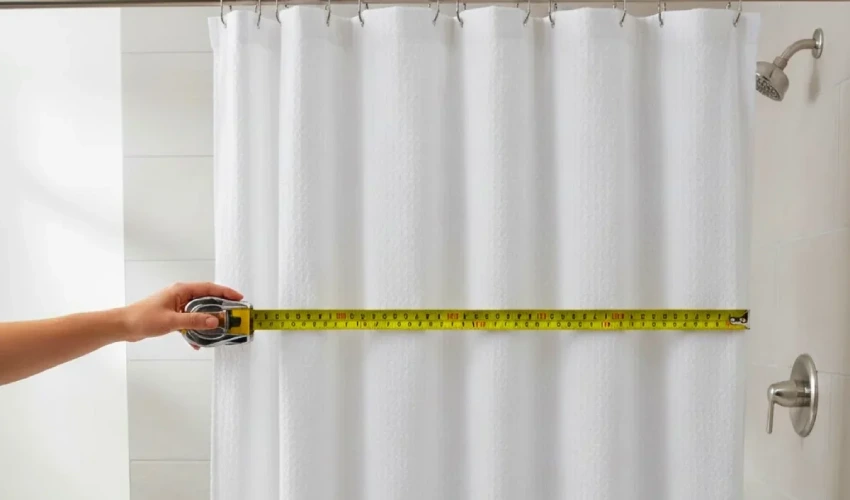
Measure the opening and the rod height, not just the shower base. Retail sizes are a starting point, but your own measurements decide the size.
- Measure the width. Measure wall to wall where the rod or track will sit. For L-shaped or corner layouts, add both sides together. Choose a curtain at least about 30 cm (12 in) wider than the opening, so it overlaps the walls and hangs in gentle folds when closed.
- Measure the drop. Measure from the underside of the rings, hooks or track carriers down to the floor at the lowest point inside the shower, usually near the drain. Measure your actual hooks, because rings and roller hooks drop by different amounts.
- Set the hem position. Aim for the hem to finish 1–2 cm above the shower floor and inside the wet area, so water runs off it towards the drain. With a curb, the hem should hang inside the curb.
- Choose the nearest size, then adjust. If you are between sizes, choose the longer one. Then raise the rod slightly, have a fabric curtain hemmed, or trim a plastic liner at the bottom if its weights are not in the part you would cut.
Worked example: a 110 cm opening with the hook line 205 cm above the floor at the drain needs a curtain at least 140 cm wide and about 203 cm long. A 72 × 84 in curtain (183 × 213 cm) fits the width but is about 10 cm too long, so you would raise the rod or trim the liner.
Common Shower Curtain Sizes
| Name | Width × Length (in) | Width × Length (cm, approx.) | Typical Use |
|---|---|---|---|
| Standard | 72 × 72 | 183 × 183 | Bathtubs; low rods |
| Stall | 54 × 78 | 137 × 198 | Narrow walk-ins and stalls |
| Long | 72 × 84 | 183 × 213 | Walk-ins with higher rods |
| Extra-long | 72 × 96 | 183 × 244 | Ceiling-height rods or tracks |
| Extra-wide | 108 × 72 | 274 × 183 | Wide or corner openings (check the length) |
Sizes vary slightly between brands, so check the stated dimensions before buying.
Choosing the Right Rod, Track and Hooks
The hardware matters as much as the curtain, because a sagging rod or sticking hooks leave gaps.
- Tension rods suit short, straight openings and rentals where drilling is not allowed. Over long spans, or with a heavy liner and wet fabric, they can slip or bow, so check the stated weight limit.
- Wall-mounted fixed rods are sturdier for daily family use. Stainless steel or aluminium resist rust better than plated steel.
- L-shaped, U-shaped or ceiling-mounted tracks suit corner and doorless walk-ins. A ceiling track must be fixed into a ceiling that can take the load, so check what is above a false ceiling before fixing.
- Hooks and rings should be rust-resistant. Roller hooks glide more smoothly on long runs, and hookless curtains with a snap-in liner make removing the liner for washing quicker. More detail: types of curtain hooks.
Do You Need a Shower Curtain Liner?
In most walk-in showers, yes. A plastic liner inside the shower area with a fabric curtain outside is the most reliable way to keep water in while choosing any look you like. The liner takes the spray, so the decorative curtain needs washing less often.
A single layer can work when the shower head points away from the opening, when the curtain itself is heavy PEVA or EVA, or when a polyester curtain is labelled for use without a liner. After each shower, separate the liner and curtain so air reaches both sides.
How to Stop Mildew and Soap Build-Up
No curtain is mould-proof. Mildew needs moisture and something to feed on, such as soap and skin residue, so a curtain that stays damp and dirty will grow it whatever the material. The US Environmental Protection Agency recommends running the bathroom fan or opening a window while showering, and keeping indoor humidity below 60%, ideally 30–50%.
- After every shower: pull the curtain fully across so it dries flat instead of bunched up. Separate the liner and curtain, and keep the fan running for a while afterwards.
- About monthly (more often in busy or poorly ventilated bathrooms): wash both liner and curtain. Machine-wash fabric curtains according to the label. Many plastic liners can go on a gentle cold cycle with a couple of towels, then hang to dry. Do not tumble-dry plastic.
- Pink or orange marks along the hem are usually a bacterial film, not mould, and regular washing removes them.
- Replace the liner or curtain when stains no longer wash out, holes start to tear, plastic turns stiff or cracked, or a musty smell lasts after washing.
Choosing and Caring for Shower Curtains in UAE Homes
In the UAE, how well a bathroom is ventilated usually matters more than the weather outside. Air-conditioned homes can be comfortable indoors, while an internal bathroom with a weak extractor fan stays damp after every shower. Choose the curtain for the bathroom you actually have.
Ventilation and Humidity
- Windowless bathrooms are common in apartments. The extractor fan is then the only way out for steam. Run it during and after showers. If it barely holds a sheet of tissue paper, ask building maintenance to check or clean it.
- Air conditioning helps, but bathrooms vary. AC usually dries the main living areas, while closed bathrooms can stay humid. A low-cost hygrometer will tell you whether the room stays above about 60% humidity long after showering.
- Homes closed up in summer. UAE mould-removal companies have reported sharp rises in enquiries over the summer, which they link in many cases to AC switched off completely during long holidays. Before travelling, wash and fully dry the curtain and liner, leave them spread open and follow your building or AC provider’s advice on settings while you are away.
Which Curtain Suits Which Bathroom
| Bathroom | Practical Choice | Why |
|---|---|---|
| Internal apartment bathroom with fan only | Heavy PEVA or EVA alone, or with a quick-drying polyester curtain | Plastic does not hold water, and polyester dries faster than cotton blends |
| Busy family bathroom | 10-gauge-plus PEVA liner, weighted hem and a rust-resistant fixed rod; keep a spare liner for wash days | Handles daily use, and a spare means there is always a clean, dry liner |
| Guest bathroom used occasionally | Fabric curtain of your choice with a liner | It has time to dry fully between uses, so softer fabrics are fine |
| Villa master bathroom with a large or doorless walk-in | Long or extra-wide curtain, or two panels, on an L-shaped or ceiling track | Covers a wide opening and a high rod without floor gaps |
| Utility or staff bathroom | Heavy PEVA or vinyl | Low cost, waterproof and easy to wipe |
Layout and Installation
- Villas often have large, open walk-ins where the shower head faces the room. Use a curtain long enough to sit inside the floor fall, and consider a fixed glass panel if water still reaches the floor.
- In compact apartment bathrooms, a stall-size curtain on a short fixed rod usually works better than an oversized curtain that bunches up and stays wet.
- Many apartments have false ceilings, so confirm there is solid fixing above before choosing a ceiling-mounted track.
A Maintenance Routine That Works Locally
- Run the fan during and after every shower, and leave the bathroom door open afterwards if the room has no window.
- Wash liners every two to four weeks in heavily used or poorly ventilated bathrooms, and monthly elsewhere.
- If white mineral marks build up on a plastic liner, wipe them off with diluted white vinegar, then rinse.
Final Thoughts
For most walk-in showers, start with a heavy, weighted PEVA or EVA liner measured to the floor fall, then add any fabric curtain you like in front. Choose hardware that suits the span, and let both layers dry after every shower. Those three steps do more for a dry floor and a mildew-free curtain than the choice of fabric.
Frequently Asked Questions
Do I need a liner with a polyester shower curtain in a walk-in shower?
Usually, yes. Polyester repels water but is not waterproof, and walk-in showers have no tub wall to catch what gets through. Skip the liner only if the curtain is labelled for use without one and the spray is not aimed at the opening.
Is PEVA better than vinyl for a walk-in shower curtain?
For most homes, yes. Both are waterproof, but PEVA is chlorine-free and usually smells less when new, while PVC vinyl tends to stiffen with age. Heavy PVC is still a durable, low-cost option for utility or commercial bathrooms.
Why does my shower curtain blow inward?
The spray and warm air moving inside the shower pull light curtains towards you. A heavier gauge, a weighted hem and a curtain wide enough to overlap the walls all reduce it. A slightly curved rod also gives you more room.
What size shower curtain fits a small walk-in shower?
For openings up to about 107 cm (42 in), a stall-size curtain of 54 × 78 in (about 137 × 198 cm) usually fits. Check that the length brings the hem 1–2 cm above the floor at your rod height.
Can I cut a shower curtain liner that is too long?
Most plastic liners can be trimmed at the bottom with sharp scissors, as long as the weights or magnets are not in the part you cut off. Fabric curtains are better hemmed, or you can raise the rod instead.
What is the best rod for a corner or doorless walk-in shower?
An L-shaped or U-shaped rod, or a ceiling-mounted track, follows the shape of the opening and holds a wider curtain without sagging. For short, straight openings in rentals, a rust-resistant tension rod is fine if it is rated for the weight.
How often should I wash my shower curtain and liner?
Wash both about once a month, and the liner more often if your bathroom stays humid. Replace either one when stains, tears or a musty smell remain after washing.