
The Best Flooring for Basements: Top Options & Costs
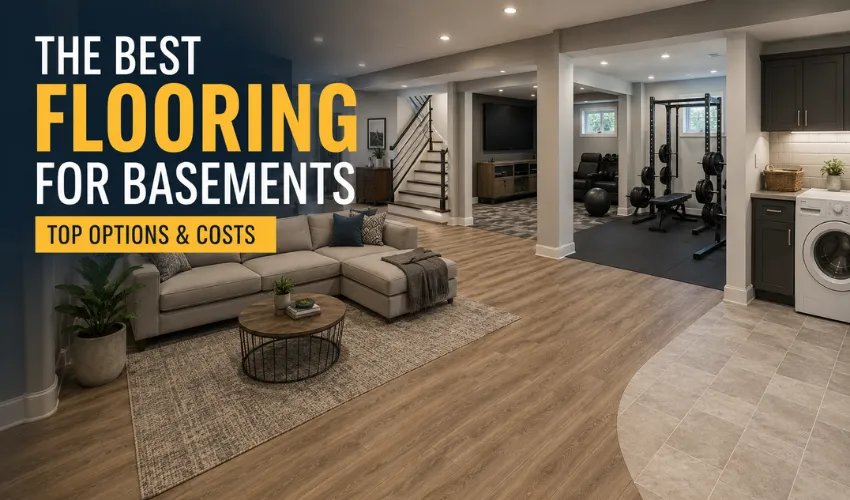
Rigid-Core Luxury Vinyl Plank ( LVP) is the best overall flooring choice for basements in 2026, as it is 100% waterproof, mold-resistant, and floats directly over concrete ($4–$12/sq. ft. installed). For flood-prone or utility zones, porcelain tile ($8–$20/sq. ft.) and epoxy coatings ($4–$12/sq. ft.) provide maximum durability without requiring replacement after water exposure.
Living areas like home theaters benefit from carpet tiles or cork for added warmth and acoustics, whereas rubber flooring handles heavy gym equipment. Homeowners should strictly avoid solid hardwood and standard laminate, as ground moisture causes rapid warping, swelling, and mold growth. In this guide by Floor Land, we will enlist the top 12 basement flooring options you can pick from.
Basement Flooring Comparison Table
The table below summarizes all twelve options reviewed in this guide. Installed costs reflect typical 2026 professional pricing in US dollars per square foot; regional labor rates shift these ranges.
Detailed Review of Every Basement Flooring Type
Each review below covers construction, moisture behavior, realistic strengths and weaknesses, and a full specification table. Costs are typical 2026 ranges for materials and professional installation; DIY installation removes most of the labor line.
1. Luxury Vinyl Plank (LVP)
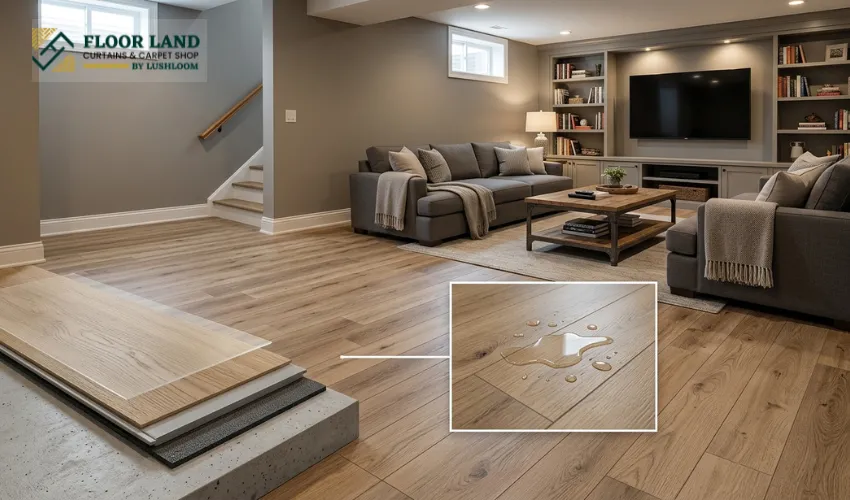
Rigid-core luxury vinyl plank is the default recommendation for finished basements in 2026 due to its inorganic, waterproof limestone-PVC core that prevents swelling and mold growth. Featuring a click-lock floating design, LVP tolerates minor moisture events and slab movement without requiring any glue.
Lifespan and overall durability depend heavily on the clear urethane wear layer: builder-grade planks feature 6 to 12 mil, a 20 mil layer is the practical minimum for family rooms, and 22 to 28 mil suits pets, kids, and rental use. Wood-polymer composite (WPC) cores feel softer and warmer underfoot but dent more easily than rigid SPC cores.
Although vinyl flooring in planks is waterproof as a material, floodwater can still pass through click joints onto the concrete slab. Heavy furniture or dragged appliances can dent planks, while cheap locking systems can gap. Fortunately, its floating installation allows easy lifting, drying, and reinstalling after severe water incidents.
2. Luxury Vinyl Tile (LVT)
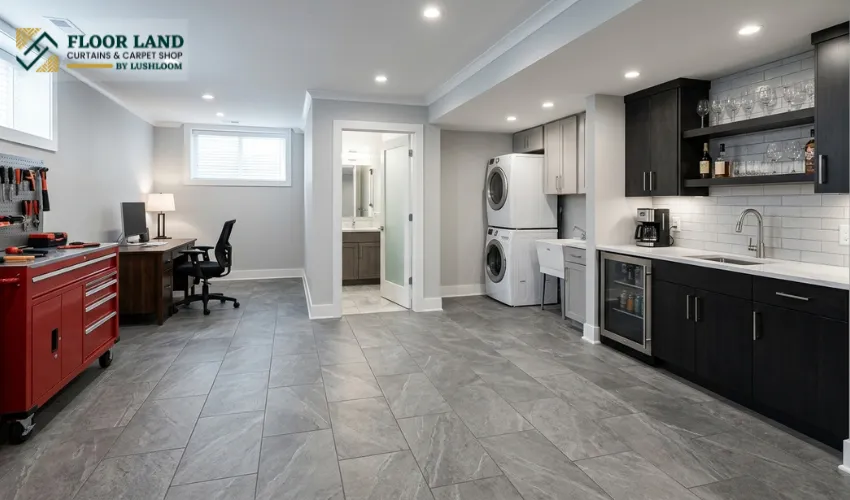
LVT is the same product as LVP in a tile format. Instead of wood-look planks, you get stone, slate, travertine, and concrete visuals, often with groutable edges that read convincingly as real tile. The core construction, wear layers, and moisture behavior are identical, so everything above about LVP applies here.
The format changes the use case. LVT suits basement kitchens, bathrooms, bars, and laundry areas where a stone look fits better than wood. Glue-down LVT is also the right call under rolling loads, such as office chairs, gym equipment on casters, or a workshop with wheeled tool chests, because a bonded floor cannot shift or separate at the joints. Glue-down installation demands a drier slab than floating, so moisture testing becomes mandatory rather than optional.
3. Porcelain Tile
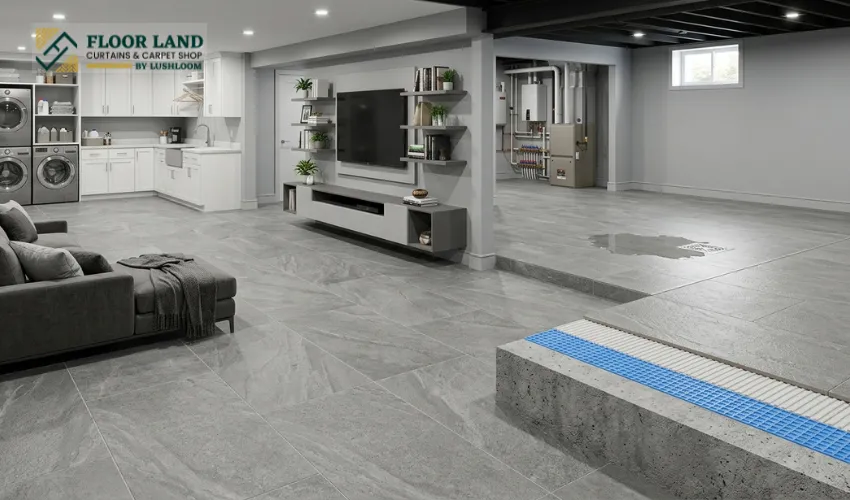
Porcelain is fired dense enough to absorb less than 0.5 percent of its weight in water under the ASTM C373 test. In practical terms, the tile itself is waterproof and completely indifferent to slab vapor, humidity, and even standing floodwater. A properly installed porcelain floor over a sound slab can outlast the house. For flood-prone basements, it is the gold standard: after a flood, you extract the water, disinfect, and keep the same floor.
The trade-offs are physical comfort and installation cost. Tile takes on the slab’s temperature, so it feels cold in most basements unless you add electric radiant mats or hydronic heat beneath it, both of which pair beautifully with porcelain. It is also hard and unforgiving underfoot, loud, and merciless to dropped glassware.
Labor is the largest line item: tile setting is skilled work, and below-grade slabs usually need a crack-isolation or uncoupling membrane so slab movement does not telegraph into the tile.
4. Ceramic Tile
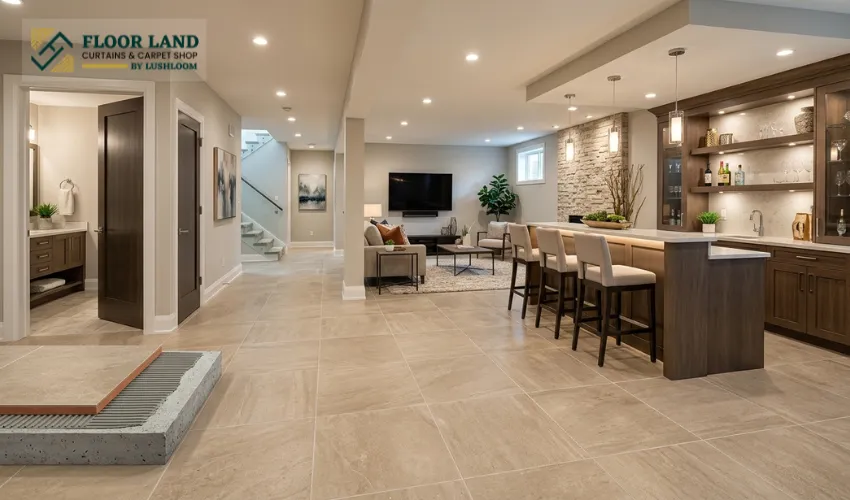
Ceramic is porcelain’s more porous sibling. It is fired at lower temperatures and absorbs roughly 3 to 7 percent of its weight in water, sometimes more. The glazed surface sheds water fine; the clay body beneath it does not. In a typical basement with normal humidity, ceramic performs well for decades.
In a basement that floods or stays chronically damp, saturated ceramic bodies can weaken bond strength over time, which is why porcelain gets the nod for wet-risk spaces.
The reason to choose ceramic is price. Materials cost roughly half as much as comparable porcelain, and it cuts more easily, which reduces labor on complex layouts. For a dry basement bathroom, bar, or entry landing, ceramic offers most of porcelain’s benefits at a lower cost. Choose a floor-rated tile (PEI 3 or higher) and a slip-resistant finish; wall-rated ceramic will not survive foot traffic.
5. Engineered Hardwood
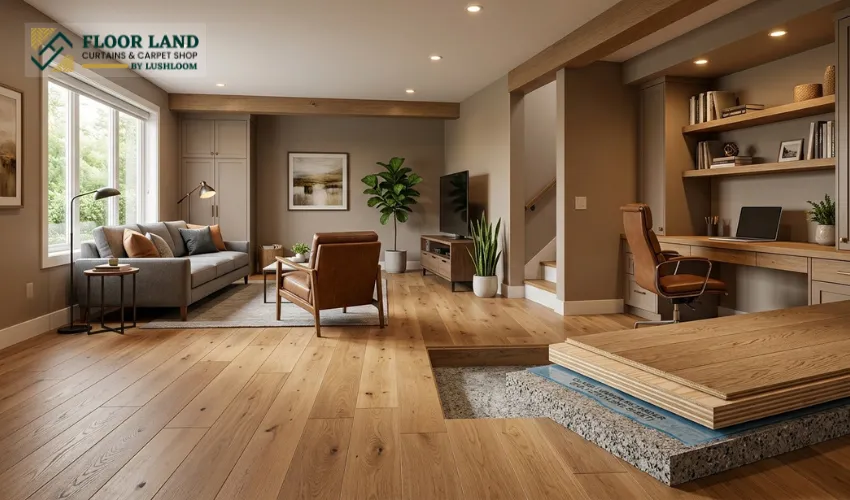
Solid hardwood should never go in a basement; every major manufacturer voids the warranty below grade. Engineered hardwood is the workaround. A thin veneer of real wood (2 to 6 mm) is bonded to a cross-laminated plywood or HDF core. The crossed plies pull against each other as humidity changes, which cuts expansion and contraction to a fraction of solid wood’s movement. That stability is what makes below-grade installation possible.
Possible, not foolproof. Engineered wood floors remain an organic product. It needs a slab that tests dry, a Class I vapor retarder (a 6-mil or thicker polyethylene sheet, or an equivalent underlayment) between concrete and wood, and year-round humidity control between roughly 35 and 55 percent relative humidity. Miss any of those and the veneer can check, cup, or delaminate. Standing water from a flood generally means replacement.
Choose it when the look and feel of real wood justifies the risk management: a dry, fully conditioned basement office, media room, or guest suite. Buy a veneer of 3 mm or more if you want the option to refinish once or twice over its life. Skip it entirely in laundry areas, near sump pits, in flood zones, or in any basement without a dehumidifier.
6. Epoxy Flooring
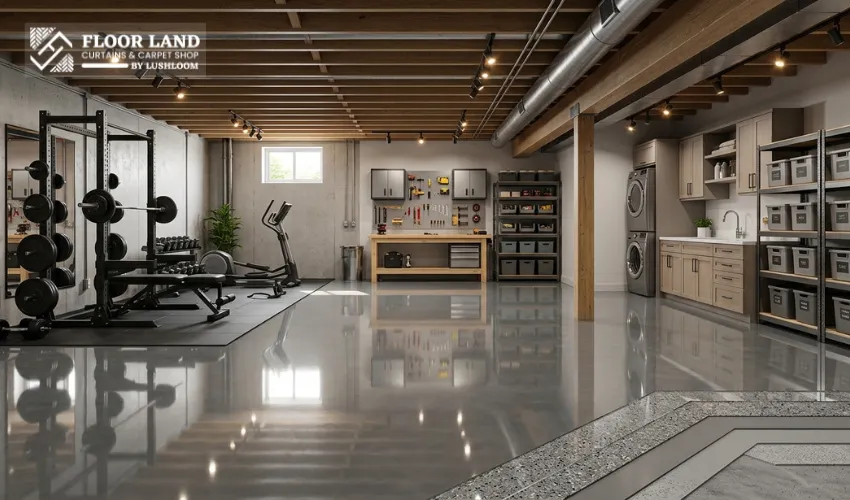
Epoxy is not a floor covering; it is a two-part resin coating that bonds directly to the concrete and becomes part of it. Cured epoxy is seamless, waterproof, chemical-resistant, and harder than the slab beneath it. For workshops, laundry zones, storage areas, and home gyms with rubber mats on top, it is hard to beat.
Decorative flake and metallic systems have also pushed epoxy into finished basements that want an industrial-modern look.
Epoxy lives or dies on two things: surface preparation and slab moisture. The concrete must be diamond-ground to open the pores, and the slab must test at or below roughly 3 pounds per 1,000 square feet per 24 hours on a calcium chloride test (or the coating manufacturer’s RH limit).
Vapor pushing up through an untested slab is the number-one cause of epoxy blistering and peeling in basements. Moisture-mitigation primers solve it but add $1 to $3 per square foot.
7. Polished Concrete
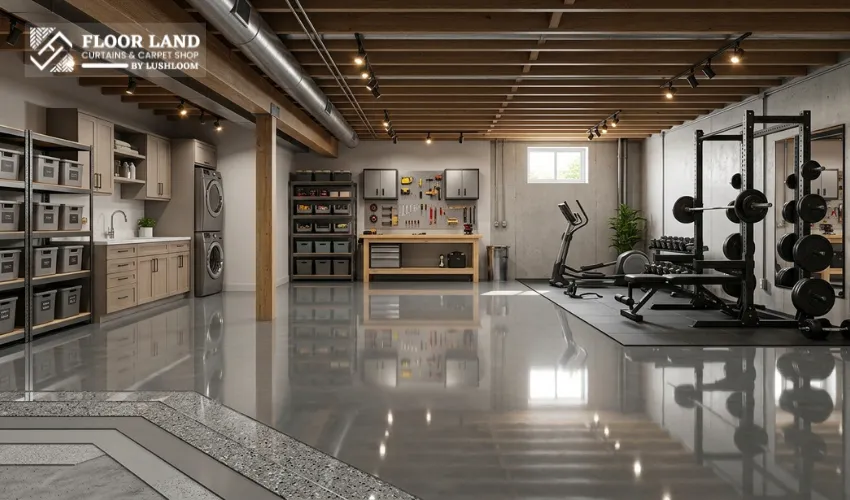
Sometimes the best basement floor is the one already there. Polishing grinds the slab with progressively finer diamond abrasives, treats it with a chemical densifier, and burnishes it to a matte or gloss sheen. There is no covering to swell, delaminate, peel, or trap moisture, which makes polished concrete effectively immune to every basement failure mode in this guide. Stains and dyes can take it well beyond utilitarian gray.
The honest downsides: it is cold and hard, period. Moreover, you need to keep the concrete flooring clean for better functionality. Area rugs solve comfort in living spaces, and they pair perfectly with radiant heat if the budget allows. Results also depend on the slab you have. Old, patched, or badly cracked concrete limits how clean the final floor looks, and grinding is dusty, loud work best left to a contractor with proper vacuum-shrouded equipment.
Some basement slabs are too thin or soft to take a true polish; those get a densified grind-and-seal instead, which looks similar and costs less.
8. Laminate Flooring
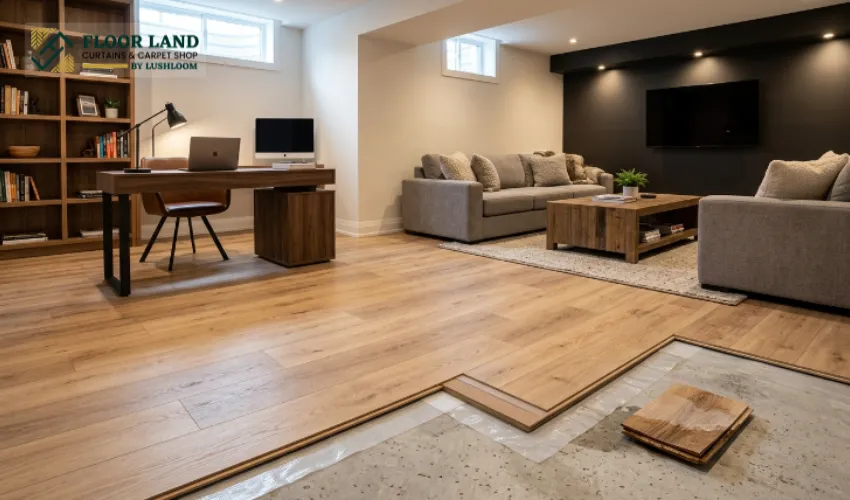
Laminate flooring is an affordable option ($1–$5/sq. ft.) offering exceptional scratch resistance and clear AC wear ratings (AC3–AC5). However, its high-density fiberboard (HDF) core poses severe risks in basements. While modern water-resistant surfaces resist topical spills for 24 to 72 hours, moisture rising from beneath a concrete slab causes the compressed wood fibers to swell permanently.
Installing laminate below grade requires three strict conditions: a thoroughly dry-tested concrete slab, a continuous 6-mil polyethylene vapor barrier with taped seams, and active basement humidity control. Because waterproof luxury vinyl plank is competitively priced, professionals generally recommend vinyl over laminate unless maximum scratch resistance is the primary priority.
9. Sheet Vinyl
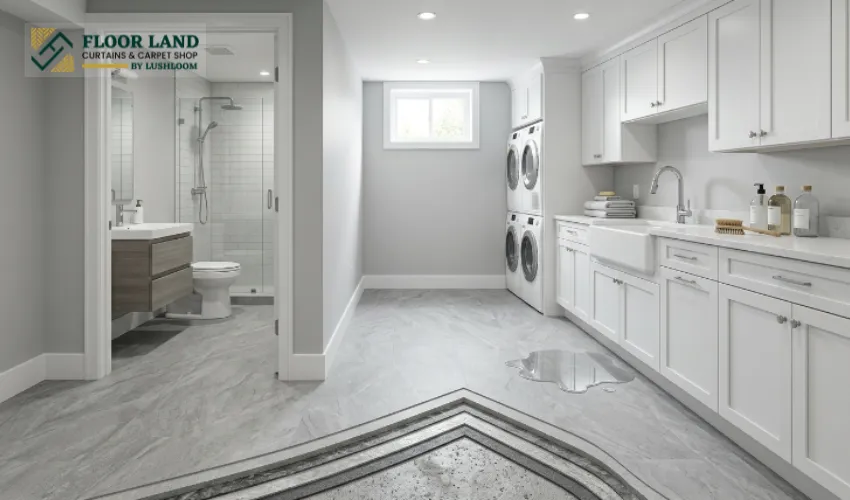
Sheet vinyl is the value play for wet-service basement rooms. It comes in rolls up to 12 feet (about 3.7 m) wide, so a laundry room or small bathroom can be covered in one seamless piece with no joints for water to find. Modern fiberglass-backed sheet vinyl is dimensionally stable, comfortable underfoot, and cheap: often under $7 per square foot installed.
The weak points are the installation method and the wear layer. Fully glued sheet vinyl over a damp slab fails the same way epoxy does; the adhesive breaks down and the sheet bubbles. Fiberglass-backed products that loose-lay or glue only at the perimeter sidestep the problem and are the right spec for basements.
10. Cork Flooring
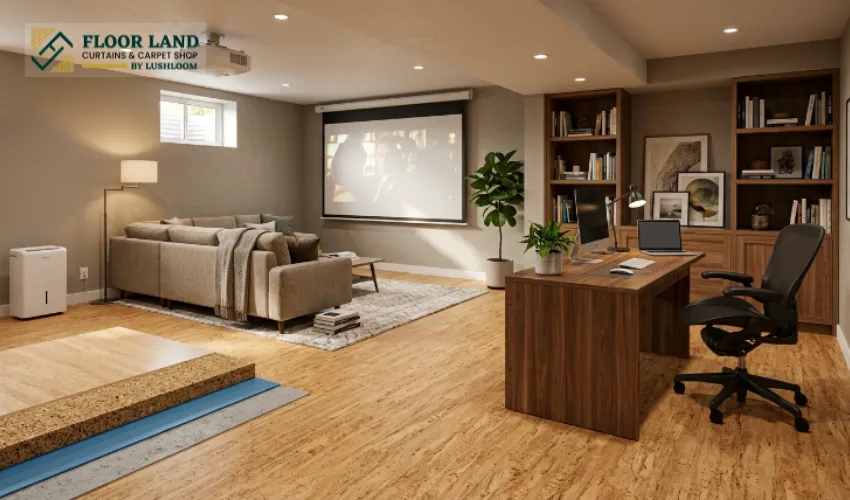
Cork stands out as a warm, quiet, and springy natural flooring choice for basement offices, playrooms, and media rooms. At 10 to 12 mm thick, its air-trapping cell structure delivers roughly R-1 thermal insulation. It is the highest of any other hard surface listed, while natural suberin repels mold, mildew, and pests.
Still, as an organic material, cork swells when soaked. It belongs strictly in dry, dehumidified basements over a vapor barrier, far from any flood risk. The soft surface dents under heavy furniture and marks under pet claws, requiring wide floor pads and a fresh polyurethane finish every 5 to 8 years to seal the seams. Never glue cork directly onto an untested concrete slab. Make sure to follow the proper maintenance and cleaning of cork flooring.
11. Rubber Flooring
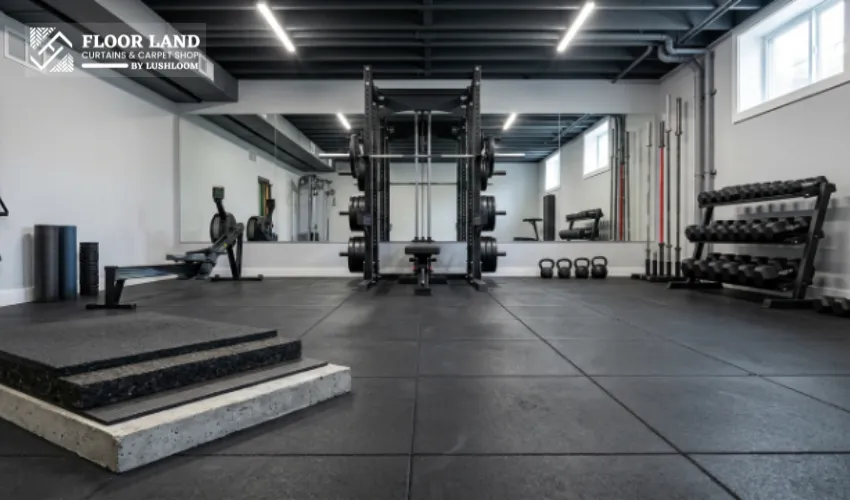
Rubber owns the basement gym. Recycled-rubber tiles and rolls from 8 mm up to 3/4 inch (19 mm) absorb dropped weights, kill noise, insulate against the cold slab, and shrug off sweat, spills, and humidity. Interlocking tiles install in an afternoon with a utility knife and no adhesive, and a damaged tile swaps out in minutes. Virgin rubber costs more but offers cleaner colors and less odor.
That odor is the main complaint: recycled rubber off-gasses a tire smell that fades over weeks but never fully disappears in poorly ventilated spaces. Rubber flooring is also heavy, can stain from some cleaners and plasticizer interactions, and looks like what it is; few people want it in a living room.
12. Carpet Tiles
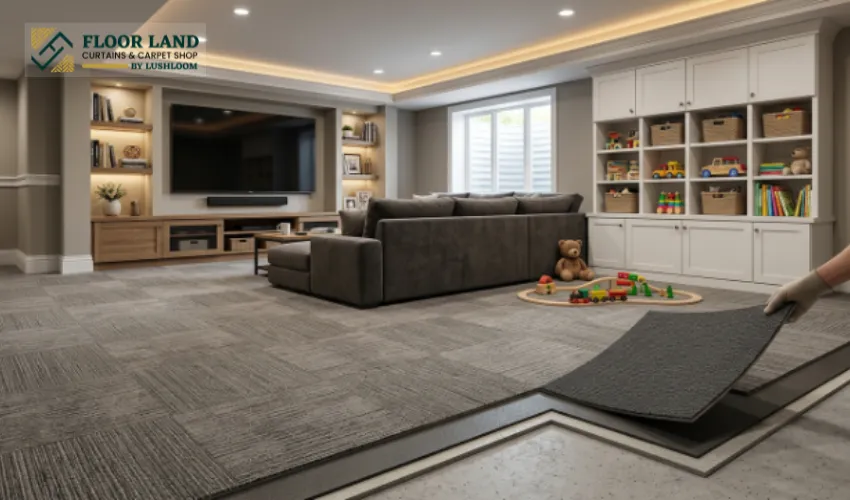
Wall-to-wall broadloom carpet is a basement liability, but carpet tiles solve most of its problems. Quality tiles use a solution-dyed nylon or polypropylene face bonded to a closed-cell PVC or vinyl backing, with no organic pad underneath.
Nothing in that stack feeds mold. When a tile gets soaked or stained, you lift it, dry or replace it, and the floor is whole again; keep a box of spares from the original dye lot.
Carpet tiles are the warmest and quietest option in this guide, which makes them the comfort pick for basement bedrooms, media rooms, and play areas in basements with controlled humidity.
They are moisture-resistant, not waterproof: a real flood still means pulling the field and drying the slab, and chronically damp basements will eventually smell musty under any carpet. Peel-and-stick and releasable-adhesive systems both work; avoid full-spread permanent adhesive below grade.
Best Basement Flooring by Use Case
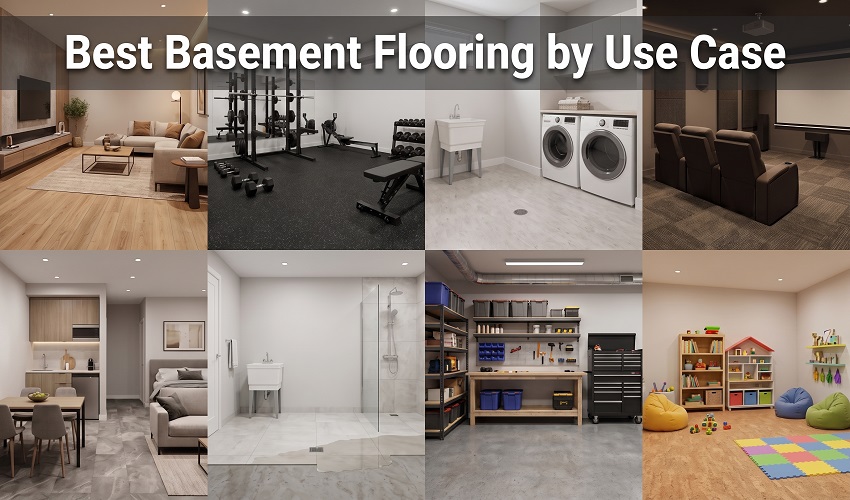
The right answer changes with the job the room has to do. These are the pairings professionals reach for first.
Finished Basement Living Space
Rigid-core LVP with a 20 mil wear layer is the standard spec: waterproof, warm enough with an underlayment, and convincing as wood. Porcelain tile with radiant heat is the premium alternative for open-plan spaces and basement kitchens.
Home Gym
Rubber tiles, 8 mm for cardio and general training, 15 to 19 mm under free weights. Many owners run epoxy or polished concrete across the whole room and drop rubber only in the lifting zone, which keeps the space easy to clean.
Laundry Room
Sheet vinyl (seamless, loose-laid) or porcelain tile. Both survive the inevitable hose failure or overflow. Add a floor drain if the plumbing is already open; it is cheap insurance no flooring can match.
Home Theater and Media Room
Carpet tiles win on acoustics and comfort in a dry, dehumidified basement. Cork is the hard-surface alternative that still absorbs sound. Keep spare tiles for spill casualties near the seating.
Rental or In-Law Suite
Glue-down LVT or 22–28 mil LVP. Tenants are hard on floors, and plank-by-plank repairability keeps turnover costs down. Avoid anything that needs humidity discipline from an occupant you do not control, which rules out engineered hardwood, laminate, and cork.
Flood-prone basement
Porcelain tile, epoxy, or polished concrete, full stop. All three can be submerged, disinfected, and kept. If you want something softer over them, use loose-laid rubber or washable rugs that can be carried out and dried.
Unfinished Basement, Storage, and Workshops
Epoxy or a densified grind-and-seal on the existing slab. Both control concrete dust, resist oil and chemicals, and brighten the space. Interlocking subfloor panels work for dedicated storage rooms where boxes must stay dry.
Kids’ Playroom
Cork in a dry basement, or LVP with a thick acoustic underlayment plus foam play mats where the action happens. Both are easier to sanitize than carpet.
Basement Flooring to Avoid
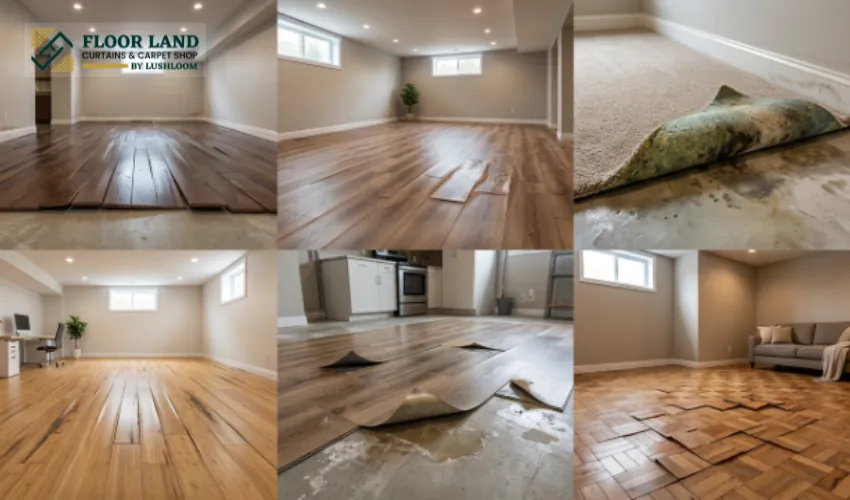
Some materials fail below grade often enough that most installers refuse to warranty them there.
- Solid hardwood. Expands and contracts too much with basement humidity; it cups, gaps, and buckles. Manufacturers void warranties below grade without exception.
- Standard (non-water-resistant) laminate. The unsealed HDF core swells permanently at the first serious moisture event.
- Broadloom carpet over organic pad. Traditional carpet with a urethane or fiber pad holds slab moisture against the concrete and becomes a mold and dust-mite habitat. If you must have wall-to-wall softness, use fully synthetic carpet tiles instead.
- Most bamboo flooring. Despite its hard surface, bamboo is a grass with high moisture sensitivity. Only specific engineered, warranty-backed bamboo lines qualify below grade, and they carry the same conditions as engineered hardwood.
- Peel-and-stick vinyl on untested slabs. The adhesive is the weak link; slab vapor releases the corners and edges within a season.
- Site-finished solid parquet and wood sleeper floors without vapor management. Any wood system that touches concrete without a Class I vapor retarder is a slow-motion failure.
Final Thoughts
For most finished basements in 2026, rigid-core luxury vinyl plank with a 20 mil or thicker wear layer is the correct default. It solves the moisture problem structurally rather than hopefully, installs fast, repairs plank by plank, and looks good enough that buyers no longer treat it as a compromise.
Step off that default when the room demands it. Porcelain tile, epoxy, and polished concrete are the only true flood-survivors and the right call for wet-risk and utility spaces. Rubber owns the gym. Carpet tiles and cork buy real comfort in basements with proven humidity control. Engineered hardwood and water-resistant laminate are conditional choices for disciplined, dry, dehumidified basements, and nothing else made of wood belongs down there at all.
Frequently Asked Questions
What is the best flooring for a basement?
Rigid-core luxury vinyl plank (SPC) is the best flooring for most basements. It is fully waterproof, installs as a floating floor over concrete, resists mold, and costs $4 to $12 per square foot installed. For flood-prone or utility basements, porcelain tile, epoxy, or polished concrete perform even better.
What basement flooring is completely waterproof?
Porcelain tile, epoxy coatings, polished concrete, rubber, and luxury vinyl (LVP, LVT, and sheet vinyl) are all waterproof materials. Porcelain, epoxy, and polished concrete are also waterproof as systems, meaning even a flood does not force replacement. Vinyl planks survive water but let it pass between joints to the slab.
Can hardwood be installed in a basement?
Solid hardwood should never be installed in a basement; manufacturers void warranties below grade. Engineered hardwood can work if the slab passes a moisture test, a Class I vapor barrier is installed, and room humidity stays between 35 and 55 percent year-round. It remains the highest-risk option on the list.
What flooring lasts longest in a basement?
Porcelain tile and polished concrete last longest, routinely exceeding 50 years below grade. Both are inorganic, waterproof, and unaffected by slab moisture. Professional epoxy lasts 10 to 20 years, quality LVP 15 to 25 years, and carpet tiles 5 to 15 years.
Which basement flooring is warmest?
Carpet tiles are the warmest basement flooring, followed by cork, which adds roughly R-1 of insulation per 10 to 12 mm of thickness. Any floor becomes warm with an insulated subfloor panel (about R-1.4 to R-3) beneath it, or with radiant heat, which pairs best with porcelain tile.
Is laminate flooring suitable for basements?
Only water-resistant laminate in a proven-dry basement, installed over a taped 6-mil vapor barrier with active humidity control. Standard laminate has a fiberboard core that swells permanently when wet. Waterproof luxury vinyl now costs about the same and removes the risk, which is why most installers recommend it instead.
Do I need a vapor barrier under basement flooring?
Yes, for anything with organic content: engineered hardwood, laminate, cork, and wood-topped subfloor panels all need a Class I vapor retarder (6-mil polyethylene minimum, seams taped). Floating vinyl does not strictly require one, though a thin poly layer is cheap insurance. Never place a barrier under glue-down or coated floors; those rely on slab bonding and use moisture testing and mitigation primers instead.
Can flooring be installed directly on basement concrete?
Yes. LVP, LVT, sheet vinyl, porcelain, ceramic, rubber, and carpet tiles all install directly over a clean, flat, dry-tested slab, and epoxy and polishing treat the slab itself. A built-up subfloor is optional, chosen for warmth and comfort rather than necessity, as long as the slab passes moisture testing.
What is the cheapest basement flooring?
Sheet vinyl is usually cheapest installed, at $2 to $7 per square foot. Concrete paint or stain runs even less but wears quickly. For durability per dollar, a densified grind-and-seal on the existing slab or entry-level ceramic tile often beats both over a 20-year horizon.
What is the best flooring for a basement that floods?
Porcelain tile, epoxy, or polished concrete. All three can sit underwater, be pumped out and disinfected, and remain in service. Add loose-laid rubber mats or washable rugs for comfort, since they can be carried outside to dry after an event.
What humidity level should a basement be kept at?
Keep basement relative humidity between 30 and 50 percent, and never sustained above 60 percent, the threshold where mold growth and wood movement accelerate. A correctly sized dehumidifier and a $15 hygrometer protect every flooring type on this list, and they are mandatory companions for wood, laminate, cork, and carpet.
How long does basement flooring installation take?
For an average 60 to 90 m² (700 to 1,000 sq ft) basement: floating LVP or laminate takes 1 to 2 days; carpet tiles or rubber, 1 day; sheet vinyl, 1 day; tile, 3 to 5 days including cure time; epoxy, 2 to 4 days including cure; polished concrete, 2 to 4 days. Add time for leveling, moisture mitigation, or subfloor systems.